


Contents
- How to choose a digital marketing agency for a PE-backed company
- Red flags to watch out for when choosing a PE-backed marketing agency
- Why WebFX is a top marketing agency for PE-backed companies
- FAQs about choosing a marketing agency for private equity
- Get started with a top marketing agency for private equity businesses today
-
What makes choosing a marketing agency different for PE-backed companies?
PE-backed companies need agencies that contribute to the value-creation plan, set up reliable measurement quickly, operate across multiple brands or CRMs, and work within a defined hold period instead of only improving general marketing performance. -
How do you choose a digital marketing agency for a PE-backed company?
Work through seven steps: evaluate revenue alignment, test how fast the agency acts, check that it scales across brands and locations, confirm it works with your existing systems, compare its proof to your complexity, balance quick wins with long-term value creation, and score every candidate on the same scorecard. -
How should agencies balance quick wins with long-term growth?
Strong agencies run two timelines at once. They pursue near-term return from paid search, CRO, and retargeting while building compounding growth from SEO, content, and brand demand, instead of optimizing only for speed or only for organic growth. -
How do you compare agencies fairly?
Score every agency against the same weighted categories, then adjust the weights to your growth thesis. A plan built on a 100-location expansion calls for a heavier scale weight, while a measurement gap calls for heavier revenue and systems weights. -
What are the biggest red flags in an agency pitch?
Major red flags include explaining revenue measurement only through traffic and leads, recommending more spend in every scenario, duplicating one campaign across every location, swapping pitch experts for generalists after signing, and keeping ownership of your campaigns, ad accounts, or data.

TL;DR: How to choose a digital marketing agency for PE-backed companies
- To choose a digital marketing agency for a PE-backed company, evaluate how a partner will grow the operating business itself, covering revenue alignment, speed, scale, systems, and proof, ahead of channel expertise, lowest retainer, or a long service list.
- The agency should connect marketing activity all the way through to pipeline, customers, and revenue, beyond traffic or raw lead volume.
- A strong partner can name where not to spend as confidently as where to spend more.
- Multi-brand and multi-location scale means standardizing data, reporting, and KPI definitions while keeping messaging and market execution local.
Choosing a digital marketing agency for a PE-backed company means finding a partner that connects marketing to revenue, moves quickly, scales across brands and locations, and works with your existing systems. The wrong agency can cost valuable time during a limited hold period.
This guide covers seven steps to evaluate potential partners, the red flags to watch for, and a weighted scorecard to compare agencies based on your value-creation goals.
Your Revenue Growth Starts Here
Tell us about your business, and we’ll create a custom plan to grow your traffic, leads, and predictable revenue.
How to choose a digital marketing agency for a PE-backed company
A stand-alone business asks whether an agency can improve its marketing. A portfolio company has to ask whether an agency can support the value-creation plan, set up reliable measurement quickly, tell leadership where to invest more or less, and absorb future acquisitions. These seven steps test for exactly that.
- Evaluate the agency’s revenue measurement capabilities
- Evaluate how quickly the agency can deliver results
- Check that their approach scales across brands and locations
- Confirm compatibility with your existing CRM and marketing systems
- Review agency experience with similarly complex businesses
- Balance quick wins with long-term value creation
- Score each agency on the same scorecard
1. Evaluate the agency’s revenue measurement capabilities
Many teams don’t have a lead problem. They have a proof problem. If an agency reports impressions, clicks, traffic, and cost per lead but can’t show which campaigns drove customers, you can’t tell which campaigns deserve more budget and which should be cut.
Ask how the agency connects campaign data to your CRM, how it measures closed revenue instead of raw leads, and what it does when your portfolio companies run different CRMs. A strong answer names the fields it would match, the report you would see, and who owns the setup.
Here’s how to know it worked: Within the first reporting cycles, you should see cost per customer by channel, not just cost per lead.
2. Evaluate how quickly the agency can deliver results
A PE-backed company can’t spend months discovering that tracking is broken or that one location is underinvested. Ask what the first 30 days would look like and how the agency ranks competing opportunities.
Look for a prioritization method built on business impact, confidence, time to return, and effort. A 100-item audit that treats every recommendation the same slows you down.
By day 30, you should have confirmed tracking and a ranked list of opportunities, with an expected return and effort level attached to each. A clear 30/60/90-day plan is the strongest signal.
3. Check that their approach scales across brands and locations
The agency needs to operate across portfolio, company, brand, region, and location without managing each entity in isolation or forcing all of them into one generic strategy. Ask what the agency would standardize and what it would keep local.
The standard answer standardizes data, reporting, attribution, and KPI definitions across every entity. It keeps messaging, creative, and market strategy local, since a campground in Florida and one in Montana don’t share the same buyer.
Then ask how it would onboard your next acquisition. A portfolio company marketing agency should have a repeatable answer, and it should line up with your post-acquisition marketing integration plan.
4. Confirm compatibility with your existing CRM and marketing systems
A strong agency shouldn’t need to replace your martech stack before it can start. Ask which platforms it integrates with, who owns the data, and whether your historical data survives a transition.
Data centralization and software consolidation are separate projects. A good agency builds visibility first and recommends platform changes only after it understands your current setup.
Make sure you get ownership in writing. You should own your ad accounts, analytics properties, and CRM data from day one.
5. Review agency experience with similarly complex businesses
Industry match is useful, but complexity match matters more. An agency may not have worked in your exact niche and still may have solved your operating problem, such as multi-location growth, multiple brands, revenue attribution, or acquisitions.
Ask what the client’s marketing infrastructure looked like before the engagement and what changed because of it. Then ask to see a reporting sample from a comparable engagement. Reports that tie results to customers and revenue tell you far more than a case-study headline.
6. Balance quick wins with long-term value creation
The strongest strategy runs two clocks at once. Near-term return comes from paid search, conversion rate optimization (CRO), retargeting, lead-routing fixes, and existing SEO opportunities already close to ranking. Compounding growth comes from SEO, content, AI search visibility, digital PR, and brand demand.
Ask what the agency would prioritize in the first 90 days and what it’s building for months six through 24. An all-paid plan buys speed but creates dependency on continued spend. An all-organic plan compounds but leaves near-term opportunities on the table.
Then ask for a time the agency advised a client not to invest in something. Disciplined capital allocation matters as much as execution, and an agency that only recommends spending more has not evaluated your situation.
WebFX’s PPC benchmarks show what this looks like in real industry data. Professional services run a $193 blended cost per lead against a 4.60% lead-to-customer conversion rate, while leisure and hospitality run a $75 blended cost per lead against a 1.90% conversion rate.
Judged on cost per lead alone, leisure looks far more efficient. Once conversion enters the picture, the cost per customer for both industries lands in almost the same place. A revenue-first agency runs that comparison before it recommends where to spend more.
7. Score each agency on the same scorecard
Score every agency against the same weighted categories, then adjust the weights to match your growth thesis. If your plan depends on a 100-location expansion, weight scale higher. If measurement is your biggest gap today, weight revenue and systems higher.
| Category | Suggested weight | Agency A | Agency B | Agency C |
| Revenue measurement | 20% | /5 | /5 | /5 |
| Strategic prioritization | 15% | /5 | /5 | /5 |
| Multi-brand and location scale | 15% | /5 | /5 | /5 |
| Martech and data capabilities | 15% | /5 | /5 | /5 |
| Relevant proof | 10% | /5 | /5 | /5 |
| Team and expertise | 10% | /5 | /5 | /5 |
| Speed and onboarding | 10% | /5 | /5 | /5 |
| Commercial model | 5% | /5 | /5 | /5 |
Before the pitch ends, ask three questions that separate an agency that runs campaigns from one that can support a value-creation plan. Who will work on our account day-to-day, compared with who showed up to the pitch? How would you onboard a newly acquired company into this reporting structure? What will we know, concretely, by the end of the first 90 days?
Red flags to watch out for when choosing a PE-backed marketing agency
Most warning signs surface during the pitch, which gives you time to push back or walk away before the contract is signed. Pay attention when an agency:
- Explains revenue measurement only in terms of traffic and leads
- Recommends more spend in every scenario and never a cut
- Duplicates the same campaign across every location
- Has no plan for onboarding your next acquisition
- Proposes replacing your platforms before it reviews your current setup
- Swaps the senior experts from the pitch for generalists after signing
- Leans on vanity metrics instead of business outcomes in its case studies
- Keeps ownership of your campaigns, ad accounts, or data
That last one carries the biggest cost. If you plan to add locations, brands, or agencies during your hold period, losing access to historical campaign data or ad accounts during a transition means rebuilding attribution and creative history from scratch, right when leadership needs continuity.
Bottom line: if you can’t take your campaign history with you, you’re renting your results.
Why WebFX is a top marketing agency for PE-backed companies
WebFX is a digital marketing agency for private equity portfolio companies that need measurable growth across brands and locations. Run us through the same scorecard you’d use for any other agency.
- Revenue measurement: RevenueCloudFX connects marketing activity to CRM and revenue data, so you can judge performance on qualified leads, customers, and closed revenue instead of clicks or raw lead volume.
- Prioritized starting plan: Our audit ranks recommendations by business impact, confidence, time to return, and effort, so your team knows what to act on first.
- Multi-location and multi-brand experience: KOA, a 500-plus location franchise network, saw a 260% increase in organic revenue. Great Northern, a multi-business-unit client, saw a 109% increase in organic traffic and a 103% increase in organic form submissions.
- Fit with your stack: RevenueCloudFX works alongside your existing CRM and martech stack, so nothing needs to be replaced before work begins.
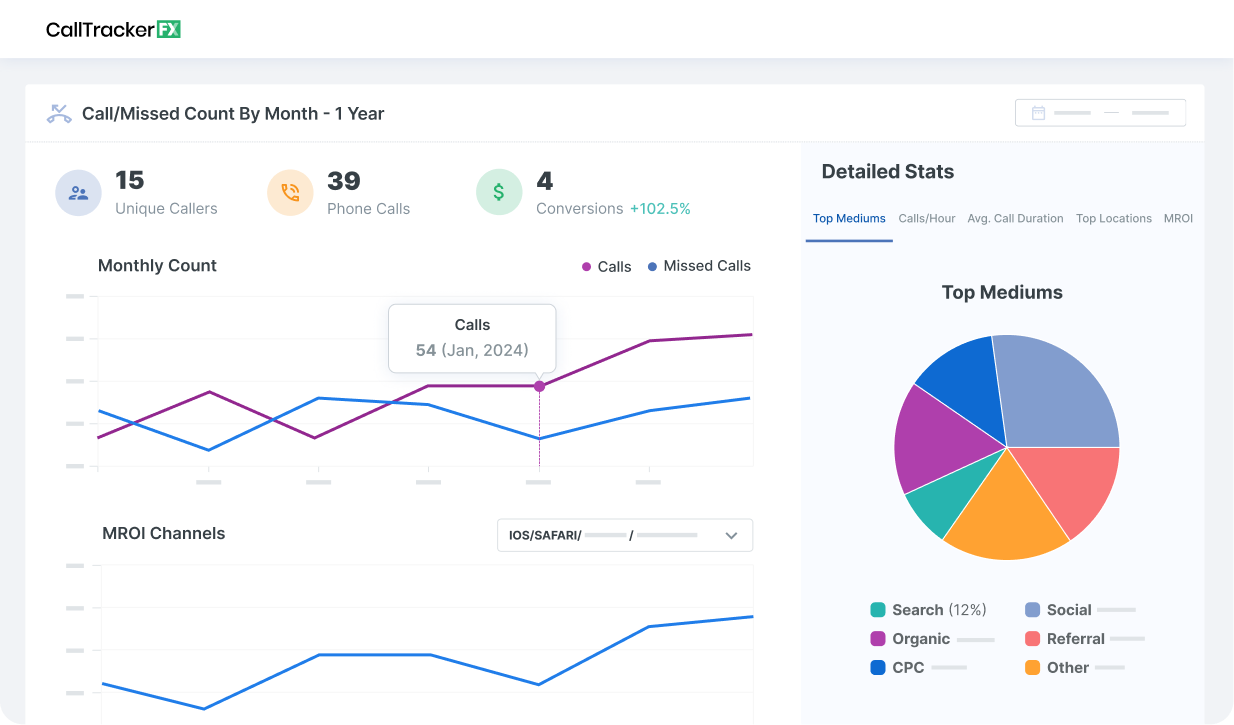
Measuring the metrics that affect your bottom line.
Are you interested in custom reporting that is specific to your unique business needs? Powered by RevenueCloudFX, WebFX creates custom reports based on the metrics that matter most to your company.
- Leads
- Transactions
- Calls
- Revenue

FAQs about choosing a marketing agency for private equity
What should a PE-backed company look for in a marketing agency?
A marketing agency for PE-backed companies should prove revenue attribution, strategic prioritization, multi-brand and multi-location scalability, CRM and data capabilities, speed, and relevant proof. Whether you call it a digital marketing agency for private equity or a portfolio company marketing agency, the agency should demonstrate how its work contributes to business outcomes rather than simply marketing activity.
How should you evaluate a private equity marketing agency?
Use a weighted scorecard based on revenue, speed, scale, systems, and proof, then adjust the weighting to match the company’s specific growth thesis.
Should private equity firms use one marketing agency across portfolio companies?
Sometimes. A shared agency can make measurement, strategy, and onboarding more efficient, but consolidation only makes sense when the agency can genuinely support each company’s different market and strategy.
Should you change marketing agencies after an acquisition?
Not automatically. Evaluate the incumbent’s results, data transparency, capabilities, and fit with the future growth strategy, then decide whether to keep, expand, supplement, or replace them. Our guide on how to evaluate marketing agency performance across brands shows how to separate agency performance from business constraints before you decide.
How quickly should a new marketing agency show results?
There’s no universal timeline. Look instead for what the agency establishes early: Reliable measurement, a performance baseline, priority opportunities, and initial tests already underway.
How do you know if a marketing agency is generating good leads?
Don’t judge lead quality by volume or cost per lead alone. Connect leads to qualification, close rate, customer value, and revenue. Fewer, higher-converting leads often create more value than a larger volume of cheap ones.
What should a marketing agency report to private equity leadership?
Marketing spend, qualified leads, pipeline, customers, CAC, marketing-sourced revenue, and ROI, with performance broken out by company or location where relevant. Channel-level metrics should support those numbers instead of replacing them.
WebFX has thousands of reviews praising our transparency, communication, and results.
WebFX Agency Rating

4.9/5
based on over 550 third-party reviews

Get started with a top marketing agency for private equity businesses today
A polished case study and a strong sales team can’t tell you whether a partner will connect marketing to revenue, move fast across a hold period, and scale as you add locations and brands. The scorecard can. Use the same one for every agency, and the partner worth a second conversation is the one that answers your questions with specifics.
If you’re ready to choose a digital marketing agency for a PE-backed company with a partner built around these steps, get your free proposal or call 888-601-5359 to talk with a strategist about your value-creation plan and where marketing fits into it.
-
 Albert Dandy Velasquez blends SEO strategy with compelling storytelling to help businesses boost their visibility and revenue online. With a B.A. in English and certifications from HubSpot, Semrush, and Google Analytics, he has written and optimized hundreds of articles on organic SEO, content strategy, and user experience. He regularly contributes to the WebFX blog and SEO.com, creating content that helps readers turn marketing goals into measurable results. When he’s off the clock, he’s usually exploring new neighborhoods on two wheels, filming travel content, or chasing golden hour with a coffee in hand. View full profile
 -

WebFX is a full-service digital marketing agency delivering revenue-driving strategies across online advertising, SEO and AI search optimization, and digital marketing. Backed by 1,100+ client reviews, a 4.9-star rating on Clutch, and proprietary revenue-tracking technology, our team helps businesses grow visibility and revenue across platforms, from Google to ChatGPT to LinkedIn. Discover how our expert team and revenue-accelerating tech can drive results for you. Learn more

Try our free Marketing Calculator
Craft a tailored online marketing strategy! Utilize our free Internet marketing calculator for a custom plan based on your location, reach, timeframe, and budget.

Contents
- How to choose a digital marketing agency for a PE-backed company
- Red flags to watch out for when choosing a PE-backed marketing agency
- Why WebFX is a top marketing agency for PE-backed companies
- FAQs about choosing a marketing agency for private equity
- Get started with a top marketing agency for private equity businesses today
Share this article


Proven Marketing Strategies
Try our free Marketing Calculator
Craft a tailored online marketing strategy! Utilize our free Internet marketing calculator for a custom plan based on your location, reach, timeframe, and budget.