


Table of Contents
- What is generative engine optimization?
- GEO vs. traditional SEO: What’s the real difference?
- Why GEO is non-negotiable for traffic and brand visibility
- How to optimize for generative engines: A practical framework
- 1. Start with the question behind the query
- 2. Make your content easy to scan and summarize
- 3. Demonstrate authority with original insight and supporting evidence
- 4. Keep technical SEO strong
- Measuring your GEO efforts’ progress
- Key GEO metrics to track (and how to use them)
- Quick check for key pages that aren’t showing up
- WebFX can help you prepare for a GEO future
- FAQs on GEO
- How much does generative engine optimization cost?
- What should you avoid doing for GEO?
- What is generative engine optimization (GEO)? GEO involves optimizing your website’s content to appear in AI search experiences (such as Google’s AI Overviews and AI Mode) and in answer engines (such as ChatGPT, Perplexity, and Claude). Its goal is to increase your visibility in these AI search tools.
- How is GEO different from SEO? GEO influences whether your content is selected, summarized, or cited in AI-generated answers. SEO focuses on ranking pages in traditional search results.
- Why does GEO matter now for traffic and brand visibility? Generative AI is changing how people get answers and evaluate options online. Our research shows that generative AI usage has grown 165 times faster than organic search, making AI visibility increasingly tied to brand discovery.
- What can you do today to improve AI visibility? Create content that fully resolves user intent, structure it for readability, support claims with evidence, and maintain strong technical SEO foundations.
- How can businesses start implementing GEO? Combine traditional SEO with GEO by ansering questions directly, backing content facts, optimizing for conversational queries, and building brand authority through reviews and third-party mentions — with AI visibility tracked through the OmniSEO® platform.
GEO isn’t about geography or geology. Generative engine optimization (GEO) is a strategy designed to help your brand appear, get cited, and stay visible in AI-generated search results from tools like Google AI Overviews, ChatGPT, Gemini, Claude, and Perplexity.
As users increasingly rely on AI to answer questions and evaluate options, visibility is shifting from rankings to recommendations. GEO ensures your content is structured, trustworthy, and easy for AI systems to understand, summarize, and reference.
What is generative engine optimization?
Generative engine optimization (GEO) is the practice of improving how AI-powered search and answer engines discover, evaluate, and reference your content when generating responses for users.
Unlike traditional search results, generative engines often summarize information directly and serve it as an answer to a user’s query. They pull information from multiple sources, assess relevance and credibility, and synthesize responses, often citing only a handful of sources.
Generative engines include experiences such as:
- Google’s AI Overviews and AI Mode
- AI-powered assistants and answer engines like ChatGPT, Claude, and Perplexity
- Other search interfaces that summarize information instead of presenting blue links
GEO focuses on whether AI-powered search tools can find your page, trust it, and use it when providing answers to users. That means optimizing for inclusion and citations and not rankings alone.
🎥Video: Intro to Generative Engine Optimization
GEO vs. traditional SEO: What’s the real difference?
SEO and GEO are closely related, but they serve different roles in modern search visibility. Traditional SEO helps your pages:
- Get crawled and indexed
- Rank for relevant queries
- Earn clicks from users scanning the search engine results pages (SERPs)
GEO builds on that foundation and influences whether an AI-powered search tool or answer engine:
- Select your content as a source
- Use your explanations, data, or examples
- Mention your product or business
- Attribute information back to your brand
The table below summarizes the differences between the two:
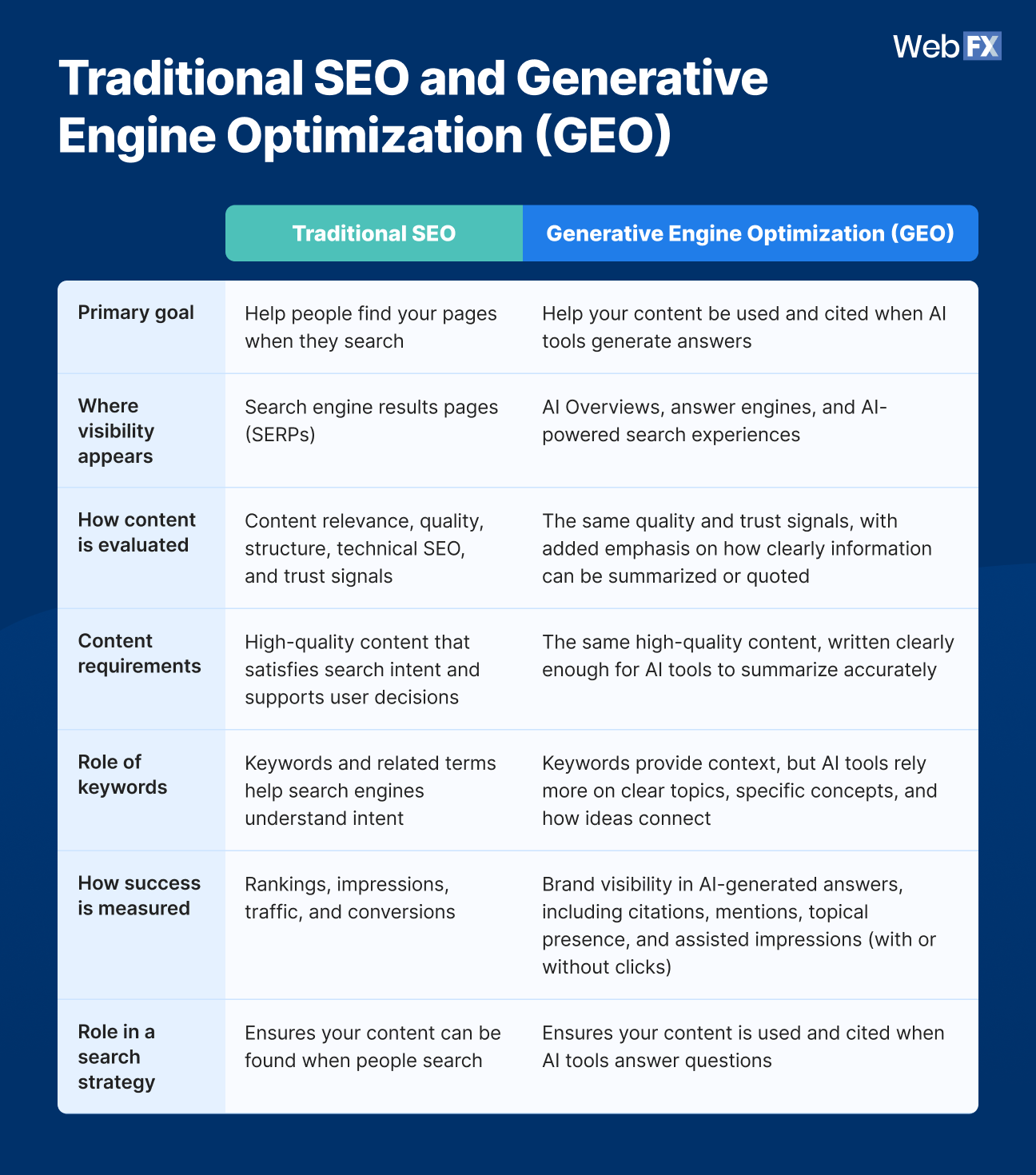
P.S. If you’re evaluating partners to execute these strategies, our breakdown of an GEO vs SEO agency covers how the two agency models differ in approach, deliverables, and measurement.
Why GEO is non-negotiable for traffic and brand visibility
The reality is that more people are using ChatGPT and other generative AI platforms to get quick answers. As a result, how users search for information — and where they look for it — is expanding beyond traditional search results.
Now, that doesn’t mean Google is going away, or that SEO is going out the door. Google remains the dominant platform for discovering information, businesses, and products. But generative AI platforms are increasingly influencing how users research options, compare solutions, and form early opinions.
Today, visibility depends on showing up across both experiences. Businesses need a search strategy that supports traditional SEO and accounts for how AI-powered search tools select, summarize, and reference content.
That’s why modern search strategies increasingly combine SEO and GEO to stay visible as search behavior evolves. You can see an example of this integrated approach in this AI search and SEO case study.
If you want to increase your visibility across platforms your audience uses, you need an omnichannel AI SEO strategy that goes beyond traditional search engines — one supported by the OmniSEO® platform to track and measure your presence across social media, AI assistants, voice search, and more.
OmniSEO® optimizes your visibility across different platforms where your audience is, including social media, AI assistants, and voice search.
How to optimize for generative engines: A practical framework
GEO isn’t something you tackle all at once. It’s a set of related priorities that work best when approached deliberately.
This framework breaks GEO into four practical areas so you can assess where your content is strong, where it needs work, and what to focus on next. Instead of chasing every algorithm update or new AI search platform, it helps you prioritize improvements that actually affect whether your content gets selected, summarized, or cited in AI-powered search experiences.
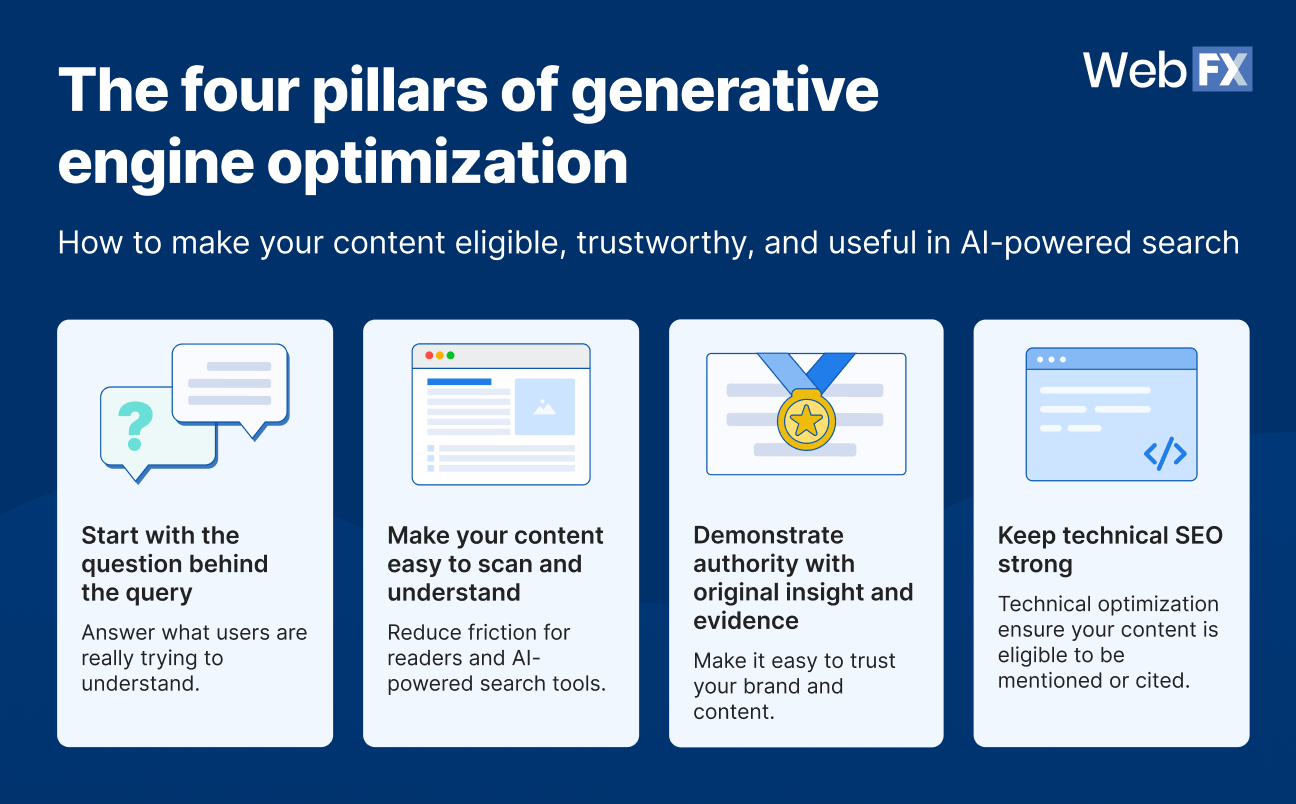
1. Start with the question behind the query
Generative engines tend to reference content that helps users understand a topic clearly and prepares them for what they’re likely to ask next. They look beyond search terms to understand the following:
- The decision the user is trying to make
- The constraints shaping that decision
- The follow-up questions that naturally come next
“The most common mistake businesses make with GEO is not thinking about the search intent behind the keyword,” says Abby F., SEO Consultant at WebFX. “Understanding your audience — including their needs and pain points — is crucial when it comes to creating content that will rank well and get cited by AI search tools.”
For example, early-stage queries like “How do noise-canceling headphones work?” are exploratory research prompts for answer engines. At this stage, users want to understand how the technology works, what problem it solves, and whether it’s relevant to their needs.
For a page to get referenced in this type of queries, it must:
- Explain the concept in simple, practical terms
- Clarify how the technology differs from alternative technologies
- Expound on the benefits and limitations of the technology
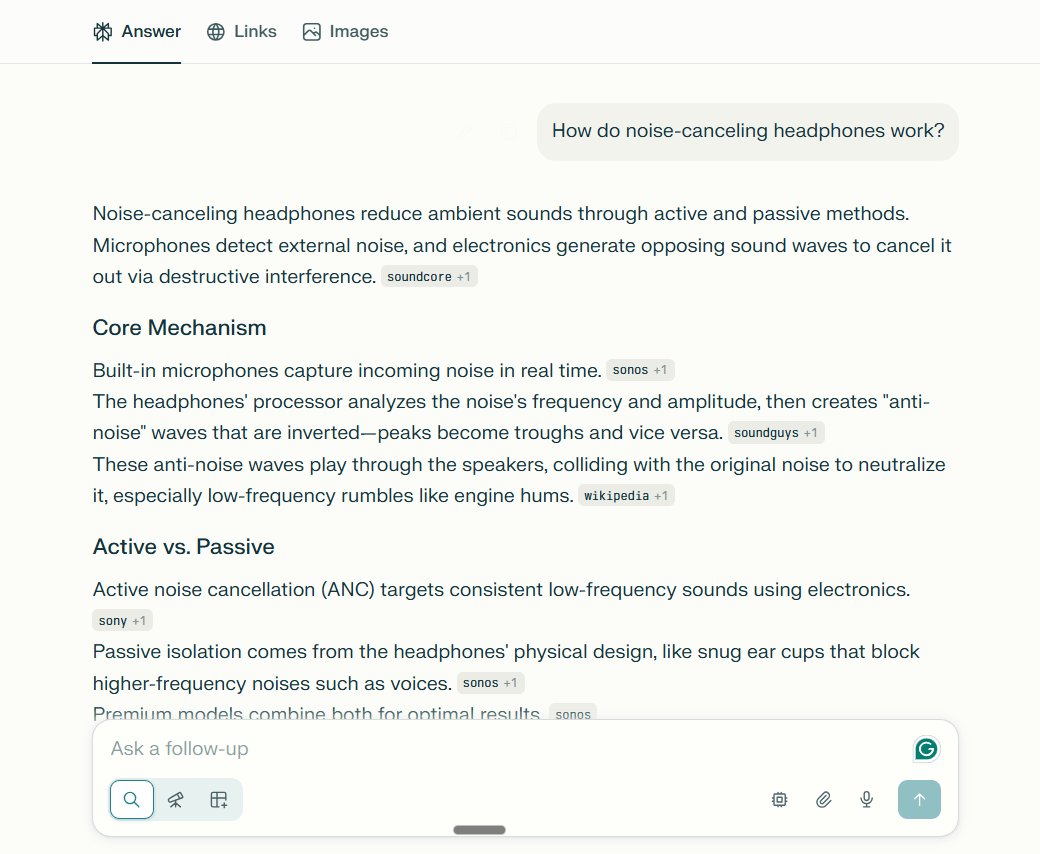
Users will naturally have follow-up questions after their initial question. They may want to know the difference between active and passive noise canceling, whether the feature is worth it, or the best noise-canceling headphones in the market today.
Content pieces that anticipate these next questions (also called next search intent) will help users in their research, so AI-powered search will likely cite or reference them. Meanwhile, pages with thin explanations aren’t favored because they aren’t as helpful to the searcher and don’t prepare users for their next search.
2. Make your content easy to scan and summarize
Aside from looking for accurate information, generative engines also search for content that’s easy to skim, understand, and parse. Prioritizing these kinds of on-page SEO strategies for AI search ensures your formatting aligns perfectly with what machine learning models look for.
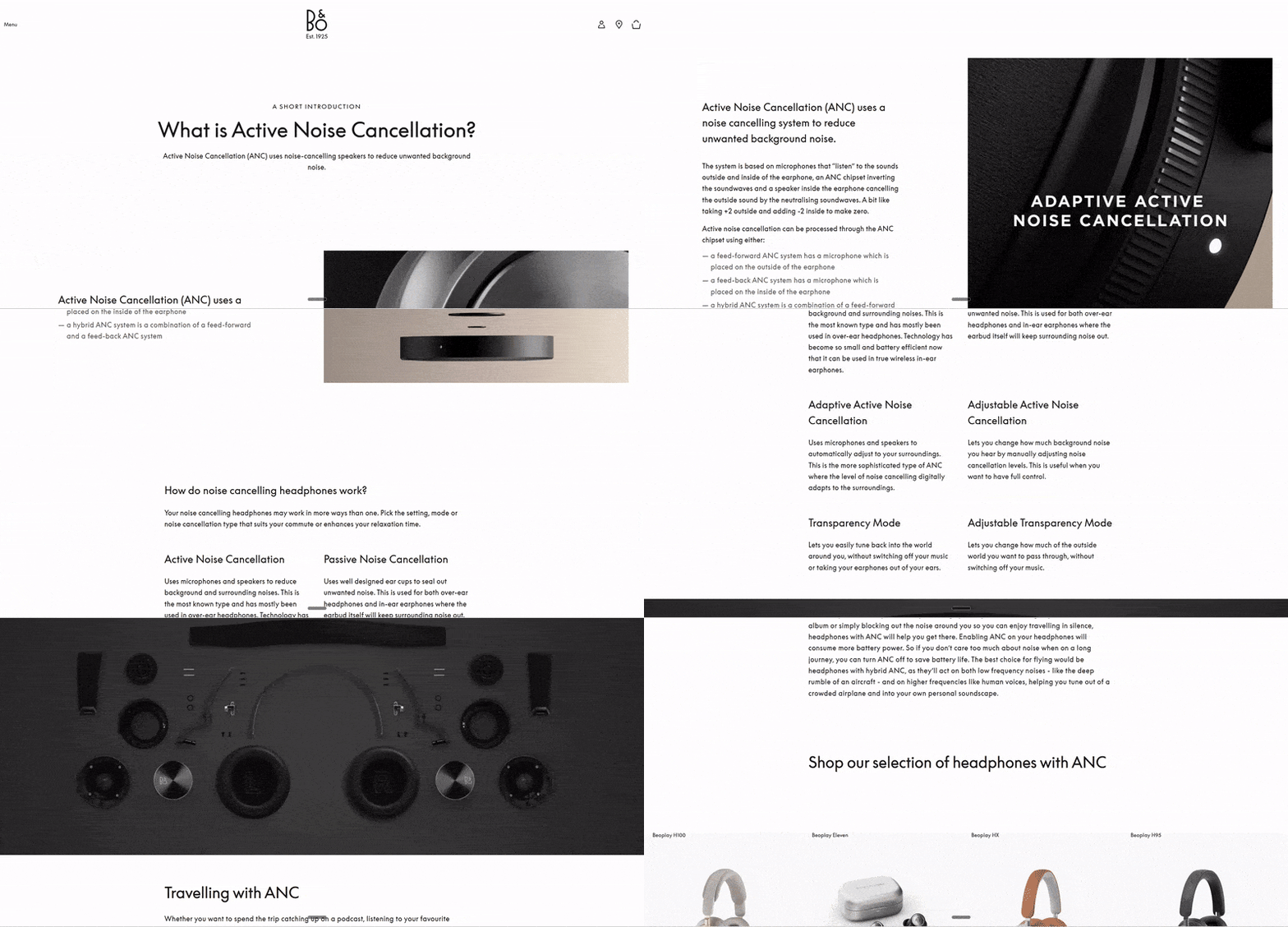
Structure your page well to help both your readers and AI-powered search platforms quickly understand what your page is about and find the answers they need. Here’s how you can do that:
- Use clear, descriptive headings: Instead of using vague headings that pique a reader’s interest, make your content easy to skim with clear headings. That way, they know which sections to go to and immediately find the answers they’re looking for. These headings also help AI-powered tools parse your content.
- Make your page easy to read: Instead of letting your readers process and understand long blocks of text, break them into different paragraphs or sections. Doing so reduces your readers’ cognitive load and provides context for AI search platforms, making your content easier to scan for both humans and machines.
- Answer questions directly: Your content must clearly communicate valuable information to your reader. That means providing direct answers about your product or helpful educational content to address their needs. Trim off fluff, and add supporting details later.
3. Demonstrate authority with original insight and supporting evidence
Authority is something readers recognize when your content is specific, accurate, and based on real-world experience. It also matters for GEO because AI search platforms are more likely to summarize and cite reliable content.
That doesn’t mean you should only publish original research and surveys, though. Instead, refrain from publishing generic explanations that don’t provide unique value to your audience and reflect nuances in your industry.
You can demonstrate authority by incorporating any of the following:
- Original insight: Share what you’ve learned from doing the work. For example, a noise-canceling headphone company could explain how its technology is developed or tested.
- Supporting evidence: Cite credible sources that support your claims, such as standards bodies, industry research, or official documentation.
- Concrete examples: Include scenarios, product details, or limitations that help readers understand how something works in real life. In our earlier example, a noise-canceling headphone business can publish a page about how a specific user, let’s say a professional, enjoys the noise-canceling headphones for work during calls and for personal use.
4. Keep technical SEO strong
Think of technical SEO as the eligibility layer for GEO. It still determines whether your content can be cited or mentioned in the first place.
AI-powered search tools rely on the same underlying infrastructure as traditional search engines to discover, access, and interpret content. If it can’t crawl, index, or render a page, it’s highly likely that the page won’t make it into AI-generated answers, regardless of how strong the content itself is.
Strong technical foundations help ensure that:
- Content is discoverable and accessible
- Pages load and function reliably across devices
- Relationships between pages and topics are clear
Technical SEO alone won’t guarantee that your content gets cited, but weak technical foundations can prevent even high-quality content from being referenced.
To support GEO, focus on the following technical priorities:
- Crawlability and indexing: Ensure your important pages can be crawled and indexed without issues. If search engines can’t consistently access your content, AI-powered tools won’t be able to reference it either.
- Schema markup: Use schema markup to clarify what your content is about and how different elements relate to each other. While it doesn’t force citations, it can improve how systems interpret context and meaning.
- Core Web Vitals and page performance: Make sure your pages load fast and behave consistently to improve user experience and help crawlers index them. Reliable page performance reduces your content’s risk of being skipped.
- Internal linking and backlinks: Internal links help establish topical relationships across your site, while backlinks reinforce credibility and discoverability. Together, they help position your content within a broader context rather than as an isolated page.
Measuring your GEO efforts’ progress
If your GEO efforts are working, you’ll notice that AI-powered search tools start pulling from your content more consistently. Your brand shows up even when users don’t ask for it directly. These are early indicators that your content is entering — and staying in — the conversation.
Understanding what “early” means in practice helps set realistic expectations. The GEO results timeline breaks down what to expect at each stage — from first appearances in AI Overviews within three to four weeks, to consistent multi-platform citations at three to six months, to compounding authority beyond six months.
However, you have to understand that AI-generated answers are personalized to users. Prompt phrasing, timing, and platforms used also affect results, so manual prompting can’t accurately measure your success or visibility.
You can use different AI visibility tools to estimate your GEO visibility and help you decide what to fix and what to double down on.
An example of a GEO tool is OmniSEO®, a platform that has helped many businesses improve their visibility in AI searches. It can track your online visibility in ChatGPT, Perplexity, Claude, Google, Meta, and Grok.
You can also use it for your competitive analysis and monitoring, as it lets you track the important queries for your business and competitors.
Visibility tools tell you where you stand — but to measure GEO success and ROI, you need to connect those visibility signals to pipeline and revenue using a framework that accounts for the attribution gaps standard analytics miss.
And if visibility signals are flat despite your efforts, our guide on what to do when GEO isn’t driving results helps you diagnose why — covering seven specific performance issues and the fixes that address each one.
Key GEO metrics to track (and how to use them)
When evaluating GEO performance, look at a set of related metrics, not just one isolated signal. Each metric answers a different question:
| GEO metric | What it measures | Why it matters | How to use it |
| Share of voice in AI-generated answers | How often your brand or site appears compared to competitors when AI tools generate answers for a topic | Shows whether you’re consistently showing up in AI-generated responses | Regularly track your share of voice for your selected high-intent topics so you can optimize them when needed. |
| Citation frequency and consistency | Which pages AI search tools reference and how often the same pages are reused over time | Repeated citations mean that a page is trusted enough to support summaries and explanations | Strengthen what’s working by updating cited pages regularly to keep them up-to-date and current. |
| Topic-level visibility over time | Whether you show up across a topic cluster (many related questions) | Users research in clusters and with follow-up prompts. Appearing multiple times throughout a cluster reinforces your brand’s visibility | Pick topic clusters related to revenue. Create or optimize existing pages related to these topic clusters. |
| Brand perception and sentiment | How your brand is described when it appears in AI-generated answers (neutral, positive, critical, or authoritative) | How AI tools frame your brand influences how a user perceives your brand | Review how your brand is mentioned. If framing is vague or neutral, add clearer positioning, proof points, and examples. If sentiment is mixed, address common objections directly in your content instead of avoiding them. |
Review these metrics to get a better idea of your GEO performance and how your brand is mentioned in AI platforms. If your brand mentions are vague or neutral, or not showing up as much as you’d like, close that gap with AI brand positioning services, proof points, and examples. If sentiment is mixed, address common objections directly in your content instead of avoiding them.
Quick check for key pages that aren’t showing up
If your page isn’t being referenced at all in AI-powered searches, use this quick diagnostic before assuming a tool or platform issue:
- Does the page clearly answer a specific question that a customer asks?
- Does it explain options, trade-offs, or limitations?
- Are examples, data points, or real scenarios included in the page?
- Does the page structure make key points easy to find?
- Is the page indexed, fast, and internally linked to related content?
FAQs on GEO
Is GEO replacing SEO?
No. SEO and GEO serve different roles in modern search visibility.
SEO helps your pages get discovered and ranked in traditional search results. GEO helps ensure your content is selected, summarized, and referenced in AI-powered search experiences. Today, businesses need both to stay visible as search behavior continues to evolve.
How do you measure GEO results?
You can track signals such as how often your content appears in AI-generated answers, which content is frequently cited, and how visible your brand is perceived to be in the answers. AI visibility tools can help you track these metrics, enabling you to identify which optimization efforts to prioritize.
Does the structure of my content matter for GEO?
Yes. Clear structure helps both readers and AI search tools understand your content. Well-organized pages with descriptive headings, clear sections, and concise explanations are easier to scan, summarize, and cite.
How much does generative engine optimization cost?
Generative engine optimization costs anywhere from $1,500 to $50,000+ per month on average. Costs vary widely depending on whether you manage in-house or partner with an agency, invest in AI visibility tracking software, and the size of your business.
If you’re going the agency route, see our guide on how to choose a GEO agency to make sure you’re getting real results for that spend.
What should you avoid doing for GEO?
One of the most common mistakes is not fully understanding the search intent behind a query.
If your content doesn’t reflect what users are actually trying to learn, compare, or decide, it’s unlikely to be selected or cited, no matter how optimized it looks.
Also, avoid doing the following:
- Publishing generic explanations
- Ignoring audience needs and pain points
- Scaling content that doesn’t add meaningful insight
See Where Your Brand Shows Up in AI Search
WebFX’s proprietary platform includes AI visibility tracking. See if your brand is part of the conversation.
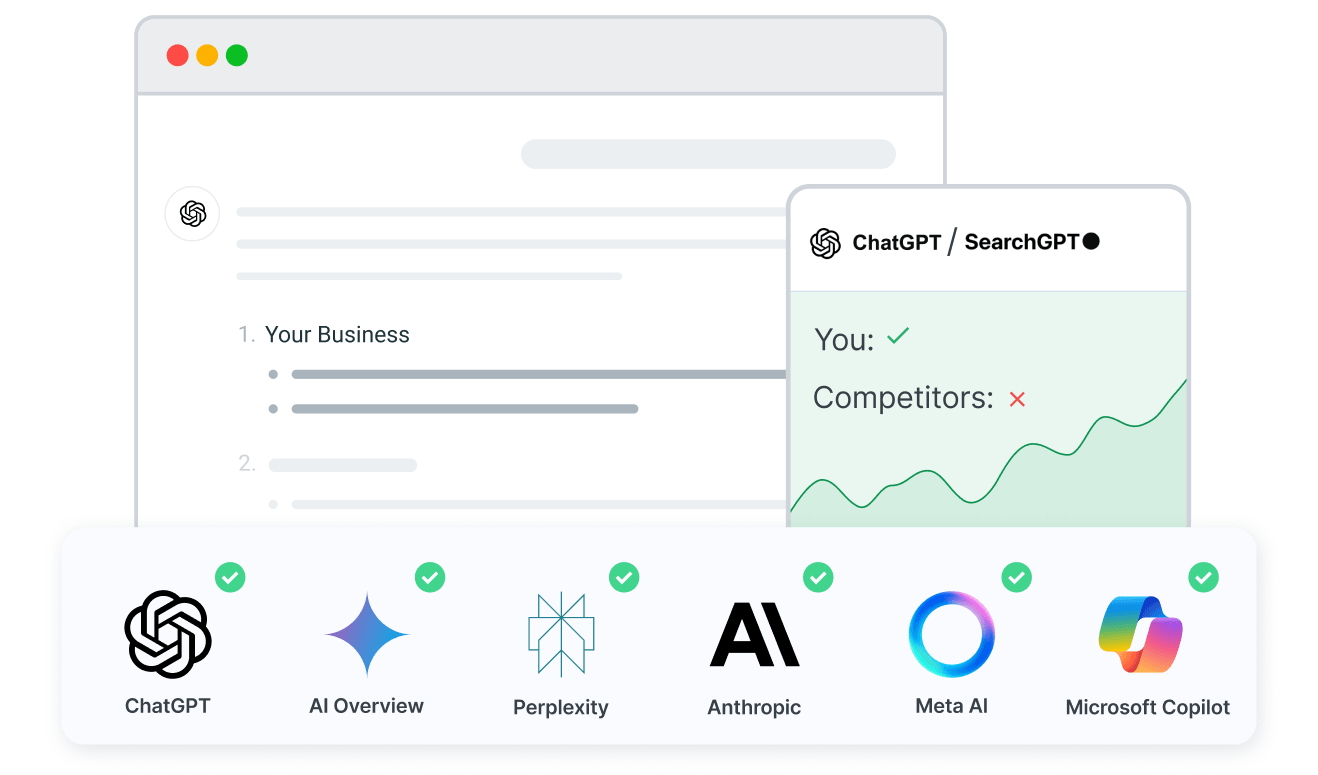
Boost your online visibility with GEO experts
As more people turn to ChatGPT and other generative AI platforms for research, businesses must adapt GEO strategies to improve their brands’ online visibility.
Get ahead of your competition and start optimizing today with WebFX. With our AI SEO services, supported by the OmniSEO® platform, you can improve your visibility across every channel your audience uses and increase your leads. Case in point: One of our clients saw a 542% boost in leads after partnering with WebFX.
Our team is pumped to learn more about your business, needs, and revenue goals. Are you ready to get started?
Contact us online or call us today at 888-601-5359 to speak with a strategist about our GEO services!
-
 Macy Storm is a Content Marketing Consultant at WebFX. She has 5+ years of experience creating content for all digital strategies and across 10+ industries. With a B.A. in Communications, she’s used her writing skills to write over 1,000+ pages for WebFX and SEO.com. Her work has been featured by Search Engine Journal, HubSpot, Entrepreneur, Clutch, and more. When she’s not clacking her keys, she’s playing video games, reading, or counting how many times people say her puppy Daisy is cute (it’s a lot of times). View full profile
 -

WebFX is a full-service digital marketing agency delivering revenue-driving strategies across online advertising, SEO and AI search optimization, and digital marketing. Backed by 1,100+ client reviews, a 4.9-star rating on Clutch, and proprietary revenue-tracking technology, our team helps businesses grow visibility and revenue across platforms, from Google to ChatGPT to LinkedIn. Discover how our expert team and revenue-accelerating tech can drive results for you. Learn more
Try our free Marketing Calculator
Craft a tailored online marketing strategy! Utilize our free Internet marketing calculator for a custom plan based on your location, reach, timeframe, and budget.
Plan Your Marketing Budget
Table of Contents
- What is generative engine optimization?
- GEO vs. traditional SEO: What’s the real difference?
- Why GEO is non-negotiable for traffic and brand visibility
- How to optimize for generative engines: A practical framework
- 1. Start with the question behind the query
- 2. Make your content easy to scan and summarize
- 3. Demonstrate authority with original insight and supporting evidence
- 4. Keep technical SEO strong
- Measuring your GEO efforts’ progress
- Key GEO metrics to track (and how to use them)
- Quick check for key pages that aren’t showing up
- WebFX can help you prepare for a GEO future
- FAQs on GEO
- How much does generative engine optimization cost?
- What should you avoid doing for GEO?
Share this article


See AI Marketing in Action
Explore how WebFX helped a regional brand get discovered in AI search experiences — proving what’s possible with today’s AI-driven marketing!
Try our free Marketing Calculator
Craft a tailored online marketing strategy! Utilize our free Internet marketing calculator for a custom plan based on your location, reach, timeframe, and budget.
Plan Your Marketing Budget