


Table of Contents
- How high-performance teams design revenue systems
- 1. Define a shared ICP and buying signals
- 2. Integrate revenue data across systems
- 3. Use AI to prioritize high-value opportunities
- 4. Formalize closed-loop feedback
- 5. Measure performance at the revenue level
- Why alignment alone limits performance in the AI era
- Assessing your revenue system readiness
- From alignment to revenue engineering
- The platform for your revenue system
-
What defines high-performance B2B marketing and sales teams in the AI era?
High-performance teams operate as unified revenue systems. They integrate marketing, sales, and product data so buyer signals directly influence prioritization and revenue reporting. -
Why isn’t alignment alone enough?
Alignment improves handoffs and coordination, while revenue systems improve decision-making by connecting buyer behavior, scoring logic, pipeline visibility, and forecasting into one structure. -
How does AI strengthen a revenue system?
AI identifies patterns in integrated revenue data. When trained on shared marketing and sales signals, it improves lead scoring, prioritization, and forecasting accuracy. -
How does RevenueCloudFX support revenue systems?
RevenueCloudFX unifies marketing and sales data into a single automation platform that provides a holistic customer view, enabling teams to improve their campaigns, drive leads, close deals efficiently, and accurately track ROI.
High-performance B2B marketing and sales teams operate in the AI era as unified revenue systems. They connect shared ICPs, buying signals, integrated data, and AI-assisted prioritization so buyer behavior directly drives targeting, outreach, forecasting, and ROI reporting.
In practice, this means moving beyond simple alignment. Instead of working in silos, marketing and sales teams use shared data and AI insights to prioritize high-value opportunities, personalize engagement, and improve revenue outcomes.
Today, alignment alone is not enough. AI has accelerated buyer research, shortened sales cycles, and made it possible to identify intent earlier. To stay competitive, high-performance B2B teams must operate as connected, AI-assisted revenue engines built around shared data, signals, and accountability.
Learn how B2B teams operate as a unified revenue engine in the AI era below.
- How high-performance teams design revenue systems
- Why alignment alone limits performance in the AI era
- Assessing your revenue system readiness
How high-performance teams design revenue systems
A revenue system connects buyer signals, qualification logic, engagement strategy, and revenue reporting across marketing, sales, and product teams. It replaces manual coordination among teams with structured integration.
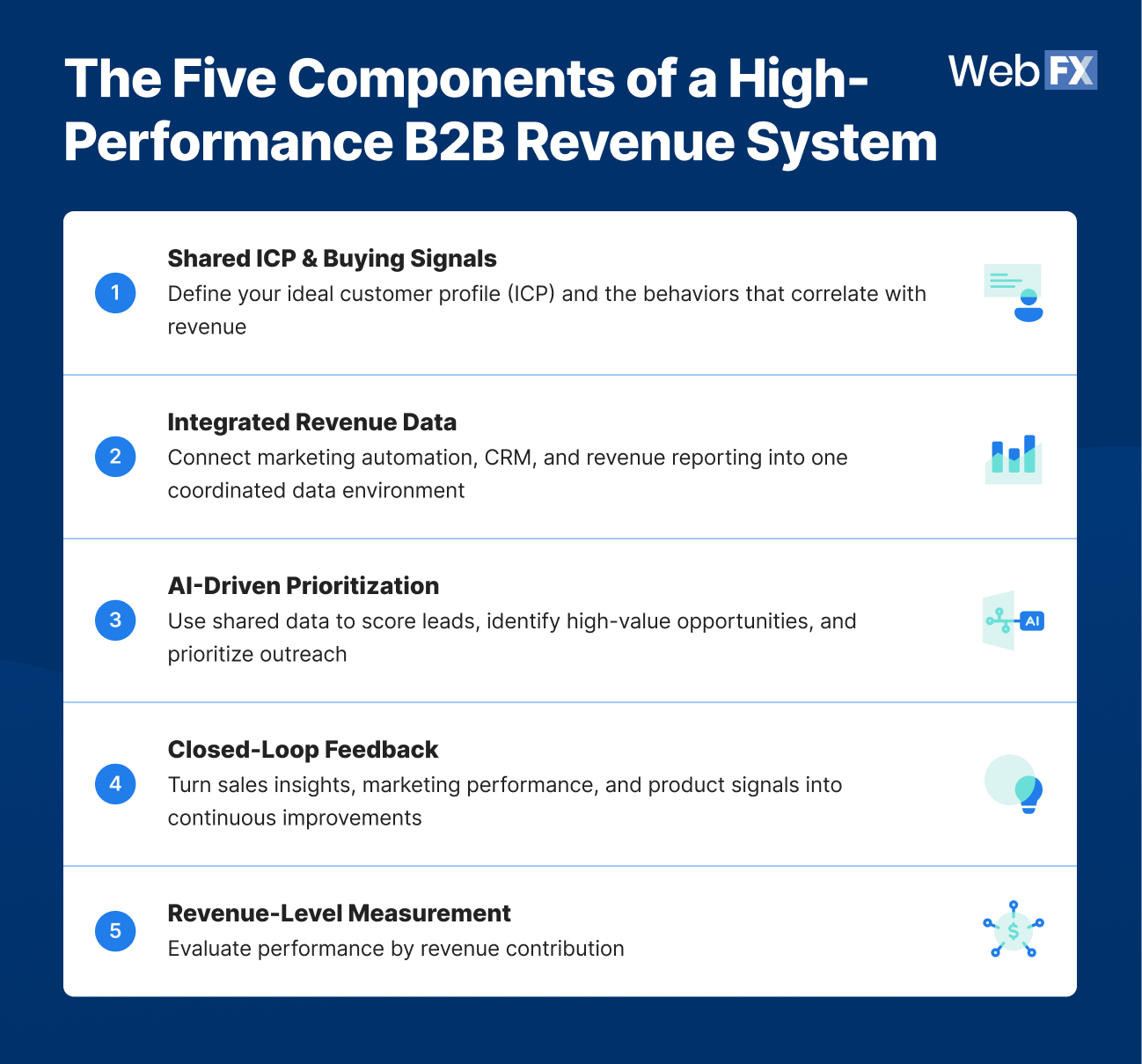
High-performance teams build this system deliberately. Here’s the framework you can adopt to turn your B2B teams into a high-performance revenue engine:
1. Define a shared ICP and buying signals
Revenue systems begin with a unified ideal customer profile (ICP). Marketing and sales define target industries, company sizes, buying roles, and revenue potential together.
High-performance teams go further. They define behaviors and buying signals associated with that ICP, including the pages they visited and other actions they’ve taken, such as filling out forms or downloading a free resource.
They refine these signals by training AI models on historical revenue data to identify which behaviors correlate with closed-won deals.
For example, a manufacturing company targeting enterprise buyers may define its ICP as organizations with over 500 employees, multilocation operations, and complex supply chain requirements. That shared definition shapes messaging, targeting, and sales outreach.
With the help of AI-powered tools, they also identify buying signals associated with that ICP:
- Comparing products during research
- Visiting pricing pages
- Downloading technical documentation
- Engaging with industry-specific case studies
2. Integrate revenue data across systems
High-performance B2B teams integrate their tech stack — their marketing automation platforms, customer relationship management (CRM) platforms, and analytics tools — into one shared data environment. That way, every demo request, proposal stage change, and closed deal update the same dataset.
Think of your revenue system as an air traffic control tower. Just as planes take off from different runways, you have simultaneous campaigns and sales calls.
Your air traffic control tower ensures a safe and efficient flow of air traffic. Meanwhile, your revenue system ensures all your teams have access to the same datasets that inform your campaigns and other efforts to attract, nurture, convert, and retain customers efficiently.
3. Use AI to prioritize high-value opportunities
High-performance B2B teams use AI responsibly and ethically to:
- Score leads based on historical conversion patterns
- Identify accounts demonstrating increased buying intent
- Prioritize outreach based on probability to close
Let’s use the earlier example of our manufacturing company. AI can help its team spot patterns and identify behaviors typical of high-quality prospects. For example, industrial buyers who visit pricing pages and download tech documents are more likely to be ready to convert than those who visit only the homepage and product pages.
Having a clear definition of high-value opportunities helps both sales and marketing teams. Your sales reps know which leads to prioritize, while your marketing team knows which campaigns drive qualified prospects and improve your revenue.
4. Formalize closed-loop feedback
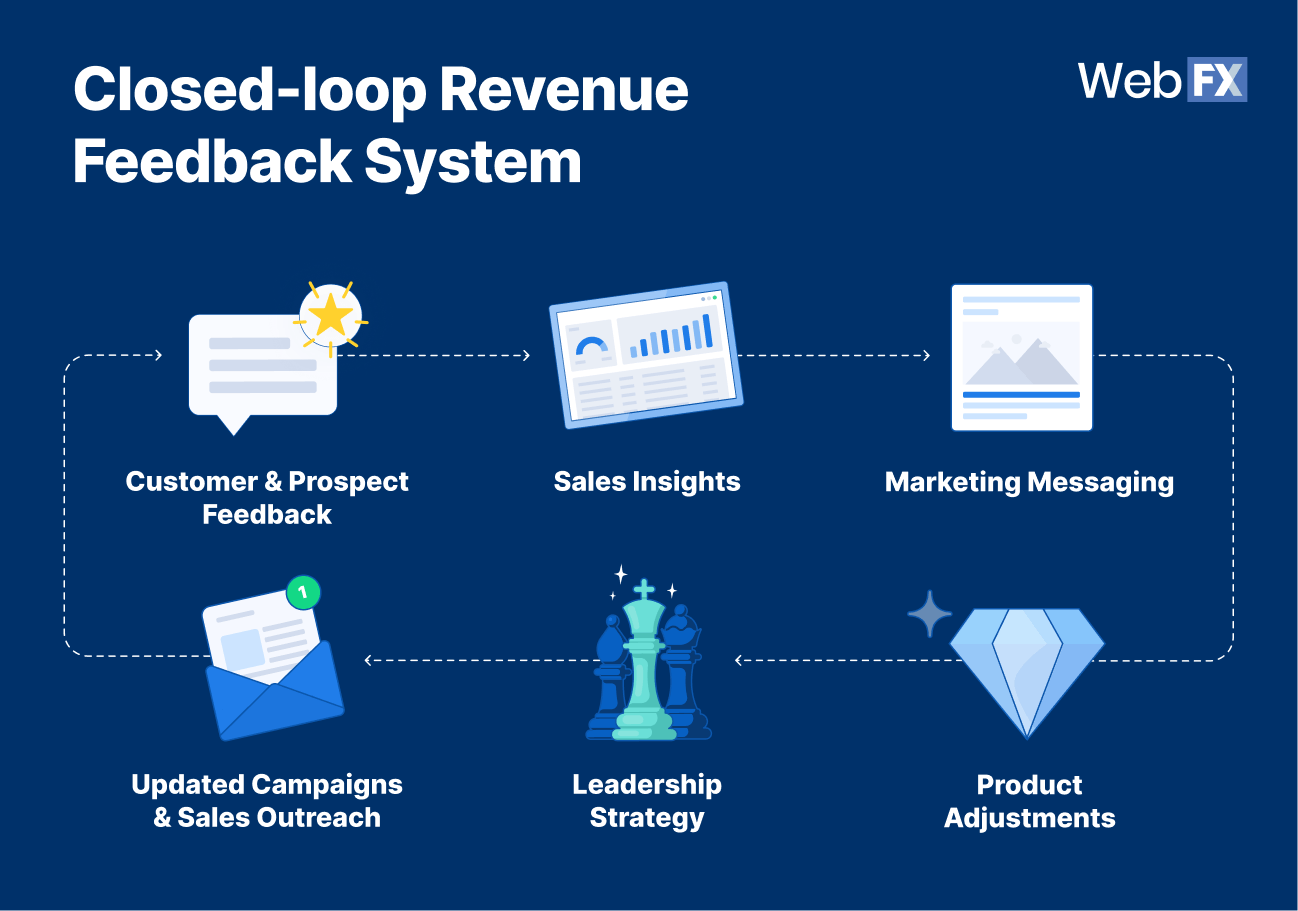
Revenue systems improve because every deal feeds it with new intelligence.
Sales objections, pricing concerns, competitor comparisons, and lost-deal reasons inform your marketing targeting and messaging updates. Marketing engagement data then informs sales outreach strategies.
High-performance teams can formalize this feedback loop through structured revenue reviews, CRM tagging standards, and shared dashboards. Closed-won and closed-lost deals update the team’s qualification assumptions and targeting criteria on a recurring schedule.
Over time, this disciplined feedback process increases conversion efficiency.
Returning to the manufacturing example, if sales consistently hears that prospects worry about ERP integration complexity, marketing adjusts website messaging and case studies to clarify proven integration success. If necessary, the product team gets involved to improve the product’s user interface and experience.
5. Measure performance at the revenue level
Revenue systems make it easier to see what actually drives growth.
Instead of reviewing marketing metrics in one dashboard and sales metrics in another, you evaluate performance through revenue contribution. Marketing sees which campaigns influence pipeline value and closed deals, while sales sees how signal-based prioritization affects deal velocity and win rates.
When reporting shows the revenue impact, you know how to allocate your budget more effectively, investing in strategies that generate qualified leads. Instead of answering the question “How many leads did this channel or strategy generate?”, your reports now answer the question “Which efforts contributed to revenue?” so you know which efforts to scale, refine, and pause.
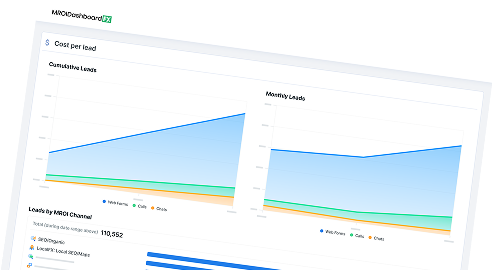
Meet RevenueCloudFX:
One platform tracking countless metrics and driving stellar results.
Why alignment alone limits performance in the AI era
Two-thirds of B2B buyers research products online before purchasing, and more and more B2B buyers are using AI platforms to discover, evaluate, and shortlist vendors.
When marketing, sales, and product teams work in silos in an AI-assisted buying journey, each team sees only a portion of the buyer’s journey, but no one connects them to see the whole customer journey.
Marketing tracks lead volume, while sales monitors pipeline stages and close rates. The product team looks at buyers’ interest in product features, and leadership evaluates revenue.
Imagine each team holding a piece of the customer journey puzzle. By the time those pieces are stitched together, the buyer has already narrowed their options.
When teams are aligned, they agree on what qualifies as a lead, when a lead becomes sales-ready, and how handoffs should occur. They coordinate campaigns and establish follow-up expectations to improve operational efficiency.
However, efficiency alone does not ensure revenue growth in an AI-driven market. High-performance teams move beyond shared meetings and aligning on lead qualification. They build systems where buyer signals directly inform lead scoring, pipeline prioritization, and revenue measurement.
Assessing your revenue system readiness
If you’re unsure whether your organization operates as a revenue system, ask yourself these questions:
- Do marketing and sales rely on the same ICP and buying signal definitions?
- Does buyer activity update scoring, pipeline visibility, and forecasting simultaneously?
- Are win-loss insights systematically reflected in targeting and updates?
- Can leadership trace revenue outcomes back to coordinated marketing and sales actions?
If your team still exports spreadsheets or uses multiple dashboards to reconcile marketing and sales numbers, your revenue system isn’t fully integrated yet.
Start by defining your ICP. Then identify the behaviors that consistently lead to revenue.
Make sure your systems reflect those behaviors automatically. If a buyer signal changes, lead scoring, pipeline visibility, and forecasts should be updated accordingly.
From alignment to revenue engineering
AI has ushered in automation and assistance to B2B teams, but it has also added competitive pressure. Today, B2B marketing, sales, and product teams must do more than align to stay ahead of the competition.
A robust revenue system gives high-performance B2B teams a structural advantage in an AI-assisted market. It turns your B2B teams into a well-oiled machine that connects targeting, engagement, prioritization, and measurement into a coordinated system.
High-performance B2B teams operate within that system daily. That disciplined structure transforms AI from an add-on into an integrated feature of your revenue growth engine.
For B2B leaders, the priority is clear: Design revenue systems that unify marketing, sales, and product teams around shared intelligence and accountability.
This system makes revenue contributions measurable and encourages shared accountability. Nobody asks “Who gets credit?” Instead, teams ask “What drives growth?”
And nobody will think their job is thankless.
The platform for your revenue system
RevenueCloudFX is our proprietary suite of tools for building your revenue system. It unifies your marketing and sales data into a single, powerful automation platform, giving you a holistic view of your customers and insights to inform your strategies.
As a result, you can enhance your campaigns, drive more leads, close deals efficiently, and grow your revenue. With RevenueCloudFX, you can see which efforts drive results so you can accurately track and grow your ROI.
In fact, our clients have seen an average ROI increase of 20% with RevenueCloudFX. You, too, can build your revenue system with WebFX.
Our team would be glad to learn more about your business and goals, and help you engineer a revenue system that drives bottom-line growth. Contact us online or call us at 888-601-5359 to get started.
-
 Maria is a Lead Emerging Trends & Research Writer at WebFX. With nearly two decades of experience in B2B and B2C publishing, marketing, and PR, she has authored hundreds of articles on digital marketing, AI, and SEO to help SMB marketers make informed strategic decisions. Maria has a degree in B.S. Development Communication major in Science Communication, and certifications in inbound marketing, content marketing, Google Analytics, and PR. When she’s not writing, you’ll find her playing with her dogs, running, swimming, or trying to love burpee broad jumps.
 -

WebFX is a full-service marketing agency with 1,100+ client reviews and a 4.9-star rating on Clutch! Find out how our expert team and revenue-accelerating tech can drive results for you! Learn more
Try our free Marketing Calculator
Craft a tailored online marketing strategy! Utilize our free Internet marketing calculator for a custom plan based on your location, reach, timeframe, and budget.
Plan Your Marketing Budget
Table of Contents
- How high-performance teams design revenue systems
- 1. Define a shared ICP and buying signals
- 2. Integrate revenue data across systems
- 3. Use AI to prioritize high-value opportunities
- 4. Formalize closed-loop feedback
- 5. Measure performance at the revenue level
- Why alignment alone limits performance in the AI era
- Assessing your revenue system readiness
- From alignment to revenue engineering
- The platform for your revenue system
Share this article


Proven Marketing Strategies
Try our free Marketing Calculator
Craft a tailored online marketing strategy! Utilize our free Internet marketing calculator for a custom plan based on your location, reach, timeframe, and budget.
Plan Your Marketing Budget