What is bot traffic and how common is it?
Bot traffic is automated, non-human activity that can click ads, visit landing pages, fill out forms, or trigger conversions without real buying intent. More than half of all web traffic is now automated, with bots accounting for 53% of traffic in 2025. Not all bots are malicious, but bad bots represent roughly 40% of web activity and can drain ad budgets by mimicking real users.
How does bot traffic waste your ad budget?
Bot traffic wastes ad budget through fake clicks, fake form fills, inflated conversion volume, and polluted CRM data. Roughly 1 in 5 ad impressions shows signs of invalid traffic, and about 1 in 4 leads is fraudulent, which means advertisers can spend real money on traffic and leads that never had buying intent.
Why is bot traffic worse in automated PPC campaigns?
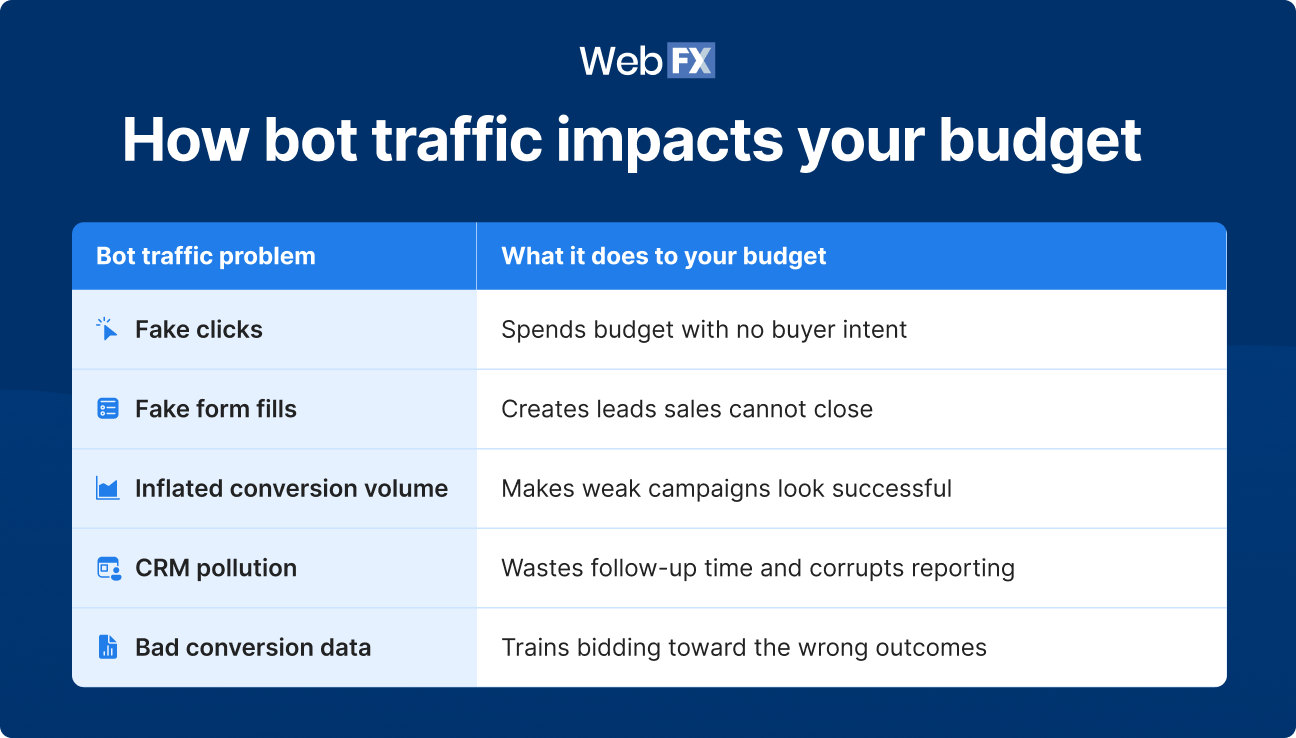
Bot traffic does more than steal clicks. It corrupts the conversion data Google Ads uses to optimize campaigns. When fake leads count as conversions, automated bidding can treat them as wins and learn to find more similar traffic, pushing budget toward bots instead of real customers.
What are the warning signs of bot traffic in paid campaigns?
Warning signs include conversion volume rising while qualified leads and revenue stay flat, cost per lead improving while sales acceptance drops, form fills with fake information or mismatched geography, traffic spikes from unusual locations or devices, and campaigns that look strong in Google Ads but do not create real pipeline.
How can advertisers reduce bot traffic waste?
Advertisers can reduce bot traffic waste by improving signal quality, not just blocking bots. That means filtering obvious invalid traffic, connecting CRM lead quality back to Google Ads, correcting or removing spam from the conversion signal, and using value-based bidding to optimize toward real revenue instead of raw lead volume.
How bot traffic is wasting your ad budget:
What’s happening: More than half of all web traffic is now automated, with bots crossing 53% in 2025 (Imperva).
Why it costs you: Every bot click and fake lead spends real budget, and roughly 1 in 4 leads is fake (Anura).
The hidden damage: In automated bidding, fake conversions become training data that teaches Google to chase more of the wrong traffic.
The fix: Blocking bots helps, but the bigger win is cleaning the conversion signal Google optimizes against.
Where it gets hard: A clean signal takes CRM-connected lead quality, updated values, and spam control most companies do not have wired up.
Bot traffic is wasting your ad budget in two ways: The money it burns on fake clicks and fake leads, and the damage it does to the data your campaigns learn from. More than half of all web traffic is now automated, and a meaningful share of paid media spend can be exposed to traffic that will never buy.
Understanding how bot traffic is wasting your ad budget starts with a shift in what the problem even is. Bot traffic used to be a tracking problem, something you cleaned up in your analytics after the fact. In automated PPC, it has become a bidding problem. When a fake lead counts as a conversion, it does not just waste budget once, it also teaches Google what to buy next.
That shift is why an estimated $37 billion in U.S. programmatic ad spend is associated with invalid traffic every year. The advertisers who protect their budgets can fix what their campaigns learn from, instead of just what they block.
Tell us about your business, and we’ll create a custom plan to grow your traffic, leads, and predictable revenue.
More than half the web is now bots
More than half of all web traffic is now automated, with bots accounting for 53% in 2025, the first sustained stretch where machines outnumber humans online, per Imperva’s Bad Bot Report 2026. That number reflects all automated traffic, so it is worth being precise about what it means for your budget.
To be fair, not every bot is malicious. Search crawlers, monitoring tools, and other “good bots” make up part of that 53%. The problem is the bad bots, the ones built to click ads, fill out forms, and drain budgets, and they account for roughly 40% of web traffic on their own.
Generative AI has made sophisticated bots cheaper to create and harder to spot. Modern bots now mimic human scrolling, typing cadence, and form-filling well enough to slip past basic filters, which means the fake click on your ad looks almost identical to a real one. This is the traffic environment your paid campaigns run in right now.
How bot traffic wastes your ad budget
How bot traffic wastes your ad budget comes down to two things: The spend it burns directly on fake activity, and the damage it does to the conversion data your campaigns optimize against. The first cost is obvious on your invoice. The second is the one that quietly compounds.
The direct waste is real money. According to a 2026 report by Fraudlogix, roughly 1 in 5 ad impressions shows signs of invalid traffic, and in high-CPC industries, a single fake click can cost you real money before anyone notices.
Fake leads waste your team’s time on top of your budget. Anura suggests that about 1 in 4 leads is fraudulent, which means your sales team burns hours chasing people who were never real. Every one of those calls is payroll spent on a bot.
The compounding damage is the part most advertisers miss. When bots convert on your ads, your bidding algorithm counts them as wins and learns to find more traffic like them. Volume-based strategies chase the number of conversions, and value-based bidding chases the ones worth the most, but both learn from whatever signal you feed them, so spam counted as a win quietly shapes tomorrow’s targeting.
This is why bot traffic costs more than the clicks it steals: It corrupts the signal your budget optimizes against. For the full breakdown of how the bidding side works, see our guide to value-based bidding and how we cut cost per qualified lead by 47%.
Signs bot traffic is draining your campaigns
Bot traffic usually shows up as a gap between your campaign metrics and your revenue reality. Your dashboard looks healthy while your pipeline does not, and that disconnect is the clearest tell.
Watch for these signals in your paid accounts:
Conversion volume climbs, but qualified leads and revenue do not follow.
Cost per lead improves on the dashboard, while your sales acceptance rate drops.
Form fills arrive with fake names, junk emails, or mismatched geography.
Traffic spikes from unexpected locations, devices, or outdated browsers and operating systems, which Fraudlogix flags as heavy invalid-traffic sources.
Campaigns look strong inside Google Ads, but never create real pipeline.
Sales reports that paid lead quality keeps getting worse over time.
No single sign proves bot traffic on its own. Together, they are a strong signal that your account needs a lead-quality and conversion-signal audit before more budget goes to waste.
Why high-cost industries feel the damage first
In high-CPC industries, bot traffic does not need to be the majority of your traffic to do serious damage. A small volume of fake clicks or fake leads can consume an outsized share of budget and distort your bidding faster than in low-cost verticals.
The math here is simple: More expensive clicks make every fake interaction costlier. Lead generation accounts that optimize around form fills and phone calls are especially exposed, because a fake lead looks like success inside Google Ads until sales tries to close it.
Expert insights from
Colton W.Sr. PPC Consultant at WebFX
“In high-CPC verticals, even a small amount of spam ingest can do quite a bit of damage — if the system is getting positive signals from low-quality leads, it will bid more aggressively on them. In a vertical where the CPC is already high, this can result in wasted spend increases that compound very fast and cost your business serious cash.”
Why the real fix is signal quality rather than just blocking bots
Blocking bots reduces waste, but it does not solve the full problem, because some fake leads always slip through and the real question is what your ad platform learns after they convert. The durable fix is signal quality: Teaching Google which conversions are real so it optimizes toward them.
Think of it in three layers:
Detection and prevention filter the obvious bad actors.
CRM lead quality tells you which conversions turned into real opportunities.
Conversion-value correction feeds that truth back to Google, so spam that reached the platform gets retracted or restated depending on your setup.
This is where value-based bidding comes in. Instead of chasing raw lead volume that bots can inflate, it optimizes toward the conversions worth the most, so your best leads carry the most weight and spam stops getting rewarded. None of that is a toggle you flip once, though: It takes coordination across paid media, sales, data, and web teams, plus a system to route real outcomes back to Google, which is where most in-house teams run out of time or infrastructure.
How WebFX keeps bots from draining your budget
WebFX keeps bots from draining your budget by connecting real lead quality from your CRM back into Google Ads, then managing your PPC strategy around that cleaner signal. You get the infrastructure and the expertise to run it, without building either in-house.
RevenueCloudFX acts as the data hub between your CRM and Google Ads. It feeds Google your real revenue instead of bot-inflated conversion counts, so your campaigns learn which leads actually turn into customers. Spam and disqualified leads get removed from the data set where your setup allows it, so the algorithm stops chasing them.
The tooling alone is not enough, which is why your dedicated team runs the strategy alongside it. On our own accounts, cleaning the signal cut cost per qualified lead by 47% year over year, and that same discipline is what protects client budgets from bot waste.
Measuring the metrics that affect your bottom line.
Are you interested in custom reporting that is specific to your unique business needs? Powered by RevenueCloudFX, WebFX creates custom reports based on the metrics that matter most to your company.
Bot traffic in paid ads is non-human activity that clicks your ads, visits your landing pages, fills out forms, or triggers conversions without any real buying intent. It ranges from simple click bots to sophisticated AI bots that mimic human behavior well enough to pass as real leads.
Bot traffic wastes your ad budget by spending money on fake clicks, generating leads your sales team cannot close, and inflating performance metrics that make weak campaigns look successful. In automated bidding, it also corrupts the conversion data Google uses to decide where to spend next.
Google Ads filters some invalid clicks automatically and may credit them back, but it does not catch everything, especially sophisticated bots and fake leads that convert. Advertisers still need CRM feedback and clean conversion tracking to keep fake conversions from shaping bidding decisions.
Fake leads are bad for automated bidding because the platform treats them as successful conversions. If those leads get counted as valuable, Google optimizes toward more traffic that looks like them, so the waste compounds instead of staying a one-time cost.
Look for a gap between your platform metrics and your business outcomes: Rising conversions with flat revenue, improving cost per lead with falling sales acceptance, fake form details, and traffic spikes from odd locations or devices. Together, these signal that your account needs a lead-quality audit.
Value-based bidding does not stop bots on its own, but it reduces the damage they do. Paired with clean conversion values, CRM feedback, and spam retraction or restatement, it teaches Google to optimize toward real revenue instead of the fake conversions bots produce.
Learn how WebFX grew a client’s conversions from paid ads by 670% and cut their cost per lead by 321%.
Bot traffic does more than steal clicks. It corrupts the data that tells Google where to spend next, and having the cleanest signal is your major advantage.
WebFX can audit your PPC conversion signal, find where bots and fake leads are distorting your performance, and build a cleaner connection between your CRM, RevenueCloudFX, and Google Ads. Your budget should be reaching real customers, and we make sure it does.









 Albert Dandy Velasquez blends SEO strategy with compelling storytelling to help businesses boost their visibility and revenue online. With a B.A. in English and certifications from HubSpot, Semrush, and Google Analytics, he has written and optimized hundreds of articles on organic SEO, content strategy, and user experience. He regularly contributes to the WebFX blog and SEO.com, creating content that helps readers turn marketing goals into measurable results. When he’s off the clock, he’s usually exploring new neighborhoods on two wheels, filming travel content, or chasing golden hour with a coffee in hand. View full profile