


Table of Contents
- What Thanksgiving revealed about AI search behavior
- Why this shift matters for TOFU-reliant businesses
- The content categories most vulnerable to AI cannibalization
- Irreplaceable content categories in 2026 and beyond
- The AI content vulnerability audit
- Let WebFX help you create content that AI can’t replicate
- AI Overviews reconstructed recipe content and surfaced it above creators’ links, causing immediate drops in clicks and visibility.
- AI is severing the traditional information-for-clicks exchange, giving users instant answers in the SERP and fundamentally disrupting TOFU content economics.
- Pattern-based how-tos, aggregated lists, beginner explainers, and public-data content are the easiest formats for AI to replicate and replace.
- Content rooted in proprietary data, lived expertise, transparent internal processes, interactive experiences, and situational specificity remains difficult for AI to infer or reconstruct.
- An AI vulnerability audit helps identify which content AI can easily summarize or replace by analyzing intent, predictability, and AI Overview triggers to build a more resilient, AI-proof content strategy.
Over Thanksgiving weekend, something unprecedented happened inside Google’s search results. Food bloggers — some with millions of monthly readers — watched their traffic fall off a cliff. Not slowly. Not subtly. But in a sudden, measurable, platform-wide drop.
Screenshots circulated of Google’s AI Overviews generating “AI slop” recipes that stitched together instructions from multiple blogs directly in the search engine results pages (SERPs). Social platforms picked it up. Journalists covered it. But the most important part wasn’t the chaos or the memes — it was the underlying signal.
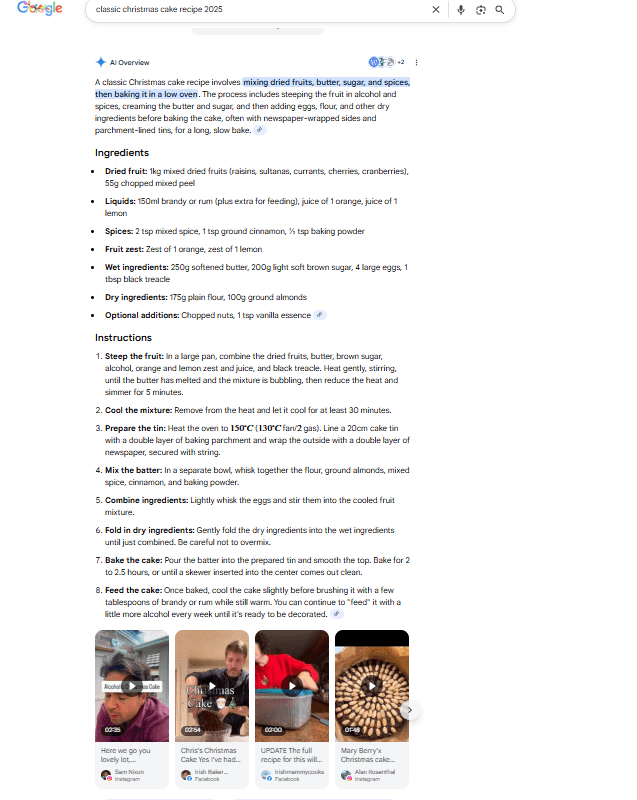
AI Overviews have been siphoning traffic from websites since they launched. However, the Thanksgiving collapse was the first time we saw a fully developed, highly competitive content vertical lose visibility almost instantly — not gradually.
In that case, any business that relies on informational content now faces a structural shift — even if the topics it covers feel “more complex” than food. An AI vulnerability audit will help you identify which content is at risk and what will stand the test of time and AI.
What Thanksgiving revealed about AI search behavior
The Thanksgiving recipe content collapse wasn’t a glitch. It was a preview of how AI will reshape the economics of search by collapsing top-of-funnel (TOFU) content visibility and reducing the need to click at all.
AI Overviews didn’t just summarize — they replaced
Food bloggers saw their recipes reconstructed into stitched-together “Frankenstein AI recipe” summaries that blended ingredients from one site with instructions from another.
Adam Gallagher of Inspired Taste said Google’s AI began presenting these combined recipes above his own link, even when users searched his brand name directly. Once AI Overviews appeared for queries on his cocktails, click-through rates dropped 30%.
AI surfaced error-prone content, and users clicked anyway
AI Overviews didn’t just generate flawed summaries. Users devoured the content anyway. It was easy to do because AI Overviews collapsed the decision process. The answer appeared instantly at the top of the SERP — no scrolling, no ads, no personal essays, no navigating complex page layouts. Convenience overrode accuracy.
Google’s guidance highlights a fundamental disconnect
Google explained that AI Overviews were just a “helpful starting point” and emphasized its intention to “make it easy for people to discover useful sites.” But creators say discovery isn’t happening. Their content now fuels the AI-generated summarized answers without reliably earning clicks.
Why this shift matters for TOFU-reliant businesses
The Thanksgiving content collapse shows exactly what happens when AI becomes the default interpreter and presenter of information. Three truths define this moment.
- AI is rewriting the economics of TOFU traffic: For two decades, TOFU content worked because delivering information required a click. AI severs that exchange. Users still search. They still need answers. But they no longer need to click to retrieve them.
- AI applies the same pattern recognition to B2B queries: The assumption that “our content is more complex” no longer holds. But AI doesn’t target complexity. It targets predictability. As long as your content follows rigid, familiar structures, AI can restitch them in a jif.
- Differentiation matters more than volume: When twenty pages collapse into one synthesized answer, volume has no value — only content. AI cannot compress and holds its ground.
The content categories most vulnerable to AI cannibalization
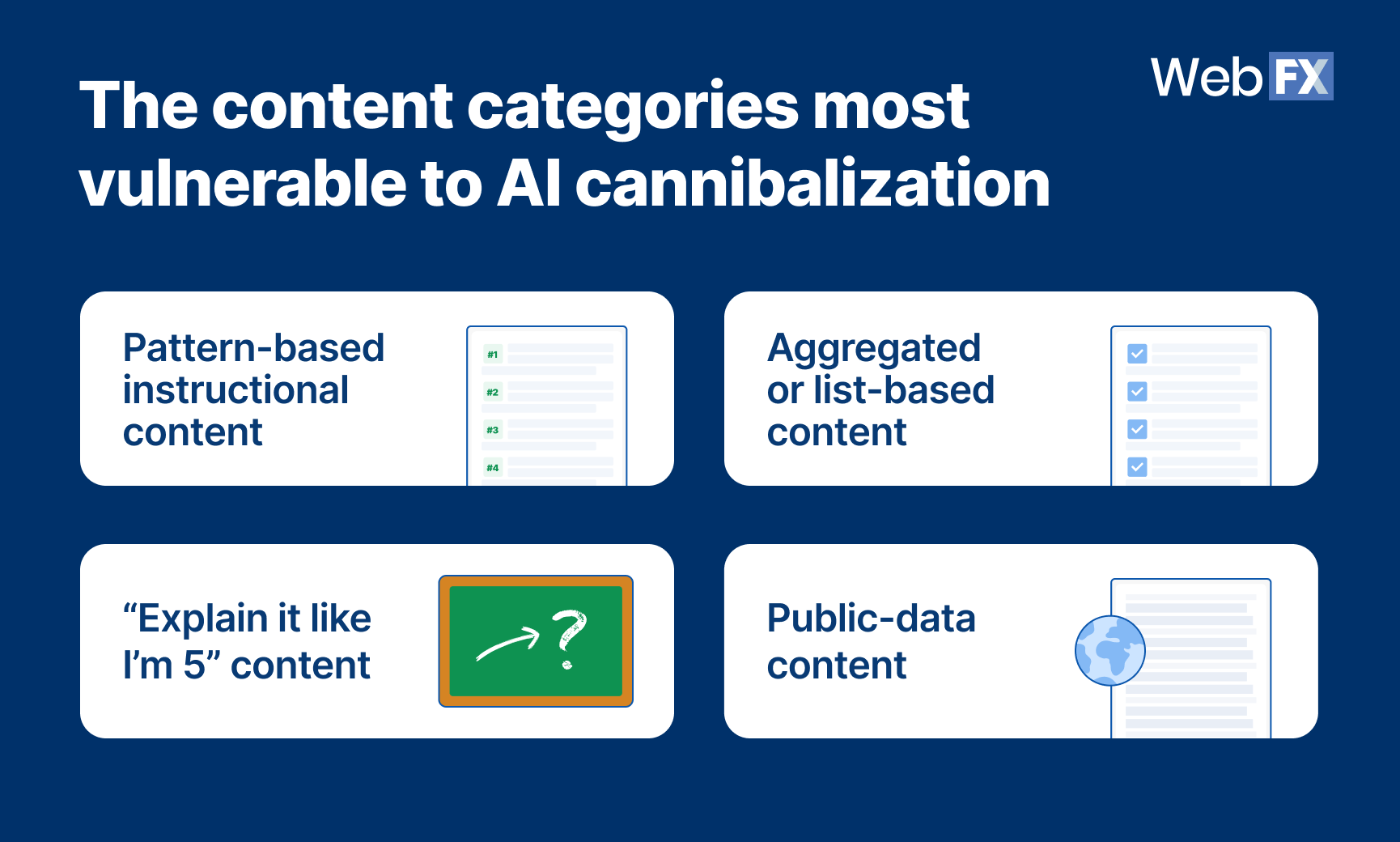
Thanksgiving revealed an important pattern: AI doesn’t flatten everything at once. It starts with content that is both predictable and interchangeable. These are the categories every business should be keen to unveil while conducting their AI vulnerability audit.
1. Pattern-based instructional content
The highest risk content categories are posts built on repeatable steps, such as recipes, how-to guides, tutorials, and troubleshooting basics. They share a universal structure that’s easy to infer and reconstruct.
That’s why food bloggers watched Google surface AI-created recipe sites with confidently incorrect cooking instructions. Once AI can assemble the pattern, the original source becomes invisible. So, businesses built on tutor-style content should treat this as their early warning.
2. Aggregated or list-based content
Roundups like “best tools,” “top strategies,” “5 steps,” and “top trends” were once considered safe TOFU pillars because they captured broad search demand. However, these formats are among the easiest for AI to replicate — and improve.
AI can merge the common elements from dozens of similar posts to produce a clean, blended list that feels authoritative because it represents the consensus across the web.
The result: Your list becomes one ingredient in the AI’s meta-list — without attribution, differentiation, or a click. This category is especially vulnerable in B2B sectors flooded with “best software for X” content.
3. “Explain it like I’m 5” content
Foundational explainers, definitions, beginner guides, and terminology breakdowns are prime targets. They are designed to simplify — and simplification is exactly what AI is designed and optimized for.
This was the downfall of Carrie Forrest (Clean Eating Kitchen), whose business relied heavily on simplified wellness explainers and starter guides. As AI Mode rolled out, Google surfaced AI-generated summaries above her content, collapsing her visibility. The result:
- Traffic down 80%
- Revenue down 80%
- A 10-person team reduced to 1
Her experience isn’t just a personal setback — it reflects a broader industry realization that the old playbook for informational content no longer holds. Rather than signaling “the end,” it underscores the need for businesses to rethink how they create, structure, and differentiate content in an AI-powered search environment.
4. Public-data content
Public data content, such as benchmarks, statistics, formulas, and other factual reference materials, is easily accessible to AI. That’s because it relies on information that already exists across dozens — sometimes hundreds — of sources.
These pages historically performed well because they consolidated scattered data into a single, convenient resource. However, today, public data is easily accessible for AI to retrieve, combine, and process — and once processed, your page becomes interchangeable with every other source that feeds the model.
Irreplaceable content categories in 2026 and beyond
AI can reconstruct anything that follows a predictable structure. It can blend, restitch, and synthesize familiar formats faster and more confidently than any human. However, it still breaks when content depends on something it can’t infer, such as:
- Original data: Brands that publish original, recurring data assets become primary sources that AI tools reference, link to, and rely on. AI can summarize the internet, but it cannot generate data that doesn’t exist.
- Lived experience: AI can define terms and outline steps, but it struggles with real-world nuance — the judgment calls, trade-offs, and contextual decisions that come from years of experience. This is where expert-driven content becomes a defensible content advantage.
- Process transparency: When a company shares its internal methodologies or decision models, it creates a content advantage rooted in lived practice—not in publicly available information.
- Experiential formats: Interactive content formats remain defensible because the value is in the functionality, not the text. They turn content from something to read into something to use — and that experiential value is difficult for AI or Google to replicate at scale.
- Situational specificity: AI works well when information is universal. It struggles when accuracy depends on location, regulation, or real-world conditions. That’s why content grounded in specific markets or operational nuance remains a defensible content advantage.
The AI content vulnerability audit
If Thanksgiving showed us anything, it’s that content collapse doesn’t happen slowly — it happens structurally.
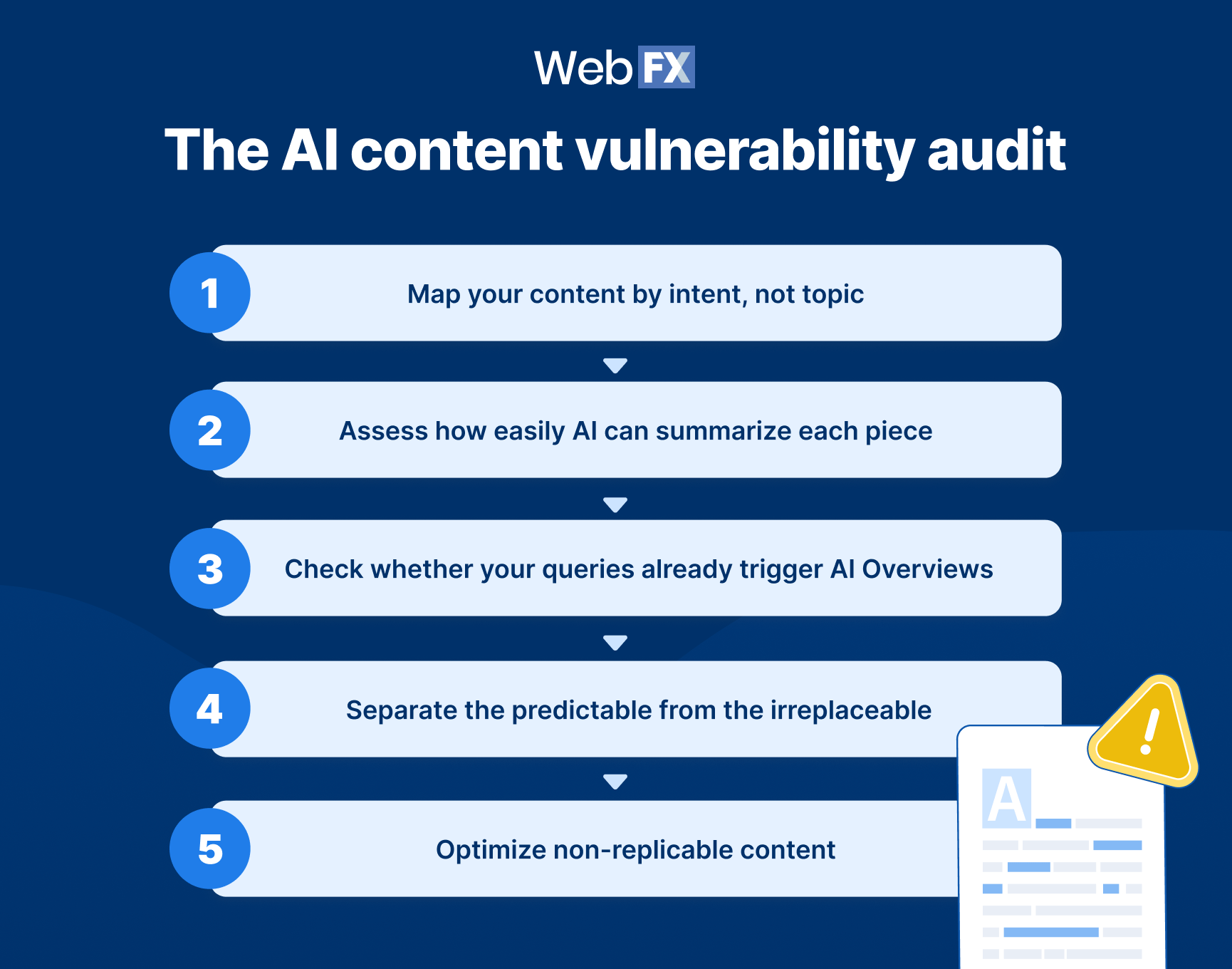
To understand which parts of your content library are at risk, you need a systematic way to evaluate how easily AI can summarize, restitch, or replace what you’ve published. That’s what the AI vulnerability audit is designed to surface.
The following AI vulnerability audit process moves you from assumption to clarity. It tells you which content is likely to disappear, which content can be strengthened, and which content must be rebuilt entirely for an AI-first search environment.
1. Map your content by intent, not topic
Start by classifying your content by search intent because AI Overviews don’t replace topics — they replace intent types. Identify which pieces fall into the categories of informational (TOFU), navigational, commercial, and transactional. In nearly every industry, informational content is the most vulnerable, and that’s where the collapse will begin.
2. Assess how easily AI can summarize each piece
Once intent is clear, evaluate your content based on a single question: Could AI produce a credible summary of this page without ever visiting it? If the answer is yes, that content is structurally exposed. Predictable structures — how-tos, definitions, “5 steps,” beginner guides — will be the first to collapse.
3. Check whether your queries already trigger AI Overviews
Search your target keywords and watch how often AI Overviews appear, how aggressively they sit above your link, and whether they cite anything at all. When AI Overviews show up consistently, click-through rate (CTR) declines follow within weeks.
4. Separate the predictable from the irreplaceable
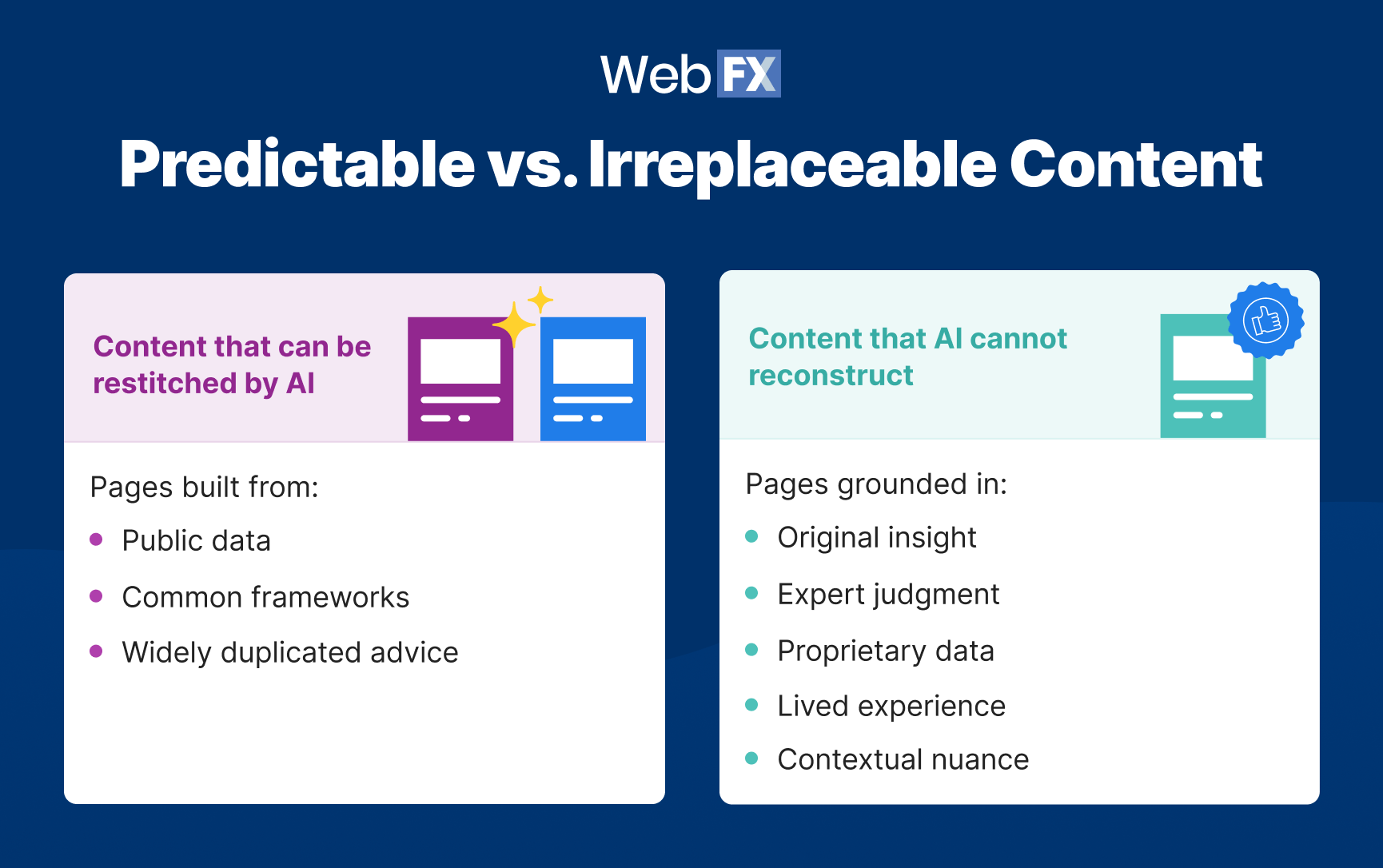
The heart of the audit is distinguishing between content that can be restitched by AI and content that AI cannot reconstruct. Pages built from public data, common frameworks, or widely duplicated advice fall into the first group.
But pages grounded in original insight, expert judgment, lived experience, proprietary data, or contextual nuance behave differently. AI can describe them, but it cannot generate them.
5. Optimize non-replicable content
High-value but predictable content should be rebuilt into something AI cannot easily flatten—expert-led analyses, frameworks, niche specificity, or experiential formats. Low-value, low-differentiation content may not be worth saving. Your goal is a library where each page offers something AI cannot infer.
Let WebFX help you create content that AI can’t replicate
The Thanksgiving recipe meltdown wasn’t an isolated failure. It was the first public demonstration of how quickly AI can reroute demand, restructure search behavior, and compress the very content models businesses have relied on for more than a decade.
Surviving this shift will mean you keep up with content marketing trends along the AI revolution in your industry, emerging content marketing trends, leaning into proprietary data, unique insights, and expert interpretation, and evolving your approach as AI reshapes the search landscape.
Your core business won’t break under this change — but your content strategy will, if it stays rooted in predictable formats. You can avoid this by partnering with WebFX as your content marketing expert.
We have 30+ years of digital marketing experience in content marketing and 8+ years investing in AI. Partnering with us equips your business with proprietary data, industry expertise, and a technology platform built to translate content into measurable business outcomes.
Request a content marketing proposal today or call us at 888-601-5359 to speak with a strategist
-
 Lornah Ngugi is a seasoned digital marketing writer with 6+ years of experience translating complex marketing strategies into engaging, results-driven content. She holds a B.S. in Business Information Technology and is certified in HubSpot Academy, Google Analytics, LinkedIn Marketing, and Google Digital Academy. Lornah regularly contributes to the WebFX blog and SEO.com, where she’s authored hundreds of marketing guides that help readers turn their goals into measurable results through practical, data-informed insights. When she’s not writing, you’ll find her enjoying a quiet walk in the park, sipping black coffee, or finding creative inspiration in a good chocolate bar.
 -

WebFX is a full-service marketing agency with 1,100+ client reviews and a 4.9-star rating on Clutch! Find out how our expert team and revenue-accelerating tech can drive results for you! Learn more
Try our free Marketing Calculator
Craft a tailored online marketing strategy! Utilize our free Internet marketing calculator for a custom plan based on your location, reach, timeframe, and budget.
Plan Your Marketing Budget
Table of Contents
- What Thanksgiving revealed about AI search behavior
- Why this shift matters for TOFU-reliant businesses
- The content categories most vulnerable to AI cannibalization
- Irreplaceable content categories in 2026 and beyond
- The AI content vulnerability audit
- Let WebFX help you create content that AI can’t replicate
Share this article


See AI Marketing in Action
Explore how WebFX helped a regional brand get discovered in AI search experiences — proving what’s possible with today’s AI-driven marketing!
Try our free Marketing Calculator
Craft a tailored online marketing strategy! Utilize our free Internet marketing calculator for a custom plan based on your location, reach, timeframe, and budget.
Plan Your Marketing Budget
What to read next