


Contents
- How to centralize marketing data across multiple companies and locations in 8 steps
- 1. Determine the decisions you need to make and the marketing data you want to centralize
- 2. Standardize your marketing and revenue definitions
- 3. Map every company's marketing data flow
- 4. Connect marketing data to CRM and revenue data
- 5. Preserve company and location-level data
- 6. Compare the locations' outcomes
- 7. Build separate views from one shared dataset
- 8. Use centralized data to find where the next marketing dollar should go
- The benefits of centralizing marketing data across locations and brands
- Why is multi-company and multi-location marketing data so difficult to centralize?
- What marketing data should be centralized vs. kept local?
- What if your companies use different CRMs?
- How do you compare marketing performance fairly across locations?
- Common multi-location marketing reporting mistakes
- What does good centralized marketing reporting actually look like?
- FAQs about centralizing marketing data
- Ready to see which locations are actually driving your revenue in 90 days?

TL;DR
- Centralize marketing, CRM, and revenue data to see which companies, locations, and channels generate revenue and where to invest your marketing budget.
- Start with shared metric definitions, connect marketing activity to revenue, and preserve company and location identifiers in one shared dataset.
- Compare qualified leads, close rates, customer value, and revenue using consistent reporting periods and local market context—not raw lead counts alone.
- Build reporting views for leadership and local teams from the same dataset. Fix tracking gaps before using dashboards to make budget decisions.
If you manage marketing across multiple brands or locations, the challenge is having a single source of truth and a consistent definition of “good numbers.”
Centralizing marketing data across your sites and brands requires three things working together:
- Shared definitions for your core marketing and revenue metrics
- A connected system that pulls each location’s marketing and CRM data into one report
- Preserved company and location identifiers so you can still see performance by market, brand, or business unit
Get this right, and you can report to your leadership which businesses are performing and which ones are underperforming. With these topics, you’ll learn how to centralize and track your marketing performance across multiple locations:
- How to centralize marketing data across multiple locations in 8 steps
- The benefits of centralizing marketing data across locations and brands
- Why is multi-company and multi-location marketing data difficult to centralize?
- What marketing data should be centralized vs. kept local?
- What if your companies use different CRMs?
- How do you compare marketing performance fairly across locations?
- Common multi-location marketing reporting mistakes
- What does good centralized marketing reporting actually look like?
- FAQs about centralizing marketing data
Meet RevenueCloudFX:
One platform tracking countless metrics and driving stellar results.
How to centralize marketing data across multiple companies and locations in 8 steps
Centralizing marketing data across a multi-location or multi-brand organization follows a repeatable sequence. Follow it in order to get a system that gives you insights on where to invest your marketing budget to grow your overall business:
- Determine the decisions you need to make and the marketing data you want to centralize
- Standardize your marketing and revenue definitions
- Map every company’s marketing data flow
- Connect marketing data to CRM and revenue data
- Preserve company and location-level data
- Compare the locations’ outcomes
- Build separate views from one shared dataset
- Use centralized data to find where the next marketing dollar should go
1. Define your reporting goals and required data
Identify the decisions you want to make with your consolidated marketing data. Then, determine the marketing and CRM data you need to centralize to make those decisions.
At the portfolio level, that’s deciding where to allocate more of the marketing budget based on each portfolio company’s ROI. If you’re a multilocation business, that’s deciding which markets are worth growing into and which locations need more (or less) budget.
Centralized marketing data also enables you to analyze channel-level data, which should help you decide which channels to invest in, because they drive qualified leads and revenue.
2. Standardize your marketing and revenue definitions
Put every portfolio company’s definition of terms in writing before you combine any data. Note down the data sources for each company and standardize the definitions.
This step is important because inconsistent definitions, such as what counts as a lead, can lead to an inaccurate analysis of your portfolio companies’ performance.
For example, Company A might mark a lead the moment a contact form is filled out, while Company B only counts a lead once a sales rep confirms the contact is a real prospect. That difference can make Company A’s lead count appear higher even if both companies generate the same amount of qualified pipeline.
As a result, budget decisions are based on an inaccurate picture of the companies’ performance.
3. Map each company’s and location’s data sources
For each company or location, document the full chain from marketing channel to revenue:
- Marketing channel
- Website or phone
- Lead
- CRM
- Sales
- Customer
- Revenue
Mapping this out is important so you’ll know if a particular company or newly acquired business has a data gap in its marketing-to-revenue chain.
In a portfolio of companies that grew through acquisition, it’s common for no one to actually know which systems are connected and which aren’t until someone tries to document them. One company might have call tracking wired into its CRM, while another has never connected its CRM to a revenue system at all.
If you find a data gap, fix it before you fold that company into any cross-company comparison. You can do this by connecting the missing integration, linking the CRM to revenue, or adding call tracking.
4. Connect marketing data to CRM and revenue data
This step distinguishes a marketing dashboard from a business performance system. Without this connection, you can only see how much traffic or how many leads a channel generates, but you can’t see whether those leads became paying customers or how much revenue came back from them.
In practice, this step involves linking each lead to the channel or campaign that generated it, then following that lead’s CRM record through to the following:
- Opportunity
- Closed sale
- Revenue tied to it
Do this consistently across every company and location, and you can trace a specific dollar of revenue back to the campaign that generated it. Making that connection hold up reliably across multiple companies, CRMs, and revenue systems is where the right technology makes the difference.
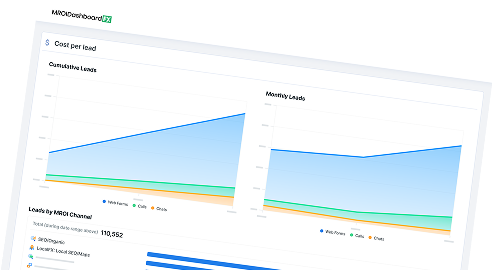
RevenueCloudFX is a platform that helps you centralize marketing data across multiple locations. Its Multi-Location Revenue Intelligence feature lets you see a clear view of what’s driving revenue and what to do next to grow your business. Powered by AI, this feature lets you:
- Compare the performance of your different locations or brands
- Analyze which products or services are driving revenue
- Examine the performance of each location’s marketing channels
- Optimize your ad spend
We’ve helped a multi-location manufacturing company increase its form submissions from paid ads by 31% with the help of RevenueCloudFX.
5. Preserve company and location identifiers
This is an important step when consolidating marketing data across multiple locations. It involves tagging every marketing and revenue record with identifiers that show where it came from:
- Parent company
- Brand
- Location
- Market
- Channel
- Campaign
Instead of a flat pile of leads and revenue with no context, you get data-rich intel that’s useful for both leadership overseeing all locations and the marketing team handling a specific location.
6. Compare performance using consistent metrics and local context
Instead of comparing each location’s raw lead counts, score every portfolio company or location on outcomes using these metrics:
- Cost per qualified lead
- Close rate
- revenue per lead
- ROAS
Use the same definitions and reporting periods across locations, then interpret the results alongside each location’s market conditions and operating capacity.
For example, Location A and Location B can both generate 100 leads. However, if Location A qualifies 70 of them and closes 25 as customers for $250,000 in revenue, while Location B qualifies 25, closes five, and generates $40,000, they didn’t perform similarly.
Likewise, a location with a $150 cost per lead isn’t automatically outperforming one with a $300 cost per lead if the cheaper leads close at 5% and the pricier ones close at 25%. Differences in customer value also affect how much those leads are worth.
Before reallocating marketing budget, account for:
- Market size and remaining demand
- Service or product mix
- How long the location has been open
- Marketing budget
- Customer value
- Capacity to serve additional customers
- Seasonality
A newer location in a smaller market may generate fewer leads than an established business while performing well for its circumstances. A location that looks efficient on paper may also have limited capacity or little remaining demand, making additional investment less useful.
Compare the full picture, from marketing spend and lead quality to sales conversion, customer value, and revenue, to decide which locations are ready for more investment and which need further investigation.
7. Build separate views from one shared dataset
Create reporting views for the people using the data and the decisions they need to make. Leadership needs an organization-wide view of marketing investment and revenue, while company and location managers need the details to improve performance.
All views should pull from the same underlying dataset. Users should be able to move from overall results to company, location, and channel detail without reconciling separate spreadsheets.
The table below shows what each view should answer and include.
| View | What it answers | What it shows |
| Portfolio and enterprise view | Why did revenue decline/increase this month? | Total marketing-sourced revenue Overall CAC and ROI Growth trends across the full organization |
| Company and brand view | Which companies are growing? | Performance of each company |
| Location and channel view | What should this location or channel owner do next? | Location-level revenue Cost per qualified lead Close rate Channel performance to report which ones are producing the most profitable customers |
Keep each view focused on its audience. Leadership should be able to assess overall performance without sorting through campaign-level detail, while location managers should have enough information to identify what to improve next.
8. Use performance insights to allocate marketing budget
Turn your scorecard into a budget decision. With every company or location scored on the same outcome metrics and adjusted for context, you’re ready to decide where to invest more marketing budget, where to fix something first, and where to pull back.
Ranking locations by raw performance alone doesn’t tell you what to do about the ones that aren’t winning. A location with high cost per lead (CPL) might have a fixable tracking gap, or it might genuinely be underperforming in its market.
Sort each company or location into one of four categories:
- Scale it: If a location is converting well and has room to grow
- Fix it: If a portfolio company’s performance is weak, but you can point to a specific, fixable cause
- Test it: If you don’t have enough data yet to call it either way
- Reduce it: If a location’s performance has stayed weak with no clear fix in sight
For example, a location with a strong close rate but low lead volume is a scale candidate, while one with a high cost per lead and no obvious cause is a test candidate until you know more.
What marketing data should be centralized vs. kept local?
Centralize high-level performance measurement and global customer and revenue data. Preserve the context of each location by keeping market demand and competitive data local.
| Data or process | Centralize | Preserve local/company context |
| KPI definitions | Yes | – |
| Revenue attribution methodology | Yes | – |
| Reporting framework | Yes | – |
| CRM field requirements | Yes | – |
| Marketing source taxonomy | Yes | – |
| Customer and revenue data | Yes | Yes |
| Budget | – | Yes |
| Market demand | – | Yes |
| Campaign performance | – | Yes |
| Customer behavior | – | Yes |
| Local competitive data | – | Yes |
Common multi-location marketing reporting mistakes
A few mistakes can show up in multi-location marketing reporting, such as:
- Rolling everything into one portfolio-wide number: This doesn’t show the performance differences between companies and locations that leadership actually needs to see.
- Comparing raw lead volume: Lead counts alone don’t account for lead quality or the revenue they generate.
- Using different lead definitions across locations: This creates comparisons that look valid but don’t measure the same thing.
- Optimizing exclusively for CPL: Cheap leads that don’t convert to customers may simply be deferred costs.
- Forcing every company to adopt the same technology immediately: This can create disruptions before the business understands what actually needs to change.
- Building dashboards before fixing attribution: This can result in a well-designed dashboard with incomplete data.
- Using last-click attribution across locations: Multi-location companies may miss how a user’s search for a nearby branch or phone call influenced an in-store visit.
- Losing location identifiers during data integration: Once that context disappears, centralized reporting becomes significantly less useful.
FAQs about centralizing marketing data
What is centralized marketing data?
Centralized marketing data brings information from multiple marketing, analytics, CRM, sales, and revenue systems into a shared reporting structure. For a multi-company or multi-location organization, that data should stay segmented by company, brand, location, channel, and campaign so leadership can see both overall performance and what’s driving performance.
What are the benefits of centralizing marketing data for multi-location businesses or franchises?
The main benefits are:
- Having a single source of truth for reporting
- Lower costs from consolidating overlapping tools and vendors
- Smarter budget allocation across locations
- More consistent brand messaging
- Deeper analytics that reveal patterns
How do you centralize marketing data across multiple locations?
Establish shared KPI definitions, inventory each location’s technology and data sources, connect marketing activity with CRM and customer data, preserve location identifiers throughout, normalize the data into a shared reporting structure, compare performance using consistent metrics, and use those insights to prioritize investment.
Do all locations or portfolio companies need to use the same CRM?
No. You can centralize marketing reporting without moving every company or location onto the same CRM. Start by:
- Defining shared reporting fields
- Mapping each CRM’s fields to the shared model
- Connecting the data to a centralized reporting layer
- Standardizing lifecycle and revenue definitions
- Validating data quality across systems
Centralizing reporting and replacing CRM systems are separate projects. You can establish shared visibility while individual companies continue using their existing systems.
What metrics should be standardized across multiple locations?
Prioritize metrics tied to customer acquisition and revenue, such as:
- Marketing spend
- Leads
- Qualified leads
- Cost per qualified lead
- Opportunities
- Customers
- Close rate
- CAC
- Marketing-sourced revenue
- ROAS or ROI
Channel-specific metrics can still vary based on each location’s strategy.
How do you compare marketing ROI across locations?
Use a consistent attribution and revenue framework, then compare spend, qualified leads, customers, CAC, revenue, and ROI across locations. Account for differences in market size, service mix, capacity, seasonality, and customer value before making any budget decisions based on that comparison.
Should marketing data be centralized after an acquisition?
Typically, yes. Centralized visibility helps leadership understand a newly acquired company’s marketing contribution within the broader organization.
How do you track marketing revenue across multiple companies?
Connect marketing source and campaign data to lead records, CRM opportunities, and customers, and closed revenue, while preserving a company or brand identifier throughout. That makes it possible to roll performance up to the portfolio level while still identifying which individual businesses generated the results.
What should a multi-location marketing dashboard include?
At minimum, leadership should be able to view spend, leads, qualified leads, customers, revenue, CAC, and ROI, segmented by location, market, channel, and campaign. Marketing teams typically need additional channel-specific metrics underneath that executive-level scorecard.
What is the biggest mistake companies make when centralizing marketing data?
The biggest mistake that multi-location companies make when centralizing marketing data is treating it like a dashboard project rather than building a measurement and decision-making project.
When creating a single source of truth, organizations must have:
- Shared definitions
- Reliable attribution
- Identifiers that preserve company and location context
Meet WebFX
Book a discovery call with us today to discuss how our multi-location marketing expertise can drive growth for your business!

Ready to see which locations are actually driving your revenue in 90 days?
Marketing data consolidation is about providing leadership and different teams with visibility into which companies, locations, markets, and channels generate revenue. Ultimately, the goal of centralizing marketing data is to measure performance and inform you of the best next steps to grow your business.
Our proprietary tool RevenueCloudFX helps you do just that. Partnering with us gives you access and assistance to make the most of the platform and its Multi-Location Revenue Intelligence feature.
With our multi-location marketing services, we can help you get up to speed with location-by-location marketing and revenue insights in 90 days. Get a custom revenue assessment by contacting us online or calling us at 888-601-5359 to get started.
-
 Maria is a Lead Content Specialist at WebFX. With nearly two decades of experience in B2B and B2C publishing, marketing, and PR, she has authored hundreds of articles on digital marketing, AI, and SEO to help SMB marketers make informed strategic decisions. Maria has a degree in B.S. Development Communication major in Science Communication, and certifications in inbound marketing, content marketing, Google Analytics, and PR. When she’s not writing, you’ll find her playing with her dogs, running, swimming, or trying to love burpee broad jumps. View full profile
 -

WebFX is a full-service digital marketing agency delivering revenue-driving strategies across online advertising, SEO and AI search optimization, and digital marketing. Backed by 1,100+ client reviews, a 4.9-star rating on Clutch, and proprietary revenue-tracking technology, our team helps businesses grow visibility and revenue across platforms, from Google to ChatGPT to LinkedIn. Discover how our expert team and revenue-accelerating tech can drive results for you. Learn more

Try our free Marketing Calculator
Craft a tailored online marketing strategy! Utilize our free Internet marketing calculator for a custom plan based on your location, reach, timeframe, and budget.
Contents
- How to centralize marketing data across multiple companies and locations in 8 steps
- 1. Determine the decisions you need to make and the marketing data you want to centralize
- 2. Standardize your marketing and revenue definitions
- 3. Map every company's marketing data flow
- 4. Connect marketing data to CRM and revenue data
- 5. Preserve company and location-level data
- 6. Compare the locations' outcomes
- 7. Build separate views from one shared dataset
- 8. Use centralized data to find where the next marketing dollar should go
- The benefits of centralizing marketing data across locations and brands
- Why is multi-company and multi-location marketing data so difficult to centralize?
- What marketing data should be centralized vs. kept local?
- What if your companies use different CRMs?
- How do you compare marketing performance fairly across locations?
- Common multi-location marketing reporting mistakes
- What does good centralized marketing reporting actually look like?
- FAQs about centralizing marketing data
- Ready to see which locations are actually driving your revenue in 90 days?
Share this article


Proven Marketing Strategies
Try our free Marketing Calculator
Craft a tailored online marketing strategy! Utilize our free Internet marketing calculator for a custom plan based on your location, reach, timeframe, and budget.