


Contents
- The three marketing models for PE-backed multi-brand companies
- In-house
- Single centralized agency
- Multiple marketing agencies
- In-house vs. single agency vs. multi-agency comparison
- Choose the right marketing model
- What each model actually costs
- Scaling through acquisitions
- Centralize measurement, whichever model you choose
- How WebFX fits into a PE-backed multi-brand marketing model
- FAQs

TL;DR: In-house vs. agency marketing for PE-backed multi-brand companies
- Choose from three models: In-house, one centralized agency, or multiple specialist agencies. Each puts capabilities in a different place.
- Weigh total cost of ownership: Compare people, agencies, technology, media, and coordination time. Comparing salary against retainer leaves out most of the cost.
- Centralize measurement in every model: Set KPI definitions, attribution, and reporting once. Let each brand shape its own creative, messaging, and local strategy.
- Test for the next acquisition: Run each model against your next few deals. A structure that fits today’s portfolio can break after the next add-on.
In-house vs. agency marketing for PE-backed multi-brand companies comes down to three models: in-house, one centralized agency, or multiple specialist agencies. A single agency fits best when the portfolio keeps acquiring brands and leadership needs comparable reporting.
In-house fits mature teams, and multiple agencies fit only when brands need specialists one partner lacks. Centralize measurement in every model.
This guide is for operating partners and portfolio-company marketing leaders who are deciding how to structure marketing across several brands, locations, or pending acquisitions.
- The three marketing models for PE-backed multi-brand companies
- In-house vs. single agency vs. multi-agency comparison
- Choose the right marketing model
- What each model actually costs
- Scaling through acquisitions
- Centralize measurement, whichever model you choose
- FAQs
Your Revenue Growth Starts Here
Tell us about your business, and we’ll create a custom plan to grow your traffic, leads, and predictable revenue.
The three marketing models for PE-backed multi-brand companies
Most PE-backed multi-brand companies choose among three structures. Each one puts capability, data, and accountability in a different place.
In-house
You hire your own specialists for strategy, SEO, paid media, content, CRO, email, and analytics. Some companies build one central team that supports every brand. Others build a team inside each portfolio company.
Best for: Organizations that want deep internal ownership and have the scale to staff every specialty.
Single centralized agency
One agency supports your brands, locations, and acquisitions while you keep oversight of performance. The agency supplies the specialists and the shared reporting.
You keep the decisions on budget and brand.
Best for: Portfolios that are acquiring and need comparable numbers across brands.
Multiple marketing agencies
Different agencies split the work by brand, channel, market, or specialty. Each partner covers a narrower slice of the portfolio.
Best for: Portfolios where brands need specialist or local expertise that one partner can’t cover, or where strong incumbents already produce results.
Running a single brand? Check out our guide to in-house vs. agency marketing.
The next section rates all three models on eight factors.
In-house vs. single agency vs. multi-agency: Side-by-side comparison
Eight factors separate the three models. Ratings run High to Low, and High is always the better outcome for the buyer.
| Factor | In-house | Single agency | Multi-agency |
| Strategic and local control | High. You set priorities directly, and local flexibility depends on how you structure teams. | Moderate. Direction is shared with the agency, and one strategy can get copied across every brand. Local flexibility works when the engagement standardizes infrastructure, not strategy. | Moderate. Each brand controls its own partner, but direction across the portfolio is split. |
| Specialist depth | Low. Every specialty (SEO, PPC, CRO, analytics) is a separate hire, and a specialist who leaves takes the capability with them. | Moderate. You get a broad bench without hiring for it, and it’s available faster than recruiting. Niche verticals or unusual channels may fall outside it. | High. You can pick the strongest specialist for each brand or channel. |
| Cross-brand reporting comparability | Moderate. One KPI dictionary is possible, but brand-level teams tend to recreate silos. | High. One KPI dictionary, one attribution method, and one tool set, tied to CRM data where systems support it. Brands, locations, and channels compare against revenue. | Low. Each agency runs its own reporting setup unless you impose a standard. |
| Cost flexibility | Low. Salaries and benefits are fixed, and hiring lags demand. | High. Scope scales up or down with the portfolio. | Moderate. Each retainer flexes, but duplicate tools and coordination time add cost. |
| Speed to onboard an acquisition | Low. Hiring takes months, and internal capacity is the constraint. | High. The new brand plugs into existing reporting and specialists, if the bench covers its vertical. | Moderate. A strong incumbent can stay in place and keep producing. Each deal still forces a keep, replace, or add decision, and each new agency’s reporting has to be integrated. |
| Cross-brand learning | Moderate. Institutional knowledge stays in the company, and the team knows your products, customers, and sales process. Learning can still stall between brand teams. | High. One partner sees every brand and carries what works across them. | Low. Insights stay with the agency that found them. |
| Ease of replacing a failing partner | Low. Rehiring takes months. | Low. More of the marketing function moves at once. | High. You swap one vendor, and the rest keep running. |
| Ease of management | Moderate. There’s one reporting line, but you own hiring and retention. | High. One accountable owner is responsible for performance. | Low. Leadership ends up coordinating vendors and reconciling their reports, and no single party owns revenue across the full customer journey. |
Ratings reflect our assessment of how each model typically performs for multi-brand portfolios.
No model rates High on every row.
The choice between a single agency and multiple agencies comes down to how much coordination cost you’re willing to trade for specialist depth.
Use this table to find the tradeoffs that matter most for your value-creation plan. There’s no universal answer.
Choose the right marketing model
Evaluate six dimensions before deciding:
- Complexity: How many brands, locations, markets, and CRMs?
- Capability: What expertise already exists and where the gaps are?
- Speed: How fast the business needs to grow or integrate acquisitions?
- Control: How much ownership leadership wants internally?
- Visibility: Can leadership currently compare brands, channels, and revenue?
- Scale: Will this model still work after 10 acquisitions or 100 locations?
Underneath all six is really one centralized vs. decentralized marketing question: How much should live in one place, and how much should stay local.
Use these questions to see which model the answers point toward:
| Question | Favors in-house | Favors single agency | Favors multi-agency |
| Need deep daily brand involvement? | Yes | ||
| Need many specialists quickly? | Yes | Yes | |
| Need centralized reporting? | Yes | Yes | |
| Acquiring companies rapidly? | Yes | ||
| Brands require highly specialized agencies? | Yes | ||
| Strong incumbent partners already exist? | Yes | ||
| Want one point of accountability? | Yes | Yes | |
| Internal team is already large and mature? | Yes | ||
| Vendor management is a major pain point? | Yes | ||
| Need maximum local autonomy? | Yes |
This isn’t a quiz where one checkmark decides the answer. Use it to see where the strongest fit actually lies once every dimension is weighed together.
What each model actually costs
The honest comparison goes beyond salary against agency retainer, toward total cost of ownership: People, plus agencies, plus technology, plus media, plus the internal coordination time each model requires.
- An in-house team’s real cost includes salaries, benefits, recruiting, management time, software, training, and turnover, beyond a base salary figure
- A single agency’s cost includes the retainer and media spend, but can require less internal management overhead since one partner owns more of the execution
- A multi-agency model adds multiple retainers, duplicate technology, and the internal coordination and reporting reconciliation someone has to own across every vendor.
For directional context, WebFX custom digital marketing plans start at $3,000 per month, with multi-location marketing costs scaling from there based on markets, service mix, technology, and execution scope.
The cheapest model on paper may not be the cheapest model in practice once coordination time and duplicate tools get counted.
Scaling through acquisitions
What happens when the next acquisition closes
An in-house team has to audit the new brand’s marketing, integrate its reporting, and take on execution, all while the rest of the portfolio keeps running. Internal capacity is usually the real constraint here, more than willingness.
A single agency can often bring a new acquisition into an existing reporting framework, technology layer, and specialist team, which usually means a shorter ramp than building that infrastructure from nothing.
A multi-agency model forces a decision every time: Keep the incumbent, replace them, or add another vendor, and figure out how their reporting integrates with everyone else’s. Each acquisition can add another layer of vendor complexity rather than plugging into one that already exists.
The strongest marketing operating model gets easier to scale as acquisitions increase, instead of more complicated.
To test each model, run it against your next two or three expected deals. Ask these three questions for each one:
- How long until the new brand reports against the same KPI definitions as the rest of your portfolio?
- Does the existing team or agency stay, get supplemented, or get replaced?
- Who has the capacity to audit the new brand’s marketing before you change anything?
Should you replace the agencies you inherit?
Not automatically. A simple framework works better than a binary keep-or-fire decision:
- Keep: The current agency performs well and aligns with the future strategy.
- Expand: The agency has capabilities worth scaling further.
- Supplement: Strong in some areas, but missing specific capabilities elsewhere.
- Consolidate: Moving the work to a centralized partner outweighs the transition risk.
- Replace: Performance, transparency, expertise, or scalability doesn’t hold up.
Agency consolidation should be driven by performance and operating leverage, above organizational tidiness.
That same evaluation carries into a broader post-acquisition marketing integration, where inherited agencies, technology, reporting, and assets all need to be assessed before consolidation decisions are made.
Centralize measurement, whichever model you choose
Even when execution stays decentralized, a few things benefit from centralizing no matter which model the company picks:
- KPI definitions
- Revenue attribution methodology
- Marketing reporting
- CRM and data standards
- Brand governance
- Agency evaluation
Centralized measurement also makes it easier to allocate marketing budget across brands and locations using comparable performance, revenue, and capacity data, rather than treating every market the same.
Of the items above, agency evaluation is the one most likely to stay with each brand. If every brand scores its agency differently, leadership can’t tell which results are strong and which were just easier to hit.
A shared scorecard fixes that. Our guide to evaluating marketing agency performance across brands shows how to build one, with business outcomes counted ahead of clicks and leads and targets that fit each brand’s own market and maturity.
Keep these flexible instead: Channel mix, creative, messaging, local search, budget allocation by market, and brand-specific content.
Centralize the operating system while leaving individual marketing decisions inside it flexible. That principle holds whether the company ends up in-house, on one agency, or spread across several, and it’s really the centralized vs. decentralized marketing question underneath the whole decision.
What about a hybrid model?
Many PE-backed organizations may eventually land on some version of a hybrid. A common split: The internal team owns brand strategy, sales alignment, and budget decisions. A central agency owns SEO, PPC, CRO, analytics, and technology.
Specialist partners cover PR, niche creative, or local market needs the central agency doesn’t.
Hybrid works well when ownership is explicit. It breaks down when responsibilities overlap, KPIs differ by team, vendors don’t share data, and nobody owns overall performance. If you’re building a hybrid, treat it as a deliberate combination of the three models above, rather than a way to avoid choosing.
How WebFX fits into a PE-backed multi-brand marketing model
WebFX functions closest to the single-agency model: One partner coordinating specialist expertise, centralized technology, and reporting across a portfolio, rather than a fragmented set of vendors leadership has to manage.
RevenueCloudFX connects company, brand, location, and channel data through to lead, customer, and revenue where the client’s systems support it, which is the specific gap a multi-agency structure tends to create.
That model has supported genuinely multi-brand and multi-location organizations. Great Northern, a client managing multiple business units, saw a 109% increase in organic traffic and a 103% increase in organic form submissions. KOA, a franchise network of 500-plus locations, saw a 260% increase in organic revenue.
The value goes beyond “one agency instead of several.” It’s one partner, specialist teams, centralized technology, shared reporting, and brand-level flexibility, together.
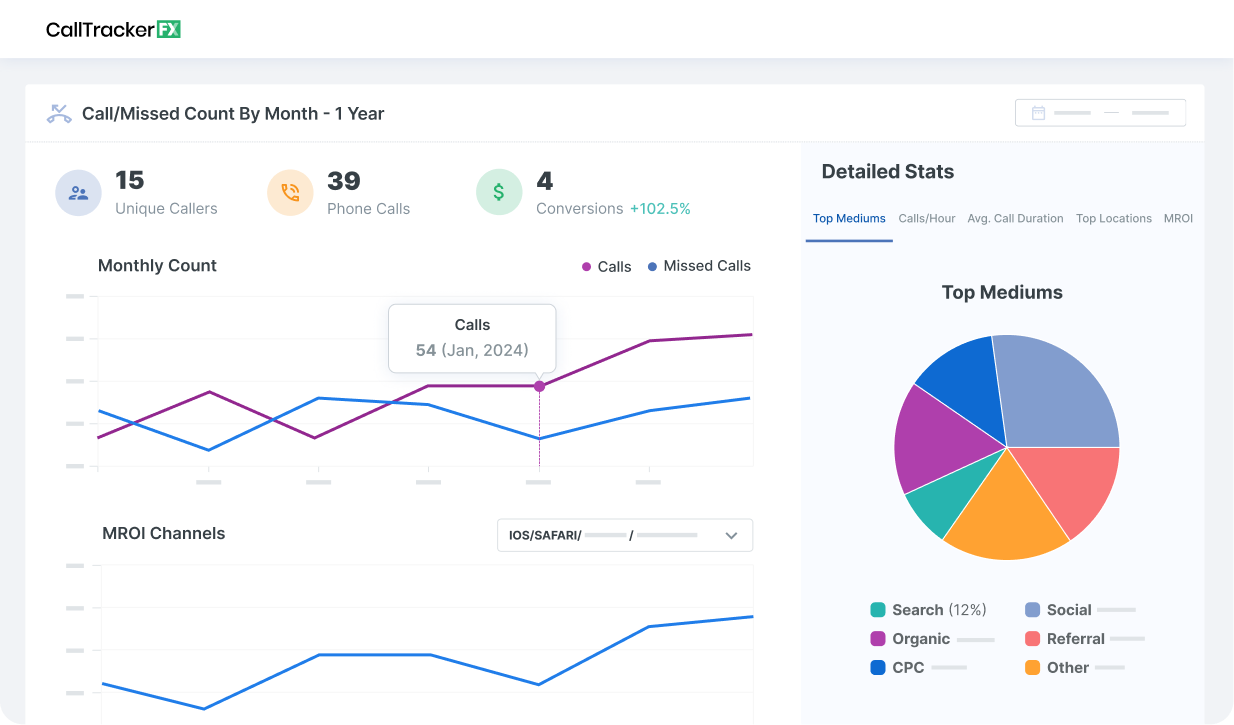
Measuring the metrics that affect your bottom line.
Are you interested in custom reporting that is specific to your unique business needs? Powered by RevenueCloudFX, WebFX creates custom reports based on the metrics that matter most to your company.
- Leads
- Transactions
- Calls
- Revenue

FAQs about in-house vs. agency marketing for PE-backed multi-brand companies
Is it better to have an in-house marketing team or an agency?
Framed as a simple in-house vs. agency marketing question, neither model is universally better. In-house teams offer control and deep company knowledge, while agencies provide broader specialist expertise and faster access to capabilities. The right choice depends on internal team maturity, growth goals, brand complexity, acquisition pace, and reporting needs.
What is the best marketing structure for a multi-brand company?
The best structure creates clear ownership while balancing centralized visibility, specialist expertise, brand autonomy, and cost. For some organizations, that’s an internal team, while for others, a centralized agency or multi-agency model works better. The in-house vs. agency marketing question comes down to where each type of expertise needs to live, more than which model is smarter overall.
When should marketing be brought in-house?
Bringing a capability in-house tends to make sense when the company has enough scale, the capability is strategically critical, and the ongoing workload justifies dedicated headcount. That doesn’t mean every marketing function needs to move in-house at once.
Should PE-backed companies use one marketing agency across multiple brands?
A centralized agency can make sense when the organization needs shared reporting, consistent measurement, cross-brand learning, and faster acquisition onboarding. The agency should still allow individual brands to keep the strategy differences that actually drive their performance.
What are the advantages of using multiple marketing agencies?
The single agency vs. multiple agencies decision usually comes down to specialization. Multiple agencies can provide deep specialization, local-market knowledge, and flexibility by brand. The tradeoff is more vendor management, more reporting complexity, and more data fragmentation to reconcile.
Is using one agency cheaper than hiring an in-house team?
It depends on total cost of ownership. Compare salaries, benefits, recruiting, technology, and internal coordination time against agency fees and media spend, rather than comparing one salary to one retainer.
Is using multiple agencies more expensive?
It can be, especially once duplicate technology, separate reporting tools, and internal vendor management get counted. Specialist agencies can still be worth that added complexity when they produce materially better results in specific areas.
How should PE firms centralize marketing across portfolio companies?
Start with the components that create visibility and accountability: KPI definitions, attribution, reporting, and data standards. Decide separately which execution components should stay at the brand level.
WebFX has thousands of reviews praising our transparency, communication, and results.
WebFX Agency Rating

4.9/5
based on over 550 third-party reviews

The real question isn’t which model is best
It’s which model matches the complexity you’re actually managing, and whether it still works after the next acquisition. In-house makes sense when the company has the scale and leadership capacity to build it.
A single agency makes sense when centralized expertise, reporting, and accountability create more leverage than building internally. Multiple agencies make sense when brands are specialized enough that separate partners are worth the coordination cost.
Run the six-dimension framework and the scorecard against your own portfolio before committing to a structure. The right answer isn’t the same for every PE-backed company, but the questions that get you there are.
Want help mapping your portfolio’s marketing structure against these criteria? Get your free proposal or call 888-601-5359 to speak with a strategist today about our proven marketing services for PE-backed companies.
-
 Albert Dandy Velasquez blends SEO strategy with compelling storytelling to help businesses boost their visibility and revenue online. With a B.A. in English and certifications from HubSpot, Semrush, and Google Analytics, he has written and optimized hundreds of articles on organic SEO, content strategy, and user experience. He regularly contributes to the WebFX blog and SEO.com, creating content that helps readers turn marketing goals into measurable results. When he’s off the clock, he’s usually exploring new neighborhoods on two wheels, filming travel content, or chasing golden hour with a coffee in hand. View full profile
 -

WebFX is a full-service digital marketing agency delivering revenue-driving strategies across online advertising, SEO and AI search optimization, and digital marketing. Backed by 1,100+ client reviews, a 4.9-star rating on Clutch, and proprietary revenue-tracking technology, our team helps businesses grow visibility and revenue across platforms, from Google to ChatGPT to LinkedIn. Discover how our expert team and revenue-accelerating tech can drive results for you. Learn more

Try our free Marketing Calculator
Craft a tailored online marketing strategy! Utilize our free Internet marketing calculator for a custom plan based on your location, reach, timeframe, and budget.
Contents
- The three marketing models for PE-backed multi-brand companies
- In-house
- Single centralized agency
- Multiple marketing agencies
- In-house vs. single agency vs. multi-agency comparison
- Choose the right marketing model
- What each model actually costs
- Scaling through acquisitions
- Centralize measurement, whichever model you choose
- How WebFX fits into a PE-backed multi-brand marketing model
- FAQs
Share this article


Proven Marketing Strategies
Try our free Marketing Calculator
Craft a tailored online marketing strategy! Utilize our free Internet marketing calculator for a custom plan based on your location, reach, timeframe, and budget.