


Table of Contents
- Why do AI search engines cite YouTube content more often?
- What kind of YouTube videos do AI search engines cite?
- 1. Long-form educational videos
- 2. Videos with timestamps and chapter markers
- 3. Newer, trend-relevant videos
- 4. Videos with clear metadata and structured descriptions
- What YouTube content AI systems rarely cite
- How to optimize YouTube content for AI extraction
- 1. Focus on long-form explainer content
- 2. Structure videos with chapters and timestamps
- 3. Treat descriptions as structured metadata
- 4. Keep content current when topics evolve
- Find out if AI search engines are citing your content
-
What percentage of AI citations come from YouTube?
YouTube drives 38.1% of all social media citations in AI-generated answers, making it the second-most-cited social platform across tools like Google AI Overviews, Perplexity, Google AI Mode, and ChatGPT. -
Why do AI search engines cite YouTube videos frequently?
AI search engines cite YouTube because long-form videos often include detailed explanations, transcripts, timestamps, and clear metadata that AI systems can extract, summarize, and reference when generating answers. -
What types of YouTube videos get cited most often?
AI systems most often cite long-form educational videos, videos with timestamps and chapter markers, newer trend-relevant content, and videos with strong titles, descriptions, and metadata. -
Does video popularity affect AI citation frequency?
Not significantly. Many AI-cited YouTube videos had relatively low engagement at the time of the study, suggesting that structure, clarity, and relevance matter more than views or likes. -
How can creators optimize YouTube content for AI extraction?
Creators should publish long-form explainer videos (typically 5–20 minutes), add chapters and timestamps, write detailed keyword-rich descriptions, and keep content updated around evolving topics.
AI search engines cite YouTube videos because the platform often provides structured, in-depth information that AI systems can extract and reference in generated answers. Long-form videos, transcripts, timestamps, chapter markers, and detailed metadata make YouTube content especially easy for AI systems to analyze.
Recent study found that YouTube now drives 38.1% of all social media citations in AI-generated answers, making it the second-most-cited social platform across major AI search experiences like Google AI Overviews, Google AI Mode, Perplexity, and ChatGPT.
This shift matters for marketers and content teams because AI-generated answers increasingly shape how users discover information online. As YouTube citations grow, well-structured video content can directly influence brand visibility in AI search results.
Why do AI search engines cite YouTube videos?
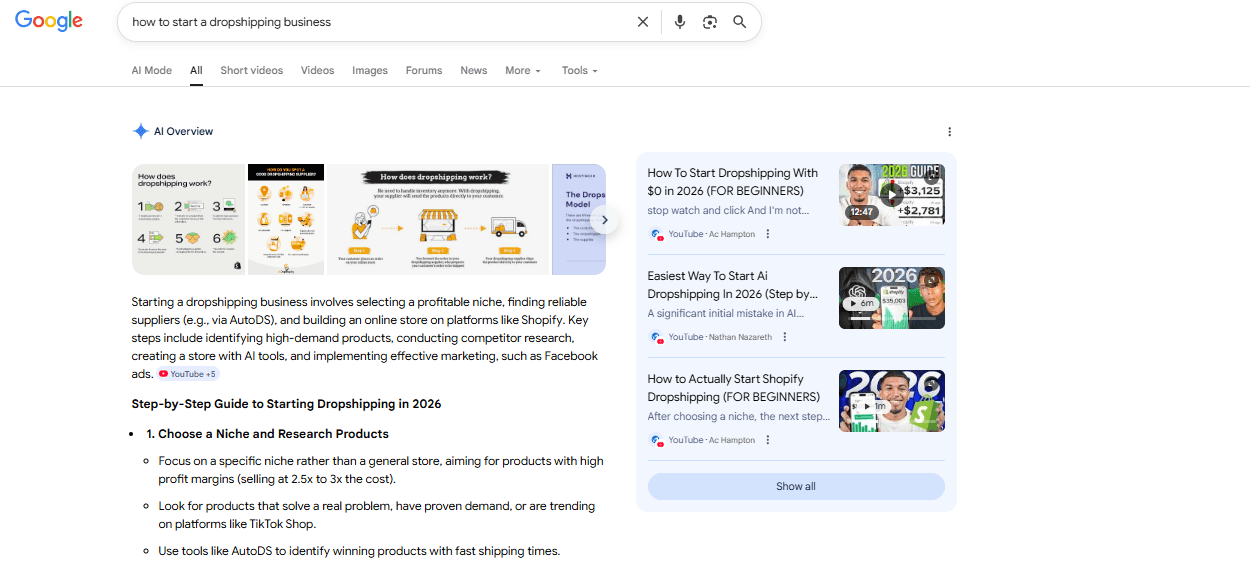
AI search engines cite YouTube because long-form videos contain detailed explanations that can be converted into text through transcripts. These transcripts give AI systems structured information they can extract, analyze, and reference when generating answers.
YouTube also hosts a massive library of educational and instructional content covering millions of topics. As a result, AI platforms often treat YouTube videos as knowledge sources, not just entertainment content.
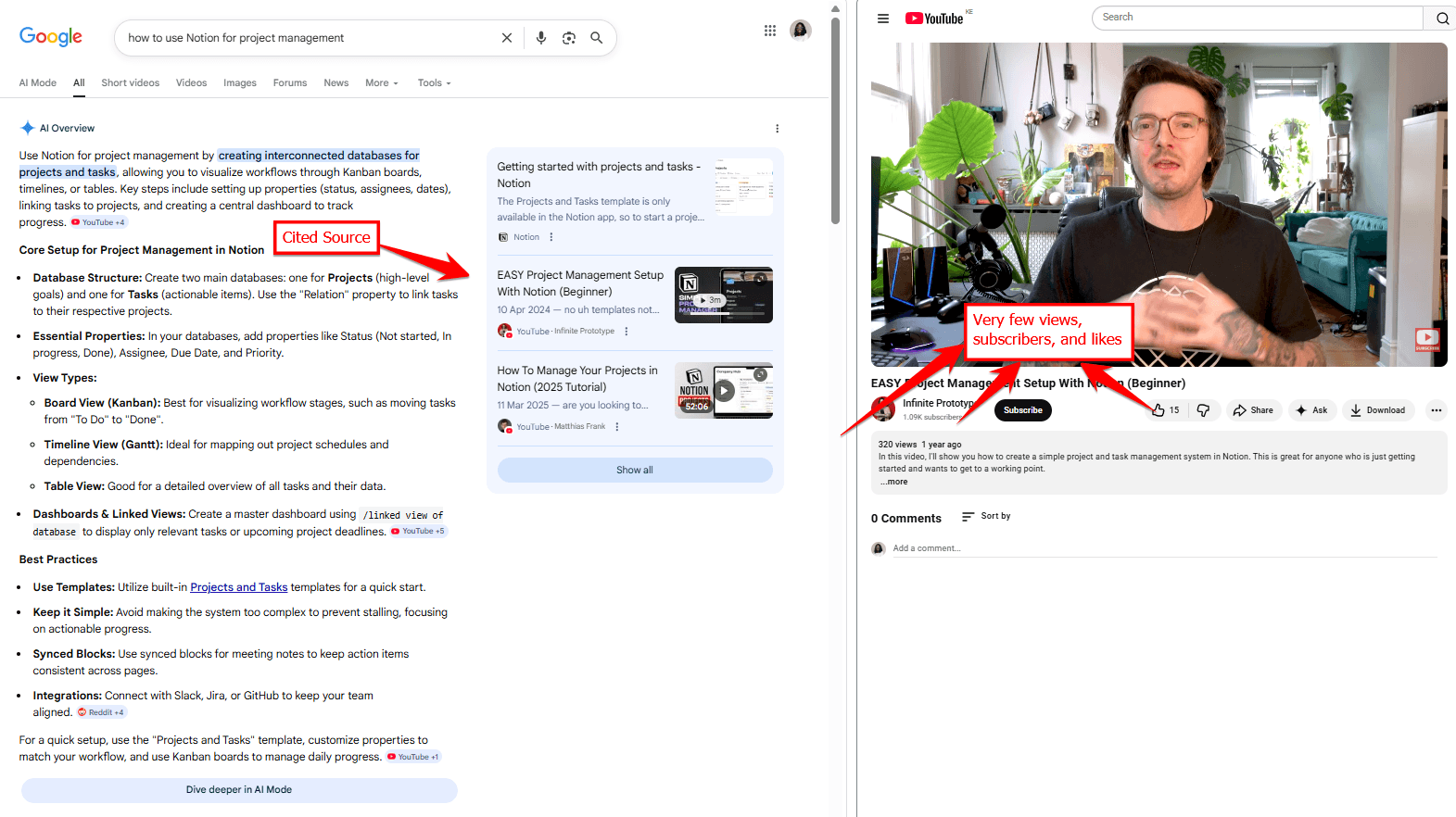
This is evident in the fact that many of the videos cited in AI answers come from content most viewers have never encountered. According to the analysis, 40.83% of AI-cited YouTube videos had fewer than 1,000 views at the time of the study, while 36% had fewer than 15 likes.
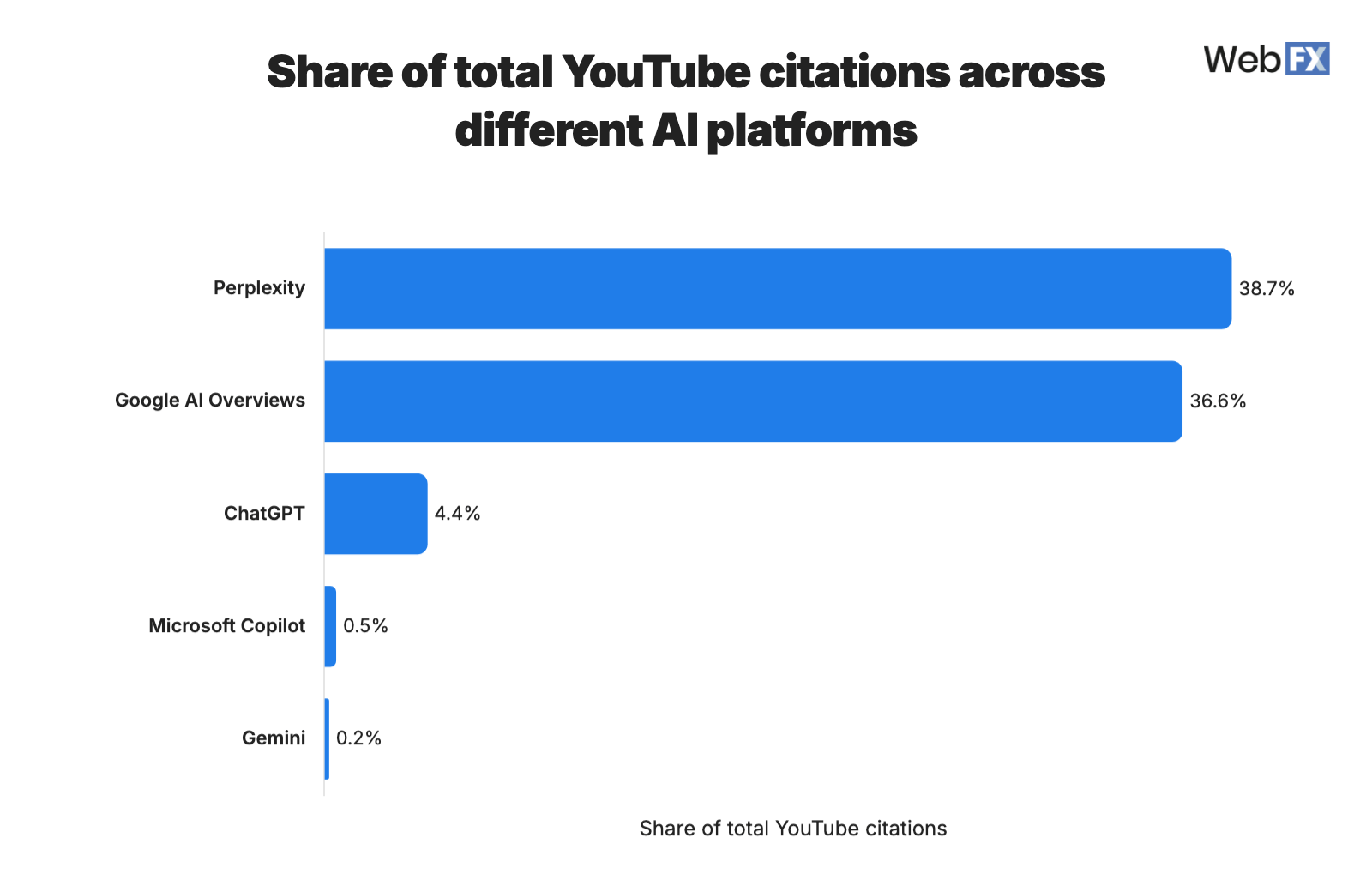
However, YouTube video AI citations vary across platforms, with Perplexity and Google AI Overviews accounting for roughly three-quarters of all observed YouTube citations in AI-generated answers.
Here’s a breakdown of the share of total YouTube citations across different AI platforms:
- Perplexity: 38.7%
- Google AI Overviews: 36.6%
- ChatGPT: 4.4%
- Gemini: 0.2%
- Microsoft Copilot: 0.5%
What makes YouTube content easy for AI systems to extract?
According to the study, the most frequently-cited YouTube videos by AI search engines include:
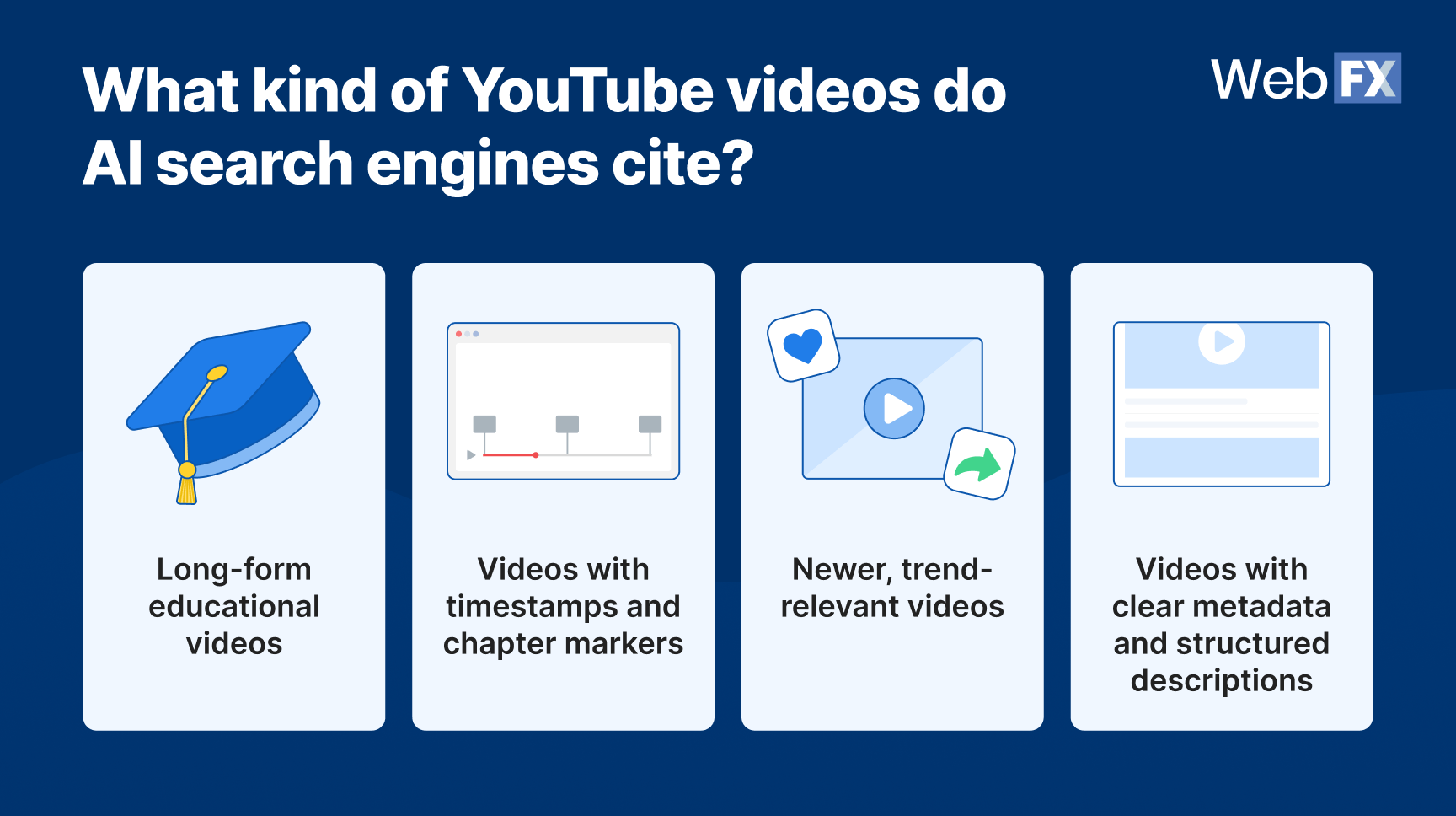
Let’s unpack each type of YouTube video below.
1. Long-form educational videos
AI search engines overwhelmingly cite long-form, reference-style YouTube videos that explain topics in depth, providing AI systems with enough context to summarize.
The dataset reveals that 94% of YouTube citations in AI answers come from long-form videos, not short-form content.
That trend contrasts with how many brands currently approach video marketing. In the past few years, marketers have prioritized short-form formats such as YouTube Shorts, TikTok videos, and Instagram Reels to maximize reach, engagement, and algorithmic distribution across social platforms.
But AI citations are changing that because they’re continually citing long-form videos that behave more like mini knowledge resources, for example:
- Tutorials
- Product explainers
- Detailed walkthroughs
- Documentaries
- Vlogs
- Interviews
- Lectures
2. Videos with timestamps and chapter markers
Video structure also affects how frequently a YouTube video appears in AI-generated answers. Videos that include timestamps or chapter markers allow AI systems to reference specific segments rather than the entire video.
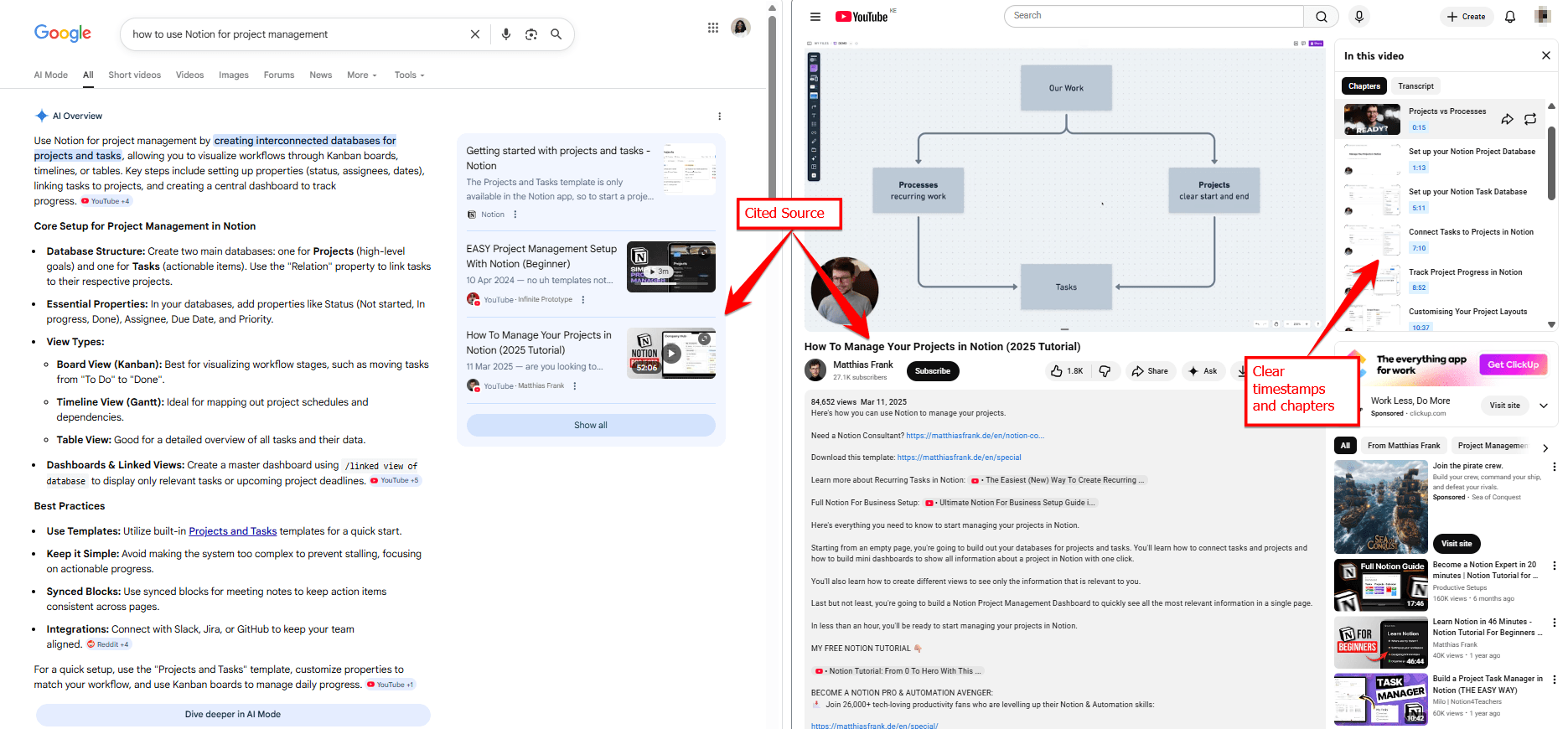
When Google AI Overviews or Google AI Mode cite timestamped videos, they often link directly to individual sections. This structure effectively turns a single video into multiple citation points, expanding the number of opportunities for AI systems to reference it across different queries.
3. Newer, trend-relevant videos
Another factor that appears to influence AI citation patterns is how recently a video was published. The study found a weak positive relationship between recency and citation frequency, indicating that newer videos were cited slightly more often during the observation window.
This pattern is most noticeable in queries where fresh information matters, such as searches for “latest,” “new,” or a specific year, like “2026 fashion trends” or “top Amazon products for 2026.” In these cases, AI systems often favor more recent sources when generating answers.
4. Videos with clear metadata and structured descriptions
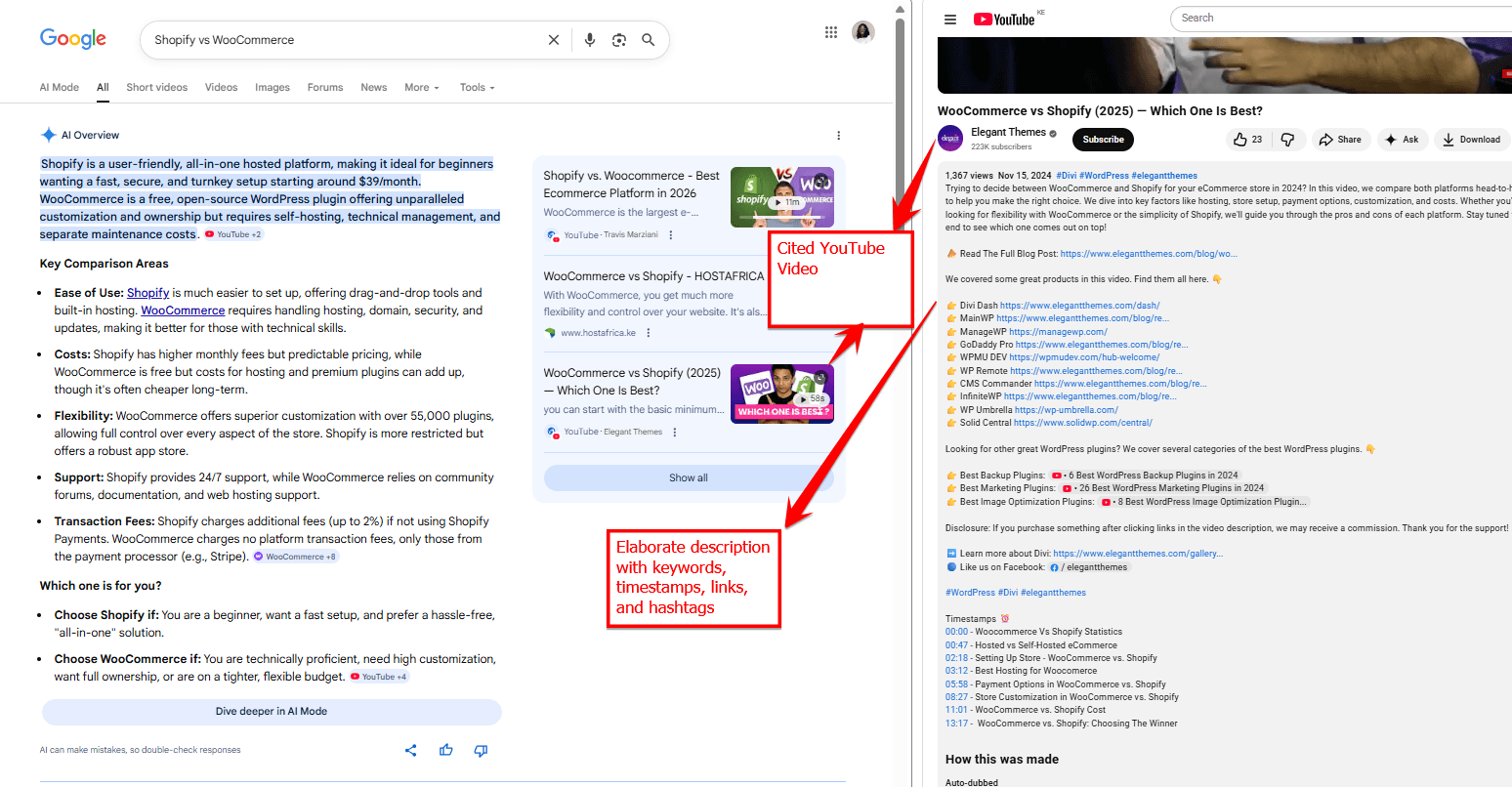
The analysis found that videos with more detailed descriptions were cited slightly more often than those with minimal descriptions. This suggests that clear summaries and structured metadata help AI systems better interpret a video’s topic.
Citable YouTube video descriptions should:
- Explain what the video covers
- Highlights key concepts,
- Include structured elements such as chapter lists, keywords, or relevant terms
- Include hashtags for additional topical signals about the subject of the video
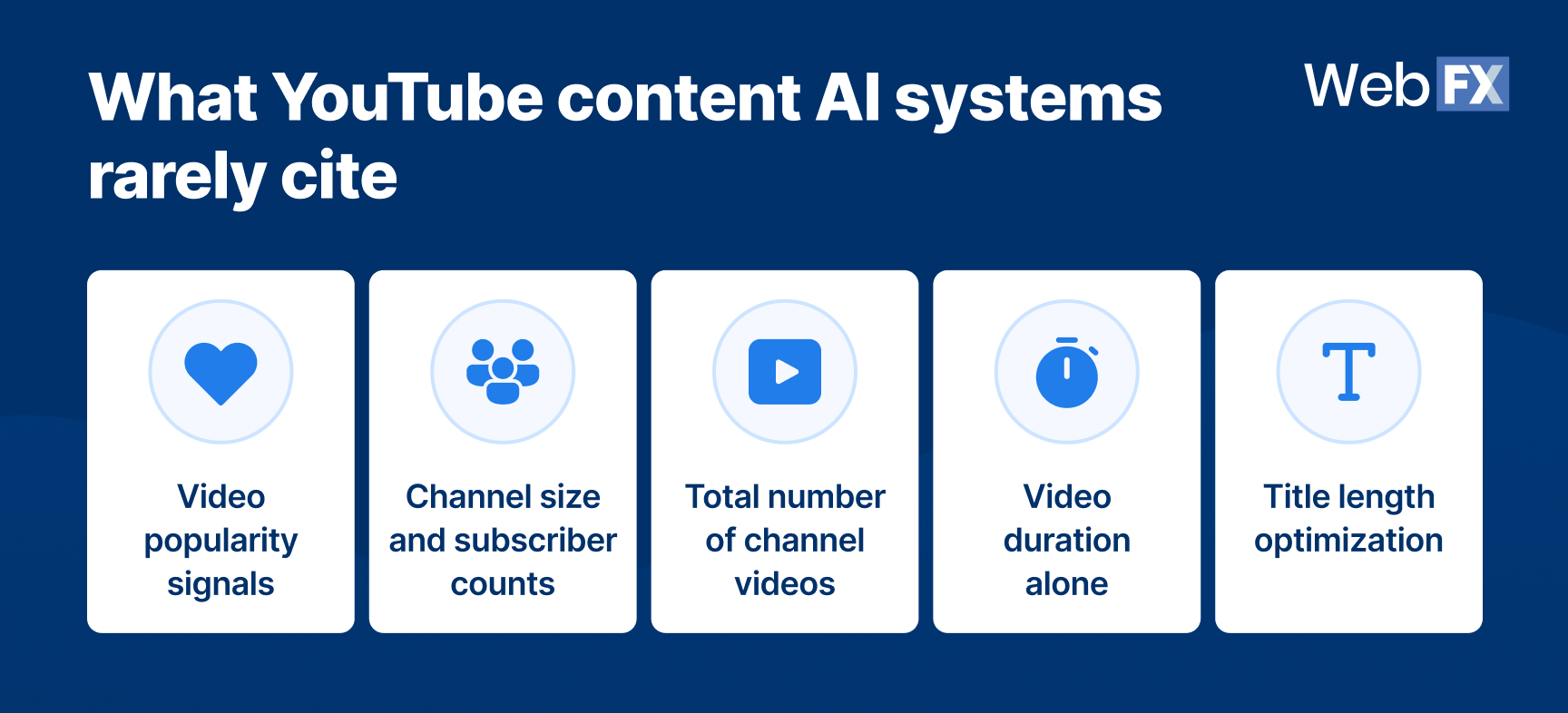
What YouTube content AI systems rarely cite
The analysis found that several common YouTube video optimization features show little measurable influence on whether a video gets referenced in AI-generated answers. Some of these include:
- Video popularity signals: Metrics such as views and likes have little effect on how often a video is cited by AI platforms.
- Channel size and subscriber counts: Larger audiences did not consistently translate into higher citation frequency.
- Total number of channel videos: While a larger library increases the number of possible citation candidates, it does not directly increase the likelihood that any single video is cited.
- Video duration alone: Simply making longer videos does not guarantee citations. The structure, relevance, and clarity of the explanations matter more than length by itself.
- Title length optimization: The dataset found no meaningful relationship between title or description length and citation frequency.
How can you optimize YouTube videos for AI citations?
If AI search engines increasingly treat YouTube videos as reference sources, content teams may need to rethink how they structure video content. The patterns identified in the study suggest that videos most likely to appear in AI-generated answers share several characteristics:
1. Focus on long-form explainer content
AI systems most frequently cite videos that fully explain a topic rather than briefly introduce it. For many topics, these are videos in the 5–20 minute range that can be broken down into digestible chunks.
Long-form videos also tend to produce clearer transcripts because they include structured narration and complete explanations. This makes it easier for AI systems to interpret the content and identify specific segments that answer a user’s query.
The best transcripts for YouTube AI citations include:
- Clear spoken explanations, not just visuals or background narration
- Structured sections or chapters that organize the topic logically
- Natural use of keywords within the narration
- Complete explanations of a question or process
2. Structure videos with chapters and timestamps
Videos that include timestamps or chapter markers are more likely to be referenced and cited by AI search engines. AI systems interpret timestamps, especially ones labeled in user-friendly language as subheadings, making your videos more extractable.
In fact, 78% of timestamped videos show a higher likelihood of being cited again. Better yet, structured video content also allows for more YouTube AI citation opportunities across different questions, particularly within Google’s AI search surfaces.
3. Treat descriptions as structured metadata
Video descriptions often serve as metadata that help AI systems understand what a video covers. Descriptions that clearly summarize the topic, list key concepts, and include relevant terms make it easier for AI models to understand a video’s content.
Chapter lists, keywords, and supporting links can further clarify the subject matter for AI systems.
4. Keep content current when topics evolve
Recency can also affect YouTube AI citation visibility, particularly for queries where users expect up-to-date information. For industries that change quickly, such as AI tools, software updates, marketing tactics, or product comparisons, regularly updating or publishing new videos can help maintain relevance within AI search ecosystems.
Find out if AI search engines are citing your content
AI search engines are increasingly citing YouTube videos as sources when generating answers. For you, that means YouTube is becoming more than a social channel. It is evolving into a visibility channel inside AI-generated search results.
The real challenge is tracking where your brand appears across AI search systems and identifying the opportunities you may be missing.
That is where the OmniSEO® platform can help. OmniSEO® allows you to monitor how your brand appears across AI search platforms such as ChatGPT, Google AI Overviews, Perplexity, and other generative engines. You can track AI citations, measure visibility across platforms, and identify the content opportunities that increase your chances of appearing in AI-generated answers.
Ready to see how your brand shows up in AI search? Start tracking with OmniSEO® today!
-
 Lornah Ngugi is a seasoned digital marketing writer with 6+ years of experience translating complex marketing strategies into engaging, results-driven content. She holds a B.S. in Business Information Technology and is certified in HubSpot Academy, Google Analytics, LinkedIn Marketing, and Google Digital Academy. Lornah regularly contributes to the WebFX blog and SEO.com, where she’s authored hundreds of marketing guides that help readers turn their goals into measurable results through practical, data-informed insights. When she’s not writing, you’ll find her enjoying a quiet walk in the park, sipping black coffee, or finding creative inspiration in a good chocolate bar.
 -

WebFX is a full-service digital marketing agency delivering revenue-driving strategies across online advertising, SEO and AI search optimization, and digital marketing. Backed by 1,100+ client reviews, a 4.9-star rating on Clutch, and proprietary revenue-tracking technology, our team helps businesses grow visibility and revenue across platforms, from Google to ChatGPT to LinkedIn. Discover how our expert team and revenue-accelerating tech can drive results for you. Learn more
Try our free Marketing Calculator
Craft a tailored online marketing strategy! Utilize our free Internet marketing calculator for a custom plan based on your location, reach, timeframe, and budget.
Plan Your Marketing Budget
Table of Contents
- Why do AI search engines cite YouTube content more often?
- What kind of YouTube videos do AI search engines cite?
- 1. Long-form educational videos
- 2. Videos with timestamps and chapter markers
- 3. Newer, trend-relevant videos
- 4. Videos with clear metadata and structured descriptions
- What YouTube content AI systems rarely cite
- How to optimize YouTube content for AI extraction
- 1. Focus on long-form explainer content
- 2. Structure videos with chapters and timestamps
- 3. Treat descriptions as structured metadata
- 4. Keep content current when topics evolve
- Find out if AI search engines are citing your content
Share this article


See AI Marketing in Action
Explore how WebFX helped a regional brand get discovered in AI search experiences — proving what’s possible with today’s AI-driven marketing!
Try our free Marketing Calculator
Craft a tailored online marketing strategy! Utilize our free Internet marketing calculator for a custom plan based on your location, reach, timeframe, and budget.
Plan Your Marketing Budget
What to read next