


Contents
- Why comparing marketing agency performance across brands is difficult
- Evaluate business outcomes and efficiency before channel metrics
- Standardize how you measure performance across brands
- Separate agency performance from business constraints
- Evaluate growth, budget allocation, and cross-channel performance
- Evaluate the agency's execution, insight, and reporting
- Build a multi-brand marketing agency performance scorecard
- How WebFX helps multi-brand companies evaluate performance
- FAQs about evaluating marketing agency performance across brands

TL;DR: How to evaluate marketing agency performance
- Evaluate marketing agency performance on five dimensions: Outcomes, efficiency, growth, execution, and insight, rather than CPL or ROAS in isolation.
- Standardize what you measure across brands, but customize what good performance looks like for each one.
- Poor marketing results don’t always mean poor agency performance. Separate what the agency controls from what the business controls before judging either.
- Score each brand separately before rolling up agency performance, so one strong brand doesn’t hide a weak one.
To evaluate marketing agency performance across multiple brands, use five dimensions: Outcomes, efficiency, growth, execution, and insight.
Apply the same framework to every brand, but set brand-specific targets based on each company’s market, maturity, budget, and customer economics, then judge the agency on whether it’s finding opportunities, prioritizing resources, and improving results over time, beyond hitting a single number.
Comparing marketing performance across brands fairly means tracking the right marketing agency performance metrics at both the business level and the channel level.
- Outcomes. Is marketing creating qualified customers and revenue?
- Efficiency. How efficiently is each brand acquiring those customers?
- Growth. Is the agency finding and capturing incremental opportunity?
- Execution. Is the agency delivering effectively and reliably?
- Insight. Is the agency helping leadership make better decisions?
The real question goes beyond whether the agency hit its KPIs, toward whether it’s creating measurable business value and helping the portfolio make better growth decisions.
The rest breaks this down brand by brand, then builds it into a scorecard. Jump to the section you need:
- Why comparing marketing agency performance across brands is difficult
- Evaluate business outcomes and efficiency before channel metrics
- Standardize how you measure performance across brands
- Separate agency performance from business constraints
- Evaluate growth, budget allocation, and cross-channel performance
- Evaluate the agency’s execution, insight, and reporting
- Build a multi-brand marketing agency performance scorecard
- How WebFX helps multi-brand companies evaluate performance
- FAQs about evaluating marketing agency performance across brands
Your Revenue Growth Starts Here
Tell us about your business, and we’ll create a custom plan to grow your traffic, leads, and predictable revenue.
Why comparing marketing agency performance across brands is difficult
- Brands have different goals and business models
- Brands have different budgets, markets, and maturity levels
- Channel metrics don’t tell the whole story
Brands have different goals and business models
Brands in the same portfolio rarely have the same job. One might exist to defend market share, another to expand into new regions, and a third to generate steady cash ahead of a sale. Judging each of them against the same growth target makes the agency look strong or weak depending on which brand you check.
Business models add another layer. A brand with a 90-day sales cycle and a brand with same-day online checkout will produce very different lead volumes and costs per customer, even with equally strong marketing.
Brands have different budgets, markets, and maturity levels
Picture three brands under the same portfolio. Brand A runs in a mature market with strong awareness, a $2M budget, and high customer value. Brand B was just acquired: Low awareness, a $500K budget, and a large untapped market.
Brand C generates strong lead volume but at lower average customer value in a highly competitive market.
Channel metrics don’t tell the whole story
Comparing CPL, ROAS, or lead volume across Brands A, B, and C without context can make one brand or agency look stronger than another for reasons that have nothing to do with execution quality. Comparable metrics don’t require identical targets. Standardize what you measure, and customize what good performance looks like for each brand.
Evaluate business outcomes and efficiency before channel metrics
- Start with revenue, customers, and qualified opportunities
- Use channel metrics to diagnose performance
- Connect marketing activity to business results
- Measure how efficiently each brand acquires customers
Start with revenue, customers, and qualified opportunities
Leadership should evaluate the agency on qualified opportunities, customers, CAC, marketing-sourced revenue, ROI, and growth, using channel metrics to explain why those numbers moved rather than as the evaluation itself. Channel metrics diagnose performance. Business metrics evaluate it.
Use channel metrics to diagnose performance
Agency reporting often centers on impressions, rankings, clicks, traffic, CTR, and CPC. Those numbers are useful for diagnosing performance. They’re not sufficient for evaluating it.
Lead volume alone can mislead in the same way. Say Brand A generates 1,000 leads that convert to 100 qualified leads and 20 customers, while Brand B generates 500 leads that convert to 250 qualified leads and 75 customers. Judged on raw lead volume, Brand A wins.
Judged on customers actually acquired, Brand B is creating substantially more value. An agency shouldn’t be rewarded for generating leads sales doesn’t want.
Connect marketing activity to business results
Marketing activity only counts as a result once it shows up in the business. Trace each brand’s work from channel to lead, qualified opportunity, customer, and revenue, using CRM data wherever possible.
If the agency can only show the first step of that path, you’re evaluating activity rather than results. Ask for the full path for every brand, using the same definitions in each one.
Measure how efficiently each brand acquires customers
Outcomes show what marketing produced. Efficiency shows what it cost. Track CAC, cost per qualified lead (CPQL), and ROI for every brand, using the same definitions and CRM-sourced customer counts.
Judge each number against the brand’s own economics. A $4,000 CAC can be strong for a brand with high customer value and a problem for one with thin margins. Use CPQL instead of cost per lead so cheap, low-quality leads don’t flatter the results.
Then check efficiency at the margin. The easiest demand gets captured first, so a brand that’s efficient at $50K a month may not be at $100K. Ask whether the next dollar still earns an attractive return.
Standardize how you measure performance across brands
- Define KPIs consistently
- Establish brand-specific benchmarks
- Compare performance against baseline and target
Define KPIs consistently
Standardizing what you measure starts with a shared measurement dictionary. Define lead, qualified lead, opportunity, customer, and marketing-sourced revenue the same way across every brand, sourced from the CRM wherever possible.
If Brand A counts every phone call as a lead while Brand B only counts qualified opportunities, Brand A will always look like it has a dramatically lower cost per lead, even if Brand B is generating better customers.
If the brands define success differently, there’s no fair way to evaluate the agency managing them.
Establish brand-specific benchmarks
Normalizing for brand differences matters just as much. Brands differ in market size, customer value, competition, budget, sales cycle, and business maturity, so don’t ask which brand has the lowest CAC without understanding why.
Compare performance against baseline and target
Compare each brand against its own baseline, against its agreed target, against its available market opportunity, and against whether incremental spend is still producing attractive returns. Compare brands using the same framework, rather than necessarily the same benchmark.
Separate agency performance from business constraints
Before penalizing an agency for a weak result, separate what it actually controls from what the business controls.
- Identify factors the agency controls
- Identify factors the business controls
- Account for shared responsibilities
- Diagnose the cause before judging the agency
Identify factors the agency controls
The agency owns the work it plans, builds, and manages. That covers campaign strategy and targeting, creative and SEO execution, landing pages and testing, and ongoing optimization.
If targeting is off, landing pages never get tested, or content ignores what customers actually search for, the agency is accountable.
| Agency-controlled | Business-controlled |
| Campaign strategy and targeting | Pricing |
| Creative and SEO execution | Sales response and close rate |
| Landing pages and testing | Capacity and CRM adoption |
| Optimization | Product or service quality |
Identify factors the business controls
Poor marketing outcomes don’t always mean poor agency performance. A brand might have slow lead response times, limited sales capacity, weak close rates, inventory constraints, or poor CRM adoption, none of which the agency controls.
Account for shared responsibilities
Website conversion, lead quality, and budget allocation usually sit somewhere in between, shared by both sides. Good agency evaluation separates accountability from blame.
Diagnose the cause before judging the agency
If an agency generates 300 qualified opportunities but sales only contacts 60% of them, or a branch can’t schedule additional customers, that’s a business constraint rather than a marketing failure. The agency should still help surface it. Whether the agency identifies when a constraint has moved beyond marketing is itself a sign of a stronger strategic partner.
Evaluate growth, budget allocation, and cross-channel performance
- Evaluate opportunities for growth
- Evaluate budget allocation
- Evaluate channels as an interconnected system
- Look for cross-brand opportunities
Opportunities for growth
Maintaining a good ROAS is valuable. Finding the next source of profitable growth is more strategic. A strong agency should be able to answer where untapped demand exists, which brands are underinvested, which markets are saturated, and which channels still have headroom, proactively identifying scale, fix, test, maintain, and reduce opportunities rather than waiting to be asked.
Budget allocation
That shows up most clearly in how the agency allocates budget. A sophisticated agency doesn’t recommend splitting budget evenly across brands or rolling last year’s spend forward unchanged. It weighs opportunity, performance, capacity, and strategic priority for each brand, the same four factors that should drive multi-location budget allocation generally, and can answer where the next marketing dollar should go, beyond how much more the portfolio could spend.
Channels as an interconnected system
It also shows up in whether the agency treats channels as a connected system instead of isolated wins. A brand’s customer journey might run through SEO, retargeting, email, and paid search together, or through AI search, the website, and paid brand search. Evaluating each channel independently can produce misleading conclusions: Paid search might just be capturing demand SEO already created.
The portfolio should optimize for total customer acquisition, which channel-level victories don’t automatically add up to.
Look for cross-brand opportunities
A multi-brand portfolio has an advantage standalone companies don’t have: Every brand works as a test environment for the others. A strong agency should be using it.
Ask where the portfolio can reuse what’s already working. A landing page layout that lifts conversions for Brand A can be tested on Brand B. A keyword theme that drives qualified leads in one market may be untapped in a sister brand’s market.
Check for overlap too. If two brands bid on the same paid search terms, they can compete in the same auctions and inflate each other’s costs, and the agency managing both should catch it.
Spotting these opportunities is one half of the job. The next section covers whether the learnings actually transfer between brands.
Evaluate the agency’s execution, insight, and reporting
- Evaluate execution quality
- Evaluate reporting quality
- Evaluate strategic insight
- Evaluate cross-brand learning
Execution quality
Execution asks whether the agency does what it said it would do, on time, at the quality each brand needs. It’s the easiest dimension to measure and the easiest to overweight.
Check four things for each brand:
- Delivery. Are planned campaigns, content, and site updates shipping on schedule
- Quality. Does the work hold up under review, with clean tracking, accurate targeting, and on-brand creative?
- Speed. How fast does the agency act on a problem or opportunity, like a tracking error or a competitor’s new offer?
- Accuracy. Do the agency’s reports and tracking match what the CRM shows?
Ask for proof. A delivery log shows whether work shipped on time, recent landing pages and ads show quality, and the fix time on the last tracking issue shows speed.
Score execution against the agency’s agreed scope, not results. A missed deadline is an execution problem. A slow quarter with everything delivered on time usually isn’t.
Execution carries a 15% illustrative weight in the scorecard later in this guide. Flawless delivery of the wrong strategy still produces weak results, so score execution alongside the other four dimensions, not in place of them.
Reporting quality
Reporting should let leadership move from portfolio down to brand, location, channel, and campaign, and back up again, with consistent KPI definitions at every level. A 60-page monthly report that documents everything that happened but recommends nothing is a red flag on its own. Reporting should produce decisions, beyond paperwork.
Strategic insight
The difference between an average agency and a strong one usually shows up in interpretation, more than delivery. Compare “organic traffic increased 12%” against “organic traffic increased 12%, but qualified lead growth was flat because the gains came from informational traffic, so we’re shifting next quarter’s resources toward three service categories with stronger conversion potential.”
The second version is interpreting, prioritizing, and recommending. Ask whether the agency explains why performance changed, challenges its own assumptions, and tells you where not to spend, as readily as where to spend more.
Forecasting and business understanding count here too. Check whether the agency’s projections for each brand held up against actual results, and whether it can explain how each brand makes money, who buys, and what happens to a lead after it reaches sales.
Cross-brand learning
One of the real advantages of a centralized agency is knowledge transfer, and it’s worth checking whether that’s actually happening. If Brand A discovers that value-based bidding produces stronger qualified leads, does that insight reach Brand B, Brand C, or a newly acquired Brand D, or does every account team rediscover it independently?
Brand-level autonomy shouldn’t mean brand-level amnesia. The organization should compound what it learns, instead of relearning the same lessons brand by brand.
Build a multi-brand marketing agency performance scorecard
- Choose the performance categories
- Score each brand consistently
- Compare scores across brands
- Look beyond the overall score
Choose the performance categories
Score every brand against the same five dimensions, weighted to reflect what matters most to the portfolio’s value-creation plan. This scorecard is what turns marketing performance across brands from a gut feeling into something leadership can actually compare.
Each category traces back to an earlier section: Outcomes and efficiency to the business outcomes section, growth to the growth and budget allocation section, and execution and insight to the execution, insight, and reporting section.
| Category | Example metrics | Illustrative weight |
| Outcomes | Customers, revenue, qualified opportunities | 30% |
| Efficiency | CAC, CPQL, ROI | 20% |
| Growth | Incremental opportunity, testing, expansion | 20% |
| Execution | Delivery, quality, speed, accuracy | 15% |
| Insight | Recommendations, forecasting, business understanding | 15% |
These weights are a starting point rather than a prescription. Adjust them to match the portfolio’s actual growth thesis before treating any single score as final.
Score each brand consistently
Score each brand separately before rolling anything up.
| Brand | Outcomes | Efficiency | Growth | Execution | Insight | Context |
| A (mature) | 5 | 4 | 4 | 5 | 5 | Defend and optimize |
| B (new acquisition) | 3 | 3 | 5 | 5 | 4 | Invest and grow |
| C (high market share) | 4 | 5 | 3 | 4 | 4 | Protect current position |
Compare scores across brands
Once every brand has a score, compare them side by side with each brand’s context next to its number. A 4 for a mature brand and a 4 for a new acquisition don’t mean the same thing.
Look beyond the overall score
Adding context to each score keeps leadership from mistaking a low score for weak execution when it’s really a hard starting point. Don’t let one strong brand hide a weak one inside a single portfolio-wide number. Roll scores up for leadership, but keep the ability to drill down.
That drill-down matters especially for new acquisitions. See the FAQ on newly acquired brands for how to set expectations in the first six months.
How WebFX helps multi-brand companies evaluate performance
WebFX builds the standardized measurement layer this whole framework depends on: Consistent definitions for leads, qualified opportunities, customers, revenue, CAC, and ROI across every brand in a portfolio, rolling up from company to brand to location to channel while preserving the ability to drill into any one of them.
RevenueCloudFX connects marketing activity to lead, customer, and revenue data where client systems support it, which is the specific gap that makes cross-brand comparison unreliable in the first place. That broader model has supported multi-brand and multi-location organizations.
Great Northern, a client managing multiple business units, saw a 109% increase in organic traffic and a 103% increase in organic form submissions. KOA, a 500-plus location franchise network, saw a 260% increase in organic revenue.
The value goes beyond reporting on multiple brands. It’s helping leadership understand which investments are actually creating value, why performance differs across brands, and what should happen next.
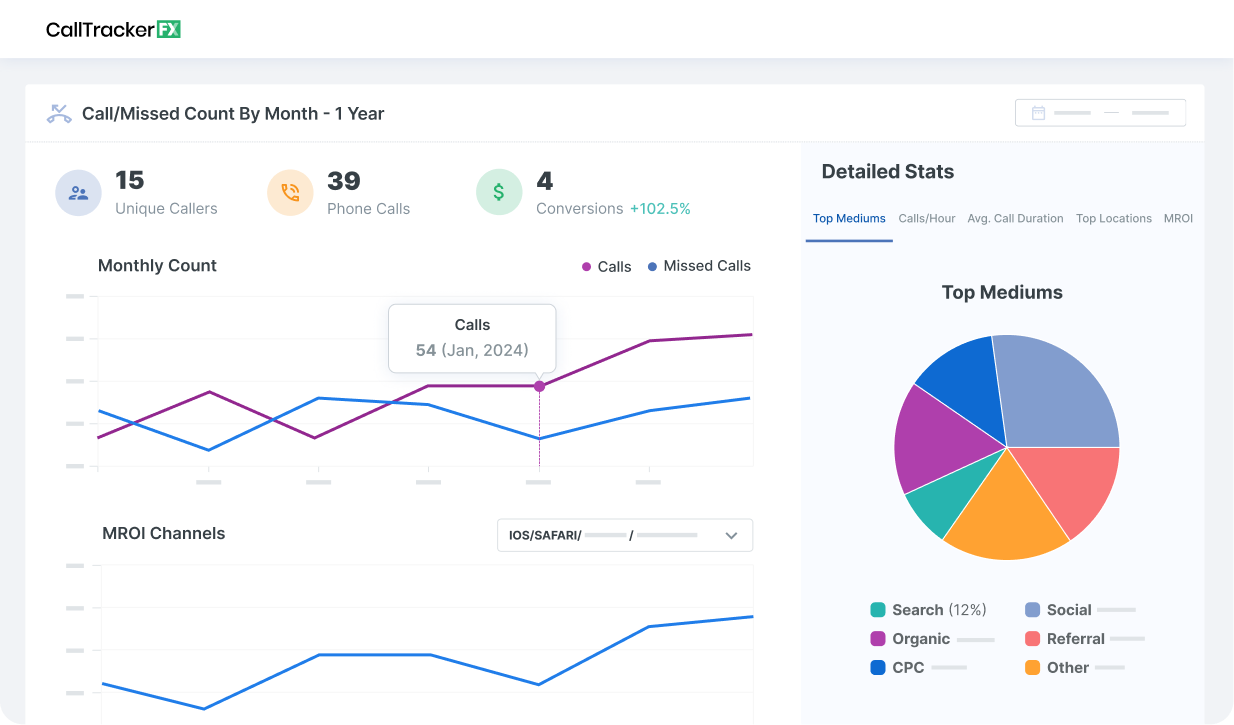
Measuring the metrics that affect your bottom line.
Are you interested in custom reporting that is specific to your unique business needs? Powered by RevenueCloudFX, WebFX creates custom reports based on the metrics that matter most to your company.
- Leads
- Transactions
- Calls
- Revenue

FAQs about evaluating marketing agency performance across brands
What KPIs should you use to evaluate a marketing agency?
The right marketing agency performance metrics prioritize business-level outcomes: Qualified opportunities, customers, CAC, revenue, and ROI. Use channel metrics like rankings, traffic, CTR, and CPL to help explain why those business numbers changed, rather than as the evaluation itself.
Should every brand use the same marketing KPIs?
Use the same core measurement definitions everywhere, but don’t force identical performance targets. Brands differ in customer value, market maturity, competition, and budget. Standardize the framework, and customize the benchmark.
How do you verify that an agency’s reported numbers are accurate?
Start by verifying attribution itself. Confirm that in-platform metrics (Google Ads clicks, Meta conversions) actually match what shows up in the CRM. An agency resistant to that kind of verification, or to independent call tracking, is worth a second look regardless of how good its reported numbers are.
What is a good marketing agency scorecard?
A useful scorecard combines quantitative business metrics with qualitative strategic performance across outcomes, efficiency, growth, execution, and insight, weighted to match the portfolio’s actual growth priorities rather than a generic template.
How do you compare marketing agencies across multiple brands?
Score each agency against the same five dimensions (outcomes, efficiency, growth, execution, insight), accounting for differences in starting point, market opportunity, and budget. Comparing raw ROAS or CPL between two brands with different starting conditions isn’t a fair comparison.
Use the same scorecard to compare agencies when more than one partner manages brands in the portfolio. Score each agency on the brands it runs, using the same categories and weights, so the comparison rests on evidence rather than on who presents best.
How should you evaluate agency performance on a newly acquired brand?
A brand that was just acquired may start with broken attribution, low visibility, and weak historical data, so its first six months should be evaluated on whether the agency established a baseline, repaired tracking, connected data, and launched initial tests, ahead of the CAC and ROI it hasn’t had time to earn yet.
The same protect-first sequencing that governs the first 90 days after an acquisition applies here: Performance expectations should mature as the brand’s marketing infrastructure matures.
How often should you evaluate a marketing agency?
Review operational performance weekly or monthly. Save strategic evaluation, including the full scorecard, for quarterly reviews, and revisit the operating model itself once a year.
Match the review cadence to the decision.
| Cadence | What it covers |
| Weekly or biweekly | Campaign changes and immediate issues |
| Monthly | Leads, customers, revenue, and brand trends |
| Quarterly | Budget allocation, growth opportunities, and the scorecard itself |
| Annually | The operating model: Scope, structure, technology, and commercial terms |
Don’t use the same meeting to manage yesterday’s PPC bid and next year’s portfolio strategy.
When should you replace a marketing agency?
Consider it when performance, transparency, strategic insight, or scalability issues persist over time, but first confirm the problem actually sits with marketing rather than with sales, operations, or another business constraint the agency doesn’t control.
Watch for the same handful of red flags across a multi-brand relationship:
- Every brand gets the same strategy regardless of its market.
- Reporting stops at leads, with no visibility into revenue.
- The agency never recommends reducing spend anywhere.
- Brands use different definitions of success.
- One strong brand’s numbers mask weak results elsewhere.
- There’s no cross-brand learning.
- Performance problems always get blamed on the client rather than examined honestly.
None of those red flags should lead straight to firing the agency. A more useful decision has five outcomes:
- Keep: A partner that’s performing well and fits the future strategy.
- Expand: A partner that could take on more.
- Supplement: Strong in some areas, but missing specific capabilities.
- Consolidate: Moving additional brands onto the partner would create real reporting and coordination benefits.
- Replace: Performance, transparency, or scalability genuinely doesn’t hold up.
If the portfolio is already juggling multiple underperforming agencies and shopping for a replacement, comparing agencies against the same criteria side by side is the next step, using the same PE-specific evaluation lens covered in how to choose a marketing agency for PE-backed companies.
Agency evaluation should lead to an evidence-based decision about scope, made deliberately rather than defaulted into.
Should a multi-brand company use one agency or several?
It depends on whether the benefits of shared reporting, attribution, and cross-brand learning outweigh what specialized, brand-specific agencies could offer. The full tradeoffs between in-house, single-agency, and multi-agency structures go deeper than performance evaluation alone, but the right structure here is whichever one creates strong performance without unnecessary fragmentation.
WebFX has thousands of reviews praising our transparency, communication, and results.
WebFX Agency Rating

4.9/5
based on over 550 third-party reviews

What strong multi-brand agency performance actually looks like
It’s an agency helping each brand create more business value, and helping the portfolio learn and improve as a whole. A high ROAS on one brand and silence on the other four is a blind spot leadership hasn’t found yet, more than a performance win worth celebrating.
Score every brand on the same five dimensions, roll the results up for a portfolio view, and keep the ability to drill back down before any budget or agency decision gets made. A marketing agency scorecard is only useful if it holds up brand by brand, beyond just on average.
Every brand in your portfolio deserves a fair evaluation built around real revenue data, rather than a KPI report that reads well on average and hides the truth brand by brand. Talk to a strategist about building that scorecard around your specific brands, or call 888-601-5359 to start the conversation.
-
 Albert Dandy Velasquez blends SEO strategy with compelling storytelling to help businesses boost their visibility and revenue online. With a B.A. in English and certifications from HubSpot, Semrush, and Google Analytics, he has written and optimized hundreds of articles on organic SEO, content strategy, and user experience. He regularly contributes to the WebFX blog and SEO.com, creating content that helps readers turn marketing goals into measurable results. When he’s off the clock, he’s usually exploring new neighborhoods on two wheels, filming travel content, or chasing golden hour with a coffee in hand. View full profile
 -

WebFX is a full-service digital marketing agency delivering revenue-driving strategies across online advertising, SEO and AI search optimization, and digital marketing. Backed by 1,100+ client reviews, a 4.9-star rating on Clutch, and proprietary revenue-tracking technology, our team helps businesses grow visibility and revenue across platforms, from Google to ChatGPT to LinkedIn. Discover how our expert team and revenue-accelerating tech can drive results for you. Learn more

Try our free Marketing Calculator
Craft a tailored online marketing strategy! Utilize our free Internet marketing calculator for a custom plan based on your location, reach, timeframe, and budget.
Contents
- Why comparing marketing agency performance across brands is difficult
- Evaluate business outcomes and efficiency before channel metrics
- Standardize how you measure performance across brands
- Separate agency performance from business constraints
- Evaluate growth, budget allocation, and cross-channel performance
- Evaluate the agency's execution, insight, and reporting
- Build a multi-brand marketing agency performance scorecard
- How WebFX helps multi-brand companies evaluate performance
- FAQs about evaluating marketing agency performance across brands
Share this article


Proven Marketing Strategies
Try our free Marketing Calculator
Craft a tailored online marketing strategy! Utilize our free Internet marketing calculator for a custom plan based on your location, reach, timeframe, and budget.