


Contents
- Trend watch: The search-social-AI traffic split just got its latest update. Here’s what the data says and what to do about it.
- Tactic talk: Short-form video works as a search saturation strategy now, more than just a social engagement play
- Tool tip: See where your brand shows up across every search surface with OmniSEO®
- FAQs about April 2026 digital marketing trends
- CTRL + V this into your Q2 strategy

Key takeaways
- Search engines hold 88.99% of global market share, but social (10.63%) and AI chatbots (0.38%) are reshaping how buyers discover brands, according to StatCounter’s March 2026 data.
- Short-form video on YouTube Shorts, TikTok, and Instagram/Facebook Reels now functions as a search and AI visibility strategy, with YouTube driving 38.1% of all social media citations in AI-generated answers.
- OmniSEO® tracks brand visibility across traditional search, social search, AI search engines, voice search, and more in one platform.
One of the biggest digital marketing trends in April 2026 centers on a growing split between search, social, and AI discovery. Search engines still drive roughly 89% of the market share worldwide, according to StatCounter’s March 2026 data. But the remaining 11% is where the momentum lives. Social platforms now account for 10.63% of the global market share, while AI chatbots, at 0.38%, remain small but are drawing growing attention as a discovery channel.
What changed this month is scale. March’s data makes the split across search, social, and AI harder to ignore and easier to act on heading into Q2. If your visibility strategy starts and ends with Google rankings, you’re optimizing for the biggest slice of the pie while also ignoring the slices expanding at breakneck speed. April 2026 is the month to fix that.
Here’s what this month’s CTRL + FX covers:
- Trend watch: The search-social-AI traffic split just got its latest update. Here’s what the data says and what to do about it.
- Tactic talk: Short-form video works as a search saturation strategy now, more than just a social engagement play
- Tool tip: See where your brand shows up across every search surface with OmniSEO®
Let’s get going.
Don’t miss our Revenue Weekly emails!
Join 200K smart marketers for the hottest marketing news and insights in your inbox.
Inline Subscription Form
“*” indicates required fields
Trend watch: The search-social-AI traffic split just got its latest update. Here’s what the data says and what to do about it.
StatCounter’s March 2026 data breaks down the market share across three channels: Search engines, social platforms, and AI chatbots. The numbers tell a story that every marketing team should pay attention to this quarter.
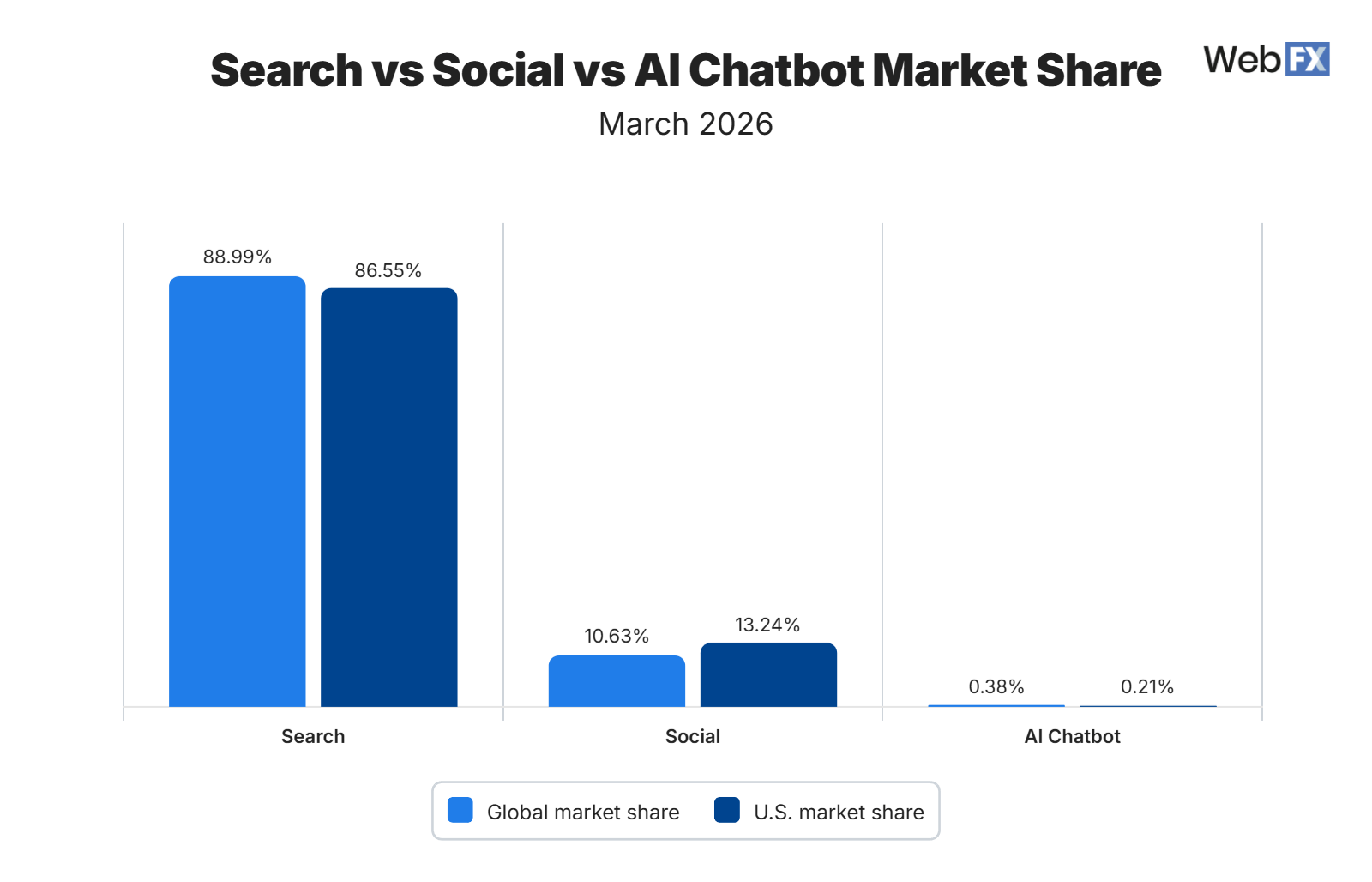
Table view
Search vs social vs AI chatbot market share (Statcounter, March 2026)
| Channel | Global market share | U.S. market share |
| Search | 88.99% | 86.55% |
| Social | 10.63% | 13.24% |
| AI Chatbot | 0.38% | 0.21% |
What this data tells you
Search dominance hasn’t collapsed. Google and other search engines still send nearly nine out of every 10 website visits. That foundation matters, and abandoning your SEO strategy based on AI hype would be a mistake. But the composition of “discovery” keeps shifting in ways that the top-line number masks.
Social platforms now hold more than 10% of market share globally, and over 13% in the United States. That U.S. social share reflects a real change in how Americans find brands, products, and answers. Platforms like TikTok, YouTube, and Instagram now function as search engines for younger demographics.
AI chatbot traffic share looks small at 0.38% worldwide. But context matters. According to our analysis of 2.3 billion site sessions across numerous industries from January 2024 to December 2025, generative AI traffic grew by 796% and converted 1.2x more than organic. A channel growing at that pace has room to expand its share.
In the grand scheme of things, search funds your visibility, social expands your reach, and AI builds your future pipeline. A strategy that only accounts for one of those three channels surrenders ground to competitors who cover all three.
The S.P.L.I.T. framework: 5 moves to capture visibility across all three channels
Use this as your Q2 planning filter. Score your current strategy against each of these five signals, and prioritize the gaps.
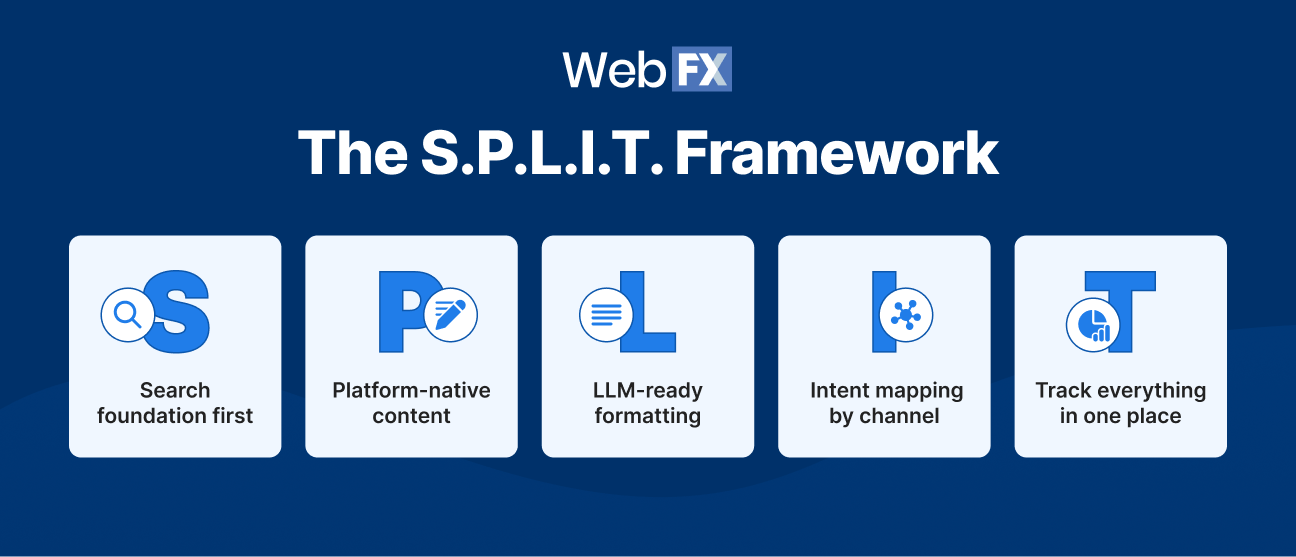
S = Search foundation first
Audit your core search engine optimization (SEO) health before expanding to other channels. Your traditional search presence funds everything else. Run a technical audit, fix crawl issues, and confirm your top 20 pages pull their weight in organic traffic. If your SEO baseline has cracks, social and AI visibility won’t compensate.
P = Platform-native content
Stop repurposing one blog post across every channel and calling it a strategy. Build content native to each surface: Long-form content for search, short-form vertical video for social discovery, and structured Q&A content for AI citation. Each platform rewards different formats, and generic cross-posting gets penalized by algorithms built to detect low-effort content.
L = LLM-ready formatting
Structure your content so AI tools can cite it: Use definitive language (“X is Y” rather than “many people believe X might be Y”); write entity-rich sentences that name specific tools, brands, and data points; use clean H2s that mirror how real people ask questions; and lead with a direct answer in the first sentence under every heading. AI models pull from section openings. If your first sentence is a throat-clearing phrase, you’ve already lost the citation.
I = Intent mapping by channel
Different channels serve different stages of the buyer journey. Search captures high-intent queries from people actively looking for solutions. Social captures passive discovery and mid-funnel consideration. AI captures research-phase questions where buyers compare options before reaching out. Map your content calendar to all three intent stages instead of treating every piece like a top-of-funnel play.
T = Track everything in one place
You can’t optimize what you measure in silos. If your search rankings live in one dashboard, your social metrics in another, and your AI mentions in a spreadsheet (or nowhere), then you’re making decisions with incomplete data. Use a unified visibility platform to monitor search performance, social discovery, and AI citations together.
The S.P.L.I.T. framework gives you the strategic layer. The next two sections give you one specific tactic and one specific tool to put it into practice this quarter.
Tactic talk: Short-form video works as a search saturation strategy now, more than just a social engagement play
Short-form video on YouTube Shorts, TikTok, and Instagram/Facebook Reels now functions as a discovery and search channel, and not just an engagement format. That distinction matters for every digital marketing trend conversation happening in Q2 2026.
All of those platforms have integrated search functionality, e-commerce tools, and AI recommendation engines that make video content indexable and recommendable far beyond organic social reach. When someone types “best CRM for small business” into TikTok’s search bar and finds a 30-second video explaining your product, that’s not social media marketing. That’s search.
Why short-form video affects search and AI visibility
Two shifts made this a priority for 2026:
1. Social platforms function as search engines.
Our generational search behavior research found that Gen Z and Millennials increasingly start product and service searches on TikTok, Instagram, and YouTube rather than Google. The StatCounter data in the Trend Watch section backs this up. Social’s 10–13% market share comes from users treating these platforms as discovery tools, and not for the sole purpose of entertainment.
2. Video content can strengthen AI visibility.
When you publish short-form video on these platforms, you expand your brand’s searchable and citable footprint across ecosystems that increasingly shape AI-generated answers and recommendations. In fact, YouTube now drives 38.1% of all social media citations in AI-generated answers, making it the second-most-cited social platform across major AI search experiences.
Creating video on these platforms today seeds the AI answers your prospects will see tomorrow. That makes short-form video valuable beyond engagement alone. It can support discovery today while strengthening your content footprint across platforms your audience already uses to search.
🎥 Video: How to Create Short-Form Videos – From Planning to Production
How to build an omnichannel video saturation strategy
Here’s a five-step process you can start this quarter:
- Pick your keystone products or services. Start with three to five offerings that have the highest search volume or buyer intent. These deserve saturation across platforms first because they carry the most revenue potential.
- Create platform-native short-form videos (15–30 seconds each). Each video should showcase one product or service clearly. Work with content creators who understand each platform’s algorithm, format norms, and audience behavior. Creator-produced content performs better than polished brand ads in these environments because the algorithms reward authenticity signals.
- Publish across all visual platforms simultaneously. Launch videos on YouTube Shorts, Instagram/Facebook Reels, and TikTok in the same rollout. Use the same core message, but format it natively for each platform’s aspect ratio and audience expectations. Simultaneous publishing maximizes your surface area across every social channel, driving that 10–13% market share.
- Optimize video metadata for search. Titles, descriptions, tags, and captions should include target keywords. This makes your content findable through platform search, not just the feed algorithm. Without keyword-optimized metadata, your videos exist in the feed but disappear from search results within the platform.
- Measure discovery, not just engagement. Track impressions from search within each platform. YouTube Studio and TikTok Analytics both surface search-driven views separately from feed-driven views. This tells you whether your video functions as a search asset or just a social one. If search-driven views grow month over month, your saturation strategy works.
Want to put this omnichannel strategy to work without building the production pipeline from scratch? Explore our high-impact social media services to get short-form video assets built for social discovery and AI visibility.
Tool tip: See where your brand shows up across every search surface with OmniSEO®
OmniSEO® is WebFX’s holistic approach to search optimization that extends beyond traditional search engines to track and improve your visibility across every platform where your audience searches. That includes traditional search engines, social search, AI search engines, voice search, and more.
You read about trends in digital marketing spreading across multiple channels in this month’s issue. OmniSEO® gives you the measurement layer to act on that reality.
🎥 Video: What is OmniSEO®? A Modern SEO Strategy for the Age of AI and Social Search
What does OmniSEO® track?
OmniSEO® provides visibility tracking, competitor intelligence, and actionable insights across the search environments where buyers increasingly discover brands today. Here’s what the platform monitors:
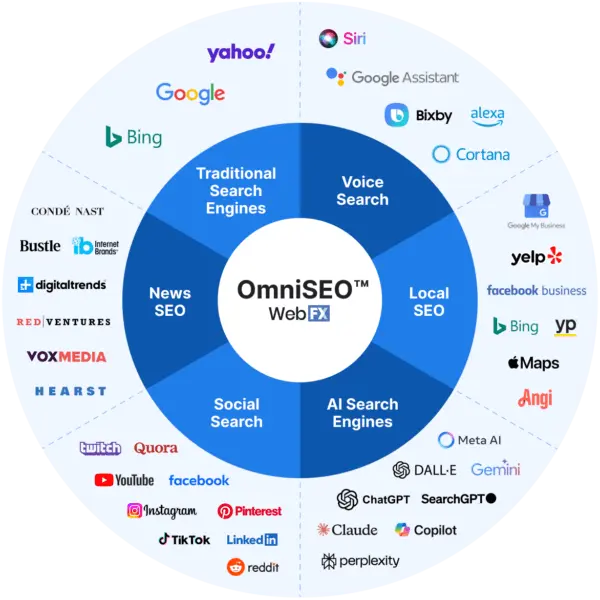
- Multi-engine visibility tracking: Real-time visibility scores across traditional search engines, AI search platforms (ChatGPT, Perplexity, AI Overviews, Gemini AI Mode, Copilot, Meta AI), and social search channels with historical trend analysis. You see whether your presence grows or shrinks across every discovery surface, not just Google.
- Citation tracking: OmniSEO® maps when and where large language models (LLMs) cite your content across different queries and platforms. It includes citation health scores based on citation frequency, domain authority, and content relevance, plus opportunity discovery for untapped citation potential.
- Competitor intelligence: Side-by-side visibility comparisons let you benchmark your performance against competitors across search, social, and AI. The platform tracks competitive share of voice, identifies keyword gaps, and monitors competitor visibility trends over time.
- Sentiment analysis: Understand how AI engines and their sources describe your brand across different topics and queries. This shows you whether AI tools position your brand positively, neutrally, or negatively when users ask about your category.
- Prompt-level tracking: Monitor which specific queries trigger your brand’s appearance in AI results. Track visibility patterns, analyze prompt performance metrics, and discover untapped prompt opportunities where your brand could capture more share.
- Strategic opportunities: OmniSEO® transforms visibility data into prioritized recommendations ranked by potential impact and effort. Quick wins, action plans, and high-impact keyword opportunities surface automatically so your team knows exactly where to focus next.
Why you need omnichannel visibility tracking now
The Trend Watch data this month makes the case clearly. The market share is split across search (89%), social (10.63%), and AI chatbots (0.38%), and the split keeps evolving. Teams that only track Google rankings measure only one channel, while the other two evolve without oversight.
The way people search keeps fragmenting. Gen Z and Millennials start product searches on TikTok and YouTube. Professionals research vendors through AI chatbots. Local buyers check Google Business Profile, Yelp, and Apple Maps.
AI search traffic is growing faster than traditional search, and brands that track and optimize for AI visibility now build citation authority that compounds over time. The more AI tools cite your brand today, the more likely they cite you tomorrow. But AI visibility is just one piece of the omnichannel puzzle.
OmniSEO® gives your team a single platform to monitor, benchmark, and act on visibility across every channel where your buyers search. That consolidation turns fragmented data into a clear strategy.
Explore OmniSEO® to start tracking your omnichannel visibility today.
Future-Proof Your SEO Strategy with OmniSEO®
Goodbye search engine optimization, hello search everywhere optimization.
FAQs about April 2026 digital marketing trends
What are the biggest digital marketing trends in April 2026?
The biggest digital marketing trends in April 2026 center on the evolving market share split across search, social, and AI channels. StatCounter’s March 2026 data shows search engines drive 88.99% of global market share, social platforms account for 10.63%, and AI chatbots hold 0.38%.
The key digital trends for marketers this quarter include optimizing for omnichannel visibility rather than search alone, using short-form video as a search saturation strategy across YouTube Shorts, TikTok, and Reels, and implementing AI visibility tracking to monitor brand presence across ChatGPT, Perplexity, AI Overviews, and other AI platforms.
What is the current search vs. social vs. AI chatbot market share?
As of March 2026, StatCounter reports global market share at 88.99% for search, 10.63% for social, and 0.38% for AI chatbots. In the United States, the split skews heavier toward social: 86.55% search, 13.24% social, and 0.21% AI chatbot.
What is omnichannel search saturation?
Omnichannel search saturation is a strategy that expands your brand’s discoverability across every platform where buyers search for products, services, and answers. Instead of optimizing for Google alone, omnichannel search saturation involves publishing content natively across search engines, social video platforms (YouTube Shorts, TikTok, Instagram/Facebook Reels), and AI-ready formats that expand your visibility across AI-generated answers. The goal is to make your brand visible at every stage of the buyer journey, on every surface where discovery happens.
How does short-form video affect AI visibility?
Short-form video affects AI visibility because AI tools like Gemini and Ask Meta AI can draw from video-rich platforms like YouTube and Meta when generating answers and recommendations. When you publish short-form video on these platforms, you create content that AI tools can reference when generating responses for users.
What is OmniSEO®?
OmniSEO® is WebFX’s holistic approach to search optimization that extends beyond traditional search engines to track and improve your visibility across every platform where your audience searches. The platform monitors visibility across traditional search engines, social search (TikTok, YouTube, Instagram, Facebook), AI search engines (ChatGPT, Perplexity, AI Overviews, Gemini AI Mode, Copilot, Meta AI), voice search, local SEO, and news SEO. It provides real-time visibility scores, citation tracking, competitor benchmarking, sentiment analysis, prompt-level tracking, and prioritized strategic recommendations.
How do I track my brand’s visibility across search, social, and AI?
Track your brand’s omnichannel visibility by using a platform like OmniSEO® that consolidates performance data across traditional search, social search, AI search engines, and more into one dashboard. OmniSEO® tracks visibility scores, citations, competitor performance, and sentiment across every major discovery channel.
CTRL + V this into your Q2 strategy
There you have it, folks. The search-social-AI traffic split keeps evolving, and this month’s data confirms that optimizing for one channel while ignoring the others is a fast way to disappear from buyer journeys. Short-form video gives you a practical way to saturate the social and AI discovery channels. And OmniSEO® gives you the tracking layer to measure your brand’s presence across every search surface in one place.
If you’re heading into Q2 with a strategy that only accounts for Google rankings, the gap between you and the teams already building omnichannel visibility gets wider every month. Explore WebFX’s award-winning SEO services, AI search optimization services, and OmniSEO® to get ahead. Or try our free SEO Checker to make sure your search foundation holds up before you expand.
Keep your eyes peeled. Follow WebFX on Instagram, LinkedIn, and YouTube to stay updated about the latest digital marketing trends, tactics, and tools. Same shortcut next month, stay optimized.
-
 Albert Dandy Velasquez blends SEO strategy with compelling storytelling to help businesses boost their visibility and revenue online. With a B.A. in English and certifications from HubSpot, Semrush, and Google Analytics, he has written and optimized hundreds of articles on organic SEO, content strategy, and user experience. He regularly contributes to the WebFX blog and SEO.com, creating content that helps readers turn marketing goals into measurable results. When he’s off the clock, he’s usually exploring new neighborhoods on two wheels, filming travel content, or chasing golden hour with a coffee in hand.
 -

WebFX is a full-service marketing agency with 1,100+ client reviews and a 4.9-star rating on Clutch! Find out how our expert team and revenue-accelerating tech can drive results for you! Learn more
Join our mission
to provide industry-leading digital marketing services to businesses around the globe – all while growing as an individual and leaving the world a better place.
I Want to Apply!
Contents
- Trend watch: The search-social-AI traffic split just got its latest update. Here’s what the data says and what to do about it.
- Tactic talk: Short-form video works as a search saturation strategy now, more than just a social engagement play
- Tool tip: See where your brand shows up across every search surface with OmniSEO®
- FAQs about April 2026 digital marketing trends
- CTRL + V this into your Q2 strategy
Share this article


Join our mission
to provide industry-leading digital marketing services to businesses around the globe – all while growing as an individual and leaving the world a better place.
I Want to Apply!