What you need to know about Google Search Console’s new branded queries filter
The new Search Console branded queries filter helps marketers separate branded and non-branded organic performance so they can report search growth more clearly and understand whether gains came from brand familiarity or SEO-driven discovery.
Marketers should stop treating organic traffic as one blended KPI because branded vs. non-branded search reflects different marketing motions, which makes separate tracking more useful for attribution, forecasting, and budget decisions.
Going forward, teams should review the branded queries filter in Search Console, track branded and non-branded metrics side by side, and pair that data with broader lead and revenue reporting for a fuller view of brand search attribution.
Google has introduced a new branded queries filter in Search Console, giving marketers a native way to separate branded and non-branded organic search performance for the first time.
The Search Console branded queries filter matters because branded and non-branded organic traffic rarely represent the same marketing motion. One often reflects brand familiarity and demand already in motion. The other shows how well your search engine optimization (SEO) and content strategy help new people find you.
In this guide, we’ll break down what changed, why it matters to marketing leaders, and how to build a simpler reporting structure that makes attribution clearer and budget conversations easier.
Google Search Console’s new branded queries filter gives marketers a clearer view of search performance
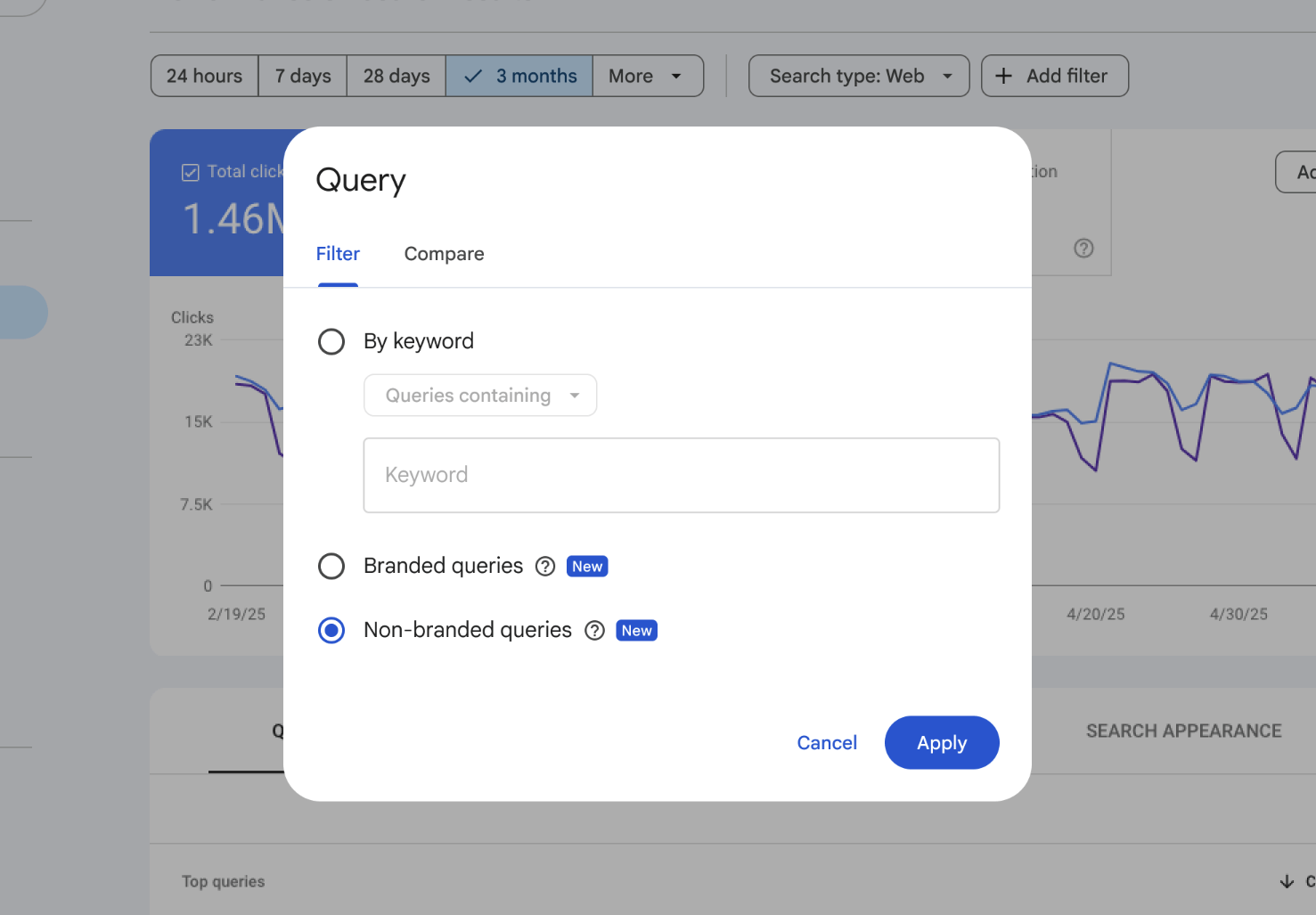
Google announced the branded queries filter in Search Console, saying it is now available for all eligible sites. In the search results performance report, the filter categorizes query data into branded and non-branded views so you can compare the two directly.
Google Search Console’s new branded queries filter.
A branded query in Google Search Console can include your brand name, close variants, misspellings, and products or services closely associated with your brand. The filter works across Web, Image, Video, and News search reporting and applies to metrics such as impressions, clicks, average position, and click-through rate.
Rather than being driven by a manual regex setup, the filter uses an internal AI-assisted system. This helps it identify brand-related queries across languages, misspellings, and unique products or services.
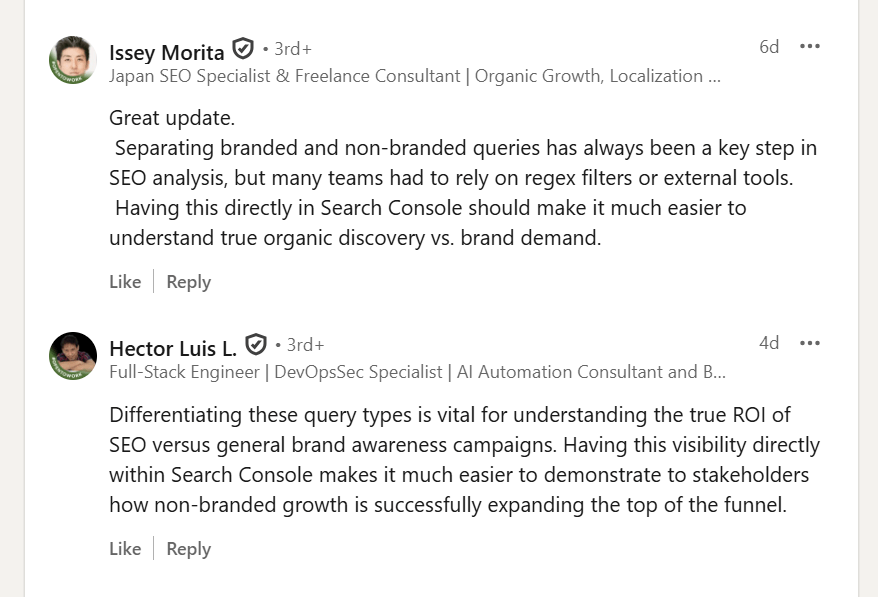
So far, the industry response has mostly been positive because the update solves a practical reporting problem. After all, it offers a useful new segmentation layer inside Search Console. Here’s a fraction of what marketers are currently saying.
Comments on LinkedIn about the new Search Console branded queries filter.
Why the branded queries filter matters to marketers
This filter matters because it helps marketers separate two different types of organic growth that should not be reported the same way. Once you split branded and non-branded performance, it becomes much easier to see what is building brand demand, what is driving search discovery, and what that means for reporting.
Separating the two makes trend lines easier to interpret. Branded growth can help you spot momentum from awareness efforts, while non-branded growth can show whether your SEO program is expanding reach and competitiveness.
Splitting these metrics leads to more honest reporting. When branded and non-branded traffic remain blended, one type of growth can mask the other, making attribution less clear and budget decisions harder to justify.
Branded query growth indicates stronger brand familiarity. These filters allow you to see when more people search for your brand by name or pair your brand with a product or service, helping you track increasing recognition and trust over time.
Brand demand visibility helps you create repeatable strategies. You’ll be able to track and repeat successful brand strategies that earn you better exposure and improve branded search activity.
Non-branded performance gives you a clearer read on SEO-driven discovery. This view helps you understand how effectively your content, service pages, and search strategy are helping new users find your business.
Expert insights from
Sarah BerryLead Web Marketing Consultant
Marketers could always filter for branded queries in Google Search Console, but catching all the variations was often a game of whack-a-mole. What makes this update meaningful is the time it saves. Instead of spending your time filtering the data, you’re spending your time analyzing it.
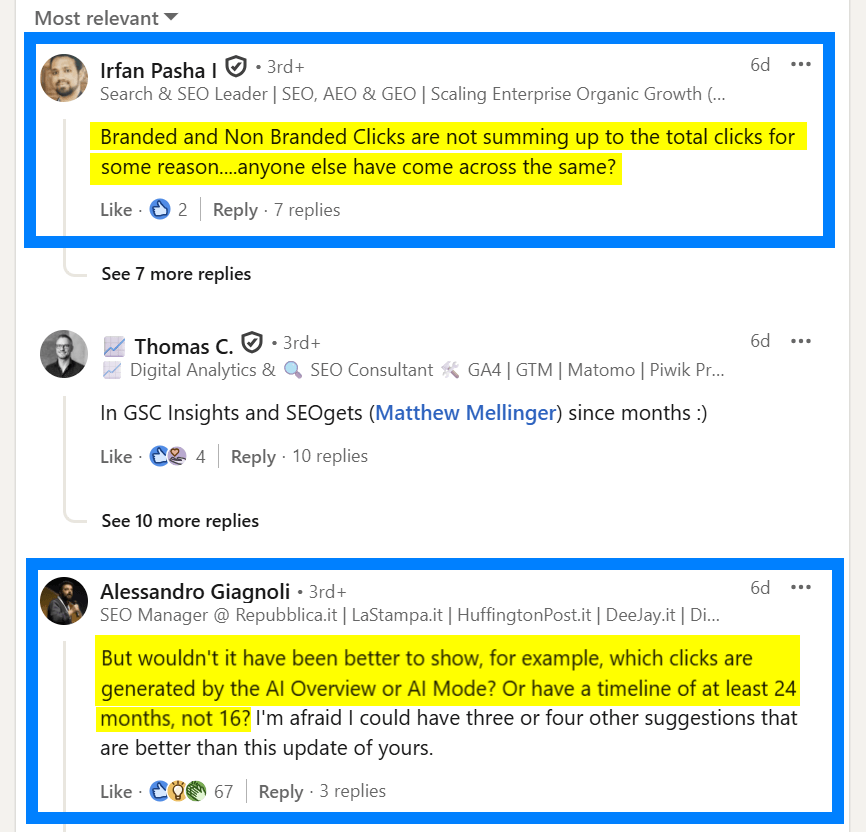
However, there are still limitations to keep in mind, and the new update has sparked questions from users. Many marketers are pointing out that there is still room for deeper brand search attribution. Check out some of the chatter for yourself.
Questions and concerns from marketers about the branded queries filter.
As you can see, the community is slightly concerned that the tool does not categorize traffic from AI Overviews and AI Mode, while others are concerned about total clicks not summing up. This means marketers still need a broader reporting context to understand full-funnel performance.
Google confirmed that occasional misclassification can happen, and Google’s John Mueller said there are no current plans to let site owners customize the branded classification manually, though feedback in the tool is welcome. So it looks like we could expect future enhancements.
If this isn’t exactly what you hoped for, you could alternatively use a platform like RevenueCloudFX, which can help you connect search visibility, leads, and revenue in one reporting environment. It does not replace Search Console, but it helps you turn Search Console insights into cleaner attribution and stronger executive reporting.
Why you shouldn’t blend branded and non-branded organic traffic
You should not blend branded and non-branded organic traffic because they describe different kinds of performance. When they live under a single headline number, the meaning of that number gets muddy.
Branded organic traffic comes from searches that include your brand name, close variants, misspellings, or brand-related products and services. Non-branded organic traffic comes from broader searches where users are looking for a topic, service, or solution and discover your site through search.
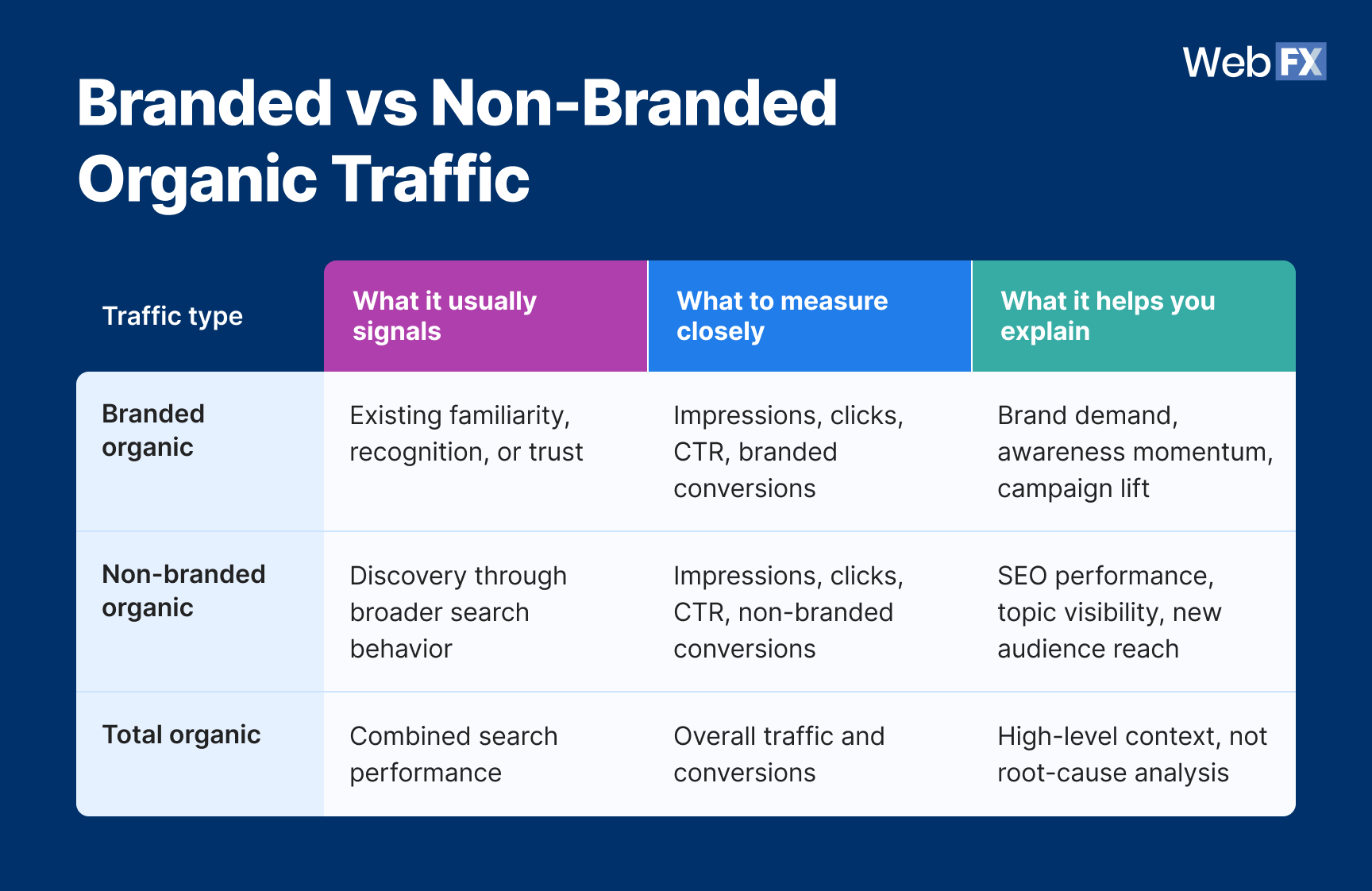
That difference matters because branded traffic often reflects existing awareness built through other touchpoints like PR, social media, referrals, podcasts, events, sales activity, or repeat exposure. Non-branded traffic tells you more about how well your content, pages, and SEO efforts capture new demand. Google explicitly frames non-branded queries as a way to understand how new users find your content. Here’s a quick look at the differences.
SEO performance, topic visibility, new audience reach
Total organic
Combined search performance
Overall traffic and conversions
High-level context, not root-cause analysis
When you report organic growth as one blended metric, you hide two separate forces. This makes it harder to show whether growth came from stronger brand recognition or from better search visibility for non-branded queries. It also becomes harder to measure SEO honestly and harder to show leadership what brand-building work actually contributed.
Expert insights from
Sarah BerryLead Web Marketing Consultant
Blending branded and non-branded organic traffic introduces a lot of ifs, ands, and buts to the story of your organic performance. When you separate the two, you empower yourself to make better, more strategic decisions.
A simpler way to report branded and non-branded organic performance
A better reporting model keeps total organic in view while splitting branded and non-branded performance into their own sections. That gives stakeholders a cleaner picture of where growth comes from and what to do next.
Track branded performance as a signal of brand familiarity
Branded performance helps you understand whether more people are actively looking for your brand and whether that attention is turning into action. You can find these metrics by applying the branded filter in the search results performance report and, for click share context, by reviewing Search Console Insights. Branded performance metrics include:
Branded impressions show whether brand-related searches are becoming more visible over time. Rising impressions often indicate increasing brand interest or stronger campaign awareness.
Branded clicks show whether that interest is turning into visits. This helps you separate awareness from actual engagement.
Branded CTR shows how effectively your visible branded results earn clicks. A strong CTR can signal trust, relevance, and strong result presentation.
Branded conversions help you connect brand demand to pipeline or revenue outcomes. Pull this by combining branded landing pages or query insights with your analytics and CRM reporting, since Search Console itself does not report revenue outcomes.
Track non-branded performance as a signal of SEO-driven discovery
Non-branded performance matters when you want to understand how effectively your SEO program expands reach and earns discovery from people who did not start with your brand in mind. This is the clearest view of whether your content and search visibility are growing net-new audience attention. Here are a few non-branded metrics to track:
Non-branded impressions show whether your pages appear for more discovery-oriented searches. This is one of the best early signals of expanding reach.
Non-branded clicks show whether your pages are earning visits from those broader searches. This is a stronger indicator of usable visibility than rankings alone.
Non-branded CTR helps you evaluate how well your titles, descriptions, and intent match convert search visibility into traffic.
Non-branded conversions show whether your discovery traffic contributes to lead generation or revenue. This is where SEO reporting starts to become much more valuable to leadership.
Keep total organic as context, not the whole story
Total organic still matters because it gives stakeholders a simple summary of overall search performance. It is useful for executive snapshots, trendlines, and quick month-over-month or year-over-year context.
What it should not do is carry the whole reporting story by itself. A total organic performance increase could reflect stronger brand demand, better non-branded visibility, or both.
For example, if total organic rises 18%, but almost all of that lift comes from branded clicks after a major awareness push, that tells a different story than a lift driven by non-branded discovery. The first points to brand momentum. The second points to SEO-led audience growth.
Build dashboards that show both views side by side
The cleanest dashboard structure includes branded organic performance, non-branded organic performance, total organic context, and lead or revenue outcomes where possible. That side-by-side layout makes it easier to explain what changed, why it changed, and where to invest next.
When reporting is more transparent, it becomes easier to defend brand investments, show honest SEO performance, and guide smarter budget decisions.
What marketers should do now
Google’s Search Console branded queries filter is most useful when you turn it into a repeatable reporting habit. Start with these four actions.
1. Review the branded queries filter in Search Console
Open the search results performance report and compare branded, non-branded, and all-query views. Look at impressions, clicks, CTR, and average position for each segment. Then note the mix you see today. That gives you a baseline you can compare against future campaigns and reporting periods.
2. Update reporting so branded and non-branded traffic are tracked separately
Revise your monthly dashboard and internal reporting structure so organic search no longer appears only as one undifferentiated number. Add separate sections for branded and non-branded performance, then include total organic as the summary view. That one change makes executive reporting clearer immediately.
3. Compare branded search movement against recent awareness efforts
Look back at PR pushes, social campaigns, product launches, thought leadership activity, podcast appearances, sponsorships, and sales visibility efforts. Then compare those timelines against branded search movement. If branded impressions and clicks rise after those efforts, you now have a stronger way to show leadership that awareness work influenced search demand.
4. Use the new filter as a starting point, not the full picture
The branded queries filter gives you a better reporting foundation. It does not replace the need to connect search behavior to leads, sales, and revenue outcomes. Use it to sharpen segmentation, then pair it with analytics, CRM, and revenue reporting so your team can answer the bigger attribution questions with more confidence.
The branded queries filter is a Search Console filter in the search results performance report that segments query data into branded and non-branded views. It helps marketers understand how much traffic comes from people already familiar with the brand versus people discovering the site through broader search behavior.
Marketers should care because those traffic types usually reflect different marketing motions. Branded traffic often signals awareness, recognition, and familiarity. Non-branded traffic tells you more about discovery and SEO-driven reach. Separating them makes reporting more transparent and more actionable.
Google says branded queries can include your brand name, close variants, misspellings, and products or services closely associated with your brand. Google also says this classification is handled by an internal AI-assisted system rather than a regex filter.
When you apply the filter, you can analyze impressions, clicks, average position, and click-through rate for the selected segment. Google says the filter works across Web, Image, Video, and News search reporting.
No. Google says it is only available for eligible top-level properties. It is not available for URL-path properties or subdomain properties, and sites with low impression volume may not qualify.
Not fully in every case. John Mueller from Google said there is a point where the data starts being tracked, which means some properties will only see the branded breakdown from that point forward.
No separate breakout is currently available. Google’s Search Console community guidance says AI Overviews and AI Mode traffic are included within overall Web search reporting in Search Console rather than reported as its own separate source.
It’s time to enhance your branded and non-branded performance tracking
Google’s branded queries filter is a meaningful upgrade because it makes organic reporting more honest. When you separate branded and non-branded performance, you get a clearer view of where growth is coming from, cleaner attribution for stakeholder conversations, and a stronger foundation for budget decisions.
If you want reporting that goes beyond native platform views alone, WebFX’s custom SEO reporting services can help you connect branded and non-branded search insights with the metrics leadership actually cares about. Learn more about our custom SEO reporting services today.
Try our free Marketing Calculator
Craft a tailored online marketing strategy! Utilize our free Internet marketing calculator for a custom plan based on your location, reach, timeframe, and budget.
Craft a tailored online marketing strategy! Utilize our free Internet marketing calculator for a custom plan based on your location, reach, timeframe, and budget.
Marketers could always filter for branded queries in Google Search Console, but catching all the variations was often a game of whack-a-mole. What makes this update meaningful is the time it saves. Instead of spending your time filtering the data, you’re spending your time analyzing it.
Expert insights from
Sarah BerryLead Web Marketing Consultant
Blending branded and non-branded organic traffic introduces a lot of ifs, ands, and buts to the story of your organic performance. When you separate the two, you empower yourself to make better, more strategic decisions.






 Thaakirah Abrahams is a Marketing Editor at WebFX, where she leverages her years of experience to craft compelling website content. With a background in Journalism and Media studies and certifications in inbound marketing, she holds a keen eye for detail and a talent for breaking down complex topics for numerous sectors, including the legal and finance industries. When she’s not writing or optimizing content, Thaakirah enjoys the simple pleasures of reading in her garden and spending quality time with her family during game nights.