


Table of Contents
- How AI is fundamentally reshaping SEO
- From rankings to relevance: What AI search rewards
- The 6-step AI SEO playbook
- 1. Analyze AI search to uncover the question behind the question
- 2. Diversify your content strategy
- 3. Establish your credibility and authoritativeness
- 4. Speak the language of AI with structured data
- 5. Structure content for citability
- 6. Use AI ethically
- Assess your AI SEO priorities with this free, practical checklist
- What each section of the checklist helps you assess
- How to use this checklist
- FAQs
- Harness the power of AI and SEO to grow your business
- Content and intent alignment
- Credibility and trust signals
- Structure and interpretability
- Visibility and measurement awareness
- Responsible AI use
- How has AI changed search visibility?AI search experiences like Google’s AI Overviews and AI Mode are changing how users discover new information and how brands earn visibility. Many users are also turning to generative AI tools like ChatGPT, Claude, and Perplexity for search.
- What type of content does AI search reward? AI systems favor content that demonstrates expertise through detailed explanations based on real use cases, clear comparisons, evidence-based guidance, and nuanced information tailored to specific audiences.
- Why is credibility crucial for AI visibility? Establishing credibility through first-hand experiences, original research, in-house expert insights, and original multimedia helps content stand out in AI-generated results. If you publish generic AI-generated content, it’s less likely to get cited by AI because it looks a lot like other pages, making it hard for AI systems to cite a particular source.
There’s no denying that AI has permeated daily and professional life. You notice it when topics like deepfakes or AI-powered translation tools make their way to your dinner table.
As a marketer, you’ve seen how AI has changed the digital marketing scene, including the search engine optimization (SEO) game. AI-powered search experiences, such as Google’s AI Overviews and AI Mode, give users synthesized answers instead of lists of links.
The result? Brands can appear in search results without earning a traditional click. Sometimes, they lose visibility even when rankings remain strong.
This shift creates a new challenge for marketers. Rankings still matter, but they no longer tell the full story. Visibility now depends on whether AI systems can understand your content, trust its accuracy, and select it when generating answers for users.
This guide explains how AI is reshaping SEO, what that means for your strategy, and how you can adapt without abandoning the fundamentals that still drive results. We’ll cover:
- How AI-powered search changes visibility and measurement
- What AI systems reward when selecting content
- The 6-step AI SEO playbook
- How to evaluate your readiness without overcomplicating the process
- FAQs
Technical SEO Foundations Are Crucial for AI SEO Success. How Does Your Site Stack Up?
Get My Free SEO Score

How AI is fundamentally reshaping SEO
Unlike traditional search engine results pages (SERPs), AI-powered search experiences don’t simply act as gateways to websites. They work as interpreters, deciding which information to present, how to summarize it, and which sources to cite.
AI search experiences like Google’s AI Overviews and AI Mode are changing how users discover new information and how brands earn visibility. And they’re doing so quickly.
AI Overviews now appear in one of every four U.S. searches.
Source: WebFX
Based on our recent research, AI Overviews now appear in one of every four U.S. searches — and in more than half of searches when queries reach seven words or longer. That frequency alone makes AI-powered results impossible to treat as edge cases.
Add to that the growing number of users turning to generative AI tools like ChatGPT, Claude, and Perplexity for search. Our analysis of 1 billion search sessions reveals that generative AI-driven traffic is growing 165x faster than traditional organic search.
With these changes, it’s crystal clear that success in search goes beyond ranking. Instead, it’s about improving your visibility wherever your audience looks for answers.
Search results now answer questions instead of listing options
A user searching for “best SaaS software for manufacturing companies” may see an AI-generated summary outlining common categories, key features, and considerations. Some brands are cited directly within that response. Others may rank well organically but never appear in the prominent summary at all.
In this environment, SEO performance depends on whether your content clearly helps AI systems understand:
- What problem you address
- Who it’s for
- Why it’s credible enough to reference.
That’s a meaningful shift from competing solely for rankings to competing for inclusion.
Visibility increasingly happens inside AI-generated answers
As AI-generated responses become more prominent, users don’t always need to click through to multiple sites to keep learning. Much of their decision-making now begins — and sometimes ends — within AI-generated summaries.
For example, a procurement manager looking for a heavy equipment rental company may form an initial impression based on an AI Overview that highlights a handful of commonly recommended vendors or a comparison chart generated by Perplexity. In that moment, visibility depends less on where your page ranks and more on whether an AI Overview mentioned your brand.
This shift changes how visibility works. Brands can gain exposure through citations in AI Overviews, summarized recommendations, or AI-generated comparisons from tools like Claude that shape user perception before a click ever happens.
If your site is getting less traffic despite maintaining search visibility, learn how to tell if AI search is hurting your traffic and how to identify the cause.
Ready to earn your spot in AI answers?
Show up where your buyers are searching – in Google, AI search, and everywhere else.

From rankings to relevance: What AI search rewards
AI systems don’t evaluate content the same way traditional ranking algorithms do. Instead of sorting pages by position alone, they assess whether a piece of content helps answer a user’s question clearly, accurately, and confidently.
That difference helps explain why some content that still ranks well isn’t as visible as it once was.
Understanding intent beyond keywords
Keywords still play a role in SEO, but AI systems place greater weight on search intent and context. They look for content that demonstrates a clear understanding of:
- The core question behind the query
- Related follow-up questions a user might ask
- Constraints such as industry, use case, or experience level
For example, a page optimized narrowly around a single keyword may still rank organically. But if it doesn’t address the broader decision a user is trying to make, it’s less likely to be selected or referenced in an AI-generated response.
In this context, relevance goes beyond keyword density alone. It’s also about whether your content aligns with how users actually think through a problem.
Of course, strong content still needs a solid technical foundation. AI systems rely on established SEO best practices, such as crawlability, accessibility, and performance, to find and interpret content consistently.
Why thin content underperforms in AI-driven search
AI systems evaluate patterns across many sources at once. Content with surface-level definitions or generic advice doesn’t get cited by AI often because these pages look a lot like one another, making it hard for AI systems to cite a particular source.
By contrast, content that’s written for a specific audience (and their pain points) typically stands out and gets cited because this page brings unique value to a particular audience and is easier for AI systems to interpret.
Consider two moving companies writing about how to relocate specialized heavy equipment. One company (let’s call it Moving Company X) publishes a list of generic tips that could apply to any move, while the other company (Moving Company Y) explains how different equipment types require specialized handling and safety considerations, and shares effective moving strategies it has used for its customers.
Even though both pages target a similar topic, Moving Company Y’s content provides context, shows experience, and offers clear guidance, making it easy for AI systems to interpret and synthesize with confidence.
In practice, AI systems tend to favor content that exhibits expertise, experience, and credibility through:
- Detailed explanations based on real use cases
- Clear comparisons that help users evaluate options
- Evidence-based guidance
- Content structure that makes key points easy to extract and summarize
- Nuanced information tailored to specific audiences or search intent
This is why thin content and loosely organized blog posts struggle to compete in AI-driven search, even if they once ranked. When AI systems generate answers, they need material they can confidently interpret and reuse.
The 6-step AI SEO playbook
To flourish in the modern AI and SEO landscape, businesses must adopt a holistic approach to marketing online. It requires adjusting how you think about content, credibility, and visibility as AI systems increasingly shape what users see first.
This playbook is a set of priorities where you can spend your effort:

Your 6-step AI SEO playbook
Let’s dive into each one:
1. Analyze AI search to uncover the question behind the question
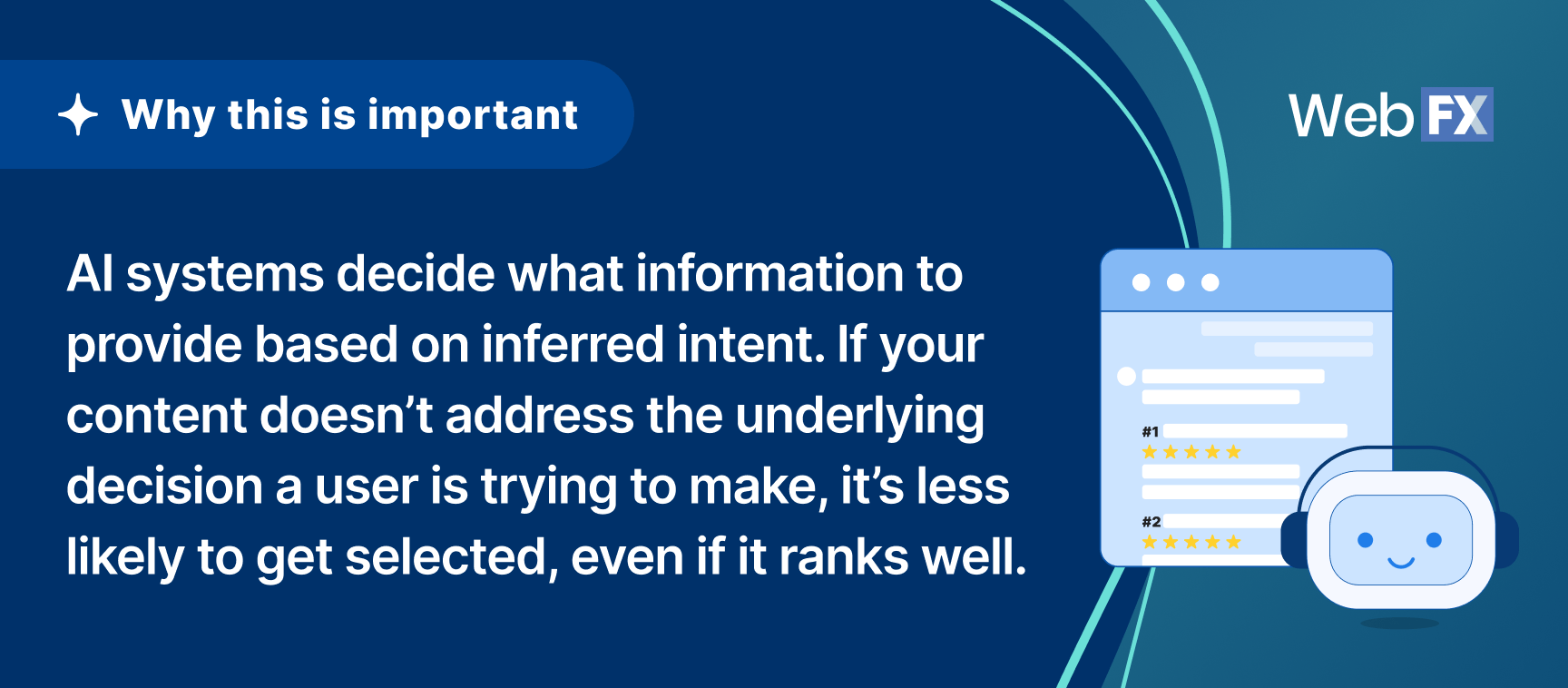
When users search, they often bring more context than their query reveals. AI systems attempt to account for that context by figuring out what the user is trying to understand, compare, or decide.
Looking at AI-generated results can help surface those underlying questions. The summaries, follow-up prompts, and cited sources often point to the considerations users care about most, even when they don’t explicitly state them.
Content that reflects those considerations is easier for AI systems to draw from because it aligns with how the problem is framed, not just how it’s phrased.
2. Diversify your content strategy
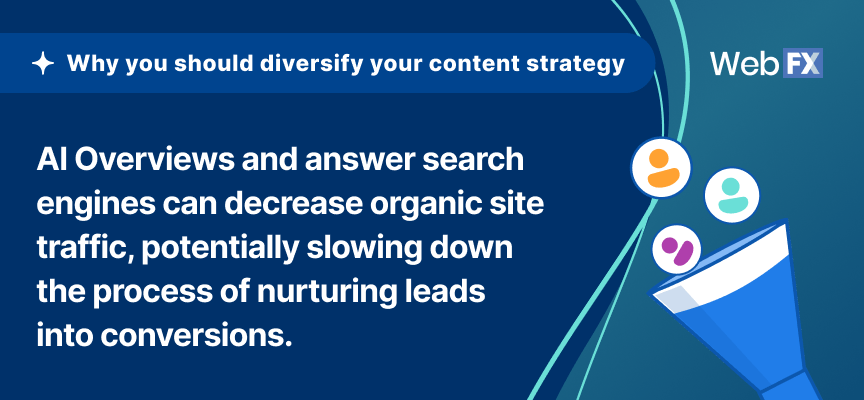
Because searchers can now get answers directly from SERPs and AI-generated responses, diversification plays a different role in SEO than it once did. It’s no longer about publishing everywhere. Instead, diversifying your content enables you to cover different types of search intent clearly.
AI systems draw from different content formats depending on the task. Comparisons support evaluation. FAQs support clarification. Glossaries support understanding. Long-form guides support decision-making.
When content is created with a specific purpose in mind, it’s easier for AI systems to identify how and when to use it.
3. Establish your credibility and authoritativeness
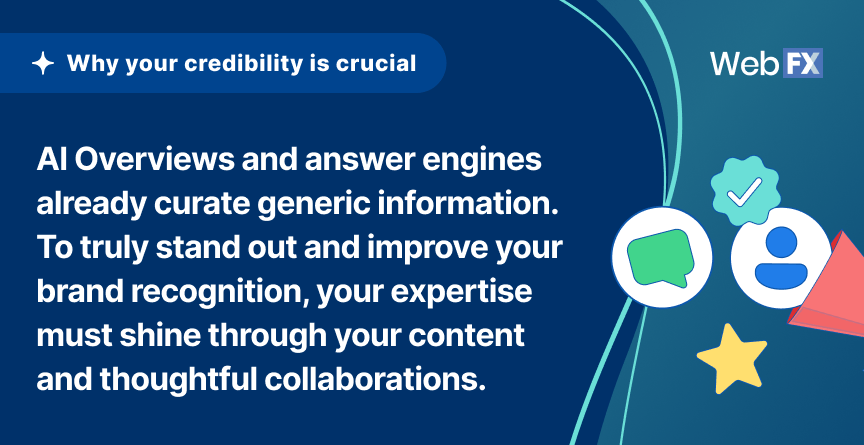
“Optimizing for AI results involves creating high-quality, relevant content while adding to the information already available from other sources,” says Chris V., TeamAI’s Head of Marketing. “The best way to show up in these snippets is to provide the reader with information they cannot find anywhere else about the topic.”
Today, simply rehashing other websites’ content won’t get you noticed. Show your expertise by adding:
- First-hand experiences and anecdotes
- Original research or survey data
- Insights from your in-house experts
- Original multimedia, such as images, infographics, and videos
In the age of zero-click searches, it’s crucial to know your target audience well and understand their pain points. That way, you create content that offers valuable perspectives for them, not just generic information on your products and their benefits for everyone. You also get to publish content that answers their FAQs.
For ecommerce businesses, this zero-click shift is becoming even more tangible with the Google universal cart — which lets shoppers compare and move toward checkout inside Google before visiting your site.
“Leverage your own expertise in your content. You also want to follow on-page, off-page, and technical SEO best practices, such as using structured data.”
Expert insights from


For example, let’s say you own a yoga studio in a city where your clientele is in their 40s to 50s. Publishing content tailored to them allows you to zero in on their concerns.
Instead of writing content about the generic benefits of yoga, you can talk about the benefits of practicing yoga later in life. That way, your target customers will see you as a studio that understands their needs and offers what they need. They may not necessarily click on your page, but they will remember your studio as the authority for yoga practice for people like them.
You can also establish your credibility and authoritativeness through other tactics, such as:
- Adding trust signals, like customer testimonials and industry awards
- Guest posting
- Collaborating with other brands with the same values and target audience as yours
4. Speak the language of AI with structured data

Structured data helps provide context about what a page represents and how different elements relate to one another. FAQs, how-tos, product information, and reviews all give AI systems clearer reference points.
Used thoughtfully, structured data reduces ambiguity and improves interpretability, especially for content designed to answer specific questions or explain defined concepts. It’s most effective when it reinforces what the content already communicates clearly.
5. Structure content for citability
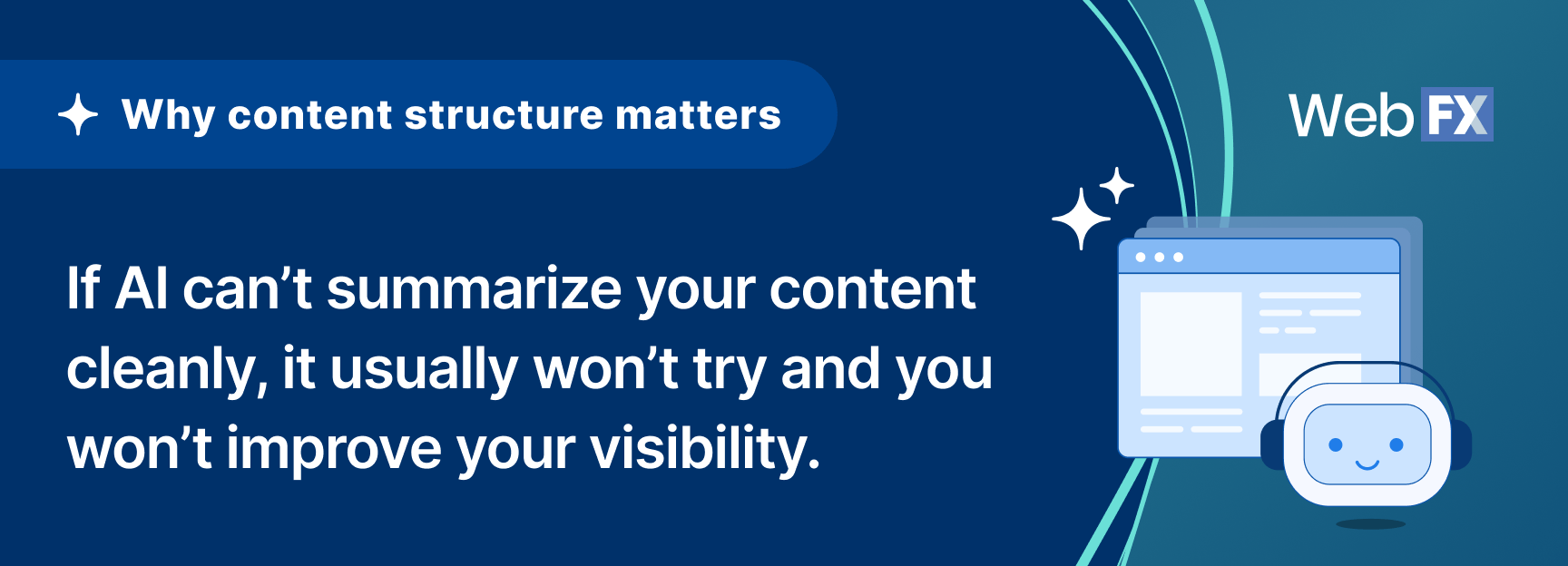
AI systems often work by extracting and recombining information from multiple sources. Content that’s clearly organized makes that process easier and more accurate.
Elements like descriptive headings, direct answers near the top of sections, and logical progression are essential on-page SEO strategies for AI search that help AI systems identify what’s worth referencing. When your key insights are buried or loosely structured, they’re more likely to be overlooked.
Your headings and logical flow also help the readers skim through your page and pick up your key messages, if they decide to click through an AI-powered summary.
6. Use AI ethically
To thrive in the world of AI and SEO, you need AI tools — and you must use them responsibly. Using AI ethically helps your business prevent the abuse and misuse of this technology.
Ethical AI practices also contribute to business sustainability, as you ensure that your AI tools’ output is accurate and free of bias. Here are some best practices:
- Mitigate bias: Bias can easily creep into your AI system. Ensure you have processes for identifying and mitigating bias.
- Protect your data and AI systems: Encrypt your data. Regularly perform security and data audits.
- Create and maintain ethical AI frameworks: Set clear guidelines on using your AI system and data. It must also detail the processes for handling ethical dilemmas and regularly updating your framework.
🎥Video: 5 benefits of AI in marketing
Assess your AI SEO priorities with this free, practical checklist
AI-driven search affects how content is interpreted, summarized, and referenced. As a result, it’s not always obvious which parts of your SEO strategy are supporting visibility and which parts may be limiting it.
This checklist helps you step back and evaluate where your current approach aligns with how AI systems surface information, and where focused improvement is likely to have the greatest impact.
Some gaps also trace back to the platform itself — if your site’s technical foundation is limiting your optimization options, the best AI website builders for SEO is a useful starting point for evaluating alternatives.
From there, each section focuses on a specific factor that influences whether AI systems can understand, trust, and reuse your content when generating answers.
What each section of the checklist helps you assess
We divided the checklist into five sections to help you evaluate the different components of your AI SEO strategy. Each section focuses on a specific factor that influences whether AI systems can understand, trust, and reuse your content when generating answers.
Content and intent alignment
These questions help you understand whether your content reflects how users think through decisions, not just how they phrase searches.
Credibility and trust signals
This section tells you whether your content demonstrates the kind of reliability and specificity AI systems tend to reuse in generated answers.
Structure and interpretability
These questions evaluate whether your content is organized in a way that makes key insights easy to extract and summarize.
Visibility and measurement awareness
This section clarifies whether you’re accounting for influence that happens before a click, where AI-driven visibility often plays out. It also helps you identify which AI visibility proxy KPIs, such as impressions, citation frequency, branded search lift, and assisted conversions, are most useful for evaluating performance.
Responsible AI use
These questions help you evaluate how your AI tool use supports accuracy and consistency rather than introducing risk or eroding trust over time.
How to use this checklist
Review each group of prompts and consider how consistently they reflect your current SEO practices.
Some areas may feel well established. Others may surface uncertainty or gaps. That contrast is useful, because it helps clarify where additional attention is most likely to matter.

How to interpret your results
Look for patterns rather than isolated gaps. When several areas point to the same issue, that’s often where you need to focus your efforts to improve your visibility.
FAQs
Will AI replace SEO?
AI isn’t replacing SEO, but it is changing how SEO works.
Search engines still rely on structured, relevant, and credible content to generate answers. What’s different is how that content is referenced.
Instead of only ranking links, AI-powered search experiences summarize information and reference sources directly, which redefines what “visibility” looks like in practice.
How do I measure success if clicks drop?
Clicks are no longer the only signal of SEO performance. In AI-driven search, visibility often happens before a user visits a site, which could be through summaries, comparisons, and cited answers.
You can use AI visibility tools to monitor and evaluate how your content appears in AI-generated search results.
Today, measuring success requires looking at impressions, engagement trends, and assisted conversions alongside traditional metrics to understand how content influences decisions earlier in the journey.
What tools do I need for AI SEO?
There’s no single tool required for AI SEO. Most teams use a combination of SEO platforms, analytics tools, and AI assistants to support research, content development, and measurement.
What matters more than the AI SEO tools themselves is having clear goals, review processes, and accountability in place so AI supports accuracy and consistency rather than introducing risk.
How long does AI SEO take to show impact?
AI SEO isn’t a one-time optimization. Improvements typically show up gradually as content becomes clearer, more credible, and easier for AI systems to interpret and reuse.
Some changes, such as improved structure or updated content, may influence visibility relatively quickly, while others build impact over time as trust signals accumulate.
Harness the power of AI and SEO to grow your business
It’s no secret that the new search landscape involves AI and SEO. To improve your online visibility and grow your bottom line through digital marketing, use AI tools responsibly, boost your credibility, and implement SEO best practices.
In other words, AI search optimization services, supported by the OmniSEO® platform, are key to improving your revenue and sustaining your growth. If you need help with AI and SEO, consider partnering with the revenue growth experts at WebFX.
Our team takes the time to understand your business, industry, and goals to craft AI and SEO strategies that will boost bottom-line growth. Our proprietary tool, RevenueCloudFX, provides insights that inform your strategies to ensure you’re getting your return on investment.
Contact us online or call us at 888-601-5359 to speak with a strategist about our AI SEO services!
Ready to earn your spot in AI answers?
Show up where your buyers are searching – in Google, AI search, and everywhere else.
-
 Maria is a Lead Content Specialist at WebFX. With nearly two decades of experience in B2B and B2C publishing, marketing, and PR, she has authored hundreds of articles on digital marketing, AI, and SEO to help SMB marketers make informed strategic decisions. Maria has a degree in B.S. Development Communication major in Science Communication, and certifications in inbound marketing, content marketing, Google Analytics, and PR. When she’s not writing, you’ll find her playing with her dogs, running, swimming, or trying to love burpee broad jumps. View full profile
 -

WebFX is a full-service digital marketing agency delivering revenue-driving strategies across online advertising, SEO and AI search optimization, and digital marketing. Backed by 1,100+ client reviews, a 4.9-star rating on Clutch, and proprietary revenue-tracking technology, our team helps businesses grow visibility and revenue across platforms, from Google to ChatGPT to LinkedIn. Discover how our expert team and revenue-accelerating tech can drive results for you. Learn more
Try our free Marketing Calculator
Craft a tailored online marketing strategy! Utilize our free Internet marketing calculator for a custom plan based on your location, reach, timeframe, and budget.
Plan Your Marketing Budget
Table of Contents
- How AI is fundamentally reshaping SEO
- From rankings to relevance: What AI search rewards
- The 6-step AI SEO playbook
- 1. Analyze AI search to uncover the question behind the question
- 2. Diversify your content strategy
- 3. Establish your credibility and authoritativeness
- 4. Speak the language of AI with structured data
- 5. Structure content for citability
- 6. Use AI ethically
- Assess your AI SEO priorities with this free, practical checklist
- What each section of the checklist helps you assess
- How to use this checklist
- FAQs
- Harness the power of AI and SEO to grow your business
- Content and intent alignment
- Credibility and trust signals
- Structure and interpretability
- Visibility and measurement awareness
- Responsible AI use
Share this article


AI SEO Success with WebFX
Try our free Marketing Calculator
Craft a tailored online marketing strategy! Utilize our free Internet marketing calculator for a custom plan based on your location, reach, timeframe, and budget.
Plan Your Marketing Budget