
AI Overviews in Finance: Where They Appear + What to Do (2.3M-Query Study)


Key takeaways
- AI Overviews trigger on 31.1% of finance searches. Treat AI citations as a core visibility channel.
- Long queries (7+ words) drive the highest AI Overview rate (55.6%). Prioritize citation-focused formatting for long-tail education pages.
- Informational intent triggers AI Overviews most often (42.8%). Build TOFU content that answers fast, then supports with depth.
- Transactional (23.9%) + local queries (24.5%) trigger fewer AI Overviews. Use these as “safer” targets for lead-driving pages.
AI Overviews appear in 31.1% of finance-related Google searches, changing how banks, fintech companies, and wealth management firms compete for visibility. For many finance keywords, AI-generated answers now sit above traditional organic results, reshaping how users discover and trust financial information.
This page breaks down where and when AI Overviews appear in finance searches, using insights from WebFX’s study of 2.3 million keywords. You’ll see which types of finance queries trigger AI Overviews most often, which keyword categories remain safer, and how search intent influences AI visibility.
You’ll also learn how finance businesses should adapt their SEO strategy, balancing traditional rankings with optimization for AI citations to protect traffic, maintain compliance-approved visibility, and continue driving qualified leads.
You can use the information below to help you determine which queries to prioritize. That will prevent you from losing out on qualified leads, loan applicants, or prospective investors.
Which finance keywords trigger the most AI Overviews?
Let’s start by looking at the two types of finance keywords that are the most likely to show AI Overviews — longer queries and informational queries.
1. Longer queries
When it comes to AI Overviews, keyword length matters. As it turns out, longer keywords are a lot more likely to surface AI responses than shorter ones are. Here’s a look at the data:
| Keyword Length | Example Keywords | AI Overview Rate | What This Means for Finance Firms |
| 1–2 words |
|
22.1% | Low risk of AI Overviews, but high competition from other firms; good for high-value terms |
| 3–4 words |
|
28.7% | Mild risk of AI Overviews, but moderate competition; ideal for pairing with conversion tools (e.g., calculators) |
| 5–6 words |
|
38.0% | Moderate risk of AI Overviews, mild competition; necessitates AI Overview optimization tactics |
| 7+ words |
|
55.6% | High risk of AI Overviews, low competition; requires focus on AI citations over traditional search results |
Quick takeaway: AI Overviews spike once queries hit 7+ words
As you can see, the AI Overview rate rises pretty dramatically once keywords reach a length of seven words or more. That puts finance companies in an interesting conundrum. Historically, it was better to target longer and more specific keywords, like “how to calculate required minimum distribution.”
Shorter keywords, however, came with a lot more competition, making them harder to rank for. Plus, long-tail keywords in finance often relate to high-stakes topics like retirement rules or tax reductions — prime opportunities for your company’s expertise to shine.
But today, the playing field is a little more even. Short-tail keywords like “best credit cards” or “mortgage rates” may still come with more organic competition, but now they carry the advantage of being less likely to trigger AI Overviews.
Ultimately, the best strategy is probably to target both long-tail and short-tail keywords, ensuring you capture broad visibility for brand awareness while still generating qualified leads from niche financial queries.
2. Informational queries
Another type of query that frequently spawns AI Overviews in finance searches is informational queries. Based on our data, AI Overviews appear in 42.8% of all informational finance searches. That comes in slightly higher than the baseline rate of 39.4% across all industries.
Quick takeaway: Educational finance pages need citation-first formatting
The takeaway here is that educational content is at greater risk of competing with AI responses in search results. That poses a challenge for finance companies, who often rely on informational topics as initial touchpoints for building trust. Some examples of finance content that might fall into this category include:
- A guide to mortgage applications
- A page detailing how credit scores work
- A list of tips for good budgeting
- A glossary of financial terms
All of those informational topics are likely to generate AI Overviews when users search for them, decreasing the traffic you’ll get to those pages.
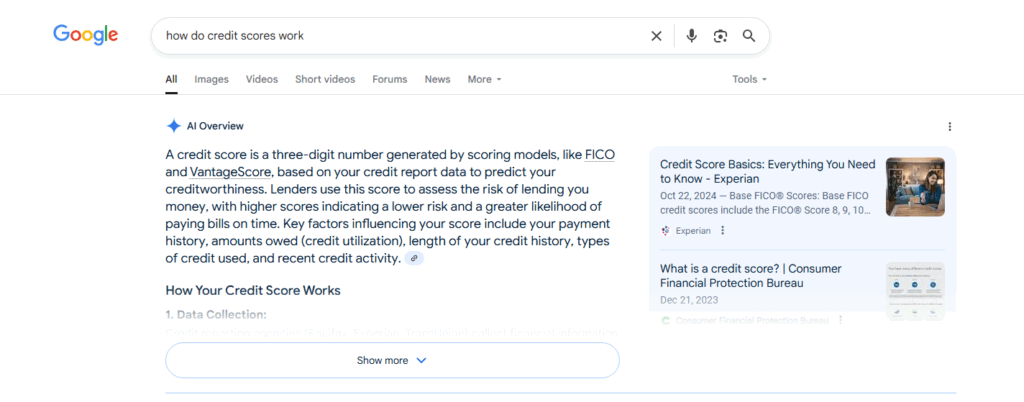
To be clear, though, that doesn’t mean you shouldn’t create informational content. You absolutely should — you just have to optimize it for AI Overviews. We’ll talk more about how to do that later on this page.
Which finance keywords are the safest from AI Overviews?
Now that we’ve looked at the finance keyword categories that are the most likely to generate AI Overviews, let’s look at which types of keywords are least likely to do so.
1. Commercial and transactional queries
We’ve already seen how common AI Overviews are in informational searches. But there are other types of search intent too, and as it turns out, they have significantly lower AI Overview rates. Here are the specific stats:
| Search intent | Example Keywords | AI Overview rate | What This Means for Finance Firms |
| Informational |
|
42.8% | High risk of AI Overviews; requires focus on AI citations alongside traditional search results |
| Commercial |
|
29.8% | Moderate risk of AI Overviews; necessitates some attention to AI citation optimization while still focusing on traditional rankings |
| Transactional |
|
23.9% | Mild risk of AI Overviews; requires some AI optimization, but allows finance companies to prioritize traditional rankings |
| Navigational |
|
16.5% | Low risk of AI Overviews, but not worth focusing heavily on due to generally low keyword value |
Quick takeaway: BOFU pages face lower AI Overview risk
Commercial queries have only slightly fewer AI Overviews than the average, but the rate drops a good bit for transactional searches, and even more for navigational ones.
This data shows the benefit of publishing plenty of bottom-of-funnel content on your website — like loan application pages or investment account sign-ups — to help balance out the impact AI Overviews will have on your top-of-funnel, informational pages.
2. Local queries
In the full version of our study, we found that adding branded and/or local modifiers to keywords significantly reduced the chances of AI Overviews appearing. However, when we look specifically at finance companies, that’s only half true. Check out the data:
| Keyword modifier(s) | Example Keywords | AI Overview rate | What This Means for Finance Firms |
| Branded |
|
37.0% | Higher risk of AI Overviews; requires firms to ensure content is accurate, compliant, and positioned for AI citation |
| Local |
|
24.5% | Lower risk of AI Overviews; still requires some AI optimization, but allows for greater focus on traditional search rankings |
| Branded + local |
|
36.5% | Higher risk of AI Overviews; requires firms to highlight localized offerings and advisor expertise to remain competitive |
Quick takeaway: Local modifiers reduce AI Overview frequency in finance searches
As you can see, branded modifiers don’t help reduce AI Overview rates for finance queries (they actually increase them slightly). Local modifiers, however — such as “near me” or “in [your city]” — do help. That means your business can really benefit from targeting local searches for financial services, such as branch locations or regional lending options.
Of course, local SEO is a good strategy to begin with, but it’s even more valuable now that it allows you to lower your chance of having to compete with AI Overviews in search results.
What do AI Overviews in finance searches mean for SEO?
If you’re worried that finance AI Overviews spell the end for SEO, don’t be. As we’ve seen from the data, there are still plenty of finance-related searches — particularly those for short-tail, local, and transactional queries — that are relatively safe from AI Overviews.
That means you can keep using traditional SEO strategies to rank in those searches, continuing to drive loan applications, account openings, and advisory leads just like you always have. That said, the rise of AI Overviews also creates an opportunity to get cited in AI responses.
Consequently, the best finance SEO strategy involves pairing traditional SEO with AI optimization. You have to use both of them together to outpace your competitors in the current search landscape.
The bottom line is, finance SEO isn’t going anywhere. It’s still one of the best ways to maintain compliance-approved visibility and acquire new clients online. But it is evolving. Given the new role of AI in search, AI optimization is an essential partner to SEO.
How should your business adapt to finance AI Overviews?
Focusing on searches with a lower risk of AI Overviews appearing is a good strategy, but it’s not enough on its own. At the end of the day, you still need to create top-of-funnel, educational content — like credit score explainers or mortgage application guides — to draw users in. And long-tail keywords remain vital for avoiding competition with other finance businesses.
So, how do you adapt for searches with AI Overviews? The short answer is, you optimize for AI citations. That means crafting your content in a way that makes it more likely for AI Overviews to cite it as a source. When you earn AI citations, it enables your business to show up at the top of the search results pages even when AI Overviews appear.
Here are some of the best tactics for making your content AI-friendly:
- Prioritize search intent in your content: Make sure all of your content is optimized for specific queries, and in particular, make sure it gives users what they’re looking for in those searches. You can check existing search results to help you gauge the search intent of a given query.
- Use structured content formats: AI has an easier time parsing (and therefore citing) pages that have a clear, well-organized content structure. That means using FAQ blocks (about tax rules, for instance), comparison tables (like for loan rates or credit card perks), bullet lists, headings, and more.
- Include compliance-approved authority signals: By grounding your content in financial compliance — such as by citing authorities like the SEC, IRS, and FDIC — you’ll demonstrate your credibility within the heavily regulated finance industry, thus increasing the likelihood of an AI Overview citing your content.
- Explain why your content matters: Rather than just handing your audience some financial info, be sure to explain why that matters to them and what they can do about it. For example, instead of only listing IRA contribution limits, explain how those limits affect retirement planning and potential tax savings.
- Signal your unique finance expertise: AI responses (as well as traditional search results) are more likely to surface your content if they view you as an expert on the topic, so be sure to emphasize the traits that make you uniquely qualified to talk about financial topics.
Each of these tips will make your content more likely to show up in finance AI Overview citations, boosting your overall search visibility — and with it, your ability to drive loan applications and investment inquiries.
OmniSEO® helps finance firms drive results in an AI-first search landscape
One of the most effective methods for adapting to AI responses in search results is to use OmniSEO®. If you’re not sure what that is, it’s a new form of SEO that focuses on optimizing for AI responses and traditional search results at the same time (as well as social media, forums, and more).
OmniSEO® is pioneered by yours truly — WebFX. We’ve been optimizing our clients’ content for AI responses for as long as they’ve existed, and we’d love to do the same for your finance business. If you’re interested in partnering with us, just give us a call at 888-601-5359 or contact us online today!

We Drive Results for Finance Firms
- Dedicated account manager backed by 750+ digital experts
- Renowned for our communication and transparency

We Drive Results for Finance Firms
- Dedicated account manager backed by 750+ digital experts
- Renowned for our communication and transparency

Unmatched talent and tech for serving financial firms
$3,000
starting price for our services
64,350+
hours of financial marketing experience