



Table of Contents
- How SEO helps doctors attract the right patients
- The core elements of SEO for doctors
- 1. Improve your local visibility so nearby patients can find you
- 2. Establish trust before patients ever contact your office
- 3. Use educational content to answer patient questions responsibly
- 4. Manage your online reputation while staying HIPAA-compliant
- 5. Ensure your website supports both patients and search visibility
- FAQs
- Acquire more patients with SEO for doctors
- Why is SEO crucial for doctors’ practices? SEO helps doctors appear in search results when 75% of patients search online for healthcare providers, allowing practices to attract new patients, compete with larger hospitals, and grow sustainably through increased visibility and appointment bookings.
- What is local SEO and why does it matter for doctors? Local SEO optimizes your practice to appear in location-based searches like “pediatrician near me” and Google’s Local-3 Pack, the first three businesses shown in local results.
- What role do online reviews play in medical SEO? Patient reviews act as both trust signals and ranking factors,.
In today’s digital-first world, patients turn to Google for doctor referrals more frequently than they rely on word-of-mouth alone. In fact, 75% of patients now search for healthcare providers online first.
Because search engines often serve as the first stop in the patient journey, your practice needs to be visible where those searches happen. That visibility does not occur by chance. It requires search engine optimization (SEO), a strategy that helps your practice get discovered, evaluated, and trusted online.
SEO is a critical part of your practice’s digital front door strategy. When implemented well, it supports patient acquisition by attracting new patients, encouraging appointment requests, and contributing to measurable, long-term practice growth.
That being said, SEO is not a quick fix. It works best as a sustained effort that builds patient demand over time, strengthens credibility, and reinforces your reputation in the community.
This guide explains how SEO works for doctors and what actually drives results, without getting lost in technical language. We’ll cover:
How SEO helps doctors attract the right patients
At its core, SEO helps doctors become easier to find and easier to trust online. When someone searches for a doctor, they are often looking for reassurance and availability. They want to know you are qualified, accessible, and reputable before they ever contact your office.
SEO supports that process by helping your practice:
- Appear in relevant searches when patients are actively looking for care
- Present clear, accurate information about your services
- Build trust through reviews, content, and consistent online signals
- Attract patients who are more likely to follow through with an appointment
For established practices, SEO also supports referrals. Even when a patient is referred by another provider or a friend, they often search your name online before contacting your office.
What they discover online may influence whether they contact you or not. Glowing reviews and a professionally made website can encourage them to call you or schedule an appointment.
The core elements of SEO for doctors
SEO for doctors focuses on improving your organic and local visibility. You want to ensure your local community can easily find you online.
This strategy also involves your website’s usability and building trust through your online presence. Below are five SEO strategies for doctors:
- Improve your local visibility
- Establish trust before patients ever contact your office
- Use educational content to answer patient questions responsibly
- Manage your online reputation while staying HIPAA-compliant
- Ensure your website supports both patients and search visibility
1. Improve your local visibility so nearby patients can find you
Most patients look for care close to home. When they search online, Google prioritizes results that feel relevant to their location and immediate needs.
Local SEO is the strategy of making your practice easy to find in your community. To strengthen your local visibility:
- Optimize your Google Business Profile with accurate, complete details.
- Keep your practice name, address, and phone number consistent across directories
- Encourage patient reviews through appropriate, compliant channels
- Monitor how your practice appears in map results for relevant searches
By optimizing your website and Google Business Profile for local search, patients searching for your specialty can more easily discover your practice.
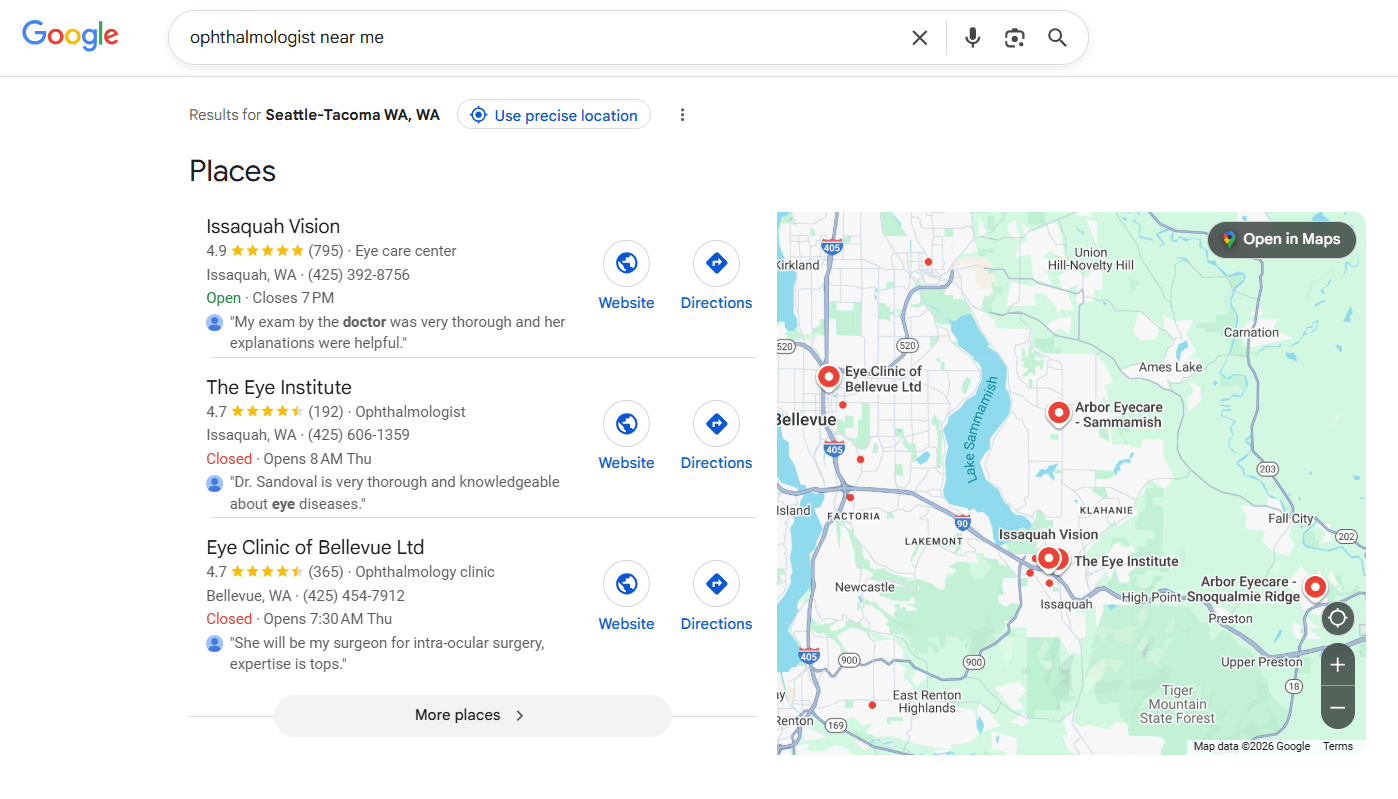
For example, if you’re an ophthalmologist, Google often shows a map and a short list of practices when someone searches for “ophthalmologist near me.” If your practice does not appear there, you may miss opportunities from patients who are actively searching and ready to book an appointment.
2. Establish trust before patients ever contact your office
Trust forms early in the patient journey. Long before a phone call or appointment request, patients review your website and online profiles for credibility signals.
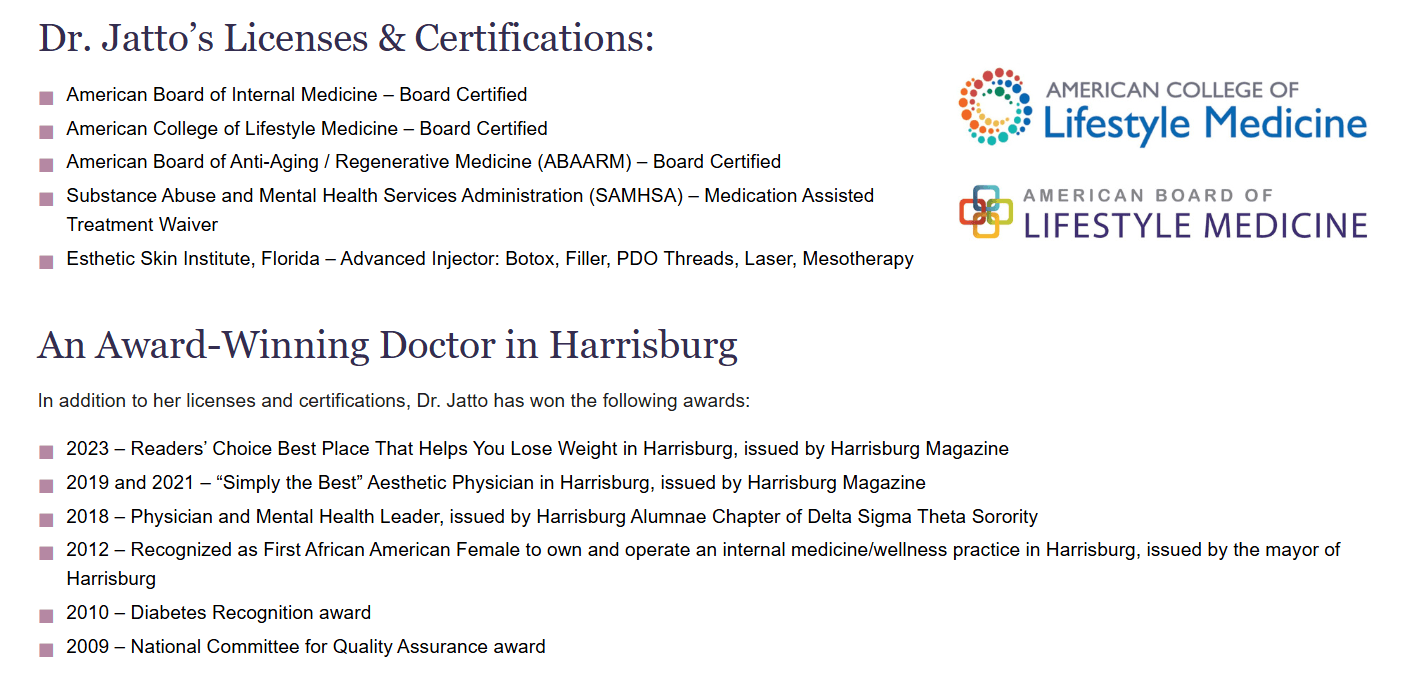
SEO supports trust-building by making it easy for patients to find:
- Provider credentials and experience
- Clear descriptions of services and conditions treated
- Consistent messaging across your website and listings
- Signals that your practice is established and reputable
For example, a patient researching a colonoscopy may compare several practices online before deciding where to schedule their procedure. If one doctor’s office clearly explains the service, introduces the provider, and answers common concerns, that practice often feels safer and more credible.
These trust signals also matter to search engines. Google looks for evidence that a medical website demonstrates experience, expertise, and reliability, even when those concepts are not explicitly labeled.
3. Use educational content to answer patient questions responsibly
Many patients arrive at your website with questions they have already been considering for days or weeks. They may want to understand symptoms, treatment options, recovery timelines, or what to expect during a first visit.
SEO-friendly content helps your practice address those questions clearly and responsibly. These content pieces should focus on medical accuracy and patient education rather than promoting your services.
Think of this content as an extension of the conversations that happen in your waiting room. When patients feel informed and prepared, they are often more confident and more likely to follow through with care.
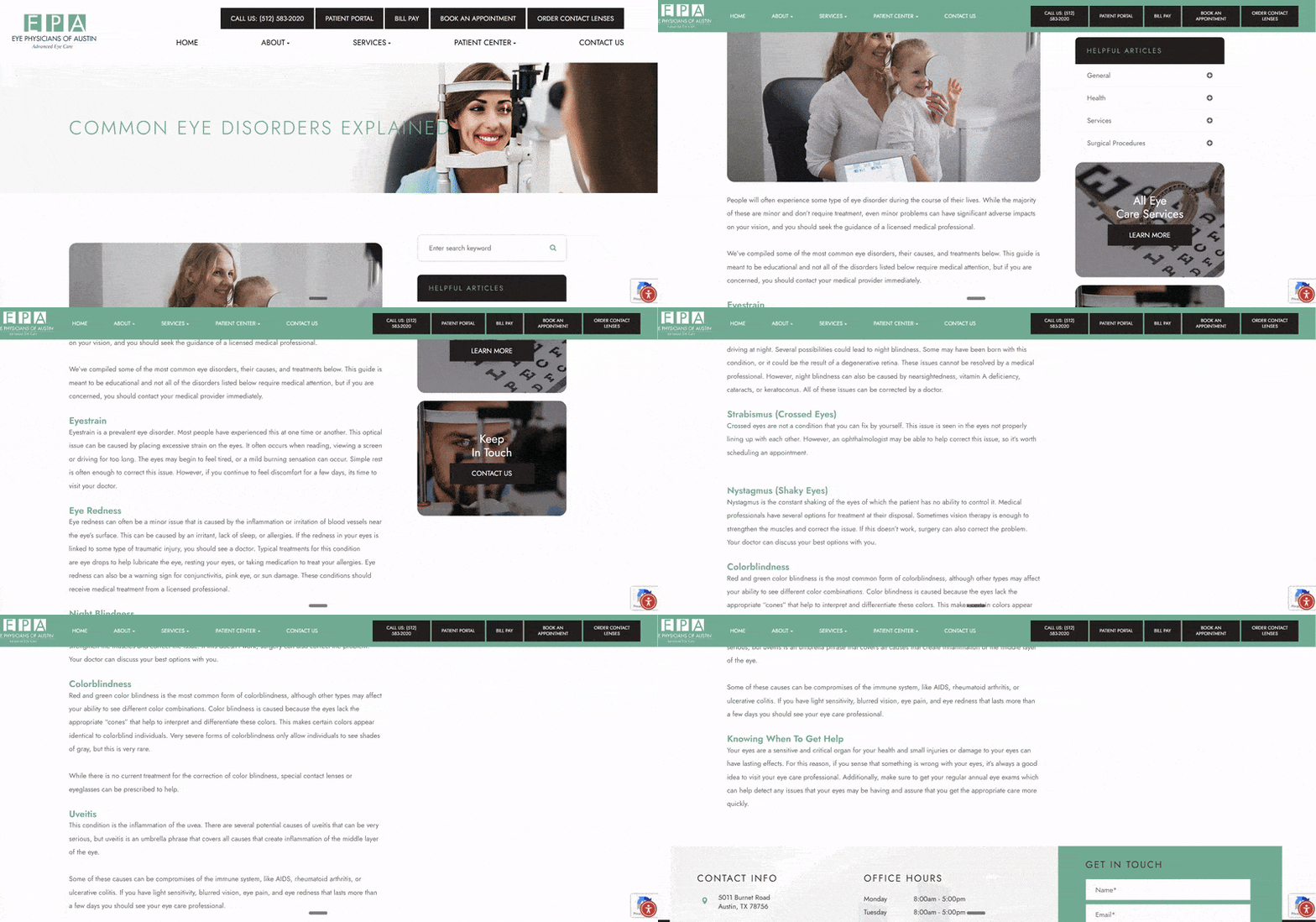
For example, an ophthalmology practice that publishes clear explanations about common eye conditions and procedures often attracts patients who are further along in their decision-making process. These patients tend to arrive with more confidence and more specific questions.
4. Manage your online reputation while staying HIPAA-compliant
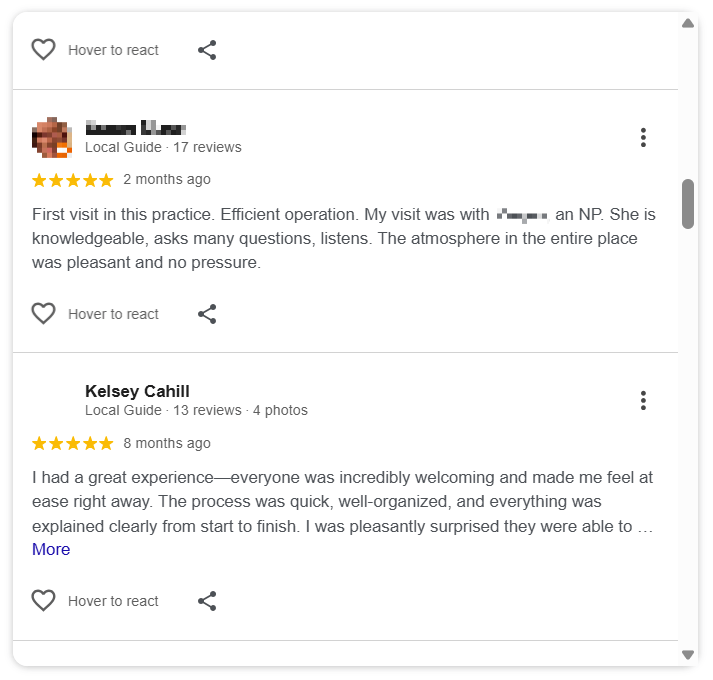
Online reviews play a significant role in patient trust. Many patients read multiple reviews before choosing a doctor, and they often notice whether a practice responds to feedback.
SEO supports reputation management by helping your reviews appear prominently and by reinforcing your credibility through consistent online signals. That being said, healthcare practices must manage reviews carefully due to HIPAA and patient privacy considerations.
To manage your online reputation responsibly:
- Encourage reviews through appropriate, compliant methods
- Respond professionally without referencing personal health details
- Avoid language that could imply a patient relationship publicly
- Maintain consistency across review platforms
For example, acknowledging feedback in a general and respectful way shows attentiveness without risking compliance issues. Over time, this approach helps build trust with both patients and search engines.
5. Ensure your website supports both patients and search visibility
Your website plays a critical role in patient acquisition. Even strong visibility and content can fall short if navigating your site or completing forms feels difficult.
From a patient’s perspective, your website should work as smoothly as your front desk. Pages should load quickly, navigation should feel intuitive, and forms should feel secure and easy to complete.
From an SEO perspective, technical performance helps support visibility and usability. Google considers factors such as the following:
- Page speed
- Mobile usability
- Visual stability
These factors fall under Core Web Vitals. While these are not the only ranking considerations, they help ensure your site delivers a reliable experience.
To ensure your site supports both patients and search engines, here are some tips:
- Use mobile-friendly layouts that adapt to smaller screens
- Make your pages load quickly on desktop and mobile devices
- Secure online forms and use clear calls to action
- Keep navigation simple so patients can find key information easily
FAQs
How long does SEO take for a medical practice?
SEO is a long-term strategy. Most practices begin to see meaningful improvements within six to 12 months, with stronger results developing over time. Competition, location, and your existing online presence all influence timelines.
SEO builds momentum gradually, which helps create more stable and sustainable patient demand.
How does Google’s AI search affect SEO for doctors?
Google increasingly uses AI systems to summarize information and reference trusted sources. For doctors, this reinforces the importance of accurate content, clear credentials, and consistent online information.
Practices that invest in patient-first content and strong trust signals tend to be better positioned as search results continue to evolve.
Should each doctor have a separate Google Business Profile?
In most cases, Google Business Profiles should represent practice locations rather than individual practitioners. There are exceptions for certain providers, but unnecessary or duplicate profiles can create confusion and visibility issues.
Evaluating your setup carefully helps avoid mistakes that could affect local visibility.
Is SEO or PPC better for doctors?
SEO and pay-per-click advertising (PPC) serve different purposes. PPC can generate visibility quickly, while SEO supports long-term patient demand and credibility.
Many practices use both, with SEO providing a foundation and PPC supporting specific campaigns or growth goals.
Acquire more patients with SEO for doctors
SEO for doctors is about building a reliable way for patients to find, trust, and choose your practice online.
When approached strategically, SEO supports patient demand by improving visibility, strengthening credibility, and creating a smoother experience for people seeking care. Over time, it becomes a steady contributor to practice growth rather than a one-time effort.
If you need help with SEO, team up with WebFX. Our SEO services for doctors ensure HIPAA compliance and patient-centric strategies that build trust and drive measurable results for your medical practice. Our 230+ health industry experts understand SEO, your industry, and your patients, giving you a competitive edge.
Request a free SEO quote for your doctor’s practice, or give us a call at 888-601-5359 to talk to a strategist about your SEO needs.
-
 Lornah Ngugi is a seasoned digital marketing writer with 6+ years of experience translating complex marketing strategies into engaging, results-driven content. She holds a B.S. in Business Information Technology and is certified in HubSpot Academy, Google Analytics, LinkedIn Marketing, and Google Digital Academy. Lornah regularly contributes to the WebFX blog and SEO.com, where she’s authored hundreds of marketing guides that help readers turn their goals into measurable results through practical, data-informed insights. When she’s not writing, you’ll find her enjoying a quiet walk in the park, sipping black coffee, or finding creative inspiration in a good chocolate bar.
 -

WebFX is a full-service marketing agency with 1,100+ client reviews and a 4.9-star rating on Clutch! Find out how our expert team and revenue-accelerating tech can drive results for you! Learn more
Try our free Marketing Calculator
Craft a tailored online marketing strategy! Utilize our free Internet marketing calculator for a custom plan based on your location, reach, timeframe, and budget.
Plan Your Marketing Budget
Table of Contents
- How SEO helps doctors attract the right patients
- The core elements of SEO for doctors
- 1. Improve your local visibility so nearby patients can find you
- 2. Establish trust before patients ever contact your office
- 3. Use educational content to answer patient questions responsibly
- 4. Manage your online reputation while staying HIPAA-compliant
- 5. Ensure your website supports both patients and search visibility
- FAQs
- Acquire more patients with SEO for doctors
Share this article


Help More Patients Find Your Practice
See how healthcare providers like Hurst Pediatric Dentistry increased local leads 5× with data-driven SEO from WebFX.

Try our free Marketing Calculator
Craft a tailored online marketing strategy! Utilize our free Internet marketing calculator for a custom plan based on your location, reach, timeframe, and budget.
Plan Your Marketing Budget
What to read next




Additional Reading



Health & Wellness Case Studies
Solving key challenges for healthcare
Our website isn’t driving enough traffic
Our expert SEO specialists, copywriters, and digital advertisers will help you increase your website’s rankings when your target audience searches for your treatments online, so you can continuously drive traffic and revenue for your practice, hospital, or business.

We’re opening a new location
Set your new hospital, brand, or practice up for future success with a range of digital marketing strategies that get your new practice in front of potential patients or B2B buyers.

We’re not attracting enough patients
Get a steady flow of new patients to your practice, hospital, or brand with expertly crafted strategies that provide a seamless, engaging user experience for your website visitors, encouraging them to become patients.

We have high patient turnover
Offer new treatments or services and need to get them in front of your potential client’s eyes? Our range of revenue-driving digital advertising and marketing services have you covered and reach the people who need your facility the most.
