


Table of Contents
- Why volume-based content strategies now work against you
- The new content mandate: In 2026 brands must operate like research firms
- What defensible content actually looks like in practice
- How this shift changes SEO outcomes over time
- How compounding authority reshapes discovery
- Let WebFX help adapt your content to the new search environment
For decades, “good enough” content worked. A well-optimized article, a competent explanation of a topic, or a detailed blog post could still earn rankings and drive organic traffic.
That era is over! Today, authenticity, original insight, and radical transparency set the competitive baseline for content that ranks and delivers measurable results.
With generative AI now embedded into nearly every content workflow, the cost and time required to produce average content have significantly decreased. In fact, 90% of marketers report faster production speeds when using AI tools.
However, AI hasn’t eliminated SEO—it has raised the bar. Brands that publish authentic data and original insights build authority, while those that rely on generic content lose visibility.
Why volume-based content strategies now work against you
For most of the last decade, content marketing rewarded output. More pages meant more keywords. More keywords meant more visibility in search results.
As generative AI accelerates publishing across industries, search results increasingly contain large clusters of pages that target the same topics, satisfy the same intent, and follow near-identical structures.
So now, search performance increasingly depends on whether your pages add net new value to the ecosystem, not on how many pages you have on your website. Minimalism in content production is becoming the thing!
Let’s get into the actual reasons why “more” content alone is working against your organic rankings and visibility efforts.
1. AI-content saturation
Generative AI can automate or accelerate 60–70% of the time spent on knowledge work, such as research, outlining, and drafting content. Considering the cost of using AI content generation tools, you can bet you’re not the only one using it to fast-track content generation.
This means the web is quickly flooding with identical content that doesn’t provide readers with much value. As a result, Google won’t rank your content well, and you also won’t be earning any meaningful visibility or traffic.
2. Topic cannibalization and internal competition
Volume-driven strategies introduce internal competition where multiple pages on your site compete for the same or closely related keywords. This phenomenon, known as keyword or topic cannibalization, forces search engines to treat multiple pages as a single page and reduces the likelihood that individual pages will rank and be visible.
3. Diminished signals of authority and uniqueness
With AI’s rise, the baseline quality of content, which encompassed useful structure, keyword coverage, and readability, is now easy to replicate. This diminishes its relative value as a ranking signal.
So, now search engines and AI systems are increasingly depending on external signals, like backlinks, citations, structured data, and unique insights to break ties between many superficially similar pages.
4. Changing user behavior and intent fulfillment
Since 2023, click-through rates have declined as search behavior has changed. Third-party studies have observed that AI Overviews correlate with a 34.5% drop in click-through rates for top organic results.
Additionally, Pew Research Center analysis found that when an AI summary appears, users click on traditional links in just 8% of searches, compared with 15% when no AI summary is shown.
When AI answers appear directly in search results and chat-based tools, many users get what they need without clicking through to a website. They scan summaries, compare sources, and move on. The click happens later or not at all.
The new content mandate: In 2026 brands must operate like research firms
Generative AI has standardized the primary differentiators between high-quality and low-quality content.
So, your content marketing plan must now be exceptional to drive measurable impact.
And what would that look like? Showing up more like an expert-led research organization and less like a journalistic publisher.
Additionally, you also need to adapt your content to indicate contribution rather than coverage if you will keep up with the accelerated content production unlocked by generative AI.
These efforts are essential because search engines now don’t ask if a page adequately answers a query in order to rank it. Instead, traditional and AI-powered search engines, like Perplexity rank pages based on what net new value your page adds to the content ecosystem.
This is why two pieces of content can appear equally complete, yet produce dramatically different outcomes over time.
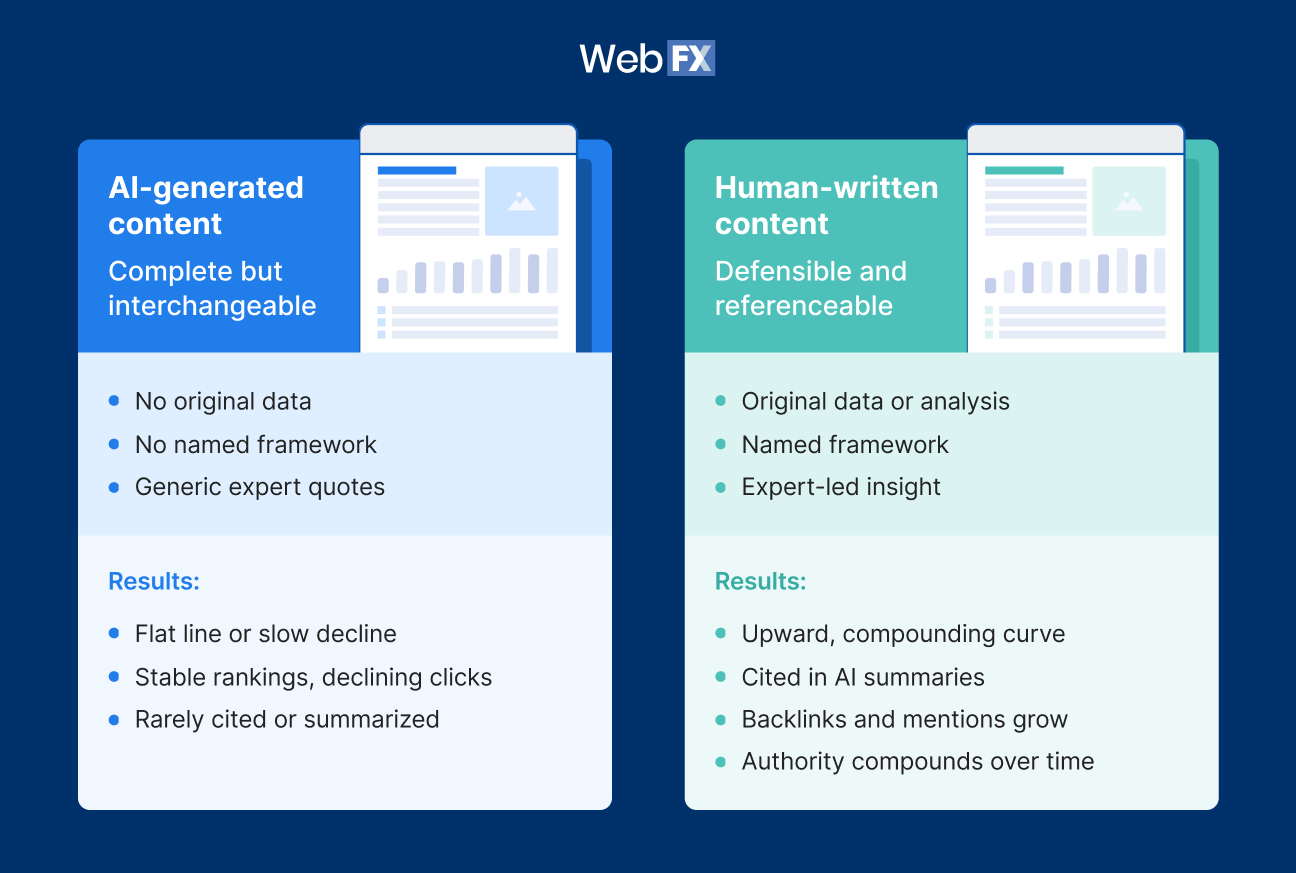
To better understand this change, it helps to compare how “high-quality content” worked before widespread AI adoption with how it functions today.
How high-quality content is evaluated: Before and after AI
The following table compares how content used to rank versus how it now ranks in the age of widespread AI production.
| Dimension | Before widespread AI adoption | After widespread AI adoption |
| Primary differentiator | Completeness and optimization | Distinctiveness and ownership |
| Content advantage | Being comprehensive and accurate | Introducing new data, insight, or models |
| Role of execution quality | Strong separator | Expected baseline |
| Source evaluation | Page-level relevance | Source-level authority and contribution |
| Value of originality | Helpful but optional | Central to visibility |
| What scales effectively | Output volume | Proprietary insight |
| Long-term performance | Keyword-dependent | Authority-compounding |
What defensible content actually looks like in practice
Defensible content has one defining trait: If it disappeared from your site tomorrow, a competitor wouldn’t recreate it by prompting an AI tool. Not quickly. Not cheaply. And definitely not at scale.
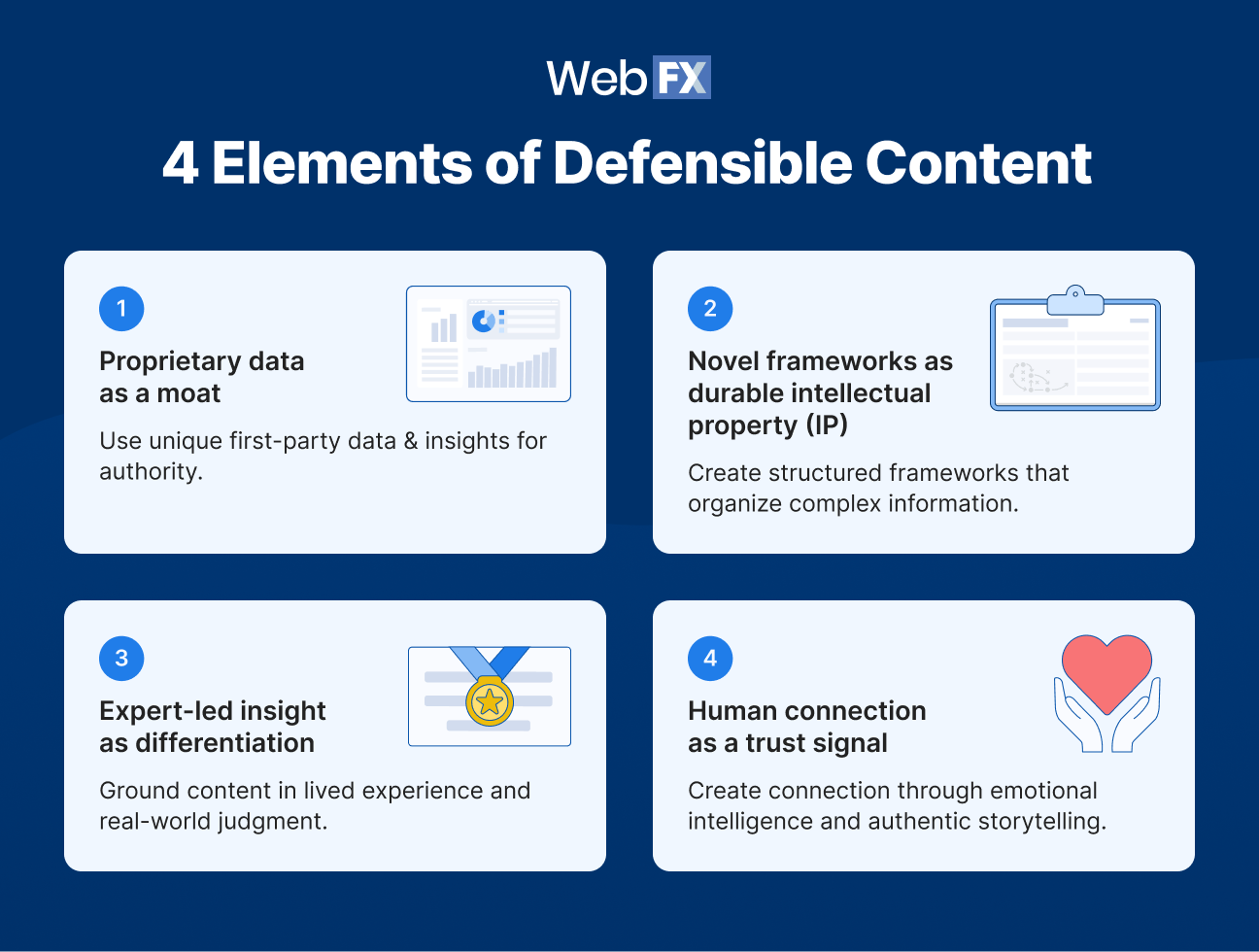
You can establish content defensibility by creating your content around the following four main elements:
1. Proprietary data as a moat
First-party data has become one of the strongest signals of authority available to brands. This could be any of the following:
- Aggregated customer insights
- Internal performance benchmarks
- Longitudinal trend analysis
- Original surveys.
Even when public datasets are involved, defensibility emerges through methodology, interpretation, and context. Two brands can analyze the same data and produce very different levels of authority depending on how insight is extracted and framed.
2. Novel frameworks as durable intellectual property (IP)
Frameworks turn insight into intellectual property. They provide internet users with a structured way of understanding insights. They’re the perfect replacement for simple, repeatable checklists that gen AI now replicates and replaces with summaries and overviews.
Unlike step-by-step guides or best-practice lists, frameworks organize complexity. They typically:
- Name a problem space
- Define categories and relationships
- Establish key dimensions
- Explain the decision criteria
- Provide a repeatable lens for analysis and decision-making
Frameworks endure because they minimize cognitive load. Once users understand them, they become reusable mental shortcuts that are easy to reference and attribute. From an AI perspective, frameworks provide structured concepts that models can reference without flattening.
3. Expert-led insight as differentiation
When AI can produce drives of content in just seconds, then unique insights and expert judgment become scarce.
So, creating content with expert-led insights gives you the edge you need in the new content era. You can unlock this by grounding your content in lived experience, real scenarios, real constraints, and real consequences.
Expert-led insights reflect how someone who has seen outcomes unfold thinks about a problem, making it more valuable and impactful.
This works because generative AI excels at summarizing consensus. It performs poorly when insight requires judgment about what matters most, what to ignore, or why common advice fails in practice.
When expert insight is embedded directly into content through analysis, interpretation, and point of view it creates differentiation that cannot be automated away.
4. Human connection as a trust signal
The oversaturation of AI-generated content on the internet has led users to be more critical of the content they consume.
Yes, users enjoy getting answers faster and more conveniently thanks to AI overviews and chat summaries. But they’re still looking for reassurance, which you can give them by conveying emotional intelligence and authentic storytelling.
Human connection makes the data, expertise, and frameworks you’ve conveyed so far believable and relatable to the people consuming your content. AI systems pick up on this, too.
Content that shows perspective, accountability, and context is easier to recognize as credible. Content that feels interchangeable is easier to summarize away.
How this shift changes SEO outcomes over time
Defensible content follows a different trajectory than content built for coverage. Rather than peaking briefly and fading, defensible content accumulates value because:
- Original data attracts citations
- Named frameworks earn mentions and brand references
- Expert-led insight builds recall and refrencability
- Human connections reinforce authenticity and strengthen credibility
Over time, these signals build authority around a source instead of dispersing it across individual pages. As a result:
- Rankings stabilize
- New content gains traction more quickly
- Visibility becomes easier to maintain
- Search performance becomes less volatile
- Algorithm updates have less impact
- Competitive pressure increases for others
How compounding authority reshapes discovery
Search systems evaluate sources across time, not just pages in isolation. When a brand consistently contributes original insight, that contribution strengthens entity-level signals that influence future visibility.
As AI-powered discovery expands, this effect accelerates. Large language models (LLMs) reference sources that demonstrate depth, consistency, and originality across related topics. Authority travels with the idea and the source behind it, extending visibility beyond individual rankings.
This creates layered discoverability. Your content starts appearing in traditional search results, AI summaries, and referenced explanations without relying on repeated keyword competition.
For brands consistently investing in content, this means SEO outcomes increasingly reflect cumulative decisions rather than isolated tactics, and here’s how:
- Content strategies centered on defensible assets build momentum over time
- Each new investment benefits from prior authority
- Each signal reinforces the next
- Performance becomes an outcome of structure rather than effort
Let WebFX help adapt your content to the new search environment
Search visibility increasingly favors brands that contribute original data, durable frameworks, expert insight, and human resonance. As AI accelerates content production across the web, execution quality has become a baseline expectation rather than a differentiator.
Content that introduces net new value compounds authority over time. It earns citations, stabilizes rankings, and surfaces across both traditional search results and AI-powered discovery. Content built primarily for coverage continues to compete at the same level, requiring constant output to maintain visibility.
This shift reframes content strategy as an investment in intellectual capital and AI strategy plays a central role in how that capital is created, operationalized, and scaled.
At WebFX, we help brands make that distinction actionable. With 8+ years of hands-on experience implementing AI across real marketing workflows, we guide organizations through AI strategy, governance, and integration in ways that strengthen authority rather than dilute it.
Are you publishing more content than ever but seeing less organic traffic? Or are your rankings flattening even though your pages are well optimized? Contact us online or call us at 888-601-5359 today to build an AI-powered content strategy that compounds results instead of chasing volume.
-
 Lornah Ngugi is a seasoned digital marketing writer with 6+ years of experience translating complex marketing strategies into engaging, results-driven content. She holds a B.S. in Business Information Technology and is certified in HubSpot Academy, Google Analytics, LinkedIn Marketing, and Google Digital Academy. Lornah regularly contributes to the WebFX blog and SEO.com, where she’s authored hundreds of marketing guides that help readers turn their goals into measurable results through practical, data-informed insights. When she’s not writing, you’ll find her enjoying a quiet walk in the park, sipping black coffee, or finding creative inspiration in a good chocolate bar.
 -

WebFX is a full-service marketing agency with 1,100+ client reviews and a 4.9-star rating on Clutch! Find out how our expert team and revenue-accelerating tech can drive results for you! Learn more
Try our free Marketing Calculator
Craft a tailored online marketing strategy! Utilize our free Internet marketing calculator for a custom plan based on your location, reach, timeframe, and budget.
Plan Your Marketing Budget
Table of Contents
- Why volume-based content strategies now work against you
- The new content mandate: In 2026 brands must operate like research firms
- What defensible content actually looks like in practice
- How this shift changes SEO outcomes over time
- How compounding authority reshapes discovery
- Let WebFX help adapt your content to the new search environment
Share this article


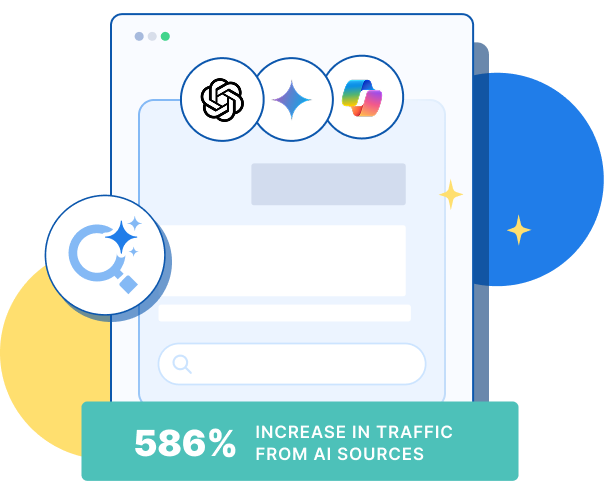
See AI Marketing in Action
Explore how WebFX helped a regional brand get discovered in AI search experiences — proving what’s possible with today’s AI-driven marketing!
Try our free Marketing Calculator
Craft a tailored online marketing strategy! Utilize our free Internet marketing calculator for a custom plan based on your location, reach, timeframe, and budget.
Plan Your Marketing Budget