



Table of Contents
- The modern roofing marketing playbook: 7 core strategies
- 1. Dominate local search: Google Business Profile (GBP) & local SEO
- 2. Get ‘Google screened’: Google local services ads (LSAs)
- 3. Turn reviews into revenue: Proactive reputation management
- 4. Scale with precision: Google Ads (PPC)
- 5. Build your brand, not just your likes: Strategic social media
- 6. Create a referral engine: Systematizing word-of-mouth
- 7. Avoid the trap: Navigating shared lead marketplaces
- In-house vs. Agency: When to hire a marketing partner
- Frequently asked questions about roofing marketing
- Build a roofing marketing system you control
-
What is the foundation of roofing marketing in 2025?
Google Business Profile (GBP) and local SEO form the foundation because 76% of people who search for local services on smartphones visit a business within 24 hours, making visibility for searches like “roofing company near me” critical for generating inspection requests and signed contracts. -
How do Google Local Services Ads (LSAs) benefit roofers?
LSAs operate on a cost-per-lead model where roofers pay only for qualified phone calls or messages rather than clicks, and the Google Guaranteed badge adds trust by verifying licensing and insurance, which increases homeowner confidence for high-ticket roofing work. -
Why are reviews crucial for roofing companies?
Reviews influence whether homeowners call, book inspections, and approve estimates for high-ticket services like roof replacement, and they should be featured on high-intent pages, converted into video testimonials, and reused in paid campaigns to reduce hesitation before large investments. -
When should roofers use Google Ads versus LSAs?
Google Ads enters the marketing mix when roofing companies want to intentionally grow revenue and design demand for specific services, materials, and locations, making it especially valuable for high-margin work like metal roofing, commercial flat roofing systems, and insurance-related jobs requiring qualified leads. -
What role does social media play in roofing marketing?
Social media builds brand familiarity and trust before homeowners request inspections by showcasing completed projects, introducing crew members, highlighting reviews and certifications, and running localized awareness ads that reinforce recognition within service areas rather than generating immediate bookings.
Roofing marketing has changed — and not in a way that favors contractors who rely on shared leads, storm-chasing platforms, or inconsistent referrals. That’s because the shift has revolutionized how homeowners find and choose the right roofing contractor for them.
Instead of waiting for a referral or responding to door-knockers after a storm, homeowners are now comparing roofers online, reading reviews, and contacting multiple companies at once. This means roofing companies marketing their services online are getting more competition than ever before for the same jobs and less visibility.
The modern roofing marketing playbook: 7 core strategies
The most effective roofing marketing strategies aren’t the ones that generate the most clicks — they’re the ones that generate inspection requests and signed contracts.
The sections below break down each core channel, so you understand not just what to do, but why it works.
1. Dominate local search: Google Business Profile (GBP) & local SEO
Seventy-six percent of people who search for a local service on their smartphone visit a business within 24 hours. For roofing companies, that behavior makes Google Business Profile (GBP) and local SEO the foundation of high-intent lead generation.
When homeowners need roof repair, storm damage inspections, or full roof replacement, they rely on local search to compare contractors quickly. Strong visibility for searches like “roofing company near me,” “best roofers in [city],” or “storm damage roof inspection” directly influences inbound calls, inspection requests, and estimate appointments.
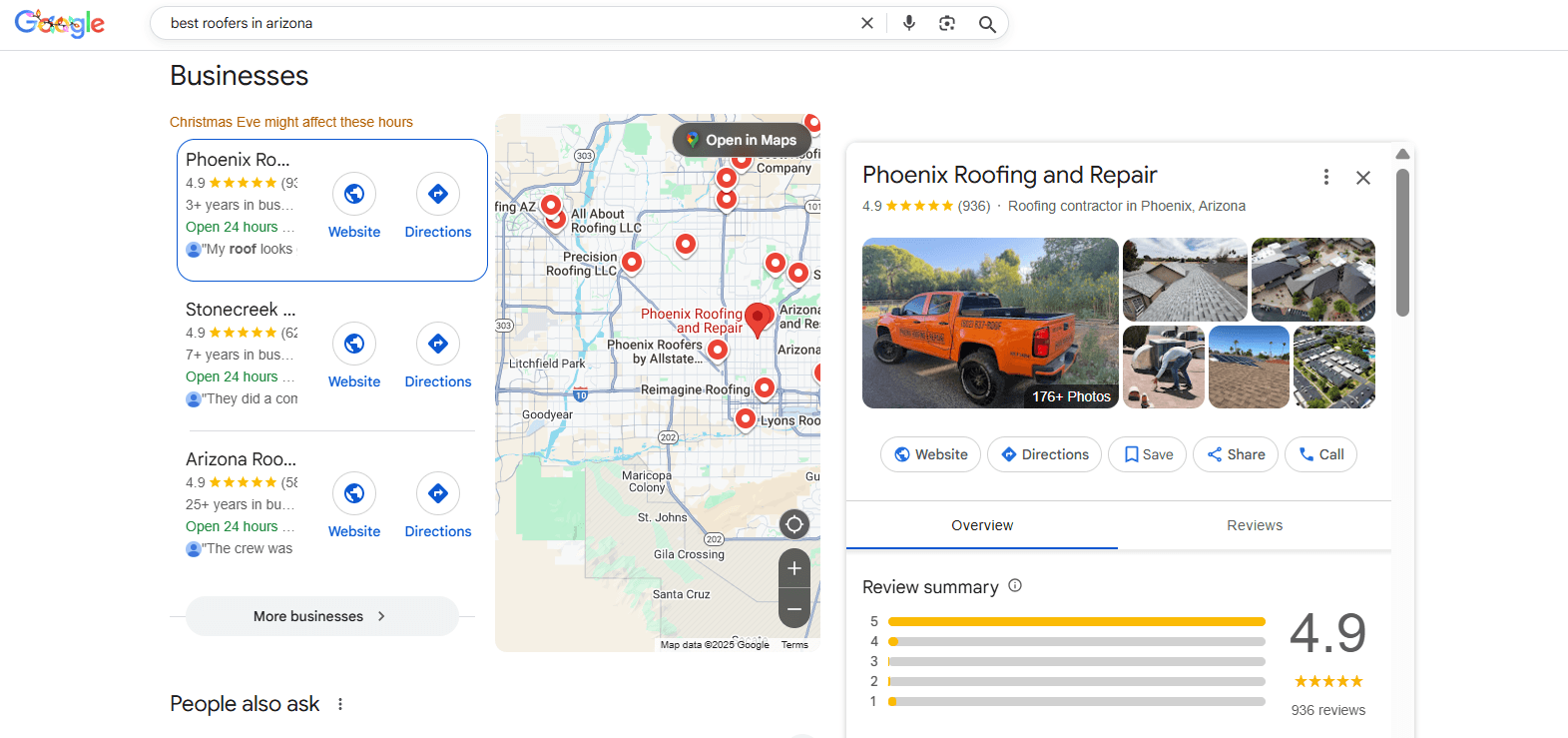
For roofers, local SEO success depends less on broad optimization and more on execution of a few core elements, like:
- Google Business Profile optimization: Accurate business details, a correctly set primary category (often “Roofing contractor”), defined service areas, and complete service listings help match your business to local roofing searches.
- Roofing-specific proof signals: Project photos, before-and-after roof replacements, jobsite images, and crew photos reinforce credibility before a homeowner calls.
- Review generation and response: Reviews influence local rankings and call-through rates, especially for competitive roofing SEO keywords tied to emergency repairs and insurance-related work.
- Service- and location-based pages: Pages targeting roof repair, roof replacement, and storm damage services by city or county support how homeowners search and help convert visibility into inspection requests.
Local SEO delivers measurable efficiency gains when executed consistently. For instance, after improving local visibility, Boss Mechanical, an HVAC service provider, achieved an 89% increase in page-one keyword rankings and reduced organic cost per lead by 70%. This demonstrates how strong local presence lowers acquisition costs over time.
2. Get ‘Google screened’: Google local services ads (LSAs)
For many roofing companies, Google Local Services Ads (LSAs) serve as the most practical entry point into paid advertising. LSAs appear at the very top of local search results and connect roofers with homeowners actively requesting service — often for roof repairs, inspections, or storm damage assessments.
LSAs operate on a cost-per-lead model, meaning you pay for qualified phone calls or message leads rather than clicks. For roofers, this structure aligns closely with how jobs start: a homeowner calls, explains the issue, and requests an inspection or estimate.
The Google Guaranteed badge adds an additional layer of trust by verifying licensing and insurance, which can increase call confidence for high-ticket roofing work.
3. Turn reviews into revenue: Proactive reputation management
In roofing marketing, reviews influence more than credibility — they shape whether homeowners call, book inspections, and approve estimates. High-ticket services like roof replacement or storm damage repairs depend heavily on trust established before the first conversation.
Modern reputation management focuses on activating social proof, not just collecting it. Strong reviews should support every stage of the buying journey, from initial research to final contractor selection.
Roofing companies that generate consistent results use reviews as visible, repeatable marketing assets:
- Feature reviews on high-intent pages: Add testimonials to roof repair, roof replacement, and inspection pages to reinforce trust where homeowners make decisions.
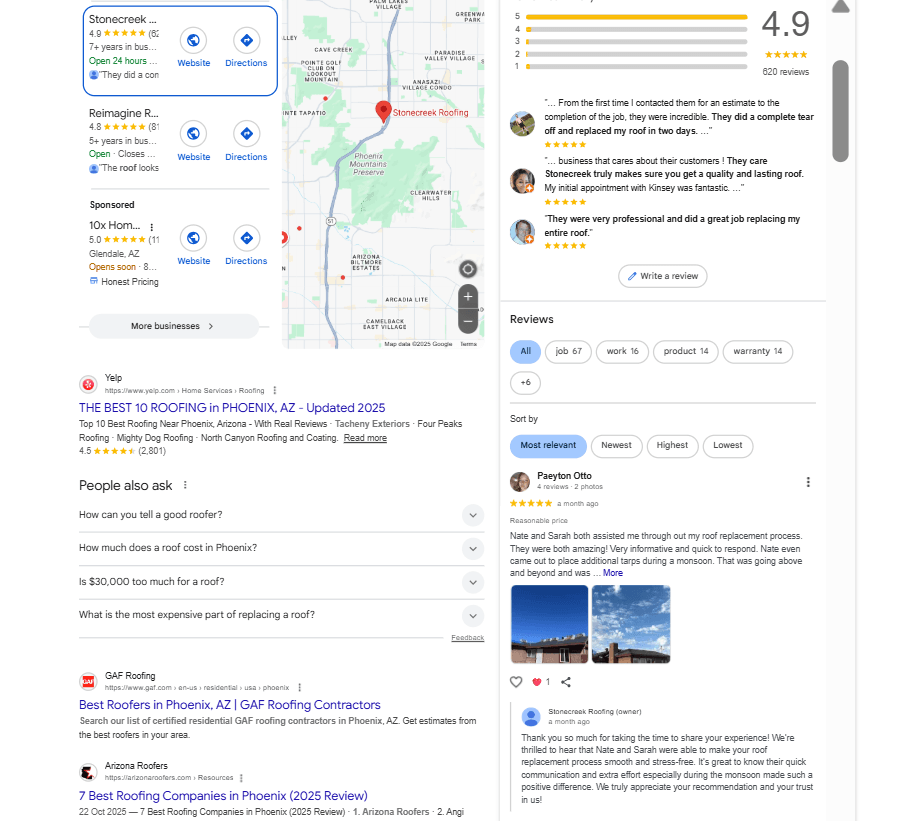
- Highlight service-specific proof: Pair reviews with the exact services mentioned, such as insurance claims assistance, emergency repairs, or full roof installations.
- Create short video testimonials: Simple post-project videos recorded on-site build credibility and reduce hesitation for large roofing investments.
- Reuse reviews in paid and social campaigns: Incorporate star ratings, homeowner quotes, and project feedback into social media ads and local promotions to warm prospects before they call.
- Respond with a system: Timely, professional responses to reviews signal reliability and influence homeowner confidence when comparing contractors.
4. Scale with precision: Google Ads (PPC)
Google Ads enters the roofing marketing mix at a specific point: when demand exists, crews are available, and the business wants to intentionally grow revenue, not simply increase call volume.
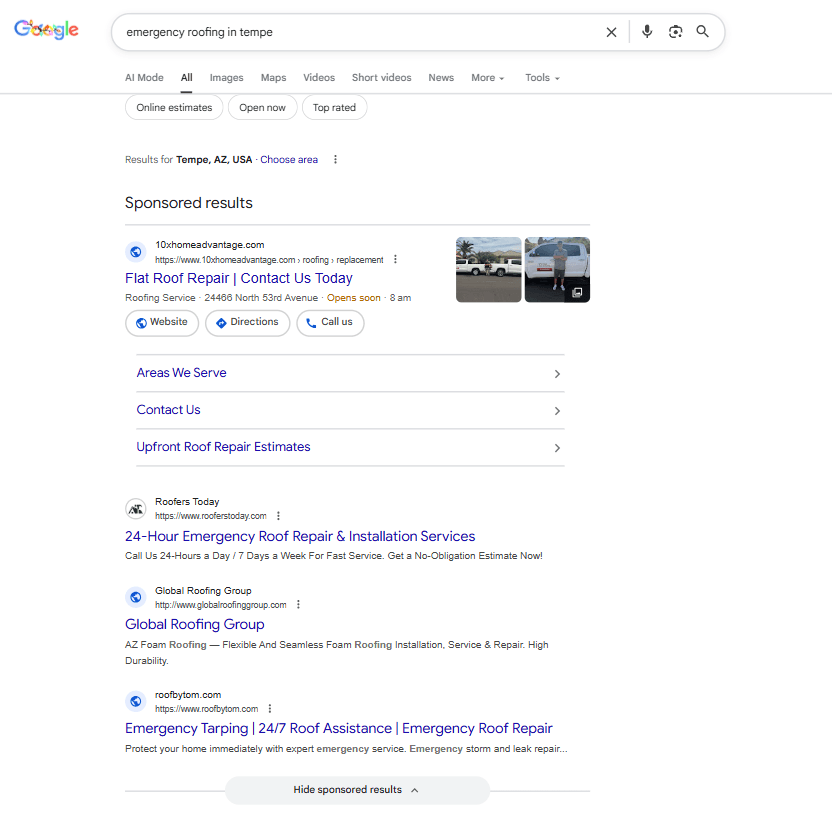
Unlike LSAs, which prioritize availability and trust signals, Google Ads allows roofers to design demand. Campaigns can focus on specific roofing services, materials, and locations, giving contractors control over which jobs they pursue and where growth happens.
This level of control becomes especially valuable for high-margin and specialized work, including metal roofing, commercial flat roofing systems (such as TPO or EPDM), large replacement projects, and insurance-related jobs that require qualified leads rather than urgency alone.
Strategic paid advertising supports scale when execution stays disciplined. After launching targeted paid campaigns, Maryland Sunrooms increased conversions from paid ads by 670% and reduced cost-per-lead by 321%, demonstrating how precision targeting can unlock growth without sacrificing efficiency.
5. Build your brand, not just your likes: Strategic social media
Social media plays a supporting role in roofing marketing, shaping familiarity and trust long before a homeowner requests an inspection or estimate. For high-consideration services like roof replacement or storm damage repairs, recognition often influences who gets the first call — even if the lead comes from a search later.
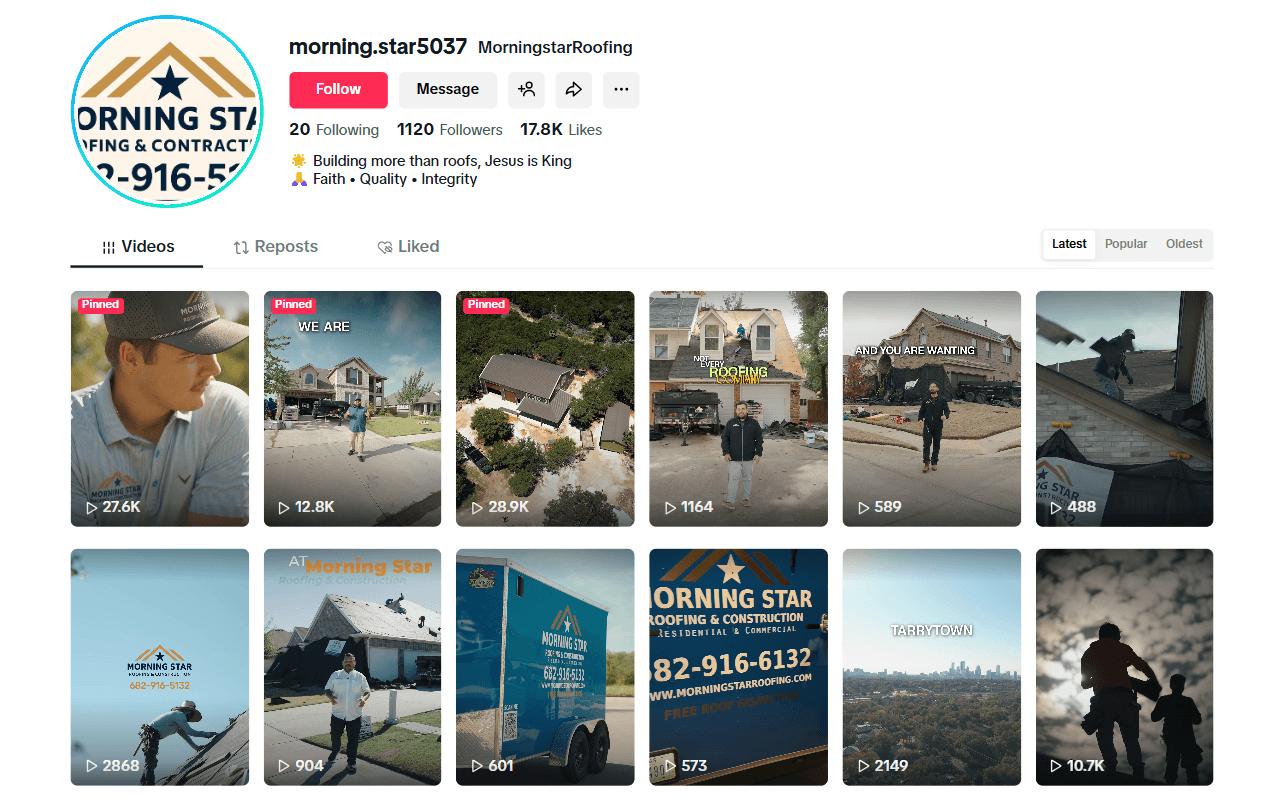
The most common mistake roofers make on social platforms involves treating social media as a direct lead channel. Platforms like Facebook, Instagram, and TikTok perform better when used to reduce uncertainty and reinforce credibility rather than generate immediate bookings.
Roofing companies that see value in social media focus on visibility and confidence-building:
- Show completed projects clearly: Before-and-after photos, drone footage, and short walkthrough videos help homeowners visualize workmanship and scale.
- Introduce the people behind the work: Crew spotlights, jobsite clips, and day-in-the-field content humanize the brand and support trust.
- Highlight proof, not promotions: Reviews, testimonials, certifications, and local awards reinforce legitimacy without sounding sales-driven.
- Run localized awareness ads: Targeted campaigns help reinforce brand recognition within service areas, supporting future search and referral activity.
6. Create a referral engine: Systematizing word-of-mouth
Referrals remain one of the highest-converting sources of roofing jobs because they arrive with trust already established. For roof replacement, insurance work, and large repair projects, a recommendation from a neighbor or family member often shortens the decision process significantly.
The difference between occasional referrals and consistent referral-driven growth comes down to process. Roofing companies that rely on passive word-of-mouth leave opportunity on the table, while those that systematize referrals turn completed projects into a repeatable source of inspection requests.
Effective referral programs focus on timing, clarity, and ease:
- Ask at the right moment: The best time to request referrals comes immediately after project completion, when satisfaction is highest and results are visible.
- Make the incentive simple: Gift cards, referral fees, or service credits give homeowners a clear reason to share your name.
- Remove friction: Short referral forms, quick text links, or follow-up emails make participation effortless.
- Reinforce locally: Yard signs, trucks, and completed-project photos help neighbors connect the referral to visible work nearby.
7. Avoid the trap: Navigating shared lead marketplaces
Shared lead marketplaces continue to attract roofing companies because they promise immediate volume. Platforms like these can surface inspection requests quickly, especially during storm season or slow periods. The challenge lies in how those leads are distributed and priced.
Shared leads introduce competition at the moment of contact. Multiple contractors often receive the same homeowner inquiry, which increases price sensitivity and reduces control over the sales process. For roofing companies offering high-ticket services, this dynamic can compress margins and consume valuable time qualifying prospects who may already be speaking with several competitors.
Some roofing companies use shared lead platforms selectively:
- As short-term gap fillers: During seasonal slowdowns or crew expansion phases
- For specific services: Minor repairs or inspections with faster sales cycles
However, reliance on shared leads creates operational risk when they become the primary growth channel. Lead quality varies, exclusivity remains limited, and long-term equity does not accumulate the way it does with owned channels.
Roofers who must use shared lead services should focus on speed and qualification. Fast response times, clear pricing boundaries, and firm service criteria help reduce wasted effort and protect profitability.
In-house vs. Agency: When to hire a marketing partner
Most roofing companies start by managing marketing internally. As lead goals grow and channels become more complex, many reach a point where internal capacity and expertise limit results.
The comparison below outlines when each approach tends to be most effective.
| Decision Factor | In-House Marketing | Agency Partner |
| Time investment | Requires ongoing attention from owners or staff alongside daily operations | Dedicated team handles execution and optimization |
| Channel coverage | Best suited for one or two core channels (GBP, reviews) | Manages multi-channel strategies (SEO, LSAs, Google Ads, website) |
| Industry expertise | Depends on internal experience and learning curve | Built-in experience with roofing and home services |
| Speed of execution | Changes happen as time allows | Faster testing, optimization, and rollout |
| Lead quality control | Limited visibility across channels | Centralized tracking and refinement |
| Scalability | Constrained by internal bandwidth | Designed to support expansion and growth |
| Cost structure | Lower upfront cost, higher opportunity cost | Higher monthly investment, broader return potential |
| Strategic guidance | Tactical and reactive | Strategic and proactive |
Frequently asked questions about roofing marketing
What is the best marketing for a small roofing company?
The most effective marketing for a small roofing company starts with high-control, high-intent channels.
Optimizing your Google Business Profile and local SEO helps capture homeowners actively searching for roof repair or replacement, while a simple referral system turns completed jobs into new inspection requests. This approach stays capital-efficient and builds momentum without relying on paid lead volume.
How do you market a commercial roofing company versus a residential?
Commercial roofing marketing typically involves longer sales cycles and fewer, higher-value projects.
Instead of broad local channels, commercial roofers benefit from relationship-driven outreach, targeted LinkedIn visibility, and content that speaks to property managers, facility directors, and developers. Residential roofing relies more heavily on local search, reviews, and neighborhood trust signals.
What marketing tools should every roofer use?
At a minimum, roofers benefit from a simple CRM, a review generation tool, and call tracking software. A CRM helps manage inspection requests and follow-ups, review tools support ongoing reputation management, and call tracking clarifies which channels drive booked jobs. Together, these tools improve visibility into lead quality and marketing ROI.
How can I automate my roofing lead follow-up?
Basic automation improves contact rates and reduces missed opportunities. Most roofing companies start by setting up an immediate SMS and email response to new web or form leads, followed by a scheduled follow-up reminder if contact isn’t made.
This approach matters because missed calls and delayed responses account for a significant share of lost roofing opportunities.
Build a roofing marketing system you control
Effective roofing marketing comes from consistency, not volume. Companies that grow sustainably focus on channels they can manage, measure, and improve over time — from local search visibility to referral-driven demand and selective paid growth.
When efforts follow a clear sequence, marketing becomes more predictable. Local SEO establishes visibility, paid channels support intentional expansion, and trust signals improve close rates across the funnel. As goals increase, execution and measurement often determine whether growth stays profitable.
Contact us online today or call us at 888-601-5359 if you’re ready to start evaluating your current roofing marketing strategy.
-
 Lornah Ngugi is a seasoned digital marketing writer with 6+ years of experience translating complex marketing strategies into engaging, results-driven content. She holds a B.S. in Business Information Technology and is certified in HubSpot Academy, Google Analytics, LinkedIn Marketing, and Google Digital Academy. Lornah regularly contributes to the WebFX blog and SEO.com, where she’s authored hundreds of marketing guides that help readers turn their goals into measurable results through practical, data-informed insights. When she’s not writing, you’ll find her enjoying a quiet walk in the park, sipping black coffee, or finding creative inspiration in a good chocolate bar.
 -

WebFX is a full-service marketing agency with 1,100+ client reviews and a 4.9-star rating on Clutch! Find out how our expert team and revenue-accelerating tech can drive results for you! Learn more
Try our free Marketing Calculator
Craft a tailored online marketing strategy! Utilize our free Internet marketing calculator for a custom plan based on your location, reach, timeframe, and budget.
Plan Your Marketing Budget
Table of Contents
- The modern roofing marketing playbook: 7 core strategies
- 1. Dominate local search: Google Business Profile (GBP) & local SEO
- 2. Get ‘Google screened’: Google local services ads (LSAs)
- 3. Turn reviews into revenue: Proactive reputation management
- 4. Scale with precision: Google Ads (PPC)
- 5. Build your brand, not just your likes: Strategic social media
- 6. Create a referral engine: Systematizing word-of-mouth
- 7. Avoid the trap: Navigating shared lead marketplaces
- In-house vs. Agency: When to hire a marketing partner
- Frequently asked questions about roofing marketing
- Build a roofing marketing system you control
Share this article


Outrank Local Competitors This Season
See how home service pros like you are dominating local Google results and booking more jobs.
Try our free Marketing Calculator
Craft a tailored online marketing strategy! Utilize our free Internet marketing calculator for a custom plan based on your location, reach, timeframe, and budget.
Plan Your Marketing Budget
What to read next




Additional Reading



Home Services Case Studies
Solving key challenges for home services companies
Our website isn’t ranking in the search results for home services
When people or businesses need home services in their area, they take to search engines like Google. Ensure your website appears at the top of the results when your target audience needs your services.

We’re struggling to grow our team
Expanding your team and growing your business go hand-in-hand. If you need help growing your team with talented and friendly employees, our recruitment marketing services have you covered.

We’re not generating enough leads
Are people visiting your website but not getting in touch with you? Our expert marketing specialists and web designers can optimize all areas of your website so you can attract and convert more of your target audience to use your home services.

We’re not attracting new customers
Having trouble increasing your online visibility, so you can attract new customers? Our award-winning marketing services get your brand in front of the right people in your local area.

Frequently asked questions about roofing marketing
What is the best marketing for a small roofing company?
The most effective marketing for a small roofing company starts with high-control, high-intent channels.
Optimizing your Google Business Profile and local SEO helps capture homeowners actively searching for roof repair or replacement, while a simple referral system turns completed jobs into new inspection requests. This approach stays capital-efficient and builds momentum without relying on paid lead volume.
How do you market a commercial roofing company versus a residential?
Commercial roofing marketing typically involves longer sales cycles and fewer, higher-value projects.
Instead of broad local channels, commercial roofers benefit from relationship-driven outreach, targeted LinkedIn visibility, and content that speaks to property managers, facility directors, and developers. Residential roofing relies more heavily on local search, reviews, and neighborhood trust signals.
What marketing tools should every roofer use?
At a minimum, roofers benefit from a simple CRM, a review generation tool, and call tracking software. A CRM helps manage inspection requests and follow-ups, review tools support ongoing reputation management, and call tracking clarifies which channels drive booked jobs. Together, these tools improve visibility into lead quality and marketing ROI.
How can I automate my roofing lead follow-up?
Basic automation improves contact rates and reduces missed opportunities. Most roofing companies start by setting up an immediate SMS and email response to new web or form leads, followed by a scheduled follow-up reminder if contact isn’t made.
This approach matters because missed calls and delayed responses account for a significant share of lost roofing opportunities.