Contents
- What is AI lead generation?
- Why is AI effective for lead generation?
- Top use cases for AI lead generation
- 1. Identify high-intent prospects before competitors
- 2. Score and prioritize leads based on conversion probability
- 3. Qualify inbound leads instantly with AI
- 4. Use AI to hyper-personalize outreach at scale
- 5. Forecast pipeline performance and buying intent
- 6. Optimize paid campaigns in real time
- How to prepare for AI integration in your lead generation process
- Common AI lead generation execution risks (and how to avoid them)
- Is AI lead generation right for your organization?
- Build a smarter lead pipeline with AI
- FAQs about AI for lead generation
AI lead generation is the practice of using artificial intelligence (AI) tools and platforms to help businesses reach more potential customers online.
More than 8 in 10 marketers worldwide now use AI in some part of their marketing efforts. For sales and marketing teams, you need AI lead generation to avoid falling behind competitors who are already leveraging it to find better prospects, engage them more effectively, and streamline the flow of opportunities.
This guide provides you with a practical AI for lead generation strategy. You’ll see how AI supports lead generation across identification, qualification, engagement, and optimization.
What is AI lead generation?
AI lead generation is the use of AI technologies to expand, accelerate, and optimize how organizations attract, qualify, and convert potential customers.
For strategic marketers, it’s is best understood as an interconnected set of capabilities:
- Audience discovery and expansion: Using data and machine learning to surface prospects who show high intent before competitors do.
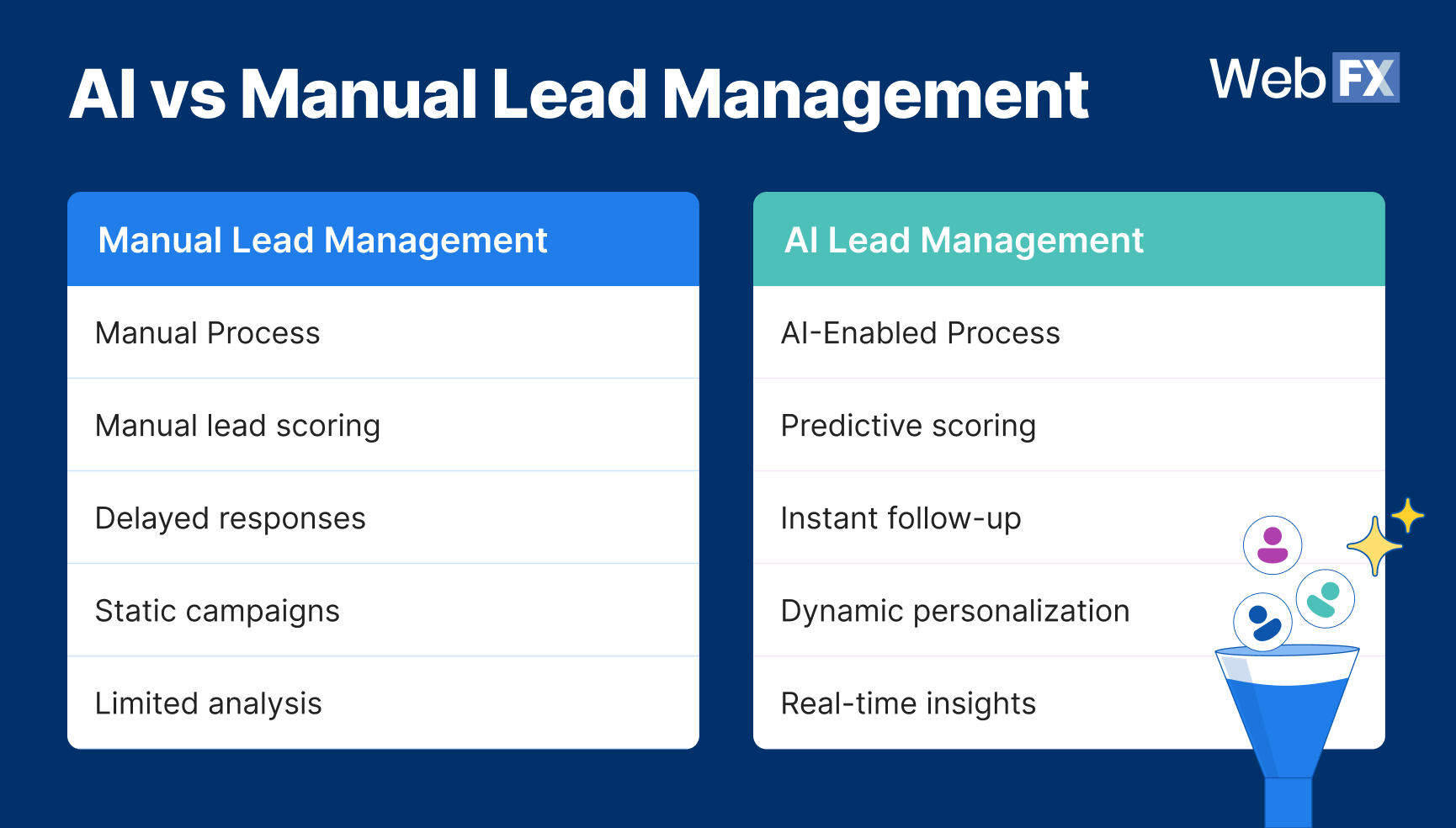
- Opportunity prioritization: Predictive scoring models rank leads by their likelihood to convert, enabling sales teams to focus on opportunities with the greatest impact.
- Context-driven engagement: AI systems adapt messaging and content recommendations based on real-time behavior and historical patterns.
- Continuous optimization: Performance data feeds back into models, improving targeting accuracy, timing, and sequencing over time.
Why is AI effective for lead generation?
Lead generation in 2026 requires precision, speed, and relevance across increasingly fragmented buyer journeys. AI strengthens pipeline performance by automating processes and reducing the time spent on manual data entry, research, and lead outreach.
Here are the key reasons organizations are accelerating AI adoption for lead generation:
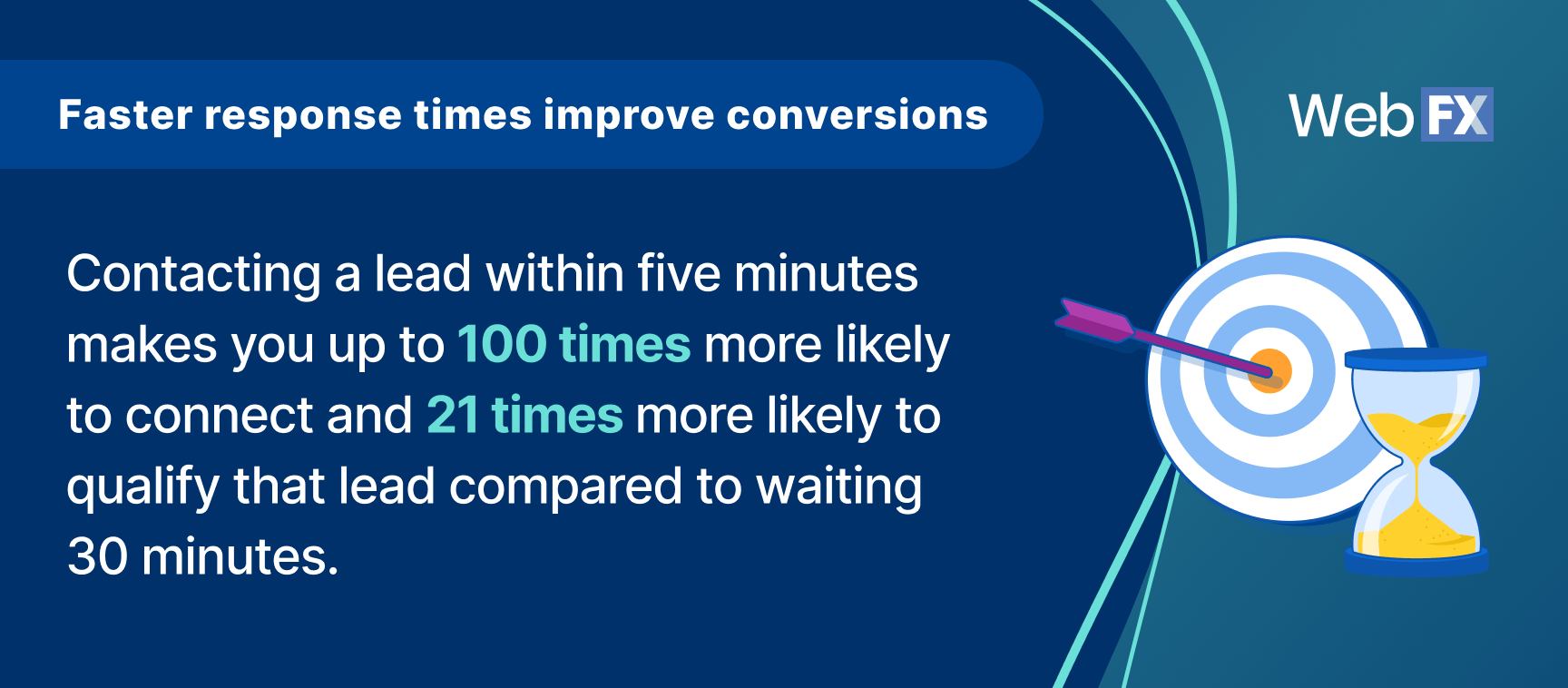
- Faster response times improve conversions: Research from MIT and InsideSales.com found that contacting a lead within five minutes makes you up to 100 times more likely to connect and 21 times more likely to qualify that lead compared to waiting 30 minutes.
- AI increases sales productivity: McKinsey estimates AI can lift sales productivity by 3–5% annually by automating repetitive tasks and improving lead prioritization.
- Buyers expect personalization: Salesforce reports that 73% of customers expect companies to understand their needs and expectations. AI enables scalable, context-driven engagement, ensuring your clients feel consistently seen and heard.
- Marketing budgets face efficiency pressure: Gartner research shows marketing budgets have declined to 7.7% of revenue in 2024 compared to 9.1% of revenue in 2023. AI helps you to do more with smaller budgets by optimizing the lead generation process.
- Data volume exceeds human processing capacity: Modern buyer journeys generate thousands of behavioral signals, which AI systems process and generate actionable insights from efficiently and effectively.
Top use cases for AI lead generation
AI’s value in lead generation becomes clearer when you examine how it operates at key points in the pipeline.
The use cases below illustrate the crucial points where AI supports lead generation:

1. Identify high-intent prospects before competitors
One of the biggest challenges in modern lead generation is identifying buying intent early enough to act on it. Prospects often research solutions long before submitting a form or requesting a demo.
So, by the time they convert, multiple vendors may already be in consideration. To spot early signs that someone may be preparing to buy, AI lead generation tools analyze behavioral signals such as:
- Repeated website visits
- High-value page engagement
- Content downloads
- Search patterns
- Third-party intent data
AI evaluates patterns that historically correlate with conversion on all relevant platforms.
A good example of an instance where AI was used for sales prospecting is during WebFX’s partnership with Enabling Devices. They came to us in 2024, looking for a solution to their declining organic traffic despite a robust traditional SEO foundation.
By implementing OmniSEO®, we helped them gain visibility into their AI visibility and unlocked clear attribution of their AI results. Now they get to enjoy:
- 542% increase in leads from AI
- 385% increase in AI Overviews visibility
- 105% increase in total visibility
2. Score and prioritize leads based on conversion probability
As lead volume grows, prioritization becomes critical.
Manual scoring frameworks that assign points to isolated actions, such as email opens or single-page visits, rarely capture the full context of buyer readiness.
AI-powered lead scoring evaluates hundreds of data signals simultaneously from multiple touchpoints, including website visits, email engagement, social media interactions, and your CRM. Then:
- Continuously refines itself as new data enters the system
- Analyzes this data to identify patterns and behaviors that have historically correlated with higher conversion rates
- Assigns scores to each lead based on factors such as demographics, actions, and overall engagement levels
Modern customer relationship management (CRM) platforms such as HubSpot, Salesforce Einstein, and Nutshell incorporate predictive lead scoring features that dynamically rank leads, allowing sales teams to focus on accounts most likely to close.
3. Qualify inbound leads instantly with AI
Not every inbound lead is ready for sales. Some visitors are researching. Others are comparing options. A few are prepared to make a decision quickly. Treating all of them the same creates friction for both marketing and sales teams.
AI-driven lead qualification helps sort inbound leads based on real engagement signals. Instead of relying only on a single form submission, AI systems evaluate behavior such as:
- Pages viewed
- Time spent on high-intent content
- Repeat visits
- Resource downloads
- Referral source
By analyzing these patterns together, AI can help determine which leads show strong buying intent and which need further nurturing.
This structured qualification improves focus. Sales teams spend more time speaking with prospects who are actively evaluating solutions, while earlier-stage visitors enter automated nurture tracks that keep them engaged without overwhelming your team.
Modern CRM and marketing automation platforms often include AI-assisted lead routing and scoring features that support this process. When implemented thoughtfully, inbound qualification becomes more consistent, measurable, and aligned with revenue goals.
4. Use AI to hyper-personalize outreach at scale
Personalized outreach consistently outperforms generic messaging in both response rates and closed sales.
Good thing AI helps you tailor outreach to real signals, such as industry, job title, company size, past engagement, and content consumption. Instead of sending the same generic message to all your leads, you can generate message variations that reflect where a prospect is in their research process.
Generative AI tools now support hyper-personalized outreach in the following ways:
- Writing segmented email sequences based on persona
- Adapting tone and positioning by industry
- Triggering follow-ups based on website or email engagement
- Recommending next-best messaging based on response patterns
Global brands already apply this model at scale. Starbucks, for example, uses its AI engine, Deep Brew, to personalize customer offers and messaging based on purchase history, time of day, and engagement patterns.
This level of behavioral personalization has contributed to stronger customer retention and increased transaction frequency. Leveraging AI in a similar way allows you to expand outreach capacity while maintaining message relevance. As a result, you improve engagement quality and protect efficiency without adding headcount.
5. Forecast pipeline performance and buying intent
It’s one thing to know who might convert. It’s another to know when they’re actually getting ready to buy.
AI helps you spot those moments. By looking at patterns over time, like repeat visits to pricing pages, multiple people from the same company browsing your site, or someone returning after weeks of silence. AI can flag when interest is building.
Instead of guessing who to follow up with first, you can see:
- Which accounts are becoming more active
- Which leads have gone quiet
- When interest starts to increase
- Where opportunities might slow down
As new activity comes in, the system updates automatically. You don’t have to manually connect the dots. That visibility helps you time your outreach better. You can reach out when someone is clearly evaluating, rather than sending another check-in email when they’re not paying attention.
6. Optimize paid campaigns in real time
Running pay-per-click ads without real-time feedback is expensive.
AI helps you adjust quickly based on what’s actually working.
Instead of waiting weeks to see which campaigns perform, AI looks at live data and automatically shifts budget toward the audiences and ads that are generating qualified leads. It can pause underperforming placements, test variations, and refine targeting without constant manual oversight.
This means you can:
- Put more budget behind audiences that convert
- Stop spending on ads that attract the wrong people
- Adjust messaging based on how prospects respond
- Focus on leads that turn into real opportunities
Platforms like Google Ads and Meta already use AI-driven bidding and targeting. When you connect that data to your CRM, optimization goes deeper — you’re not just chasing clicks, you’re improving the quality of leads entering your pipeline.
Over time, this protects your budget and helps you get more value from every dollar you spend.
How to prepare for AI integration in your lead generation process
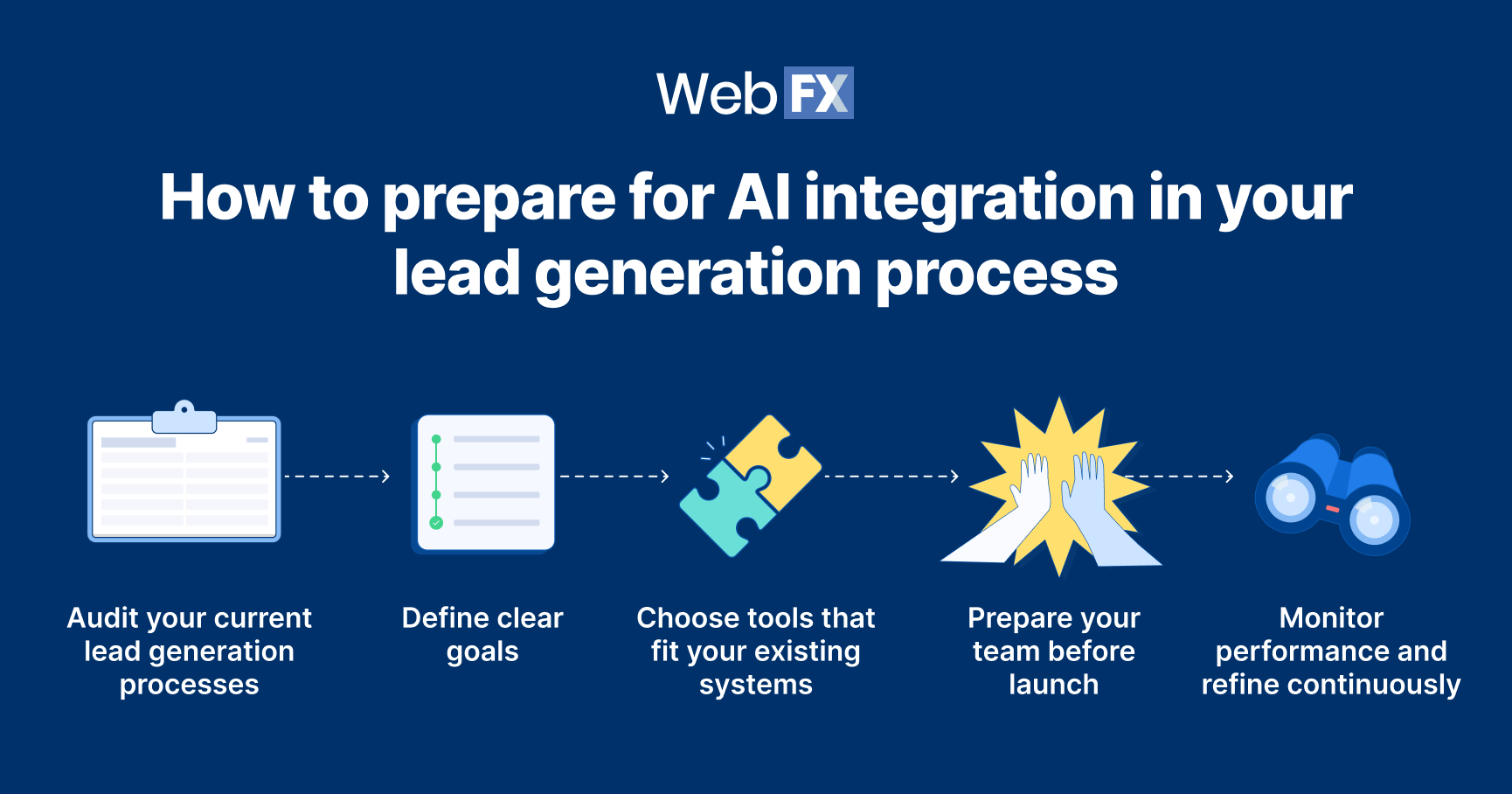
AI works best when it strengthens a process that already exists. So, here’s how to go about implementing AI for lead generation:
- Audit your current lead generation processes: Before introducing new tools, take time to understand how your current lead generation system operates. Look at how leads are captured, scored, routed, and followed up on today. Identify friction points and make a plan to smooth those out.
- Define clear goals: Be specific about what you want AI to improve. Do you want to increase qualified leads? Improve conversion rates? Shorten the time to first response? Improve visibility into lead sources? Clear goals make it easier to evaluate tools and measure results later.
- Choose tools that fit your existing systems: AI tools should integrate with your CRM, marketing automation platform, and advertising channels. If a solution requires you to rebuild your workflow from scratch, adoption becomes harder.
- Prepare your team before launch: Technology alone does not improve performance. Your team needs to understand what it does and how to use it.
- Monitor performance and refine continuously: After implementation, track meaningful metrics, lead quality, conversion rate by source, time to conversion, and engagement levels.
Common AI lead generation execution risks (and how to avoid them)
AI can improve how you generate and manage leads. It can also create confusion if introduced without structure. Most execution issues don’t come from the technology itself. They come from unclear processes and expectations.
Here are the most common risks to watch for.
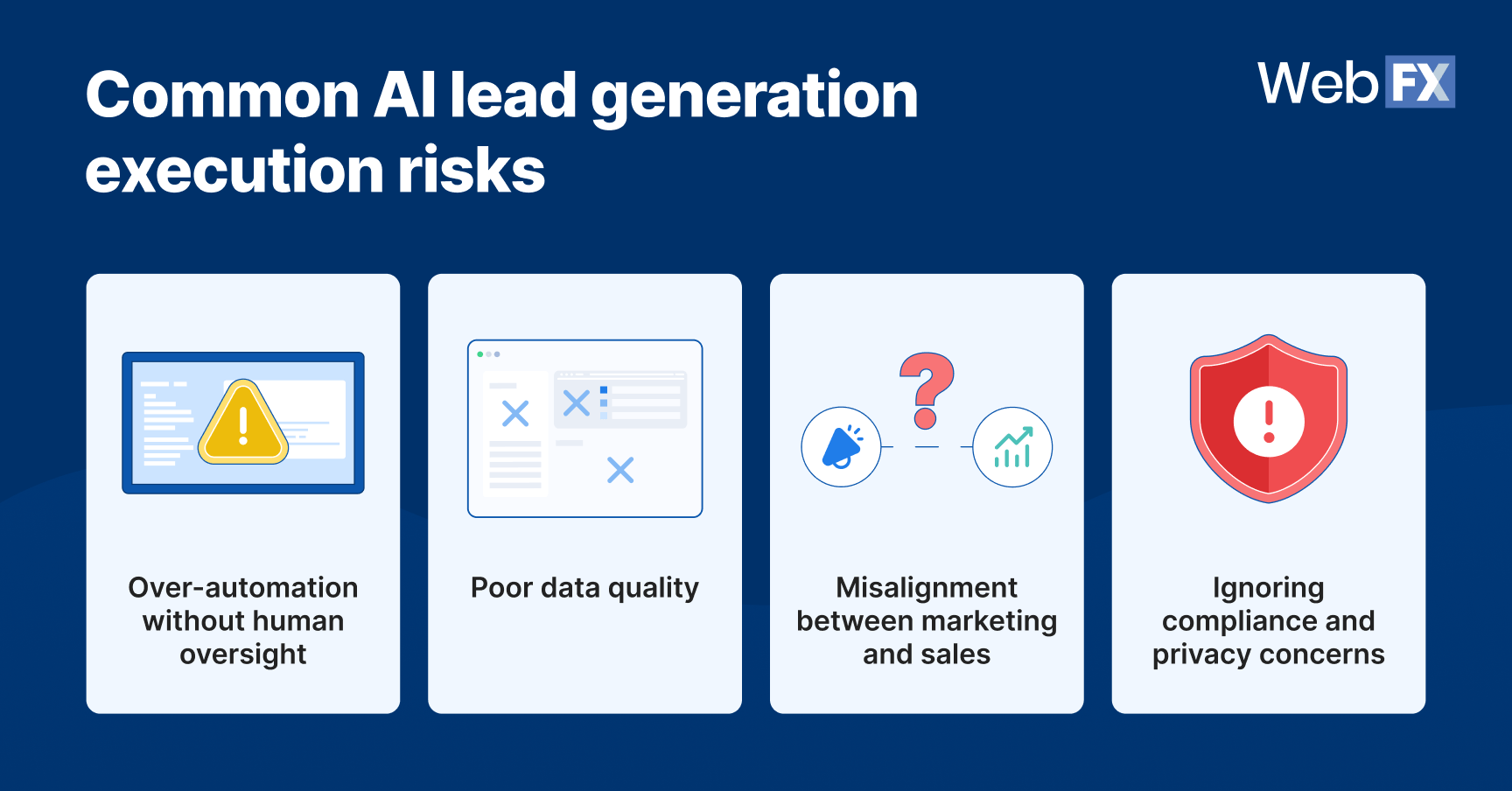
- Over-automation without human oversight: Fully automated systems can misinterpret signals or send poorly timed messaging. Human judgment should guide final decisions and step in when intent is strong or when conversations become nuanced.
- Poor data quality: AI systems rely on clean, structured data. If your CRM contains outdated records, duplicate contacts, or inconsistent fields, predictions and scoring will be less reliable. So, you should audit your data before implementation and ensure clean inputs for accurate output.
- Misalignment between marketing and sales: If marketing relies on AI scoring but sales ignores it, or if sales expects AI to replace relationship-building, friction builds quickly. Align early, agree on what qualifies as a strong lead, how scores are interpreted, and when handoffs happen.
- Ignoring compliance and privacy concerns: AI often processes large volumes of behavioral and personal data. Mishandling that data can create regulatory and reputational risk. Review your data policies, ensure compliance relevant regulations, and be transparent about how data is used in automated processes.
Is AI lead generation right for your organization?
AI can improve how you identify, prioritize, and engage leads. Whether it makes sense for you depends on your current systems, scale, and growth goals.
You can determine whether lead generation is for you by asking the following assessment questions:
- Do you manage enough lead volume to benefit from automation? Manual review may still be effective if you generate a few highly qualified inquiries each month. However, you’re better off using AI to manage hundreds to thousands of leads across multiple channels.
- Do you struggle with prioritization or response timing? If high-intent prospects sit in your CRM without fast follow-up, or if sales time is spent chasing low-quality inquiries, AI will help to improve structured scoring and behavioral tracking.
- Is your data organized and reliable? AI relies on clean, structured data. If contact records are inconsistent, duplicated, or missing engagement history, predictions and scoring will be less accurate.
- Do you want better visibility into what actually drives revenue? If it’s difficult to connect marketing activity to sales outcomes, AI-driven attribution and tracking can provide clearer insight into which channels, campaigns, and engagement patterns influence conversion.
- Are you prepared to combine automation with human judgment? AI strengthens systems. It does not replace relationships. If you are willing to define clear handoff points, monitor performance, and refine workflows over time, AI becomes a multiplier. Without that oversight, it can create noise.
FAQs about AI for lead generation
What is AI lead generation?
AI lead generation uses machine learning, predictive analytics, and automation to improve how you identify, qualify, and engage potential customers.
Instead of manually reviewing leads or sending static outreach, AI analyzes behavioral signals, engagement history, and conversion patterns to prioritize high-intent prospects and improve timing.
How does AI improve lead quality?
AI evaluates multiple signals at once, including website behavior, engagement history, firmographic data, and timing patterns to determine which prospects are most likely to convert. This helps you focus on higher-intent opportunities rather than relying on isolated actions, such as a single form submission.
Can AI replace traditional lead generation methods?
AI strengthens existing lead generation systems. It enhances targeting, scoring, and personalization, but still depends on a clear strategy, strong messaging, and human relationship-building. The most effective systems combine automation with human oversight.
What types of businesses benefit most from AI lead generation?
Organizations that manage high lead volume, operate across multiple acquisition channels, or serve buyers with complex research journeys typically benefit most. AI becomes especially valuable when response speed, prioritization, and attribution clarity directly impact revenue.
How long does it take to see results from AI lead generation?
Timeline depends on implementation scope and data quality. Improvements in prioritization and response time can occur quickly. Predictive modeling and optimization tend to strengthen over time as more behavioral data is processed.
Is AI lead generation compliant with data privacy regulations?
AI systems must follow the same data protection standards as any marketing technology. Compliance depends on how customer data is collected, stored, and processed. Organizations should ensure adherence to regulations and maintain transparent data practices.
What are the biggest risks when implementing AI for lead generation?
Common risks include poor data quality, unclear goals, over-automation without oversight, and misalignment between marketing and sales. Clear processes, structured training, and ongoing monitoring reduce these risks significantly.
Build a smarter lead pipeline with AI
AI is reshaping how businesses discover, prioritize, and convert leads. Organizations that apply AI strategically gain faster response times, better lead prioritization, and clearer insight into what drives pipeline growth.
WebFX helps businesses turn those insights into measurable results with RevenueCloudFX, our proprietary marketing platform built to connect marketing activity directly to revenue.
With AI-powered analytics and attribution built into RevenueCloudFX, businesses gain visibility into the campaigns, channels, and buyer signals that drive growth. In fact, our technology has already helped generate 12,335 AI-driven leads and more than 617,125 visits from AI-generated traffic for our clients.
Combined with 8+ years of AI investment and our internal AI engine TeamAI, WebFX helps businesses automate workflows, uncover opportunities faster, and scale marketing performance.
Contact us online or call us at today to speak to a strategist about your custom AI lead generation strategy.
-
 Emily Carter is the Sr. Content Team Lead at WebFX, where she leads the creative team behind the company’s website, blog, and email campaigns. With an M.S. in Digital Marketing and 10+ years of experience, she’s written and reviewed hundreds of articles on marketing, SEO, and tech, helping businesses turn complex topics into actionable strategies. Her work appears across WebFX and its brands, including SEO.com, Nutshell, and TeamAI, and has been featured by Social Media Today, HuffPost, and more. Outside the office, she’s usually road-tripping, hiking, or planning her next national park adventure.@emcarter16
 -

WebFX is a full-service marketing agency with 1,100+ client reviews and a 4.9-star rating on Clutch! Find out how our expert team and revenue-accelerating tech can drive results for you! Learn more

Try our free Marketing Calculator
Craft a tailored online marketing strategy! Utilize our free Internet marketing calculator for a custom plan based on your location, reach, timeframe, and budget.
Contents
- What is AI lead generation?
- Why is AI effective for lead generation?
- Top use cases for AI lead generation
- 1. Identify high-intent prospects before competitors
- 2. Score and prioritize leads based on conversion probability
- 3. Qualify inbound leads instantly with AI
- 4. Use AI to hyper-personalize outreach at scale
- 5. Forecast pipeline performance and buying intent
- 6. Optimize paid campaigns in real time
- How to prepare for AI integration in your lead generation process
- Common AI lead generation execution risks (and how to avoid them)
- Is AI lead generation right for your organization?
- Build a smarter lead pipeline with AI
- FAQs about AI for lead generation
Share this article


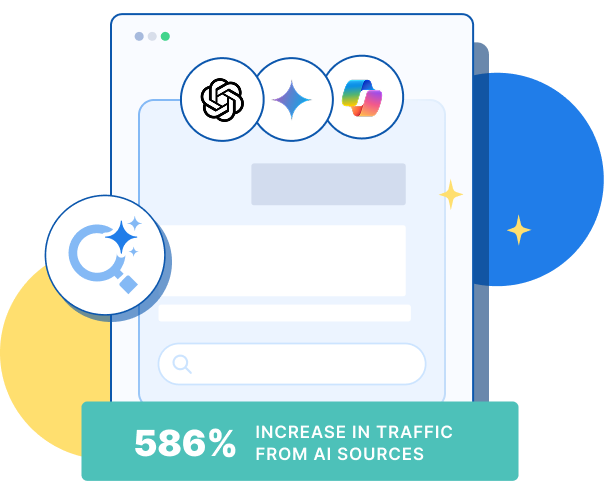
See AI Marketing in Action
Explore how WebFX helped a regional brand get discovered in AI search experiences — proving what’s possible with today’s AI-driven marketing!
Try our free Marketing Calculator
Craft a tailored online marketing strategy! Utilize our free Internet marketing calculator for a custom plan based on your location, reach, timeframe, and budget.