


Table of Contents
- How to use ChatGPT for digital marketing
- 1. Research and analysis
- 2. Content marketing
- 3. Email marketing
- 4. SEO
- 5. PPC and paid media
- 6. Social media marketing
- 7. Data reporting
- Best practices for using ChatGPT for digital marketing
- Limitations of ChatGPT for digital marketers
- FAQs about using ChatGPT for digital marketing
- Leverage the power of AI with digital marketing experts
- Provide background information about a particular topic
- Generate topic ideas
- Create blog outlines
- Develop a list of FAQs for your business or product page
- Get subject line ideas
- Personalize email messages
- Analyze your email copy
- Keyword research
- Understand search intent
- Generate SEO titles
- Create content outlines
- What is ChatGPT?
- How much does ChatGPT cost?
- Can ChatGPT replace a marketing team?
- What are the best ChatGPT prompts for digital marketing?
- Is ChatGPT safe to use for business?
-
What is ChatGPT and how does it help digital marketers?
ChatGPT is an AI tool that helps marketers speed up research, generate ideas, draft copy, and automate repetitive tasks across SEO, content, email, PPC, and social media channels when used with specific prompts. -
How can ChatGPT improve content marketing workflows?
ChatGPT assists content marketers by generating topic overviews, brainstorming blog post ideas, creating content outlines, and developing FAQs, though it requires human oversight to ensure quality and accuracy. -
What are best practices for writing ChatGPT prompts?
Effective prompts should be specific and include audience details, goals, format, tone, and constraints, with follow-up prompts used to refine outputs and separate conversations maintained for each topic. -
What are ChatGPT’s main limitations for marketers?
ChatGPT can hallucinate false information, fabricate sources, exhibit training data biases, and lacks strategic judgment, requiring human verification and review before any output reaches audiences. -
How does ChatGPT support PPC and paid media campaigns?
ChatGPT generates multiple ad copy variations under character limits, drafts responsive search ad descriptions, and suggests audience targeting segments, saving time on repetitive campaign building tasks.
Knowing how to use ChatGPT for digital marketing is no longer optional for teams that want to move fast. Marketers across every channel, from SEO and content to email and paid media, are using ChatGPT to speed up research, generate ideas, draft copy, and automate repetitive tasks.
But using it well means knowing where it helps and where it falls short. A vague prompt gives you generic filler. A specific one gives you a usable first draft in seconds.
This guide covers seven practical ways to use ChatGPT across your digital marketing stack, plus best practices, limitations, and ready-to-use prompts for each.
Here’s what we’ll cover:
- How to use ChatGPT for digital marketing
- Best practices for using ChatGPT for digital marketing
- Limitations of ChatGPT for digital marketers
- FAQs about using ChatGPT for digital marketing
Don’t miss our Revenue Weekly emails!
Join 200K smart marketers for the hottest marketing news and insights in your inbox.
Inline Subscription Form
“*” indicates required fields

How to use ChatGPT for digital marketing
ChatGPT fits into nearly every stage of the digital marketing workflow. Here are seven use cases with prompts you can adapt for your own campaigns.

7 use cases of ChatGPT for digital marketing
Caveat: Like most AI tools, ChatGPT is prone to hallucinations. Always fact-check its responses.
Let’s go through each one of these bot marketing applications:
1. Research and analysis
ChatGPT is a handy tool for research and analysis purposes. In fact, one-third of marketers and advertisers in Europe, and North and South America have been using generative AI for research.
Got a topic you need to quickly familiarize yourself with? Use ChatGPT to give you curated background information.
For example, you’re marketing a bakery that wants to introduce new seasonal pastry flavors. You can use ChatGPT to get background information on the most recent food industry reports and surveys to get new ideas.
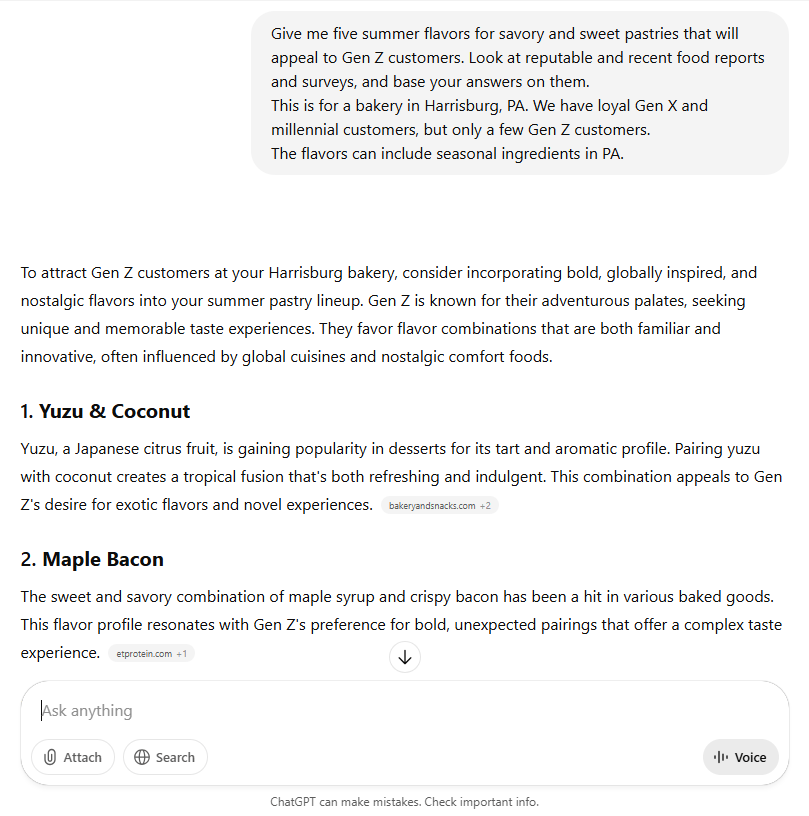
ChatGPT is also a helpful tool for preliminary competitive analysis. Use it to discover new competitors or analyze your competitors’ social media strategy.
Sample ChatGPT prompts for research and competitive analysis
- To identify your competitors’ strengths and weaknesses, and opportunities for your business: Analyze [Competitor A]’s product lineup, pricing, positioning, product descriptions, and customer reviews. What are the products’ strengths and weaknesses? How do their products compare to my company’s?
- To analyze consumer sentiment on your products: Give me a summary of the top customer insights on [Product A]. Review social media and forum discussions, and customer reviews on Google, Yelp, and other directories. Outline changes in their preferences, satisfaction, and sentiments on my product and competitor’s.
- To forecast competitive trends: Identify the latest products that [Competitor A and B] launched in the past six months. Analyze their marketing campaigns, messages, and positioning. List potentially new customer needs and pain points that these new products address.
- To stay ahead of emerging trends in your industry: Identify the top five emerging market trends in [Industry] based on recent reputable industry reports, research, and surveys.
2. Content marketing
Writers and content marketers don’t need to worry about ChatGPT taking over their jobs. Instead, you can use ChatGPT for content creation by asking it to:
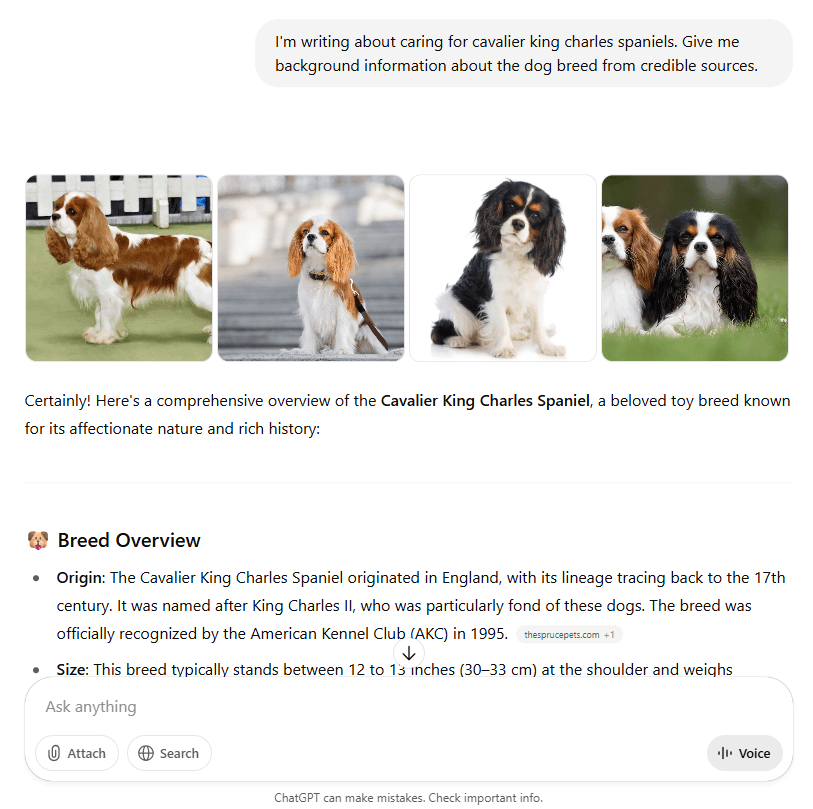
Provide background information about a particular topic
ChatGPT can also aid with your research on a specific topic. For example, let’s say your pet store business must create a blog post on a relevant topic you’re unfamiliar with. You can ask ChatGPT to provide you with preliminary information.
Generate topic ideas
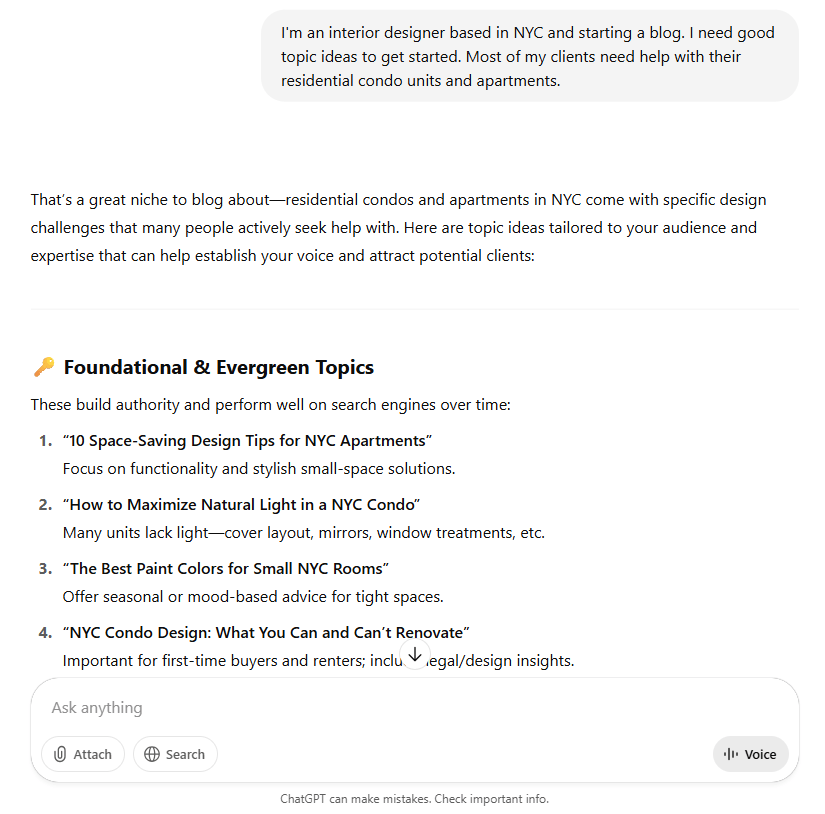
If you need help developing new topics for content marketing, you can use ChatGPT for suggestions. You can ask broad topics or request topics specific to your audience by providing more details about your buyer personas.
Create blog outlines
Instead of letting ChatGPT write your website content (which lacks the personal touch and expertise of humans), use the AI chatbot to create your outline. Use follow-up prompts to identify sections you must add and opportunities to outrank your competitors.
Develop a list of FAQs for your business or product page
Are you developing a frequently asked questions (FAQs) section for your website? Ask ChatGPT to suggest FAQ topics relevant to your business. Ask follow-up questions if you need to refine your list.
Sample ChatGPT prompts for content marketing
- To get an overview of a topic: Tell me more about [Topic]. I’m writing a piece about [Topic]’s [subtopic]. It will be published on a blog of a [Business/Niche]. Our customers are [General Customer Description].
- To brainstorm content ideas: Generate about 10 blog post ideas for a [Business] blog. Our customers are [General Customer Description].
- To generate blog outlines: Create an outline on the topic [Primary Keyword] for a [Business/Nature]’s blog. The primary keyword is [Target Keyword]. My customers are [Brief Customer Description].
- To generate FAQs for your business or product: Generate a list of questions related to my [Nature of Business] business [or product].
3. Email marketing
About 49% of marketers using AI create email content with it. This doesn’t mean ChatGPT can write your email messages for you, though.
Instead, use it for the following tasks:
Get subject line ideas
Prompt ChatGPT to provide an initial list of compelling subject lines for your email. Think of it as a brainstorming activity with the tool.
To ensure a click-worthy subject line, have copywriters and email marketers write your final subject line ideas and A/B test them.
Personalize email messages
When writing welcome messages or other automated emails, tailor them to your recipient with the help of ChatGPT.
For example, let’s say you’re marketing a travel agency. Your customers subscribe to your email newsletter for various reasons — some of them are looking for offers on solo, budget-friendly travels, while others want updates on holiday tour packages for a family.
Use ChatGPT to create variations of your automated emails based on your customer segments. A word of caution, though: Check and edit each personalized version to add a human touch.
Analyze your email copy
ChatGPT is also a handy tool for analyzing your email copy. Prompt it to check your copy’s tone and appeal to your recipients.
Are your key messages clear? Does it have suggested tweaks to improve your copy? You can ask these questions in your follow-up prompts.
Take ChatGPT’s suggestions and feedback with a grain of salt, though. Test it with other human users, and use your judgment, too.
Sample ChatGPT prompts for email marketing
- To generate subject line ideas: Give me 10 email subject lines to promote my [Offer/Product/Service/Event] among my target audience. I’m marketing a [Business] selling [Product/Services] among [Customers] in [Location].
- To personalize email messages: Write variations of my email copy below for my different customer personas of [Customer Persona A, B, and C] using a suitable tone for each one. [Email Copy]
- To analyze email messages: Analyze the tone and style of my email subject and copy. How can I make them more engaging and persuasive? [Email Copy]
4. Search Engine Optimization (SEO)
SEO is a valuable strategy for marketers to reach their customers. In fact, 50% of marketers say that SEO provides a better ROI than any other marketing strategy.
Today, you can use ChatGPT for SEO to streamline your processes:
Keyword research
SEO professionals can use ChatGPT for keyword research. You can also ask it for long-term keywords relevant to your business.
To ensure you’re using the most recent and relevant keywords, complement your keyword research with tools like KeywordsFX. KeywordsFX is a free keyword suggestion tool that gives you insights into the keywords that your target audience is searching for.
Understand search intent
Search intent is the reason a user performs a search. When it comes to ChatGPT vs. Google, Google’s search engine results page (SERPs) can give you an idea of users’ search intent, but ChatGPT can provide much more information.
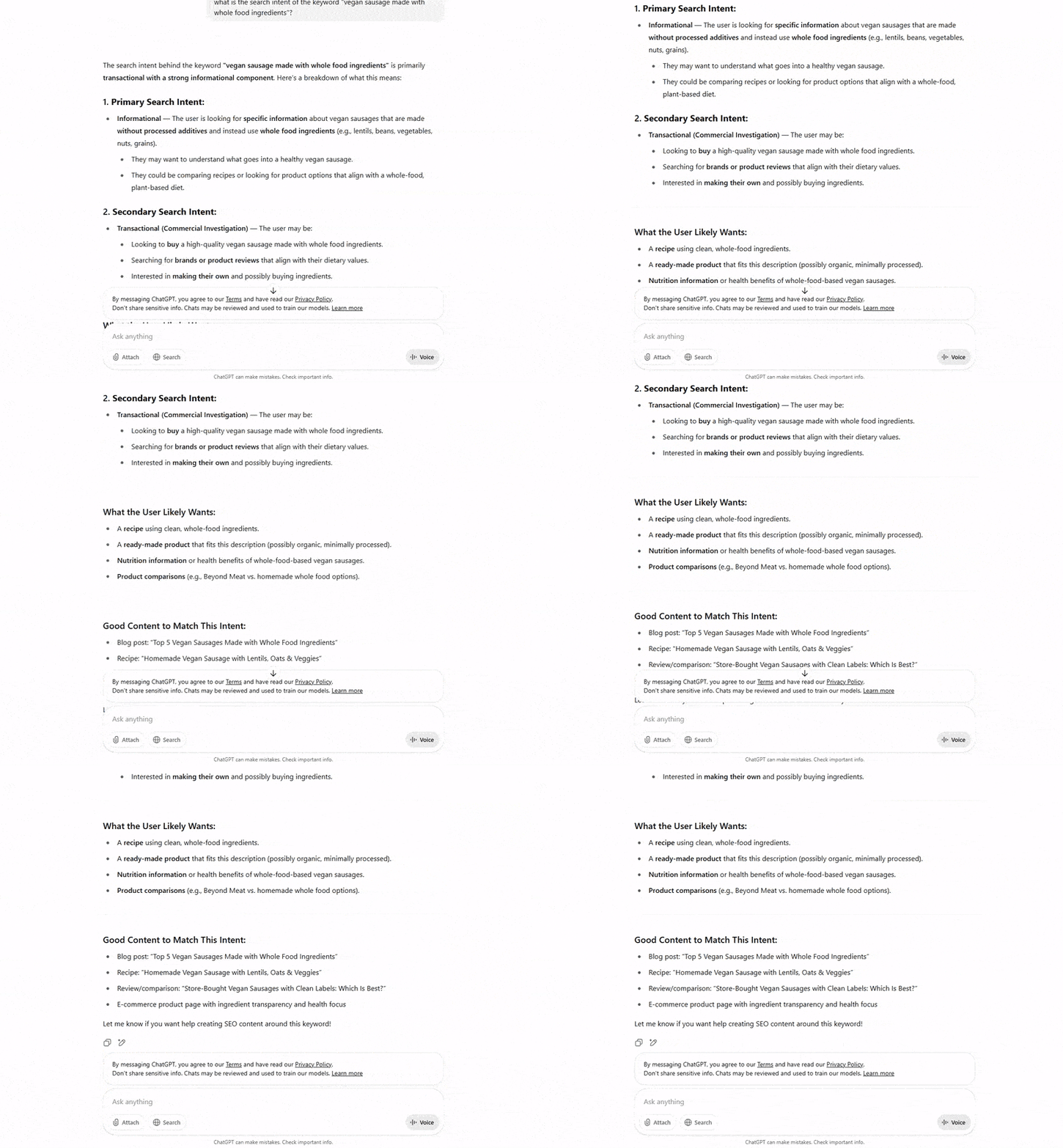
You can use ChatGPT as a Jarvis-like assistant to help you identify and analyze search intent. Take this conversation with the AI about the search intent of the long-tail keyword “vegan sausage made with whole food ingredients.” Most of the ranking pages on the SERPs are recipes for vegan sausages.
ChatGPT, however, added that it could also have transactional intent. It also added what other things the searcher could be looking for, so it can help you identify the next search intent. The next search intent is what a user searches for after they’ve found the answer to their first search query.
Generate SEO titles
Digital marketers can also use ChatGPT to suggest SEO titles based on the keywords and their intent.
Never use ChatGPT’s output as your final product, though. Chances are, your competitors are trying to rank for the same keywords, so they may use the SEO titles suggested by an AI. It’s good practice to edit and improve on ChatGPT’s suggestions.
Create content outlines
As ChatGPT’s popularity grows, more businesses will use this AI to create an entire blog post or SEO content. The consequence is that your website’s content will likely resemble your competitor’s. You can avoid this by using ChatGPT as a content outline creator and adding sections that you deem important.
Search engines like Google won’t automatically penalize you for using AI-generated content. In its guidance on AI-generated content published in February 2023, Google said that the appropriate use of AI or automation is not against its guidelines. By “appropriate,” it means the content must not aim to manipulate search rankings.
In the same document, however, Google underscored the importance of original and high-quality content showcasing expertise, experience, authoritativeness, and trustworthiness (E-E-A-T) to rank in SERPs.
An AI that rehashes published information can’t possibly create pieces that demonstrate expertise, right? Google Search has been spotting poorly quality content written by humans and AI for years, so its systems can determine helpful content.
Sample ChatGPT prompts for SEO
- For keyword research: Give me long-tail keywords related to [Topic]. This is for a [Business] in [Location].
- To understand search intent: Analyze the ranking pages for the keyword [Keyword]. What is the search intent for the keyword? What types of pages are ranking?
- To create SEO title suggestions: Generate 10 SEO title tags for a [Content Type such as Blog Post, Product Page, or Category Page] about [Topic]. Include the primary keyword [Keyword].
5. Pay-per-click (PPC) and paid media
Paid media teams can use ChatGPT to speed up the most repetitive parts of campaign building. Need 15 Google Ads headline variations under 30 characters? ChatGPT can generate them in seconds. Need responsive search ad descriptions that match your landing page messaging? Give it the page URL context and your value props, and it will draft variations you can test.
You can also use it to brainstorm audience targeting angles. Describe your product and ideal customer profile (ICP), and ask ChatGPT to suggest interest-based and keyword-based audience segments you might not have considered.
The output won’t replace your media strategist’s judgment on bids, budgets, or campaign structure. But for the volume work of writing ad copy variations and testing angles, it saves real time.
Sample ChatGPT prompts for PPC and paid media
- For ad copy variations: Write 10 Google Ads headline options (under 30 characters each) for a [Business] promoting [Offer]. The target audience is [Audience]. Focus on [key benefit or differentiator].
- For audience brainstorming: Suggest 10 interest-based and keyword-based audience segments for a Google Ads campaign promoting [Product/Service]. The ideal customer is [ICP Description].
6. Social media marketing
Social media managers juggle multiple platforms, formats, and posting schedules. ChatGPT can take some of that weight off by helping you draft posts, brainstorm content calendar ideas, and repurpose existing content into platform-specific formats.
For example, you can paste in a 1,500-word blog post and ask ChatGPT to pull out three LinkedIn post angles, two Instagram captions, and a Twitter thread. It won’t nail the platform nuance perfectly every time, but it gives you a starting framework that’s faster than writing each one from scratch.
You can also use it for hashtag research. Describe your post topic and target audience, and ChatGPT will suggest relevant hashtags organized by reach and specificity.
Sample ChatGPT prompts for social media marketing
- For repurposing content: Turn this blog post into 3 LinkedIn posts, 2 Instagram captions, and 1 Twitter thread. Keep each platform’s tone and format conventions in mind. Here’s the post: [Paste Content].
- For content calendar ideas: Suggest 20 social media post ideas for a [Business] for [Month]. The audience is [ICP]. Mix educational, promotional, and engagement-focused posts.
7. Data reporting
Pulling data from Google Analytics, ad platforms, and email tools is one thing. Turning that data into a clear narrative for your team or client is another. ChatGPT can help bridge that gap.
Paste in a table of campaign metrics, and ask ChatGPT to summarize performance, flag anomalies, and suggest next steps. It can also help you write the executive summary sections of monthly reports, turning raw numbers into plain-language insights that non-marketers can understand.
It won’t catch everything a trained analyst would, and you should always verify its interpretation. But for drafting report narratives and spotting surface-level trends, it speeds up a task that most marketers find tedious.
Sample ChatGPT prompts for data reporting
- For performance summaries: Summarize the performance of this campaign based on the data below. Highlight what went well, what underperformed, and recommend 2-3 next steps. Here’s the data: [Paste Data].
- For report narratives: Write an executive summary for a monthly digital marketing report. The key metrics are: [List Metrics and Values]. Keep it under 200 words and explain what the numbers mean in plain language.
Best practices for using ChatGPT for digital marketing
When used responsibly, ChatGPT can help you optimize your campaigns and streamline your processes. Get the most out of ChatGPT with these best practices:
- Understand its capabilities and limitations. Know what ChatGPT is good at (drafting, brainstorming, summarizing) and where it struggles (accuracy, nuance, original thinking). That context helps you use it where it actually adds value.
- Write specific prompts. Vague instructions produce vague output. Include your audience, goal, format, tone, and any constraints. The more context you give, the more usable the response.
- Provide background context. Give ChatGPT the details it needs: your industry, ICP, brand voice, or campaign parameters. Background information helps it tailor responses instead of defaulting to generic copy.
- Use follow-up prompts. One prompt rarely gets you the final output. Treat each follow-up prompt as a refinement step to calibrate tone, depth, or direction. The conversation gets better the more you iterate.
- Start a new conversation for each topic. ChatGPT can lose context in long threads with multiple topics. Keep one conversation per project or task for cleaner results.
- Always fact-check. ChatGPT hallucinates. Verify stats, claims, and citations against primary sources before publishing or acting on anything it generates.
- Practice ethical AI use. Be transparent with your team and customers about how you use AI. Have governance policies in place and review outputs for bias before they go live.
Limitations of ChatGPT for digital marketers
ChatGPT can support your marketing workflows, but it has real limitations that affect output quality.
- Hallucinations: ChatGPT can fabricate stats, invent sources, and confidently present incorrect information. Any output that includes claims, data, or citations needs verification against primary sources before you use it.
- Bias: Training data biases can surface in ChatGPT’s recommendations, from skewed audience assumptions to tone-deaf messaging. Human review is essential for anything that reaches your audience.
- Lack of strategic judgment: ChatGPT can draft and brainstorm, but it can’t evaluate whether a campaign makes sense for your market, your budget, or your brand. Strategy still requires human expertise and context that the model doesn’t have.
FAQs about using ChatGPT for digital marketing
Let’s answer commonly asked questions related to ChatGPT and digital marketing here:
What is ChatGPT?
ChatGPT is an AI chatbot developed by OpenAI. It uses large language models (LLMs) to generate human-like text responses based on your prompts, and it can assist with tasks like drafting content, brainstorming ideas, analyzing data, and answering questions.
How much does ChatGPT cost?
ChatGPT has a free version with limited access. Paid plans start at $8 per month with ChatGPT Go, while ChatGPT Plus costs $20 per month for higher usage limits and access to more advanced features. Business and Enterprise plans are also available for teams.
Can ChatGPT replace a marketing team?
ChatGPT cannot replace a marketing team. It can accelerate tasks like drafting, research, and brainstorming, but it lacks the strategic thinking, creative judgment, brand knowledge, and accountability that human marketers provide.
What are the best ChatGPT prompts for digital marketing?
The best ChatGPT prompts for digital marketing are specific and include context about your business, audience, goals, and preferred format. Prompts for keyword research, content outlines, ad copy variations, email subject lines, and competitive analysis tend to produce the most actionable results.
Is ChatGPT safe to use for business?
ChatGPT is generally safe for business use when you follow responsible AI practices. Avoid sharing sensitive customer data or proprietary information in prompts, always review outputs before publishing, and establish internal guidelines for how your team uses AI tools.

AI Workspace for Business Teams
Imagine an AI workspace where you can collaborate with team members, share prompts, and leverage personas for generative AI.
Empower My Team with AI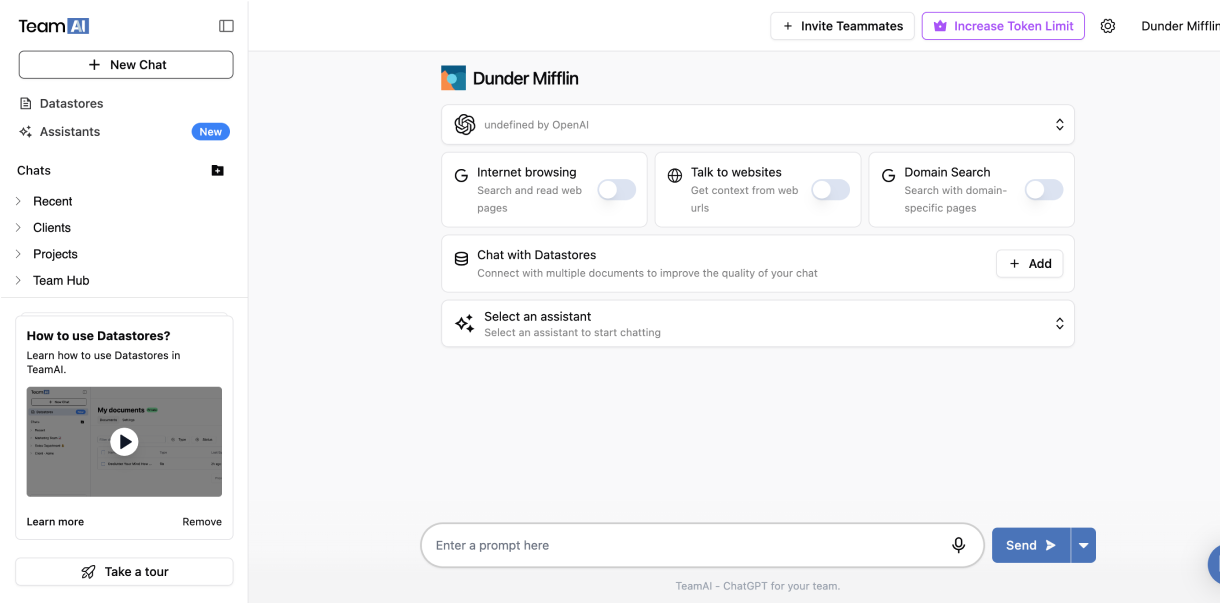
Leverage the power of AI with digital marketing experts
ChatGPT can help your marketing team move faster, but speed without strategy doesn’t drive revenue. That’s where WebFX comes in.
With over 30 years of experience and more than $10 billion in revenue driven for clients, our team of 750+ specialists pairs AI-powered tools with proven marketing strategies to deliver results you can measure.
Ready to see AI deliver real ROI? Contact us online or call 888-601-5359 to speak with a strategist about our ChatGPT optimization services today.
-
 Maria is a Lead Emerging Trends & Research Writer at WebFX. With nearly two decades of experience in B2B and B2C publishing, marketing, and PR, she has authored hundreds of articles on digital marketing, AI, and SEO to help SMB marketers make informed strategic decisions. Maria has a degree in B.S. Development Communication major in Science Communication, and certifications in inbound marketing, content marketing, Google Analytics, and PR. When she’s not writing, you’ll find her playing with her dogs, running, swimming, or trying to love burpee broad jumps.
 -

WebFX is a full-service marketing agency with 1,100+ client reviews and a 4.9-star rating on Clutch! Find out how our expert team and revenue-accelerating tech can drive results for you! Learn more
Try our free Marketing Calculator
Craft a tailored online marketing strategy! Utilize our free Internet marketing calculator for a custom plan based on your location, reach, timeframe, and budget.
Plan Your Marketing Budget
Table of Contents
- How to use ChatGPT for digital marketing
- 1. Research and analysis
- 2. Content marketing
- 3. Email marketing
- 4. SEO
- 5. PPC and paid media
- 6. Social media marketing
- 7. Data reporting
- Best practices for using ChatGPT for digital marketing
- Limitations of ChatGPT for digital marketers
- FAQs about using ChatGPT for digital marketing
- Leverage the power of AI with digital marketing experts
- Provide background information about a particular topic
- Generate topic ideas
- Create blog outlines
- Develop a list of FAQs for your business or product page
- Get subject line ideas
- Personalize email messages
- Analyze your email copy
- Keyword research
- Understand search intent
- Generate SEO titles
- Create content outlines
- What is ChatGPT?
- How much does ChatGPT cost?
- Can ChatGPT replace a marketing team?
- What are the best ChatGPT prompts for digital marketing?
- Is ChatGPT safe to use for business?
Share this article


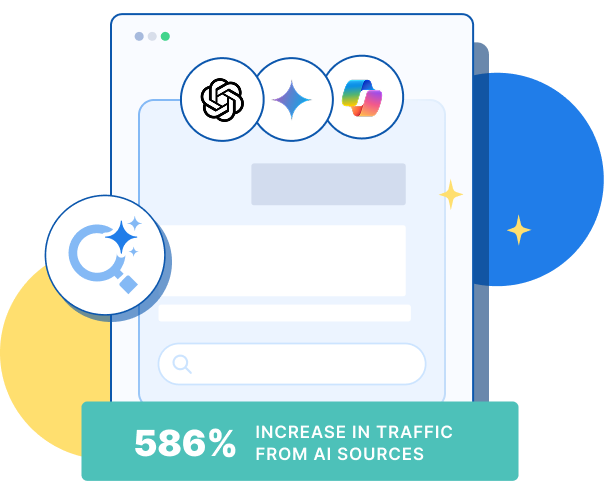
See AI Marketing in Action
Explore how WebFX helped a regional brand get discovered in AI search experiences — proving what’s possible with today’s AI-driven marketing!
Try our free Marketing Calculator
Craft a tailored online marketing strategy! Utilize our free Internet marketing calculator for a custom plan based on your location, reach, timeframe, and budget.
Plan Your Marketing Budget