
Gain Traction Online with Digital Marketing Strategies for Heavy Equipment Companies
-
 insights from 100,000+ hours of heavy equipment marketing experience
Table of Contents
- What effective digital marketing means in the heavy equipment industry
- 7 digital marketing strategies for heavy equipment companies
- 1. Build a high-conversion website that supports long sales cycles
- 2. Capture high-intent demand with SEO (including inventory-led SEO)
- 3. Use paid search to reach buyers actively evaluating equipment
- 4. Develop high-value content to nurture long sales cycles
- 5. Nurture prospects with email marketing and automation
- 6. Reinforce brand credibility with social proof, video, and visibility
- 7. Track the right KPIs to measure true ROI
- A practical way to think about qualifying heavy equipment leads
- What the future of digital marketing looks like for heavy equipment companies
- FAQs
- Building a digital strategy that supports real revenue growth
7 digital marketing strategies for heavy equipment companies

Digital marketing strategies for heavy equipment
- Build a high-conversion website that supports long sales cycles
- Capture high-intent demand with SEO (including inventory-led SEO)
- Use paid search to reach buyers actively evaluating equipment
- Develop high-value content to nurture long sales cycles
- Nurture prospects with email marketing and automation
- Reinforce brand credibility with social proof, video, and visibility
- Track the right KPIs to measure true ROI
In this guide, we’ll break down the digital marketing strategies that help heavy equipment companies generate qualified demand, including a practical framework for qualifying leads before they reach sales.
7 digital marketing strategies for heavy equipment companies
Digital marketing works best in this industry when strategies support one another. The following seven strategies address how buyers research, evaluate, and decide, while helping sales teams focus their time where it matters most.
1. Build a high-conversion website that supports long sales cycles
For heavy equipment companies, a website functions less like a brochure and more like a research hub.
Buyers visit your website with specific questions, and your site must help them find answers quickly. So make sure you include the following on your website:
- Detailed equipment specifications and application information
- Safety and compliance considerations
- Use cases that show how equipment performs in real-world environments
- Availability and logistics
- FAQs
- Pricing
- Inquiry forms or contact information
Aside from providing these details, an effective heavy equipment website supports multiple buyer intents. A visitor researching equipment for purchase needs a different path than someone looking for rentals, service, or parts.
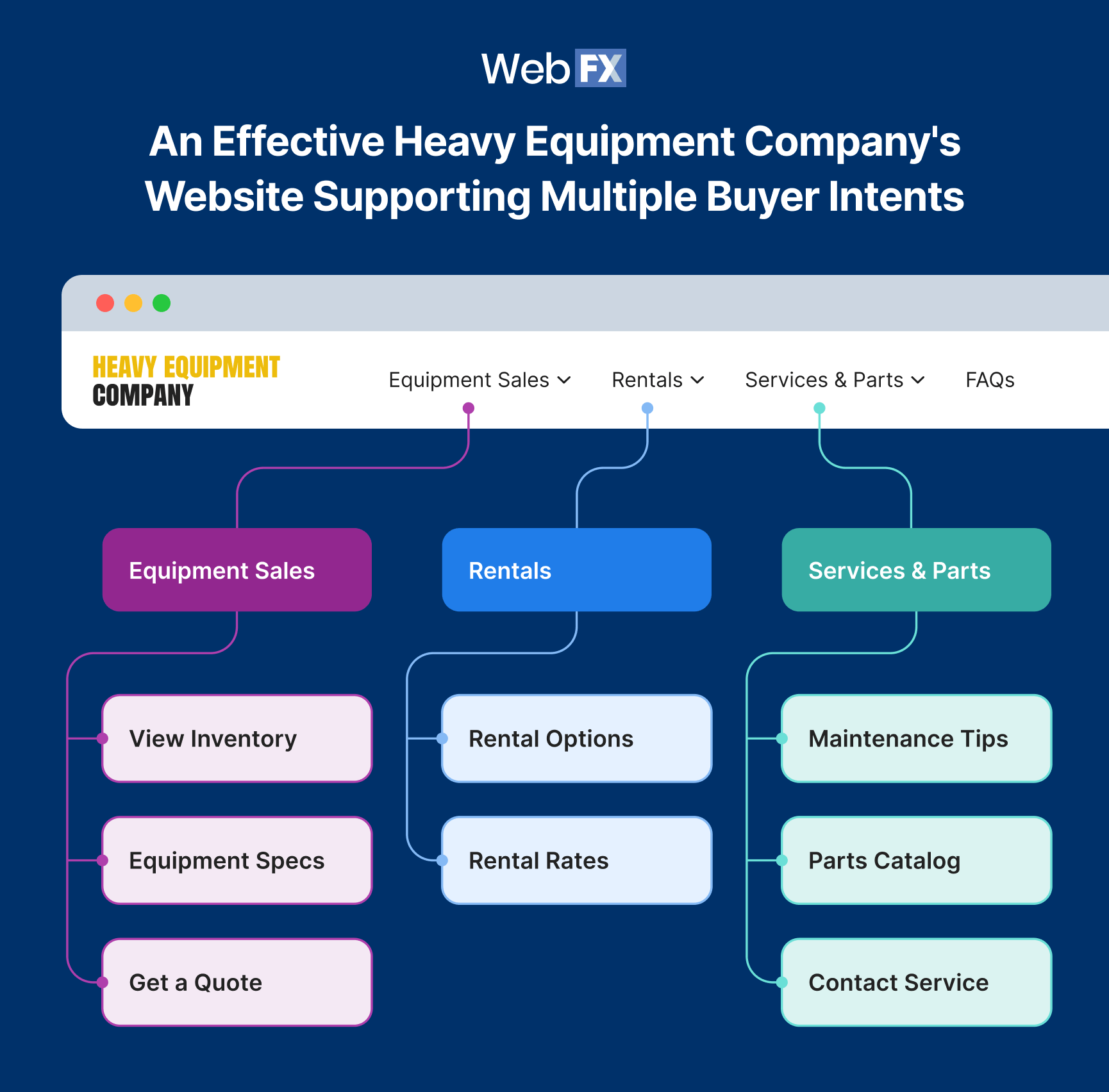
To help buyers who have different purchase needs, your website should clearly have:
- Distinct sections or navigation paths for equipment sales, rentals, service, and parts
- Direct connections between equipment information and relevant next steps, such as inventory, applications, or service options
- Clear inquiry and contact options for buyers who are ready to ask about availability, pricing, or timelines
When buyers can educate themselves on your site, inquiries are more likely to come from buyers who are ready to take the next step.
Hear What It’s Like to Work With WebFX!

“Our website has experienced a significant increase in traffic since starting with Webfx. Our team is very impressed with the clicks we are experiencing with our Geo-Fencing campaigns and we look forward to seeing our monthly reports with the positive results.”
Heavy Equipment Dealership
2. Capture high-intent demand with SEO (including inventory-led SEO)
Search engine optimization (SEO) plays a central role in heavy equipment marketing because buyers use search engines during the research phase. It’s important for your heavy equipment business to show up when buyers are actively looking for specific equipment.
Heavy equipment buyers commonly search by:
- Equipment category or application
- Specific models or specifications
- Availability within a certain region
This is where inventory-led SEO becomes especially valuable. Inventory-led SEO is the practice of optimizing individual equipment listings and inventory pages for search. It allows companies to be discovered by buyers who are narrowing options and looking for something specific.
In addition to inventory-led optimization, effective SEO for heavy equipment includes:
- Category and application pages aligned with buyer use cases
- Informational content that supports early-stage research
- Internal linking that guides buyers from research content to relevant inventory or next steps
3. Use paid search to reach buyers actively evaluating equipment
Next on our list of digital marketing strategies for heavy equipment companies is to use paid search ads.
Paid search complements SEO by boosting your visibility when your prospects are actively evaluating equipment. While SEO builds momentum over time, pay-per-click advertising (PPC) allows you to appear immediately for high-intent searches.
In heavy equipment marketing, paid search performs best when campaigns are segmented by buyer readiness.
For example, a search for “best skid steer attachments for forestry” reflects early-stage research. A search for “2023 CAT 299D3 for sale near me” reflects a buyer who is much closer to action. Both searches are valuable, but they require different messaging, landing pages, and follow-up expectations.
Pro tips to improve your ads’ efficiency:
- Align keywords with clear intent levels
- Match landing pages to the buyer’s research stage
- Avoid sending early-stage buyers directly to sales pages
4. Develop high-value content to nurture long sales cycles
Content plays a key role in heavy equipment marketing because buyers need time and information to evaluate their options. The most effective content supports buyers differently depending on where they are in the decision process.
Early in the process, heavy equipment buyers may need help understanding which type of equipment fits their needs. Later, they may need detailed comparisons or real-world examples to justify decisions.
Here are some content types that you can publish to help your potential buyers:
- Comparison guides help buyers narrow options between equipment types or models
- Buying guides clarify evaluation criteria such as performance, maintenance, and long-term cost considerations
- Use cases show how equipment performs in real environments, helping buyers visualize outcomes
5. Nurture prospects with email marketing and automation
Most heavy equipment buyers aren’t ready to speak with sales after a single interaction. They’d like to conduct their own research before even inquiring.
So how will you build rapport with prospects and nurture your relationship with them if they want to do their own research? Email marketing can support buyers while they continue researching on their own.
Email nurturing allows heavy equipment companies to:
- Share educational resources based on buyer interest
- Reinforce key considerations over time
- Stay visible during long evaluation periods
Pro tip: Make sure you only share relevant resources to prospective buyers via email. That way, you’re being a helpful partner who doesn’t spam their inboxes.
Email marketing often works alongside automation. Automation helps deliver relevant content based on behavior and reduces manual follow-up.
For example, if a prospect fills out an inquiry form for a specific heavy equipment, they get an automated email with more information about the product they’re interested in. As a result, your potential buyers receive information when it’s most useful.
6. Reinforce brand credibility with social proof, video, and visibility
When investing in heavy equipment or committing to long-term leases, buyers want reassurance that they’re choosing a reliable partner.
Give them credibility signals, which include:
- Video demonstrations showing equipment in action
- Customer reviews and testimonials
- Case studies that highlight real-world outcomes
- Third-party validation and compliance indicators
- Consistent visibility across platforms buyers use to double-check decisions
Social media may not always drive direct leads, but it reinforces expertise and consistency. Video content, in particular, helps buyers visualize performance and build confidence before contacting sales.
7. Track the right KPIs to measure true ROI
Last on our list of digital marketing strategies for heavy equipment companies is to track the right KPIs. Measuring performance in heavy equipment marketing requires looking beyond surface-level metrics. Here are some meaningful KPIs to track:
- Traffic quality and engagement: Are the right buyers reaching pages like inventory, specs, and comparisons?
- Conversion intent and buyer readiness: Are leads asking about specific models and availability, or submitting vague inquiries?
- Sales feedback and alignment: Are sales teams able to move these leads into real conversations?
- Attribution across extended buying cycles: Which channels influence deals over time, especially when weeks pass between first visit and inquiry?
You can get these insights from analytics platforms, CRMs, marketing automation tools, and sales feedback. By tracking these indicators, you can identify which channels attracted ready buyers or which content helped your prospects make decisions. As a result, you know how to adjust strategies for better results.
For companies managing data across multiple platforms, unified reporting tools, such as RevenueCloudFX, can help connect marketing activity to revenue outcomes more clearly.
What effective digital marketing means in the heavy equipment industry
Before diving into tactics, it helps to clarify what “effective” actually means in heavy equipment marketing.
Effective digital marketing for heavy equipment companies helps buyers move closer to making a well-informed buying decision, even if that decision takes time. Rather than measuring success by activity alone, it focuses on whether marketing is helping buyers make progress.
That means supporting three outcomes that reflect how heavy equipment buyers evaluate suppliers:
- Awareness: Making your company visible when buyers begin researching solutions or equipment categories or applications
- Education: Providing detailed, credible information that helps buyers compare options and understand trade-offs
- Validation: Reinforcing trust through proof, experience, and consistency before sales engagement
The strongest digital marketing strategies in heavy equipment act like decision-support systems. They help buyers move forward at their own pace — and help sales teams understand who’s actually ready for a real conversation.
Learn More About Heavy Equipment Marketing Agencies
A practical way to think about qualifying heavy equipment leads
Not every inquiry is equal in heavy equipment marketing. Some buyers are still gathering information, while others are narrowing options. Then, you have a small group ready to talk about availability, pricing, or next steps..
Before responding to an inquiry, heavy equipment teams can pause and assess buyer readiness. That way, your team knows how to approach your potential buyer and the kind of follow-up most suitable for the buyer.
The visual below outlines a practical way to think about lead qualification in heavy equipment marketing using buyer context, intent, and timing to guide your next steps.
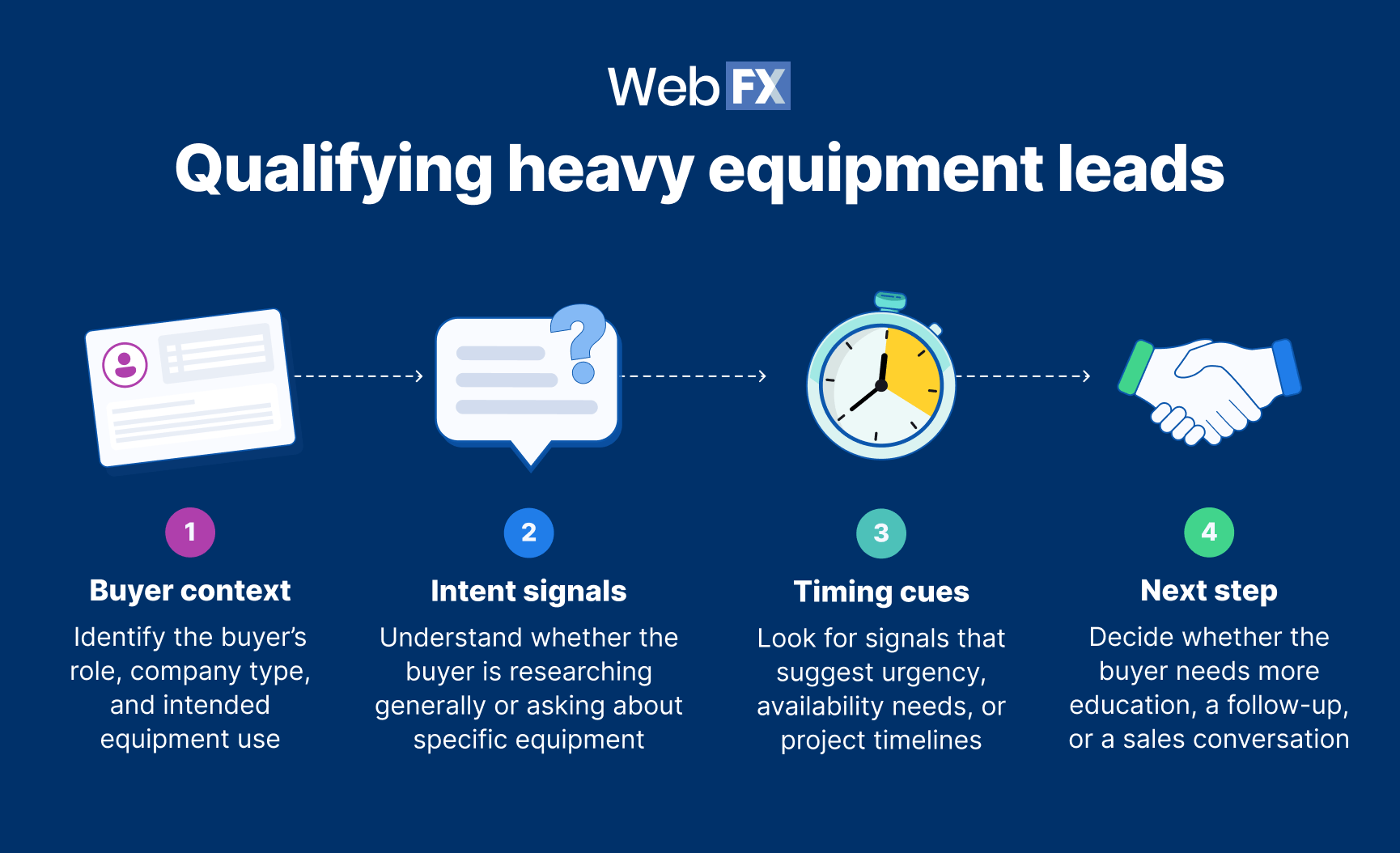
Using a shared way to think about buyer readiness helps marketing and sales teams stay aligned, especially when buyers are researching independently and moving at different speeds.
This approach doesn’t replace your CRM or existing processes, though. Use this method to help teams decide how to respond so you don’t rush early-stage prospects and slow down buyers who have decided.
What the future of digital marketing looks like for heavy equipment companies
Buyer behavior continues to change. Your prospects are increasingly leading their own research and educating themselves before contacting sales.
That’s why visibility across different channels is important. Buyers may discover equipment through search engines, AI-powered tools, or industry content they encounter while researching options.
Heavy equipment companies that adapt focus on:
- Creating educational content buyers can trust during long evaluation cycles
- Maintaining visibility where buyers research and compare options
- Aligning marketing signals with timely, informed sales follow-up
RC Mowers provides an example of how a structured digital strategy can improve visibility, attract qualified demand, and support conversion outcomes by aligning content, search presence, and buyer readiness.
Learn how we increased traffic from AI sources by over 1,100% and core conversions by 500% from AI sources

FAQs about digital marketing for heavy equipment companies
Which digital marketing strategies work best for heavy equipment companies?
The strategies that tend to work best are the ones that match how buyers research equipment. That usually means focusing on high-intent search, educational content, and lead qualification, especially since heavy equipment purchases involve longer evaluation cycles.
How long does it take to see results?
It depends on the channel. SEO and content typically take time to build traction, while PPC can generate visibility more quickly when it’s aligned with buyer readiness and intent.
How do you avoid unqualified leads?
Unqualified leads slow sales teams down, which is why reducing them matters. To minimize unqualified leads, align your channels, content, and follow-up strategies around buyer intent. That way, sales conversations start with buyers who are ready to speak with your team.
Is digital marketing worth it for heavy equipment companies?
Yes, digital marketing is worth it for heavy equipment businesses when strategies support long sales cycles and sales conversations. Digital marketing tends to be most effective when it focuses on qualified demand and alignment with sales.
We Drive Results for Heavy Equipment Companies
- 145+ experts in heavy equipment
- You get a team dedicated to your success



Building a digital strategy that supports real revenue growth
Digital marketing for heavy equipment companies works best when it reflects how buyers actually research and decide. By focusing on qualified demand and alignment between marketing and sales, you can turn digital visibility into measurable growth for your heavy equipment company.
If you want to scale your efforts, you can partner with a reliable digital marketing agency that understands the heavy equipment industry. WebFX is one such agency, with 100,000+ hours of experience in the industry, helping our clients generate qualified leads and revenue.
Contact us online or call us at 888-601-5359 to speak with a strategist!
Table of Contents
- What effective digital marketing means in the heavy equipment industry
- 7 digital marketing strategies for heavy equipment companies
- 1. Build a high-conversion website that supports long sales cycles
- 2. Capture high-intent demand with SEO (including inventory-led SEO)
- 3. Use paid search to reach buyers actively evaluating equipment
- 4. Develop high-value content to nurture long sales cycles
- 5. Nurture prospects with email marketing and automation
- 6. Reinforce brand credibility with social proof, video, and visibility
- 7. Track the right KPIs to measure true ROI
- A practical way to think about qualifying heavy equipment leads
- What the future of digital marketing looks like for heavy equipment companies
- FAQs
- Building a digital strategy that supports real revenue growth
Solving key challenges for heavy equipment companies
Our website isn’t driving enough traffic
Attract more web traffic, leads, and conversions so you can sell more of your heavy machinery equipment with our team of expert SEO specialists, copywriters, web designers, and more.

We’re not generating enough leads
Drive leads and fill your sales funnel with personalized lead generation strategies that reach and resonate with your target audience. Just in the past five years, our lead generation experts have generated more than 7.8 million leads for our clients

We’re not renting enough equipment
Access data-driven marketing strategies that get your new or used equipment in front of the people most likely to convert with our suite of digital marketing solutions for heavy machinery companies.

We’re not closing enough sales
Optimize your processes and strategies for every stage of your prospect’s buying cycle with our end-to-end marketing solutions and technology that unify marketing and sales data.
