



Table of Contents
- Master local SEO for high-intent homeowners
- Run hyper-targeted paid search (PPC) campaigns
- Leverage paid social ads (and avoid common mistakes)
- Build a referral engine with strategic local partnerships
- Go old school: Canvassing and local events
- Create authoritative content that answers homeowner questions
- Host educational webinars and virtual consultations
- Use case studies and video testimonials to build trust
- Differentiate between residential vs. commercial lead gen
-
What is solar lead generation?
Solar lead generation is the process of attracting, nurturing, and converting homeowners or businesses into qualified solar inquiries by capturing contact information through channels like SEO, PPC, referrals, and landing pages, then qualifying leads based on property ownership, intent, budget, and timeline. -
Why has the solar lead landscape changed in 2026?
The 2026 solar market features potential customers spread across more channels (Google, social media, AI search), longer conversion cycles as homeowners compare multiple installers, increased compliance requirements, and shared leads from third-party vendors that reduce close rates and increase competition. -
How does local SEO capture high-intent homeowners?
Local SEO captures about 80% of local searches that convert by optimizing Google Business Profiles, building location-specific landing pages, and managing reviews to appear when homeowners search terms like “solar company near me” at the exact moment they signal purchase readiness. -
What makes PPC campaigns effective for solar companies?
Hyper-targeted PPC campaigns organized around buyer intent clusters (federal tax credits, state rebates, financing queries) using long-tail keywords like “cost of solar roof panels in Philadelphia” convert at higher rates and lower costs than broad generic terms like “solar panels.” -
Why should solar companies differentiate residential from commercial lead generation?
Residential solar is an emotional, savings-driven purchase with shorter sales cycles decided by homeowners, while commercial solar focuses on ROI and tax strategy with longer cycles involving CFOs and facilities managers, requiring completely different messaging, channels, and proof points.
Lead generation for solar companies in 2026 requires more than running ads or buying a list of names. To generate high-quality solar leads that turn into installations, you need a blended system of owned, earned, and paid channels, measured for lead quality, compliance, and conversion performance.
If you’ve felt frustrated by fake submissions, shared leads, or a sales team that says “these leads are bad,” you’re not alone. Many solar businesses invest heavily in marketing but lack a structured way to evaluate lead sources and protect marketing return on investment (ROI) per install.
In this guide, you’ll learn how to:
- Build a diversified solar lead generation strategy
- Evaluate any lead source using a quality and compliance framework
- Blend buying and generating leads strategically
- Improve speed-to-lead and close more installations
What is solar lead generation?
Solar lead generation is the process of attracting, nurturing, and converting homeowners or businesses into qualified solar inquiries that can move into your installation pipeline. The goal of solar lead gen is to transform casual browsers into sales opportunities.
A high-quality solar lead typically:
- Owns the property
- Shows clear installation interest
- Has a realistic timeline
- Provides valid contact details
- Grants compliant marketing consent
- Fits your service area
A true solar lead generation system involves:
- Demand generation: You generate awareness and interest through channels like search engine optimization (SEO), pay-per-click advertising (PPC), social media ads, referrals, and partnerships.
- Lead capture: You collect contact information through landing pages, quote forms, phone calls, webinar registrations, or in-person canvassing.
- Lead qualification: It involves scoring leads based on intent level, authority, budget alignment, timeline, and geographical fit.
- Consultation: A solar lead only becomes valuable if it turns into a booked consultation, a signed contract, or a completed instal.
The 2026 solar lead gen landscape: Why quality and compliance decide ROI
While solar demand in 2026 remains strong, homeowners have changed how they search and convert over the years. Also, competition has intensified, advertising costs have increased, and consumers have grown more cautious.
Here are some of the shifts you must navigate as you market your solar company in 2026:
- Potential customers are spread across more channels, including Google search, Google Maps, AI Overviews, social media feeds, and AI-powered search engines.
- Solar consumers take longer to convert because they now compare multiple installers, validate online reviews, and review financing structures.
- Compliance risk for solar companies has increased; now you must get clear sourcing transparency, verifiable consent, and exclusive ownership.
- Many third-party vendors sell the same leads to multiple installers, causing lower answer rates, faster lead fatigue, lower close rates, and increased lead price competition.
- Clients expect faster response times and reward the first company to respond effectively.
Nine proven strategies for generating high-quality solar leads
High-performing solar companies build a portfolio of lead acquisition channels that balance speed, stability, and scalability.
Some channels capture immediate demand. Others build long-term equity. Some require higher upfront investment but reduce cost per install over time. The right mix depends on your market position, sales capacity, and growth goals.
Below is a complete menu of modern solar lead generation strategies. You do not need all nine at once. The objective is to select and combine the right channels based on your budget, operational maturity, and appetite for risk.
- Master local SEO for high-intent homeowners
- Run hyper-targeted paid search (PPC) campaigns
- Leverage paid social ads (and avoid common mistakes)
- Build a referral engine with strategic local partnerships
- Go old school: Canvassing and local events
- Create authoritative content that answers homeowner questions
- Host educational webinars and virtual consultations
- Use case studies and video testimonials to build trust
- Differentiate between residential vs. commercial lead gen
1. Master local SEO for high-intent homeowners
About 80% of local searches convert, meaning most people searching with local intent go on to take action, such as visiting a site, calling, or converting. When someone searches “solar company near me” or “solar installers in [city],” they signal purchase demand and readiness.
Local search engine optimization (SEO) helps you capture that demand by increasing your visibility at the exact moments homeowners are looking for a solar provider in your service area. It involves improving proximity signals, strengthening relevance, and building prominence.
Effective local SEO for solar companies should involve:
- Optimizing your Google Business Profile: Your GBP listing determines whether you appear in the Map Pack when homeowners search nearby installers. It builds visibility and trust before a prospect visits your website with accurate service areas, real installation photos, detailed service descriptions, and well-managed reviews.
- Building and managing local reviews: Homeowners rely on peer validation before requesting quotes. Proactively ask satisfied customers for feedback after installation and respond professionally to every review to demonstrate responsiveness.
- Creating location-specific landing pages: Building location-specific pages such as “Solar Repair in [City]” or “Solar Panel Installation in [County].” Each page should include localized copy, proof of nearby projects, and clear calls to action. Avoid duplicate content. Tailor messaging to local incentives, utility rates, and regulations.
2. Run hyper-targeted paid search (PPC) campaigns
Pay-per-click advertising works great for your solar company when you stop targeting broad terms like “solar panels” and start structuring campaigns around buyer intent.
So, in 2026, you ought to stop grouping all traffic under generic campaigns and start organizing your website around intent clusters, such as:
- Federal tax credit queries
- State or utility rebate searches
- Brand-specific searches (e.g., Tesla solar roof cost in [ZIP code])
- Financing-related queries
Hyper-targeted PPC ads improve ad relevance, lower wasted campaign spend, and increase conversion probability.
Long-tail keywords matter here. A search like “cost of solar roof panels in Philadelphia” signals significantly higher intent than “solar panels.” These searches often cost less per click and convert at higher rates because they reflect active comparison behavior.
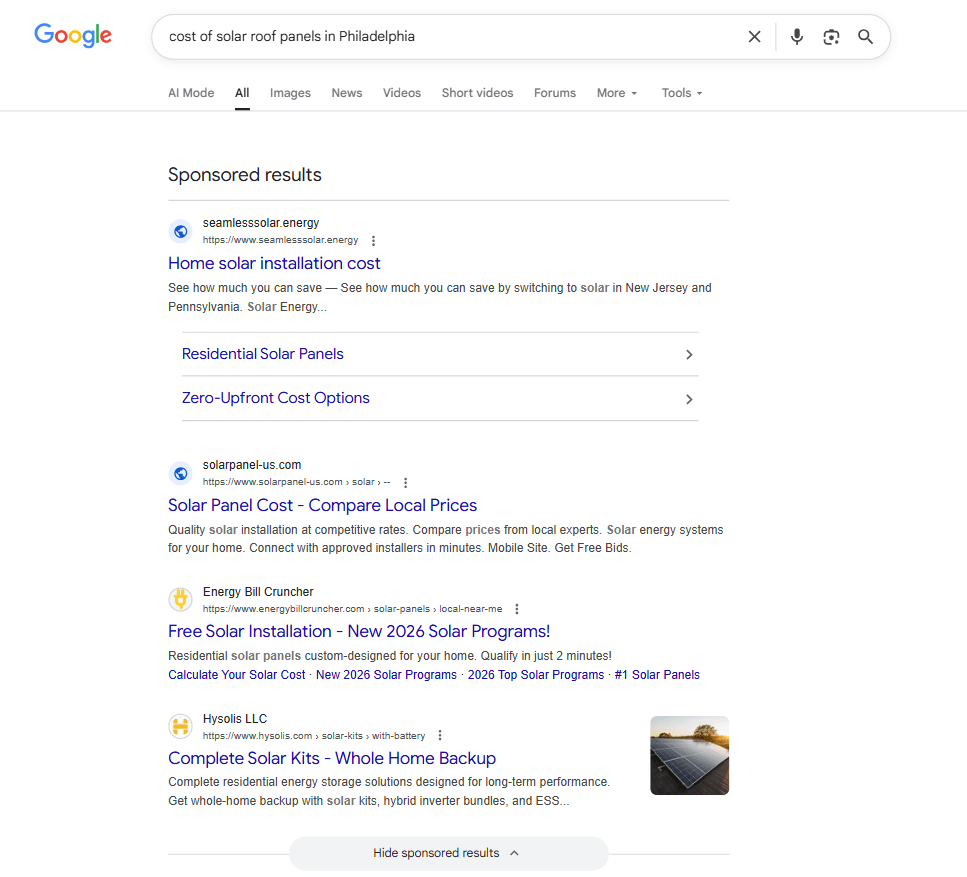
Equally important are negative keywords. When setting up campaigns, you need to exclude terms like “jobs,” “training,” “DIY,” or “wholesale” to prevent budget leakage. Filtering unqualified clicks also protects cost per lead and improves marketing ROI per install.
When structured and optimized correctly, PPC becomes a growth lever rather than a cost burden.
Targeting the right queries with aligned landing pages transformed paid media from an expense into a scalable acquisition engine.
3. Leverage paid social ads (and avoid common mistakes)
Many solar companies try paid social media ads and walk away frustrated. They generate form fills, but contact rates stay low, and appointments rarely convert. Trying a different platform may not fix the issue, because that’s not the problem; the actual issue is highly likely to be how you structure the campaigns.
Social media advertising works best when you treat it as a qualification channel, not just a traffic source. Unlike search, social platforms reach homeowners before they actively look for installers.
For example, someone scrolling Facebook may see rising utility bills, energy rate hikes, or a neighbor’s recent solar installation before they ever search “solar company near me.” That early exposure shapes awareness and intent long before a bottom-of-funnel search happens.
That means your social media ads targeting and offers must create intent. So, how do you do it?
Start by building campaigns around lookalike audiences modeled from your highest-value customers, not broad filters like age, income, or homeownership alone.
Export a list of closed installs from your CRM and upload it to the platform. When you seed campaigns with real installation data, the algorithm identifies behavioral and property signals that resemble buyers who already converted. This dramatically improves alignment between ad delivery and actual installation likelihood.
Next, replace generic calls to action like “Learn More” with specific, value-driven offers. A direct offer, such as “Get a Free Solar Savings Report for Your Address,” sets a clear expectation and attracts homeowners who are genuinely exploring installation.
4. Build a referral engine with strategic local partnerships
A referral engine is a structured system that generates qualified solar inquiries through trusted relationships. For solar companies, this includes both a formal customer referral program and strategic partnerships with local businesses that influence homeowners before they begin searching online.
Homeowners trust what their peers say. In fact, about 88% of people trust consumer reviews as much as recommendations from friends and family. This underscores why referral engines, including strategic partnerships and review programs, drive higher-quality leads for solar companies.
An effective referral engine should:
- Start by formalizing your customer referral program
- Not rely on passive word-of-mouth
- Create a clear incentive structure, such as a cash reward, bill credit, or gift card
- Promote your referral program through post-install follow-up emails, SMS campaigns, and customer newsletters
- Make it simple to refer by providing a direct referral link or a dedicated phone number for tracking.
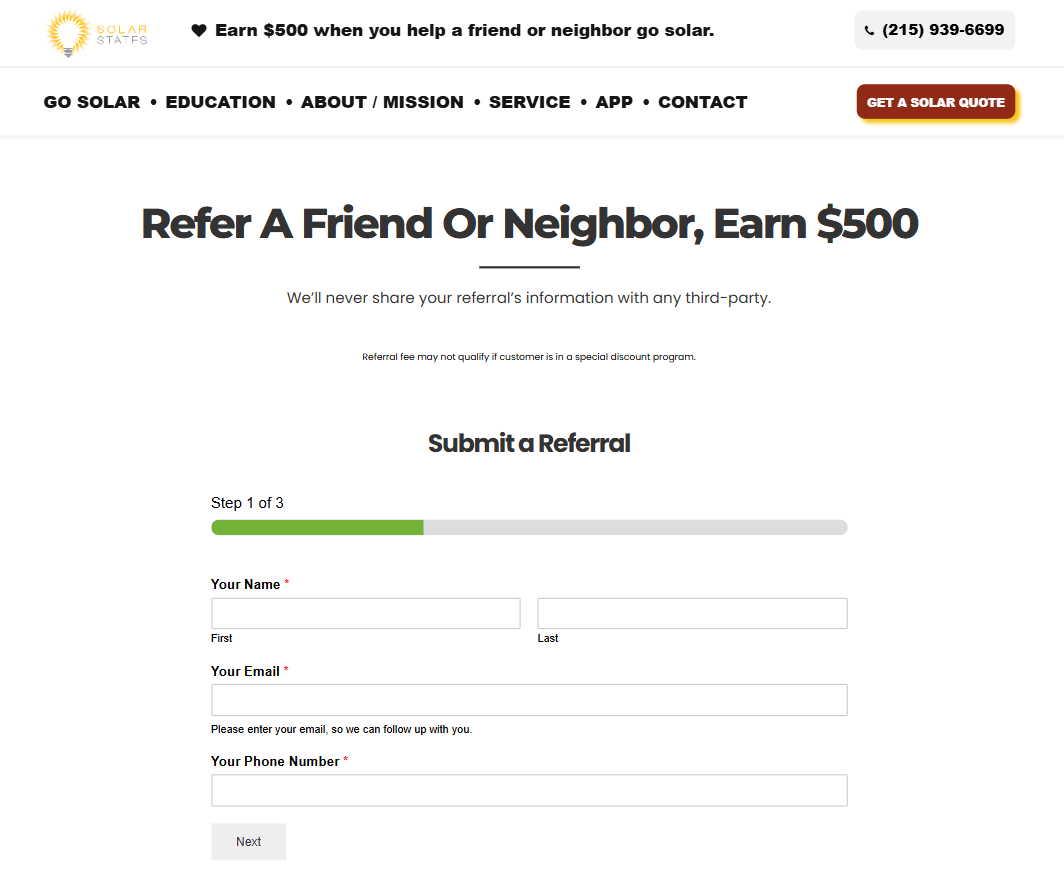
Then expand into strategic partnerships with other local home service providers, like:
- Roofers are natural collaborators because roof replacements often precede solar installations.
- Real estate agents regularly work with homeowners evaluating long-term energy costs.
- HOAs influence clusters of properties and can open access to entire neighborhoods.
Structure these relationships intentionally with commission-based agreements, co-branded educational materials, and trackable referral systems. Schedule regular check-ins to review performance and refine messaging.
5. Go old school: Canvassing and local events
Door knocking and merchandising at local events often get dismissed as outdated tactics. In reality, when executed strategically, these traditional marketing tactics remain among the most powerful trust-building channels in solar, especially in neighborhoods where installations are already visible.
When homeowners see panels going up on a neighbor’s roof, curiosity increases. That moment creates a short window where brand presence matters. Canvassing allows you to meet prospects at that exact point of awareness, before they search online or submit a form elsewhere.
In 2026 canvassing is data-driven and integrated with your digital systems. Instead of paper clipboards and generic flyers, equip representatives with:
- Territory-tracking apps to prevent overlap and measure coverage
- Tablets that calculate estimated savings on-site using utility rates
- Digital forms that capture contact information instantly
- CRM integration for immediate follow-up routing
Even when attending local events, like community fairs, home shows, and HOA meetings, use interactive tools and visual project portfolios. Don’t forget to incorporate incentive-focused messaging to move conversations toward scheduled consultations.
When structured properly, canvassing and local engagement do not compete with digital marketing. They amplify it. They build recognition, accelerate trust, and often improve conversion rates for prospects who later search your company by name.
6. Create authoritative content that answers homeowner questions
Content marketing is an effective way of reducing your dependence on paid media. Creating helpful, educational resources continues attracting homeowners long after they’re published.
Think about how people actually approach solar. They don’t wake up ready to schedule an install. They start with questions, like:
- “Does solar increase home value?”
- “How does the federal solar tax credit work?”
- “Is solar worth it in [State]?”
- “How long is the payback period?”
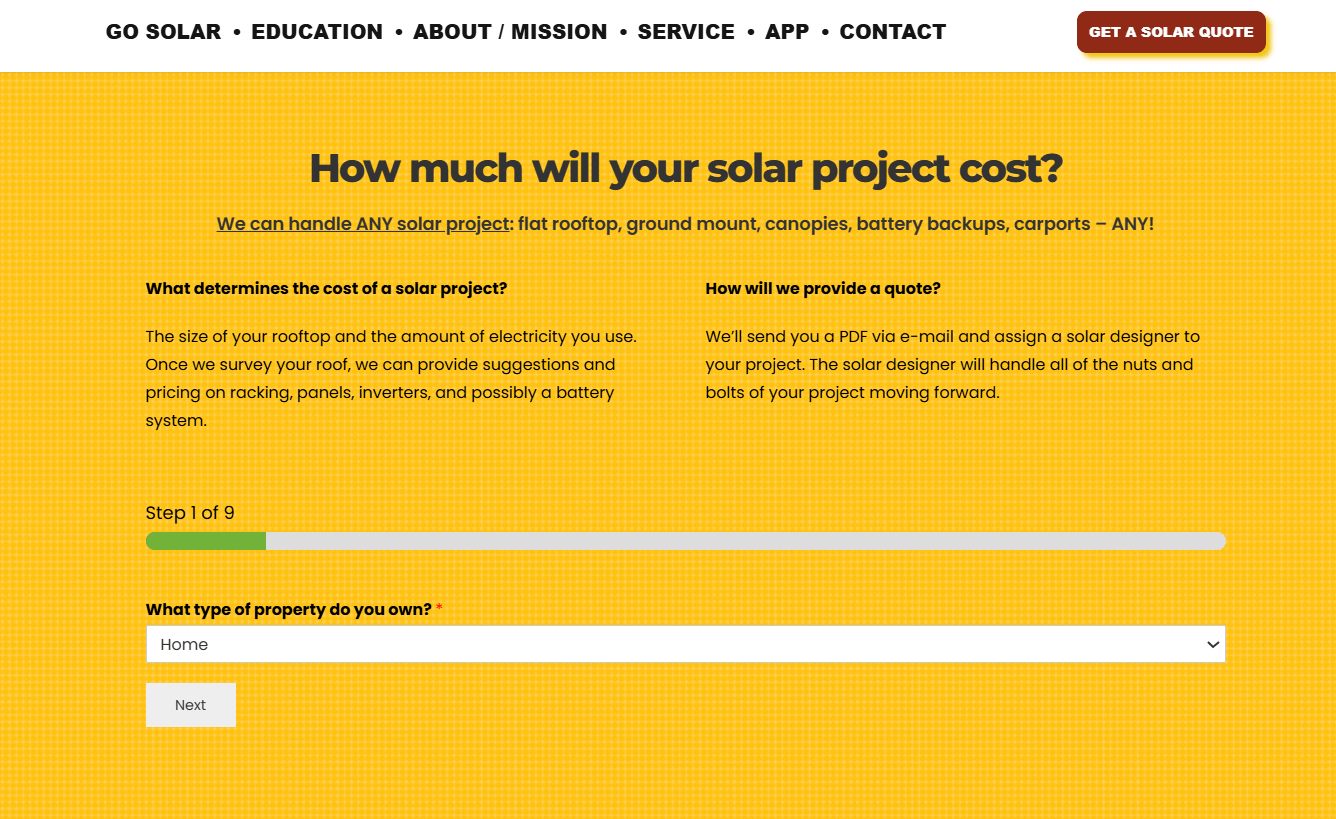
If your company consistently answers those questions clearly and honestly, with blogs, detailed FAQ pages or videos, you earn trust before a sales conversation ever begins.
Instead of publishing short blog posts, invest in comprehensive, localized guides such as a state-specific solar incentives resource or a detailed breakdown of solar ROI in your service area. These assets should address objections, explain financing clearly, and connect educational content to consultation opportunities.
For solar companies, strong content does more than rank. It builds credibility, supports sales conversations, and improves marketing ROI per install.
7. Host educational webinars and virtual consultations
Solar is a complex purchase. Many homeowners hesitate not because they lack interest, but because they lack clarity.
Hosting educational webinars and virtual consultations gives you a scalable way to educate and qualify multiple prospects at once. Use these to help homeowners understand how federal tax credits work, what rebates apply locally, how financing affects monthly savings, and whether solar makes sense for their specific situation.
A webinar allows you to address those concerns upfront in a transparent, educational format. Focus on practical, high-interest topics such as “Solar 101: How to Navigate Federal Tax Credits and Local Rebates” or “Is Solar Worth It in [Your State]?”
Promote the session through email campaigns, retargeting ads, and social media. Require registration details that help qualify attendees, such as property ownership, ZIP code, and installation timeline.
After the webinar, your registration list becomes a high-intent lead source. Segment attendees based on engagement, send a follow-up email with the recording, and invite them to schedule a personalized savings review. Have your sales team follow up within 24 to 48 hours while interest is still high.
When structured correctly, webinars create momentum, streamline qualification, and help you move multiple prospects toward consultation in a measurable, efficient way.
8. Use case studies and video testimonials to build trust
Case studies and video testimonials turn your past installations into proof that future customers can believe.
Solar is a high-ticket decision that requires homeowners to evaluate risk keenly. They want to know: Will this actually work for someone like me?
A strong case study answers that question before your sales team ever gets involved.
So, you should structure your case studies to be very specific; instead of saying “We helped a family save money,” show measurable outcomes. For example, explain:
- The homeowner’s situation and concerns
- The solution you recommended
- How long did the installation take
- What financing option they chose
- What their estimated payback period looks like
- The financial and practical results
- A short testimonial in their own words
Then include before-and-after utility costs, system size, and location context when possible. Numbers build credibility.
You should also consider showing practical proof with short video testimonials. A 30- to 60-second clip of a homeowner describing their experience often builds more trust than paragraphs of written copy.
Place these videos on landing pages, service pages, and even retargeting ads. Seeing and hearing a real customer reduces uncertainty and improves conversion rates.
9. Differentiate between residential vs. commercial lead gen
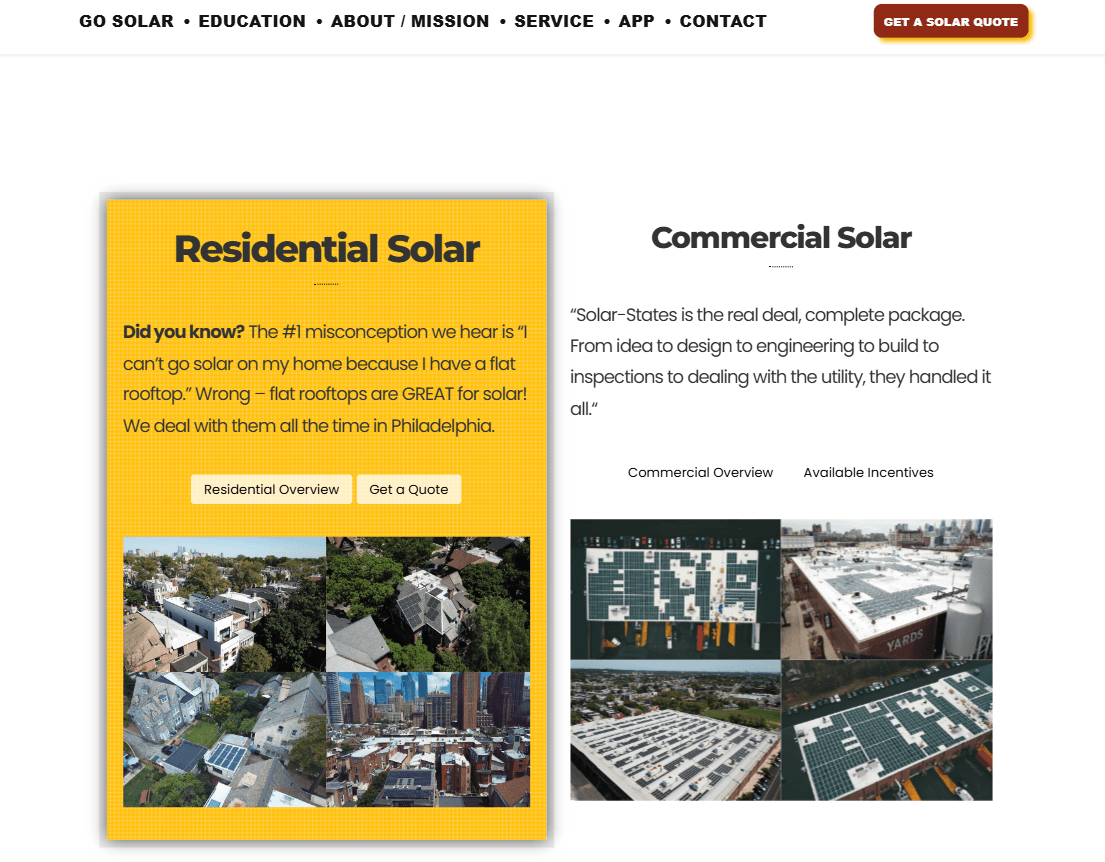
One of the biggest gaps in solar marketing content is the assumption that residential and commercial lead generation work the same way. They don’t, and treating them as interchangeable often leads to mismatched messaging, underperforming campaigns, and confused sales teams.
Residential solar is typically an emotional, savings-driven purchase. Homeowners often consider it to lower their monthly utility bill, increase property value, and do something environmentally responsible. The decision often happens at the kitchen table, influenced by neighbors, online reviews, and visible installations nearby.
Commercial solar, on the other hand, is centered on return on investment, depreciation, tax strategy, long-term operating costs, and energy price stability. The decision may involve a CFO, owner, facilities manager, or even a board. The sales cycle is longer, the documentation is heavier, and the risk tolerance is lower.
Understanding this distinction changes how you structure campaigns, qualify leads, and forecast revenue. Here’s a closer look into how residential and commercial lead generation differ.
| Attribute | Residential | Commercial |
| Sales cycle | Shorter | Longer |
| Decision-makers | Homeowner | CFO / Facilities Manager |
| Motivation | Savings & sustainability | ROI & operational cost reduction |
| Best channels | Google, Facebook, Nextdoor | LinkedIn, industry networks |
| Proof needed | Testimonials | Financial case studies |
Buying solar leads vs. generating your own: A blended strategy
For years, the default advice in solar marketing circles was simple: never buy leads. The reasoning made sense. Shared data, inflated pricing, and questionable consent practices created frustration and legal risk for many installers.
But in 2026, that advice is incomplete.
Buying solar leads is not inherently good or bad. It is a strategic decision. The right question is not “Should we buy leads?” It is “When does buying leads support our growth model and under what conditions?”
Generating your own leads through SEO, PPC, referrals, and content gives you control. You own the data, shape the messaging, and protect brand positioning. Over time, owned channels typically produce stronger margins and more predictable performance.
Buying solar leads, however, offers advantages that internal channels cannot always match. It provides immediate volume, allows you to test new geographies quickly, and helps fill pipeline gaps during seasonal dips or expansion phases.
Let’s look at the scenarios where buying leads would be better versus when you’re better off generating your own leads.
| Buying Solar Leads Makes Sense | Generating Your Own Leads Is Better |
| Entering a new city quickly | Building long-term market presence |
| Filling short-term volume shortages | Maintaining steady, predictable demand |
| Testing demand before heavy investment | Reducing long-term cost per install |
| Limited control over messaging | Full control over positioning and experience |
| Requires strict vendor vetting | Lower external compliance exposure |
From lead to install: How to qualify and convert more deals
Research shows that roughly 78% of sales go to the first company that responds. In solar, where multiple installers may contact the same homeowner, minutes matter. Aim to respond within five minutes whenever possible.
Automated alerts, CRM routing rules, and clear ownership assignments prevent inquiries from sitting idle.
Next, implement a simple qualification framework such as BANT — Budget, Authority, Need, Timeline. This involves confirming that the prospect:
- Owns the property
- Understands financing options
- Shows clear installation interest
- Has a realistic timeline.
Then establish a structured follow-up cadence. A basic sequence might include:
- Immediate phone call
- Follow-up text message
- Confirmation email with scheduling link
- Second call attempt within 24 hours
- Additional touches over the next several days
Frequently asked questions for solar lead generation
What is solar lead generation?
Solar lead generation is the process of identifying, attracting, and converting homeowners or businesses into qualified prospects for solar installation. It goes beyond collecting names or form submissions by building a predictable pipeline that combines demand capture, structured qualification, and disciplined follow-up.
What are the most effective strategies for solar lead generation?
The most effective solar lead generation strategies combine multiple channels rather than relying on just one:
- Strong local SEO captures high-intent homeowners actively searching for an installer
- Strategic partnerships generate trusted referrals
- Targeted paid ads help you scale volume when needed
The “best” strategy is usually a blended approach. Owned channels build long-term stability, while paid and referral channels provide speed and flexibility.
How can solar companies use digital marketing to get leads?
Solar companies use digital marketing to meet homeowners at different stages of the buying journey. For example:
- Search engine optimization (SEO) helps you appear in local searches when prospects are actively looking for an installer
- Pay-per-click (PPC) ads capture immediate demand from high-intent queries
- Social media ads allow you to target homeowners based on location, demographics, and interest signals before they begin searching
What tools are essential for managing solar leads?
At a minimum, you need three core tools:
- A customer relationship management (CRM) system tracks inquiries, conversations, and pipeline stages
- Marketing automation software nurtures prospects who are not ready to install immediately
- Solar design and proposal software to generate professional, accurate quotes quickly
What are the key principles for successful solar lead generation?
Successful solar lead generation campaigns focus on three principles:
- Prioritize lead quality over raw volume
- Adopt a blended strategy that combines generating your own leads with selectively purchasing
- Implement fast, consistent follow-up to maximize appointment setting and close rates
How can partnerships help solar companies find new customers?
Partnerships with complementary businesses, such as roofers, real estate agents, and electricians, create a stream of warm, high-trust referrals. These leads often convert at higher rates because credibility transfers from the referring partner to your company.
Take control of your solar lead generation strategy
Successful solar lead generation in 2026 is about building a resilient, multi-channel system that balances owned, earned, and paid acquisition while measuring what actually drives installs.
The companies that win are the ones that understand their numbers, track source quality, protect compliance, and respond fast. And they evaluate every lead based on its impact on cost per install and long-term profitability.
If you’re ready to stop wasting budget on low-quality or shared leads and start investing in what truly scales, request a free proposal today or call us at 888-601-5359 to speak to one of our 380+ home services strategists.
-
 Lornah Ngugi is a seasoned digital marketing writer with 6+ years of experience translating complex marketing strategies into engaging, results-driven content. She holds a B.S. in Business Information Technology and is certified in HubSpot Academy, Google Analytics, LinkedIn Marketing, and Google Digital Academy. Lornah regularly contributes to the WebFX blog and SEO.com, where she’s authored hundreds of marketing guides that help readers turn their goals into measurable results through practical, data-informed insights. When she’s not writing, you’ll find her enjoying a quiet walk in the park, sipping black coffee, or finding creative inspiration in a good chocolate bar.
 -

WebFX is a full-service marketing agency with 1,100+ client reviews and a 4.9-star rating on Clutch! Find out how our expert team and revenue-accelerating tech can drive results for you! Learn more
Try our free Marketing Calculator
Craft a tailored online marketing strategy! Utilize our free Internet marketing calculator for a custom plan based on your location, reach, timeframe, and budget.
Plan Your Marketing Budget
Table of Contents
- Master local SEO for high-intent homeowners
- Run hyper-targeted paid search (PPC) campaigns
- Leverage paid social ads (and avoid common mistakes)
- Build a referral engine with strategic local partnerships
- Go old school: Canvassing and local events
- Create authoritative content that answers homeowner questions
- Host educational webinars and virtual consultations
- Use case studies and video testimonials to build trust
- Differentiate between residential vs. commercial lead gen
Share this article


Outrank Local Competitors This Season
See how home service pros like you are dominating local Google results and booking more jobs.
Try our free Marketing Calculator
Craft a tailored online marketing strategy! Utilize our free Internet marketing calculator for a custom plan based on your location, reach, timeframe, and budget.
Plan Your Marketing Budget
What to read next




Additional Reading


Home Services Case Studies
Frequently asked questions for solar lead generation
What is solar lead generation?
Solar lead generation is the process of identifying, attracting, and converting homeowners or businesses into qualified prospects for solar installation. It goes beyond collecting names or form submissions by building a predictable pipeline that combines demand capture, structured qualification, and disciplined follow-up.
What are the most effective strategies for solar lead generation?
The most effective solar lead generation strategies combine multiple channels rather than relying on just one:
- Strong local SEO captures high-intent homeowners actively searching for an installer
- Strategic partnerships generate trusted referrals
- Targeted paid ads help you scale volume when needed
The “best” strategy is usually a blended approach. Owned channels build long-term stability, while paid and referral channels provide speed and flexibility.
How can solar companies use digital marketing to get leads?
Solar companies use digital marketing to meet homeowners at different stages of the buying journey. For example:
- Search engine optimization (SEO) helps you appear in local searches when prospects are actively looking for an installer
- Pay-per-click (PPC) ads capture immediate demand from high-intent queries
- Social media ads allow you to target homeowners based on location, demographics, and interest signals before they begin searching
What tools are essential for managing solar leads?
At a minimum, you need three core tools:
- A customer relationship management (CRM) system tracks inquiries, conversations, and pipeline stages
- Marketing automation software nurtures prospects who are not ready to install immediately
- Solar design and proposal software to generate professional, accurate quotes quickly
What are the key principles for successful solar lead generation?
Successful solar lead generation campaigns focus on three principles:
- Prioritize lead quality over raw volume
- Adopt a blended strategy that combines generating your own leads with selectively purchasing
- Implement fast, consistent follow-up to maximize appointment setting and close rates
How can partnerships help solar companies find new customers?
Partnerships with complementary businesses, such as roofers, real estate agents, and electricians, create a stream of warm, high-trust referrals. These leads often convert at higher rates because credibility transfers from the referring partner to your company.
Solving key challenges for home services companies
Our website isn’t ranking in the search results for home services
When people or businesses need home services in their area, they take to search engines like Google. Ensure your website appears at the top of the results when your target audience needs your services.a

We’re struggling to grow our team
Expanding your team and growing your business go hand-in-hand. If you need help growing your team with talented and friendly employees, our recruitment marketing services have you covered.c

We’re not generating enough leads
Are people visiting your website but not getting in touch with you? Our expert marketing specialists and web designers can optimize all areas of your website so you can attract and convert more of your target audience to use your home services.c

We’re not attracting new customers
Having trouble increasing your online visibility, so you can attract new customers? Our award-winning marketing services get your brand in front of the right people in your local area.
