


Contents
- How to rank in AI search results for B2B in 2026
- 1. Optimize your content for machine readability
- 2. Build authority and trust signals that AI models rely on
- 3. Expand your B2B brand presence beyond your website
- 4. Strengthen your technical SEO for efficient AI parsing
- 5. Monitor and audit your AI visibility
- What this means for your existing SEO strategy
- FAQs about ranking in AI search results for B2B
- You know what to do. Now let’s scale it.
-
How do AI tools function as B2B buyers’ new search engines?
B2B buyers increasingly use AI tools like Microsoft Copilot, Google Gemini, and ChatGPT to research vendors, compare solutions, and build shortlists directly within their workflow, making AI visibility essential for brands to appear in these AI-generated recommendations. -
What makes content machine-readable for AI tools?
Machine-readable content includes structured formats (HTML, structured PDFs), clear headers (H1, H2, H3), explicit problem-solution statements, data tables with labeled columns, FAQ formats, and specific outcome statements rather than vague descriptions or image-heavy PDFs. -
How do authority and trust signals impact AI citations?
AI models prioritize content with first-party data, original research, expert attribution, definitive language, and entity-rich descriptions (specific brand names and tools), with cited content mentioning proper nouns at 3x the rate of generic content. -
Why is third-party platform visibility crucial for AI search?
AI models pull data from across the web, including review platforms (G2, TrustRadius, Capterra), LinkedIn, Reddit, and industry publications, so brands must maintain active profiles and encourage customer reviews on multiple channels to strengthen citation signals. -
How does AI search optimization complement traditional SEO?
Traditional SEO remains essential as AI models rely on Google’s index and organic rankings to determine trusted sources, but AI search optimization ensures content gets cited accurately when AI tools generate vendor comparisons and recommendations for buyers.
To rank in AI search results for B2B, you need content AI tools can access, parse, trust, and cite when buyers research solutions. That means structured, machine-readable content, topical authority backed by original data, definitive statements AI models can quote directly, and visibility across the third-party platforms LLMs pull from.
Right now, your B2B buyers are increasingly asking Copilot or Gemini to compare vendors in your category in a Microsoft Word file or directly in their Gmail inbox. Is your brand in the answer?
To be clear, none of this replaces your SEO strategy. Strong organic rankings are the foundation AI models use to determine which sources to trust. But if you’re only optimizing for clicks, you’re missing the layer where your buyers are progressively making buying decisions.
The goal of ranking in AI search for B2B isn’t just visibility. It’s making sure your brand shows up accurately when buyers use AI to research vendors, narrow options, and build shortlists.
Here’s how to get ahead and rank in AI search results for B2B:
- How to rank in AI search results for B2B in 2026
- What this means for your existing SEO strategy
- FAQs about ranking in AI search results for B2B

AI Workspace for Business Teams
Imagine an AI workspace where you can collaborate with team members, share prompts, and leverage personas for generative AI.
Empower My Team with AI
How to rank in AI search results for B2B in 2026

According to Responsive’s Inside the Buyer’s Mind report, nearly two-thirds of B2B buyers now use generative AI as much as or more than traditional search when researching vendors. For tech buyers specifically, that number jumps to 80%.
AI search is the new research layer for B2B buyers, and if your AI search strategy for B2B hasn’t caught up yet, your brand may be missing from the vendor comparisons, recommendations, and shortlists buyers now generate inside AI tools. Here are five steps to make your brand the one AI tools pull from when your buyers ask for recommendations.
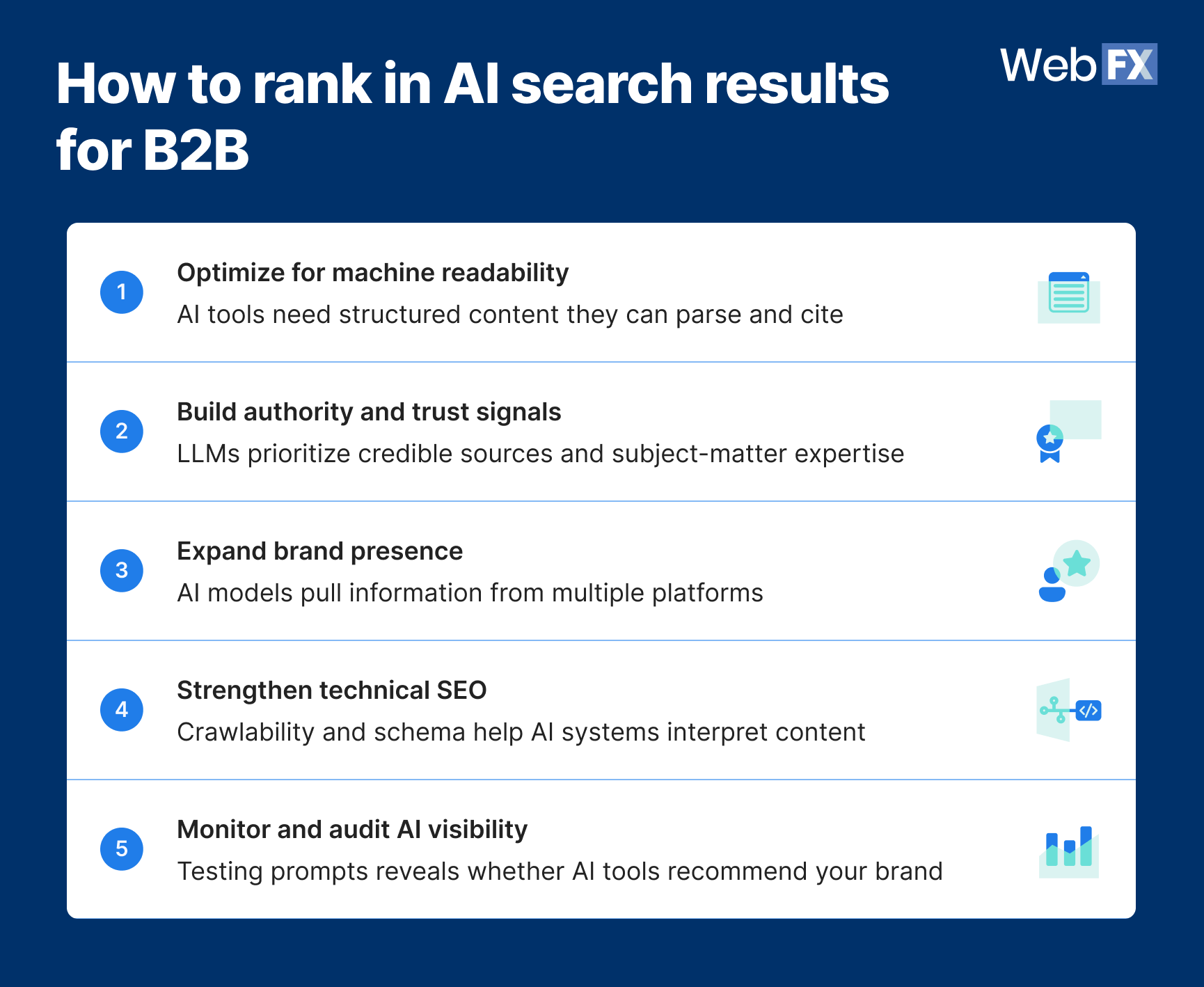
Table view
How to rank in AI search results for B2B in 2026
| Step | Action | Reason |
| 1 | Optimize for machine readability | AI tools need structured content they can parse and cite |
| 2 | Build authority and trust signals | LLMs prioritize credible sources and subject-matter expertise |
| 3 | Expand brand presence | AI models pull information from multiple platforms |
| 4 | Strengthen technical SEO | Crawlability and schema help AI systems interpret content |
| 5 | Monitor and audit AI visibility | Testing prompts reveals whether AI tools recommend your brand |
1. Optimize your content for machine readability
Audit your existing content for machine readability. AI models need structured information to synthesize vendor comparisons and recommendations, and if your B2B content isn’t formatted for machines to parse, it’s far less likely to get cited when buyers ask AI tools which solutions to consider.
You can start with what you already have. Pull up your whitepapers, case studies, data sheets, and sales decks, then ask one question: Can a machine read this?
AI assistants don’t process content the way humans do. They need clear headers, explicit problem-solution statements, data tables with labeled columns, and structured comparisons. A beautifully designed PDF with text embedded in images is much harder for Microsoft Copilot to parse. A case study buried in a gated landing page with no indexable text is something Google Gemini is far less likely to find.
To solve this, first, run an audit with these questions:
- Are your core content assets in machine-readable formats (HTML, structured PDF, markdown)?
- Do your case studies include explicit outcome statements? (“Company X reduced cost-per-lead by 34% in 90 days” beats “Company X saw great results.”)
- Are your product comparisons structured as data tables with labeled rows and columns, or buried in paragraph form?
- Do your whitepapers lead with clear definitions and problem statements in the first 200 words?
If you’re not sure where to begin, here are some key actions to start with:
- Use FAQ and Q&A formats to directly answer specific buyer questions, as these are highly likely to be cited by AI tools.
- Use descriptive H1, H2, and H3 tags to create a clear hierarchy that AI bots can crawl and understand.
- Include comparison tables and lists so AI can pull clean, structured data points from your content.
On the flip side, here’s what AI tools consistently skip over:
- Gated content behind forms (the AI can’t access it)
- Image-heavy PDFs without extractable text
- Generic thought leadership with no specific claims or data
- Content that talks about your product in vague superlatives without measurable outcomes
The end goal here is to make every content asset answer a question clearly enough that an AI could extract and cite it in a vendor summary.
2. Build authority and trust signals that AI models rely on
Invest in first-party data, expert attribution, and topic depth. AI prioritizes credible, authoritative sources to avoid hallucinating, which means demonstrating E-E-A-T matters just as much for AI search optimization for B2B as it does for traditional SEO, if not more.
These are what build AI-recognized authority:
- First-party data and original research: Incorporate proprietary data, case studies, and insights from your sales and support teams. AI models favor unique content they can’t find elsewhere.
- Topic clusters, not isolated articles: Create in-depth, connected content around core topics. When your site has multiple posts covering a topic from different angles, it signals authority and depth to AI systems.
- Problem-solving content: Address specific B2B buyer pain points (e.g., “how to solve [problem] in [industry]”). AI tools surface content that resolves queries with direct, specific answers.
- Expert attribution: Content attributed to named subject matter experts with verifiable credentials gets weighted more heavily than generic brand content.
Research from Kevin Indig’s Growth Memo found that text with definitive language like “[Product] is a [category] platform that [specific capability]” gets cited nearly twice as often as vague descriptions. AI models prefer content that resolves a query with a direct statement.
Entity-rich content works the same way. Cited content mentions specific brands, tools, and proper nouns at roughly 3x the rate of generic content. “Top tools include Salesforce, HubSpot, and Pipedrive” beats “There are many good tools for this task” every time.
3. Expand your B2B brand presence beyond your website
Get your brand visible on G2, LinkedIn, Reddit, and industry publications. AI-generated vendor recommendations rely on data from across the web, so visibility on third-party sites is essential for your AI visibility for B2B. If your brand only shows up on your own domain, well, that gives AI models a limited signal set to work with.
To build cross-platform authority, start with these:
- Review platforms: Maintain active profiles on G2, TrustRadius, and Capterra. TrustRadius found that 72% of buyers encountered Google’s AI Overviews during research, and 90% clicked through to cited sources, many of which are third-party review sites.
- LinkedIn and industry publications: Publish thought leadership, contribute guest content, and ensure your executives are active on LinkedIn. AI models weigh mentions across authoritative platforms when determining which brands to cite.
- Reddit and community forums: Monitor and participate in relevant subreddits and industry communities. AI tools like OpenAI’s ChatGPT frequently pull from Reddit discussions when generating recommendations.
- Customer advocacy: Encourage reviews, case study participation, and customer testimonials across multiple channels. Peer validation is one of the strongest citation signals for large language models (LLMs).
4. Strengthen your technical SEO for efficient AI parsing
Make sure AI crawlers can access, read, and categorize your site. AI bots require fast, clean websites to consume information efficiently. Your technical SEO foundation is your best enabler, and it determines whether AI tools can even access and process your content.
Optimize for AI search with these technical SEO priorities:
- Schema markup: Implement FAQ, HowTo, Article, and Product schema to help AI systems understand and categorize your content. Structured data gives AI clear signals about what your page contains.
- Fast load times: AI crawlers, like traditional search bots, prioritize fast-loading pages. Slow sites may get deprioritized or skipped entirely.
- Crawl accessibility: Make sure your robots.txt isn’t blocking AI crawlers. Check that your most valuable content is publicly accessible and not locked behind login walls or aggressive bot-blocking rules.
- Clean URL structure and internal linking: Logical site architecture helps AI tools understand the relationships between your content and map your topical authority.
- Mobile optimization: AI models still largely rely on Google’s index, which uses mobile-first indexing. A poor mobile experience can hurt your visibility across both traditional and AI search.
5. Monitor and audit your AI visibility
Open ChatGPT, Copilot, and Gemini and search your own product category. This is the step that changes how you think about AI visibility for B2B, and it takes less than 15 minutes.
Use the same prompts your buyers would:
- “Compare the top five [your category] platforms for mid-market companies.”
- “Draft a vendor comparison for [your product category] focused on ROI and integration.”
- “What are the pros and cons of [your brand] vs. [competitor]?”
Now audit the output:
- Does the AI mention your brand at all?
- Does it get your value proposition right, or does it hallucinate features you don’t offer?
- Does it position your competitor more favorably because their content was easier for the model to parse?
This is a simple test to track AI search rankings, but it tells you more about your brand’s AI footprint than any analytics dashboard, and whether AI tools can accurately describe what you do when a buyer asks.
Make this a monthly habit as AI models update frequently, competitors publish new content, and buyer prompts evolve. A monthly “Witness test” across major AI tools gives you a baseline to track whether your brand’s visibility is improving or declining.
We call this practice In-Workflow Optimization (IWO): Inventory your content for machine readability, Witness how AI tools currently see your brand, and Optimize for citation.
What this means for your existing SEO strategy
Let’s be clear here: SEO is not dead. Not even close.
Google still processes over 5 trillion searches each year, and organic rankings still drive qualified traffic and leads. AI Overviews themselves cite web sources, which means strong traditional SEO actually feeds your AI visibility.
The point is not to abandon your SEO strategy. It’s to make sure that the strategy also helps your B2B brand appear when AI tools shortlist and weigh vendors.
Here’s how AI and SEO disciplines complement each other:
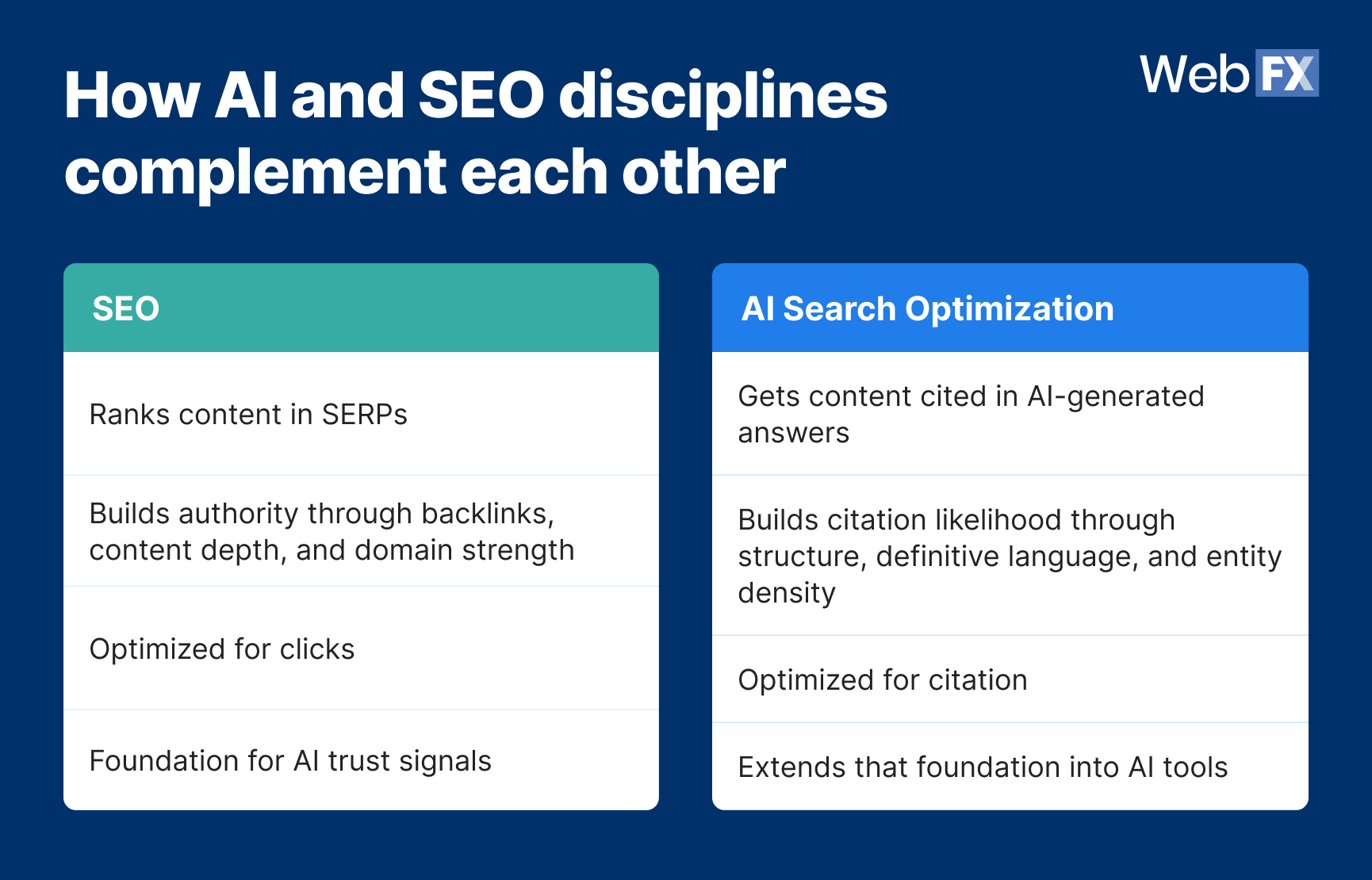
Table view
how AI and SEO disciplines complement each other
| SEO | AI Search Optimization |
| Ranks content in SERPs | Gets content cited in AI-generated answers |
| Builds authority through backlinks, content depth, and domain strength | Builds citation likelihood through structure, definitive language, and entity density |
| Optimized for clicks | Optimized for citation |
| Foundation for AI trust signals | Extends that foundation into AI tools |
Your SEO foundation doesn’t become irrelevant. In fact, it becomes the base that AI visibility for B2B builds upon. But SEO wasn’t specifically designed to control how your content performs when Copilot summarizes it in Word or compares it to a competitor in a ChatGPT prompt. An AI search strategy for B2B closes that gap by making sure your content gets cited with your value proposition intact.
Keep investing in SEO. It’s what gives AI models a reason to trust you. But if you’re not optimizing to improve visibility in AI results, you’re leaving the conversation before your buyer even starts one.
You can do that work manually, but scaling it across ChatGPT, Copilot, Gemini, and Perplexity is where most B2B teams hit a wall. If that process isn’t realistic, OmniSEO® gives you a more efficient way to monitor visibility and act on what you find.
Future-Proof Your SEO Strategy with OmniSEO®
Goodbye search engine optimization, hello search everywhere optimization.

FAQs about ranking in AI search results for B2B
How do I rank in AI search results for B2B?
Start with In-Workflow Optimization (IWO): Inventory your content assets for machine readability, Witness how AI tools like ChatGPT, Copilot, and Gemini currently describe your brand, and Optimize for citation by using definitive language, structured data, and entity-rich statements that AI models can extract and cite.
Is AI search optimization different from regular SEO?
AI search optimization for B2B builds on traditional SEO but adds a new layer. SEO focuses on ranking in search engine results pages (SERPs). AI search optimization focuses on being cited and accurately represented when AI tools summarize, compare, or recommend solutions. Both are important, and strong SEO actually strengthens your AI visibility.
How do I check if my brand shows up in AI search results?
One way to track your AI visibility is by running manual AI prompt checks. Open ChatGPT, Microsoft Copilot, Google Gemini, and Perplexity. Ask each one to compare vendors in your product category or recommend solutions for a problem you solve. Note whether your brand appears, whether its description is accurate, and how it compares to competitors in the generated response.
Does traditional SEO still matter for B2B?
Yes. Search engines still process billions of queries daily, and organic rankings continue to drive qualified traffic. AI models also use web authority signals (like backlinks and domain authority) to determine which content to cite. Strong SEO is the foundation that AI search optimization for B2B builds on.
Which AI tools are B2B buyers using for research?
The most common AI tools include ChatGPT, Microsoft Copilot (embedded in Word, Outlook, and Excel), Google Gemini (embedded in Gmail and Docs), and Perplexity. Any effective AI search strategy for B2B should account for all, since buyers use them at different stages of the research process.
What type of content gets cited by AI models?
In B2B, content gets cited more frequently by AI models when it:
- Uses definitive, declarative language
- Names specific brands, tools, and proper nouns
- Presents information in structured formats like comparison tables and FAQs
- Gains third-party validation across platforms like LinkedIn, G2, and Reddit
How often should I audit my AI visibility?
Monthly. AI models update frequently, competitors publish new content, and buyer prompts evolve. A monthly “Witness test” across major AI tools gives you a baseline to track whether your brand’s visibility is improving or declining.
You know what to do. Now let’s scale it.
These five steps work, but running the Witness test manually across ChatGPT, Copilot, Gemini, and Perplexity every month, tracking citation gaps, and optimizing content across every AI platform takes time most B2B teams don’t have.
That’s what OmniSEO®, our proprietary tech and platform, was built to solve. It tracks your brand’s visibility across every major AI platform, benchmarks your performance against competitors, and pairs the data with a dedicated team of AI search specialists who execute a tailored strategy for you.
WebFX has 30+ years of experience and a team of 750+ digital experts helping businesses like yours rank through every search evolution. This one is no different.
Cited brands close deals. Silent brands don’t. Get your free proposal or call 888-601-5359 to speak with a strategist about our AI search optimization services today.
-
 Albert Dandy Velasquez blends SEO strategy with compelling storytelling to help businesses boost their visibility and revenue online. With a B.A. in English and certifications from HubSpot, Semrush, and Google Analytics, he has written and optimized hundreds of articles on organic SEO, content strategy, and user experience. He regularly contributes to the WebFX blog and SEO.com, creating content that helps readers turn marketing goals into measurable results. When he’s off the clock, he’s usually exploring new neighborhoods on two wheels, filming travel content, or chasing golden hour with a coffee in hand.
 -

WebFX is a full-service marketing agency with 1,100+ client reviews and a 4.9-star rating on Clutch! Find out how our expert team and revenue-accelerating tech can drive results for you! Learn more

Try our free Marketing Calculator
Craft a tailored online marketing strategy! Utilize our free Internet marketing calculator for a custom plan based on your location, reach, timeframe, and budget.

Contents
- How to rank in AI search results for B2B in 2026
- 1. Optimize your content for machine readability
- 2. Build authority and trust signals that AI models rely on
- 3. Expand your B2B brand presence beyond your website
- 4. Strengthen your technical SEO for efficient AI parsing
- 5. Monitor and audit your AI visibility
- What this means for your existing SEO strategy
- FAQs about ranking in AI search results for B2B
- You know what to do. Now let’s scale it.
Share this article


See AI Marketing in Action
Explore how WebFX helped a regional brand get discovered in AI search experiences — proving what’s possible with today’s AI-driven marketing!
Try our free Marketing Calculator
Craft a tailored online marketing strategy! Utilize our free Internet marketing calculator for a custom plan based on your location, reach, timeframe, and budget.