
SEO for Heavy Equipment Companies: Revenue-Driven Strategies That Deliver Growth
Learn how to get better results from SEO for heavy equipment companies in this compilation of the most impactful steps and strategies for heavy equipment search engine optimization.
-
 insights from 100,000+ hours of heavy equipment marketing experience
Table of Contents
- Key SEO strategies for heavy equipment
- 1. Build a technical foundation that supports large inventories
- 2. Target high-intent keywords based on buyer readiness
- 3. Create content that supports education and evaluation
- 4. Use local SEO to capture immediate demand
- 5. Measure SEO success based on lead quality and outcomes
- How heavy equipment buyers actually search online
- FAQs about SEO for heavy equipment companies
- Support your heavy equipment company’s revenue growth with SEO
- Why is SEO important for heavy equipment companies and dealers?
-
What is SEO for heavy equipment companies?
SEO for heavy equipment companies focuses on supporting buyers throughout their 180-day sales cycles by ensuring visibility across 46 average touchpoints, helping prospects find relevant information from initial research through vendor evaluation to purchase decisions. -
How do heavy equipment buyers search online?
Buyers search with varying intent levels: informational searches for equipment specs and use cases (early research), commercial searches comparing brands and models (evaluation stage), and transactional searches including location-based terms (ready to engage with sales teams). -
Why is technical SEO important for equipment inventories?
Strong technical foundations ensure search engines can crawl and index large inventories by creating accessible category pages, controlling filter-generated URLs to prevent duplicates, reducing thin content, and improving mobile performance for field research. -
How should keywords be targeted by buyer readiness?
Keywords should map to buying stages rather than just search volume, with broad equipment-type queries targeting early researchers, specific model/pricing searches reaching evaluators, and geographic/availability terms connecting with buyers ready to inquire or purchase. -
What makes local SEO critical for equipment companies?
Local SEO captures immediate demand from buyers solving constraints like finding nearby equipment, confirming service areas, or understanding delivery options by optimizing Google Business Profiles, creating location pages, and reinforcing local signals through relevant content.

SEO for heavy equipment companies is the practice of optimizing a business’s online presence to stay visible throughout the long, complex buying journey. It aligns content, inventory, and local visibility with buyer intent, helping prospects find the right information as they research and evaluate options. Effective SEO drives qualified traffic, supports decision-making, and contributes to inquiries and sales.
SEO for heavy equipment companies plays a critical role in a buying journey that is typically long and complex. According to heavy equipment industry benchmarks, heavy equipment sales cycles average around 180 days and involve roughly 46 touchpoints before a customer converts.
That length is driven by extensive research, multiple stakeholder consultations, and detailed vendor comparisons before a prospect ever contacts a sales representative.
In this environment, SEO supports visibility at every stage of the buying cycle. It ensures your business appears as prospective buyers evaluate equipment types, compare manufacturers and dealers, and research next steps.
In this guide, we’ll break down how heavy equipment buyers search online and the core SEO strategies that help heavy equipment companies stay competitive throughout the entire journey.
- Core SEO strategies that support the heavy equipment buying cycle
- How heavy equipment buyers actually search online
- FAQs about SEO for heavy equipment companies
Key SEO strategies for heavy equipment
One of the most common mistakes heavy equipment companies make with SEO is treating it primarily as a channel to boost awareness. When awareness becomes the primary focus, teams often measure success solely by rankings or visits, rather than evaluating whether those visits lead to inquiries or closed deals.
The strategies below focus on using SEO to support revenue growth by aligning visibility with buyer readiness, lead quality, and long-term contribution to the sales pipeline.
- Build a technical foundation that supports large inventories
- Target high-intent keywords based on buyer readiness
- Create content that supports education and evaluation
- Use local SEO to capture immediate demand
- Measure SEO success based on lead quality and outcomes
1. Build a technical foundation that supports large inventories
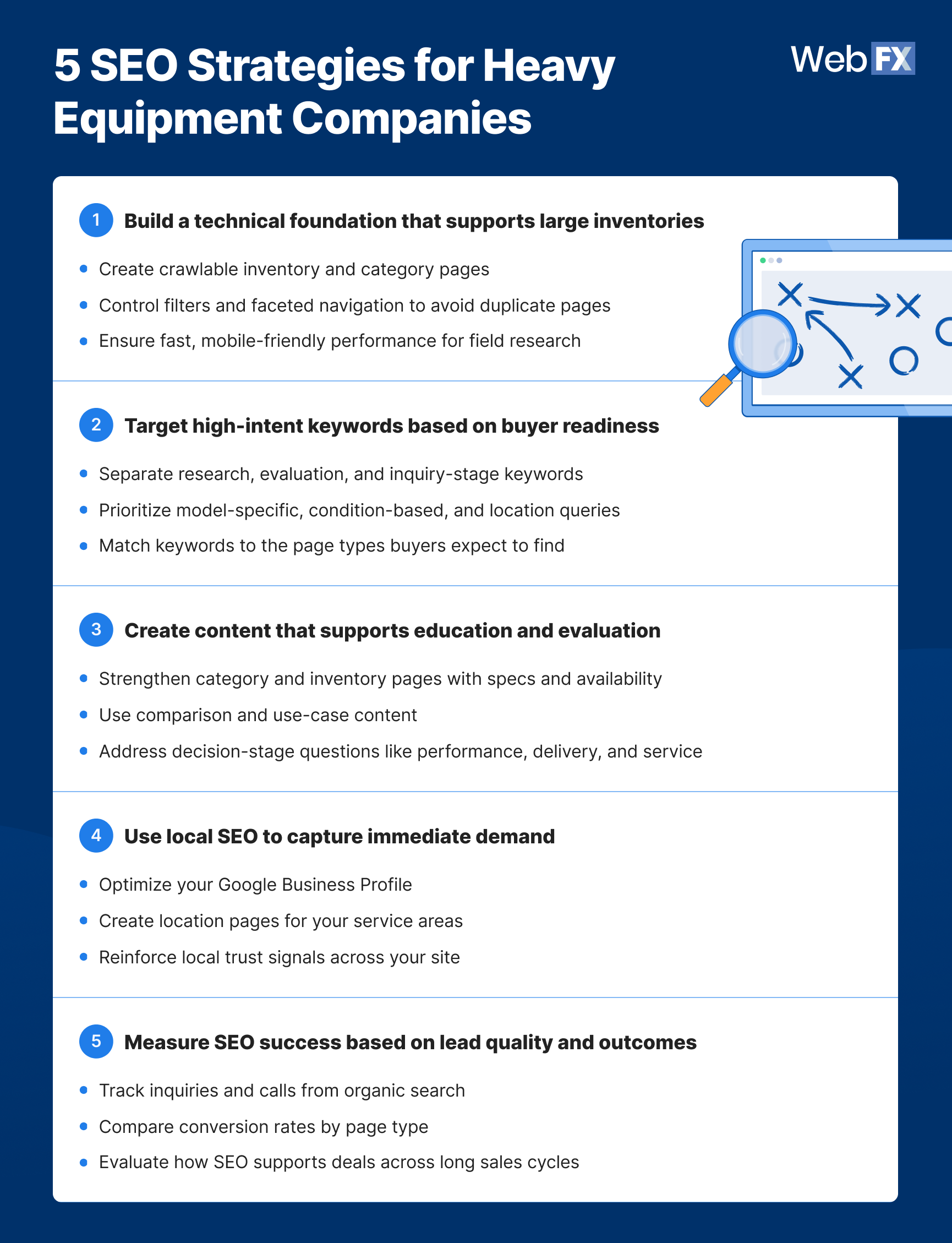
Large inventories, multiple categories, and filtering options can make it difficult for buyers and search engines to find and prioritize your most important pages.
A strong technical foundation ensures that buyers — and search engines — can consistently access your inventory and category pages throughout the buying process. Without it, even well-targeted keywords and strong content struggle to perform.
Improve your site’s technical foundation with these tips:
- Create crawlable inventory and category pages that search engines can easily discover and index.
- Control how filters and faceted navigation generate URLs so variations don’t create unnecessary duplicates.
- Reduce duplicate or thin listings by consolidating similar pages where possible.
- Improve mobile performance, so that buyers researching equipment in the field can still use your site on phones.
These steps help ensure that high-intent pages remain visible when buyers are actively evaluating options.
2. Target high-intent keywords based on buyer readiness
Keyword strategy for heavy equipment companies works best when it reflects how buyers progress toward a decision. Instead of focusing only on search volume, prioritize queries that align with sales, rentals, parts, or service offerings.
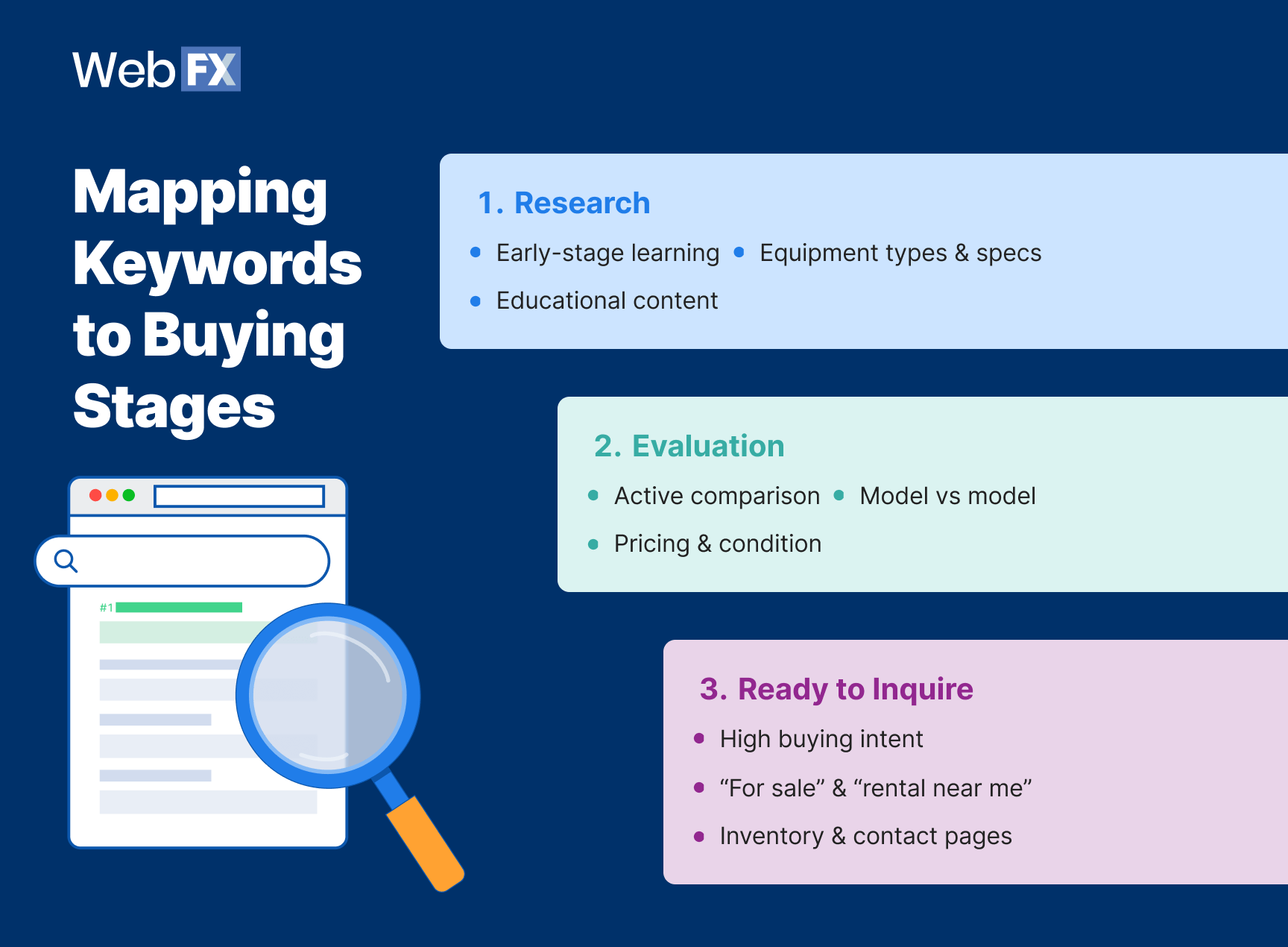
For example, broad searches about equipment types often attract early researchers. Searches on specific models, conditions, pricing context, or geographic availability tend to reflect buyers who are actively evaluating options.
Mapping keywords to buying stages helps ensure that SEO visibility supports real demand. It also makes it easier to prioritize keywords that drive qualified inquiries rather than surface-level traffic.
To target high-intent keywords:
- Review your existing keyword targets and content through a buyer-readiness lens.
- Identify which keywords support early research, evaluation, and readiness to inquire.
- Each group must point to an appropriate page on your website, whether an information resource, category or inventory page, or conversion-focused page.
3. Create content that supports education and evaluation
Educational content helps buyers learn, but evaluation content helps them decide. For heavy equipment companies, both matter.
Category pages, inventory listings, comparisons, and use-case content answer the questions buyers ask as they narrow their options. Common evaluation questions include suitability for specific jobs, performance differences, availability, and next steps.
To support both education and evaluation with SEO content:
- Strengthen category and inventory pages: Include specifications, availability details, and next steps.
- Create comparison and use-case content: Help buyers assess fit for specific jobs or environments.
- Anticipate common decision-stage questions: Performance differences, delivery timelines, and service support are typical follow-up questions you can address with content.
4. Use local SEO to capture immediate demand
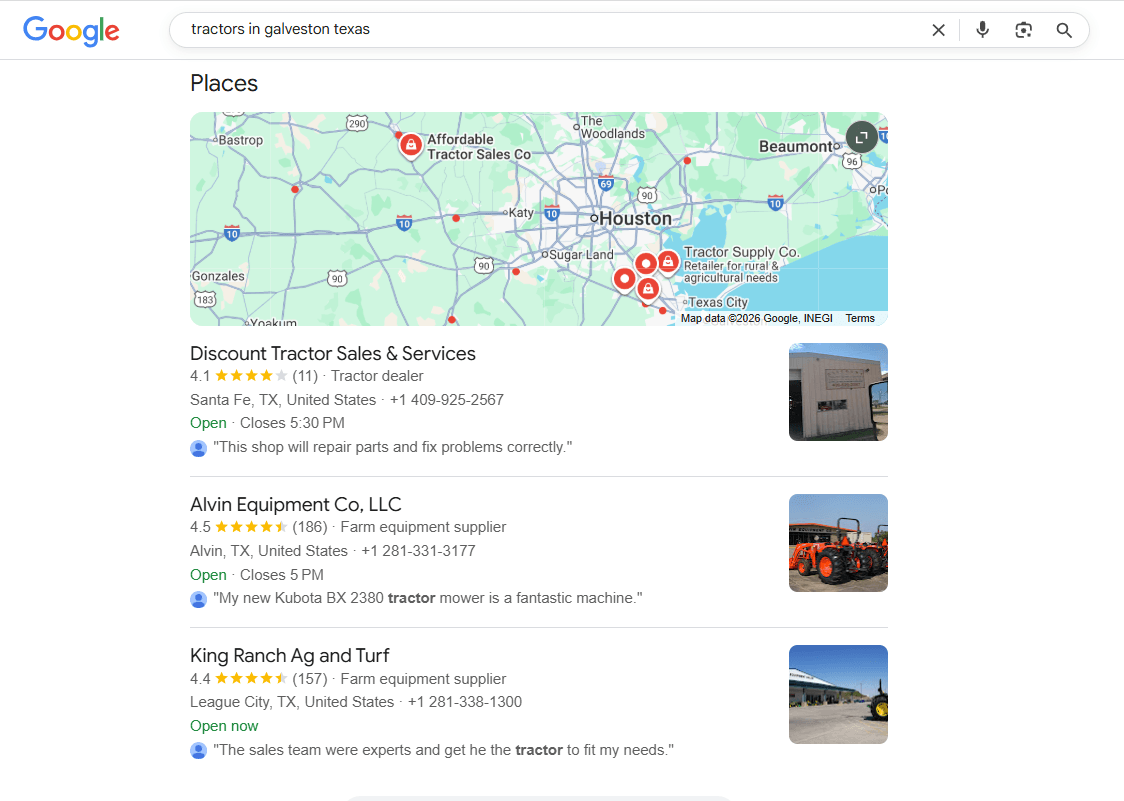
Local SEO plays a critical role for dealerships, rental providers, and service-based heavy equipment businesses. When buyers search locally, they are often trying to solve immediate constraints — finding equipment nearby, confirming service areas, or understanding delivery options.
Here are ways to improve your local online presence:
- Optimize your Google Business Profile to reflect accurate locations, hours, and offerings.
- Create location pages tied to real service areas.
- Reinforce local signals through content that highlights responsiveness, delivery coverage, and on-the-ground support.
When combined with high-intent keyword targeting, local SEO improves your business’s visibility when buyers are ready to engage or inquire.
5. Measure SEO success based on lead quality and outcomes
For heavy equipment companies, measuring SEO success goes beyond rankings and traffic. What matters most is whether organic visibility contributes to inquiries, sales opportunities, and long-term revenue.
To keep measurement aligned with business outcomes:
- Track inquiries and calls generated from organic search.
- Compare conversion rates across page types, such as inventory, category, and informational pages.
- Evaluate how organic search contributes to deals over time, even when it isn’t the final touchpoint. This helps account for long sales cycles where SEO supports research and evaluation before a sale closes.
How heavy equipment buyers actually search online
Heavy equipment buyers search with different levels of intent depending on where they are in the buying process.
Start by understanding the search behaviors of heavy equipment buyers. Are they ready to talk to your sales team, or did they just start their research?
We can categorize their searches according to their intent:
- Informational searches: Queries about equipment types, specifications, maintenance requirements, or use cases. These searches show that a buyer is in the early research stages.
- Commercial searches: Comparisons between brands, models, or price ranges. Buyers using these queries are usually evaluating options and narrowing choices.
- Transactional searches: Queries that include terms like “for sale,” “used,” “rental,” or location-based modifiers. Buyers using these terms are often closer to engaging with your sales team.
Search behavior also reflects real-world constraints. Heavy equipment buyers usually need to confirm:
- Availability
- Service coverage
- Delivery timelines
- Proximity
Location-based searches also matter because logistics and post-sale support affect their purchase decisions.
The opportunity for heavy equipment companies lies in clearly differentiating these intents. Effective SEO strategies ensure your buyers can find the right page for their needs at different stages of research.
If they’re researching specs and use cases, they’ll find your category and product pages. When they’re ready to speak with your sales team, the right page on your website will appear when they search. This approach helps meet prospects where they are, instead of forcing them into a one-size-fits-all experience.
FAQs about SEO for heavy equipment companies
What is SEO for heavy equipment companies?
SEO for heavy equipment companies is optimizing a business’s online presence to stay visible throughout the buying journey. It helps prospects find the right information, supports decision-making, and drives qualified leads and sales.
How does SEO work for heavy equipment companies?
SEO supports visibility across the research, evaluation, and inquiry stages of heavy equipment buyers. Instead of chasing traffic volume, effective SEO helps heavy equipment companies stay present while buyers compare options and prepare to engage.
What are the most effective SEO strategies for heavy equipment dealers?
Effective SEO strategies include the following:
- A strong technical foundation
- Intent-based keyword targeting
- Evaluation- and education-focused content
- Local SEO
- SEO performance tracking tied to lead quality
What types of keywords should heavy equipment companies target?
Keywords that reflect buyer readiness tend to perform best. These include model-specific queries, condition qualifiers, rental or purchase intent, and location-based terms that imply searchers are evaluating options or ready to inquire.
What kind of content should a heavy equipment website create?
In addition to educational content, heavy equipment websites should create pages that help buyers evaluate options. They can create category pages, inventory listings, comparisons, and use-case content that address common decision-making questions.
Why is SEO important for heavy equipment companies and dealers?
SEO supports revenue growth by attracting qualified buyers and guiding them toward inquiry. By aligning visibility with buyer readiness, SEO helps sales teams engage prospects who are closer to a decision.
Support your heavy equipment company’s revenue growth with SEO
SEO can be a powerful growth channel for heavy equipment companies. With the right SEO strategies, you can attract the right buyers at the right stage.
Partner with WebFX to get experts on board and help you with your SEO strategies. Our team has 100,000+ hours of experience in the heavy equipment industry, so you can rest assured that they’ll take the time to know your business and create a personalized SEO strategy that suits your needs and goals.
Contact us online or call us at 888-601-5359 to get started!
Learn how we increased SEO conversions by 113% for a heavy equipment client.

Table of Contents
- Key SEO strategies for heavy equipment
- 1. Build a technical foundation that supports large inventories
- 2. Target high-intent keywords based on buyer readiness
- 3. Create content that supports education and evaluation
- 4. Use local SEO to capture immediate demand
- 5. Measure SEO success based on lead quality and outcomes
- How heavy equipment buyers actually search online
- FAQs about SEO for heavy equipment companies
- Support your heavy equipment company’s revenue growth with SEO
- Why is SEO important for heavy equipment companies and dealers?



Solving key challenges for heavy equipment companies
Our website isn’t driving enough traffic
Attract more web traffic, leads, and conversions so you can sell more of your heavy machinery equipment with our team of expert SEO specialists, copywriters, web designers, and more.

We’re not generating enough leads
Drive leads and fill your sales funnel with personalized lead generation strategies that reach and resonate with your target audience. Just in the past five years, our lead generation experts have generated more than 7.8 million leads for our clients

We’re not renting enough equipment
Access data-driven marketing strategies that get your new or used equipment in front of the people most likely to convert with our suite of digital marketing solutions for heavy machinery companies.

We’re not closing enough sales
Optimize your processes and strategies for every stage of your prospect’s buying cycle with our end-to-end marketing solutions and technology that unify marketing and sales data.
