



Table of Contents
- Your 5-step playbook for profitable PPC for home services
- Step 1: Choose the best PPC platforms for your home services business
- Step 2: Set a realistic budget and bidding strategy for home services PPC
- Step 3: Structure your home services PPC campaigns for maximum relevance
- Step 4: Write PPC ads and landing pages that convert home service leads
- Step 5: Track and optimize your home services PPC campaigns for profitability
- DIY vs. hiring a PPC agency: Making the right call
- When DIY makes sense
- When hiring an agency makes sense
- The hybrid approach
- Questions to ask before deciding
- FAQs about PPC for home services
- Need help running profitable PPC campaigns?
Most home services businesses waste thousands on pay-per-click (PPC) because they bid on the wrong keywords, target too broadly, or run ads that fail to match what customers want when they search. The result is clicks that cost money but never turn into booked jobs.
Done right, PPC for home services fills your schedule fast with high-intent customers ready to hire. Your ads appear at the exact moment people search for emergency repairs, installations, or routine maintenance, and you only pay when someone clicks. With proper tracking in place, you see which ads drive calls, which keywords book jobs, and your true cost per customer.
This guide walks you through running profitable PPC campaigns, including how to target the right audience, write ads that convert, and track ROI so every dollar spent supports real, measurable revenue.
Let’s get into it:


“*” indicates required fields
Your 5-step playbook for profitable PPC for home services

Profitable PPC campaigns focus on one metric: Cost per booked job. Clicks and impressions don’t matter if they’re not turning into revenue. Throwing money at Google and hoping for calls wastes the budget on leads that never convert.
Companies using PPC advertising see strong returns. For home services with high-ticket jobs, that ROI climbs higher when campaigns are structured correctly. The difference between wasted spend and profitable campaigns comes down to following a proven process.
Step 1: Choose the best PPC platforms for your home services business
Before creating a single ad, decide which platforms will reach customers ready to book and what success looks like for your business.
What are Google Local Services Ads?
Google Local Services Ads (LSAs) are pay-per-lead ads that appear at the top of search results with a green “Google Guaranteed” badge. LSAs offer the most direct path to qualified leads for home service businesses because you only pay when a customer contacts you, not for every click. Google pre-screens customers before connecting them to you, filtering out low-quality inquiries.
Once LSAs are running, add Google Search Ads to capture additional volume. Google processes roughly 180,000 monthly US searches for “plumber near me” and 78,000 for “handyman.” Search ads let you bid on high-intent keywords when customers actively need help.
Choose PPC platforms based on customer intent
Different platforms serve different purposes in your home services PPC strategy:
| Platform | Best for | Typical CPC | Audience intent |
| Google Ads | High-intent searches (emergency repairs, installations) | $3.50 average | Ready to book now |
| Bing Ads | Lower-cost search traffic | $2.50-$3.00 | Actively searching |
| Facebook Ads | Brand awareness, retargeting, seasonal promotions | $0.50-$3 | Discovery phase |
Google captures immediate-need leads from people searching “emergency plumber” or “AC repair near me.” Facebook builds awareness and nurtures past customers who might need seasonal services like furnace maintenance or gutter cleaning.
What is Cost Per Booked Job, and why does it matter?
Cost Per Booked Job is your total ad spend divided by the number of completed jobs that generated revenue. This metric matters more than impressions, clicks, or even cost-per-lead because it directly ties your PPC for home services campaigns to actual income.
If you spend $500 on ads and book five jobs worth $300 each, that’s $1,500 in revenue from a $500 investment. Spend the same $500 but only book two jobs? You’re barely breaking even after labor and materials.
Everything in this playbook focuses on lowering your Cost Per Booked Job while maintaining lead quality.
Step 2: Set a realistic budget and bidding strategy for home services PPC
Most home service businesses ask “how much should I spend on PPC?” Wrong question. The right question is “how many jobs do I need to book, and what can I afford to pay per customer?”
Work backward from revenue goals
Start with your target. If you need 20 new customers per month and your average job is worth $400, you need $8,000 in monthly revenue from PPC. If you can afford to spend 25% of revenue on marketing, that’s a $2,000 monthly ad budget.
Now calculate your maximum cost per booked job. With a $2,000 budget targeting 20 customers, you can spend up to $100 per booked job and still hit your goals.
What is the average cost per lead for home services PPC?
Industry benchmarks for cost per lead vary by service type and whether you serve residential (B2C) or commercial (B2B) customers:
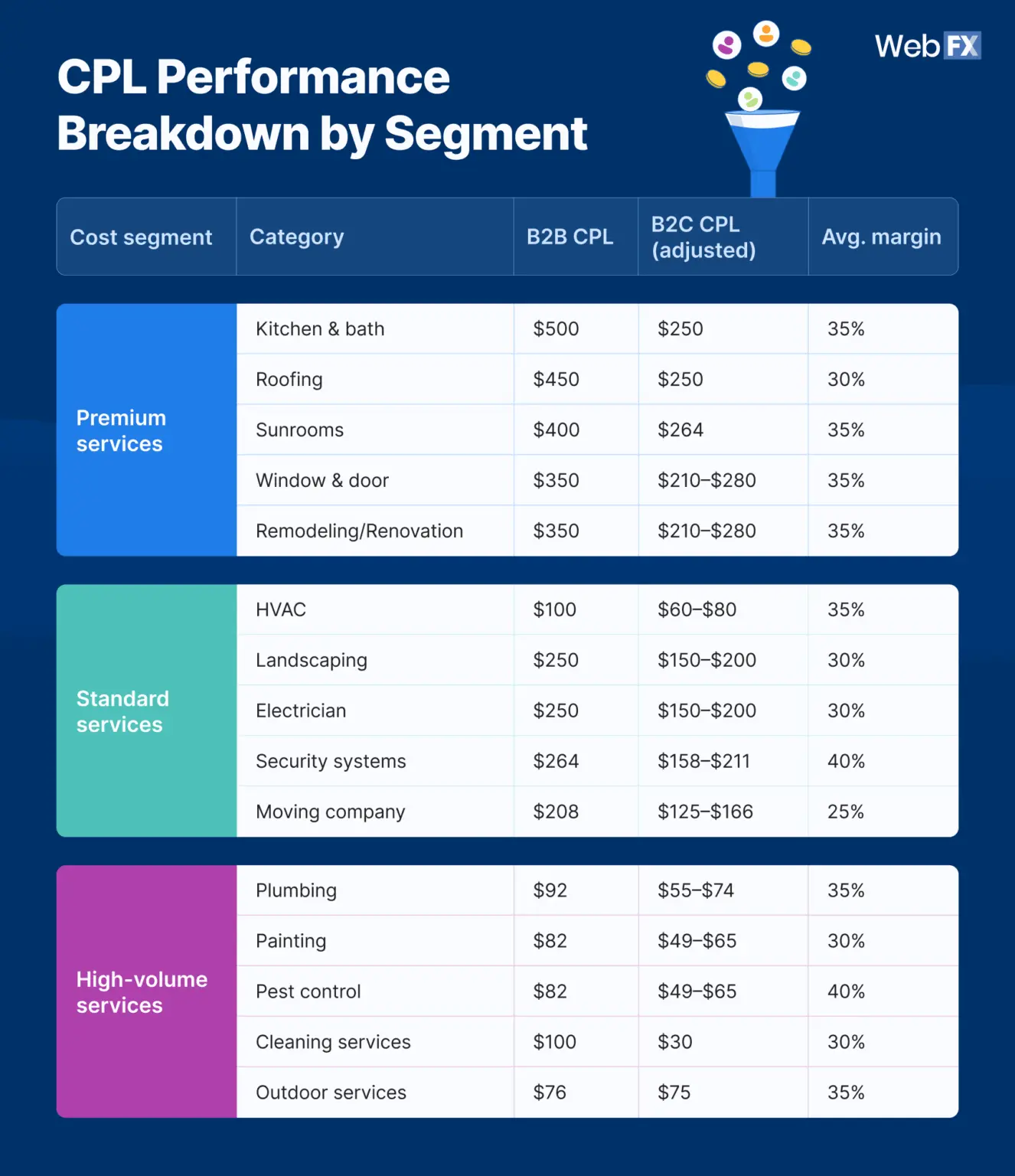
These are starting points, not guarantees. Your actual numbers depend on service area, competition, and how well your campaigns convert leads into jobs. Track conversions from lead to booked appointment to calculate your true Cost Per Booked Job.
Choose your PPC bidding strategy
For new home services PPC campaigns, start with Manual CPC bidding. Manual CPC is a bidding strategy where you set the maximum amount you’ll pay for each click on your ads. This gives you control while you gather conversion data. Set bids based on keyword value (emergency services can justify higher bids than routine maintenance).
Once you have 30+ conversions per month, switch to Maximize Conversions or Target CPA bidding. These automated strategies use machine learning to optimize for your cost-per-acquisition goals.
What’s the difference between ad spend and management fees?
Your total PPC investment includes two parts:
- Ad spend: Money paid directly to Google, Facebook, or Bing for displaying your ads
- Management fees: Time or agency costs to build, monitor, and optimize campaigns
Budget for both. Small-to-midsized businesses invest an average of $9,000 to $10,000 per month in PPC. This includes both ad spend and management costs. A $2,000 monthly ad spend might require 10-15 hours of management time or $500-$800 in agency fees.
Step 3: Structure your home services PPC campaigns for maximum relevance
Poor campaign structure is the most common and costly mistake home service businesses make. Lumping all services into one ad group kills relevance and wastes budget on clicks that never convert.
Why you need separate campaigns for each service
If you offer emergency plumbing and water heater installation, create separate ad groups with dedicated keywords, ads, and landing pages for each service.
Here’s why: Someone searching “emergency plumber” needs help now. Someone searching “water heater installation cost” is researching options. These searches have different intent, different urgency, and require different messaging. Mixing them in one ad group means your ads won’t match what people actually want.
How to structure PPC campaigns for home services
- Create one campaign per major service category (plumbing, HVAC, electrical)
- Build separate ad groups for each specific service within that category
- Use tightly themed keywords (5-20 per ad group) that match the service
- Write ads that mirror the exact search terms in each ad group
- Send clicks to landing pages built specifically for that service
This structure improves your Quality Score, which is Google’s measure of ad relevance based on expected click-through rate, ad relevance, and landing page experience. Higher Quality Scores lower your cost-per-click and improve ad position.
What are negative keywords and why do they matter?
Negative keywords are search terms you exclude from triggering your ads, preventing wasted spend on irrelevant clicks. Add these to your home services PPC campaigns immediately:
- DIY terms: “how to,” “DIY,” “yourself,” “tutorial”
- Job seekers: “jobs,” “careers,” “hiring,” “salary”
- Free services: “free,” “cheap,” “discount,” “volunteer”
- Wrong services: If you’re a plumber, exclude “electrician,” “HVAC,” “roofing”
Step 4: Write PPC ads and landing pages that convert home service leads
Your ad gets the click. Your landing page gets the call. Both need to work together for successful PPC for home services campaigns.
How to write high-converting ads for home services
High-performing home service ads follow this structure:
Headline 1: Service + Location
Example: “24/7 Emergency Plumber in Austin”
Headline 2: Trust Signal or Offer
Example: “Licensed & Insured | No Call-Out Fee”
Headline 3: Urgency or Benefit
Example: “Same-Day Service Available”
Description: Reinforce value and include a call to action
Example: “Serving Austin for 15 years. Free estimates on all repairs. Call now or book online in 60 seconds.”
This formula works because it answers the three questions every searcher has: Can you help me? Can I trust you? What happens next?
What makes a high-converting landing page for home services?
Your PPC landing page should include these essential elements:
- Clear headline matching your ad (if ad says “Emergency Plumber,” headline says “Emergency Plumber”)
- Phone number above the fold (large, clickable on mobile)
- Simple contact form (name, phone, service needed – nothing more)
- Social proof (Google reviews, BBB rating, years in business)
- Trust signals (licenses, insurance, guarantees, certifications)
- Mobile-first design (most home service searches happen on phones)
- Fast load time (under 3 seconds)
Remove navigation menus and footer links. Every element should push toward one action: Calling or filling out the form.
Most home service calls happen within 5 minutes of the initial search. Your landing page needs to make contacting you the easiest option on their screen.
Step 5: Track and optimize your home services PPC campaigns for profitability
Tracking clicks is easy, but tracking which clicks turn into revenue is where most businesses fail with their PPC for home services campaigns.
Why Cost Per Booked Job is the most important PPC metric
Cost Per Booked Job is your north star metric. Clicks don’t pay the bills. Leads don’t pay the bills. Only booked jobs that turn into invoices generate revenue.
To calculate it, you need to track the full customer journey:
- Ad click
- Phone call or form submission (lead)
- Scheduled appointment (booked job)
- Completed service (revenue)
How to set up call tracking for home services PPC
Use call tracking software to assign unique phone numbers to each campaign. When someone calls, you’ll know exactly which ad drove that call.
Connect your CRM to track which leads convert into scheduled jobs. This reveals your lead-to-booking conversion rate, which is just as important as cost-per-lead.
If 100 leads cost $5,000 but only 20 turn into booked jobs, your Cost Per Booked Job is $250. If you improve your sales process and convert 30 leads into jobs, Cost Per Booked Job drops to $167 without spending another dollar on ads.
How to optimize PPC campaigns based on revenue data
Review performance weekly:
- Which keywords generate booked jobs at the lowest cost?
- Which ad copy drives the highest conversion rates?
- What time of day produces the best leads?
- Which landing pages convert visitors into customers?
Double down on what works. Cut what doesn’t.
Maryland Sunrooms connected their PPC campaigns to real business outcomes and saw a 670% increase in conversions from paid ads, helping them exceed annual revenue goals. That’s the impact of tracking profitability, not vanity metrics.
Have intelligent conversations with your team or agency about what drives growth. Focus on Cost Per Booked Job, and every optimization decision becomes clear.
Explore WebFX Home Services Marketing Services
DIY vs. hiring a PPC agency: Making the right call
Running your own PPC campaigns saves money upfront. Hiring an agency costs more but often delivers better returns. The decision depends on your budget, time, and campaign complexity.
When DIY makes sense
Consider managing PPC yourself if:
- Monthly ad spend is under $2,000
- You offer one primary service in one location
- You have 5-10 hours per week for campaign management
- You’re comfortable learning Google Ads and Bing Ads platforms
- You can track performance and make data-driven adjustments
Small businesses with limited budgets and simple services often start with DIY. A single-location plumber offering emergency repairs can run effective campaigns without agency support.
When hiring an agency makes sense
Consider hiring a PPC specialist or agency if:
- Monthly ad spend exceeds $3,000
- You serve multiple service areas or locations
- You offer 5+ distinct services requiring separate campaigns
- You lack the time to monitor and optimize campaigns weekly
- Your campaigns aren’t hitting target cost-per-lead or ROAS goals
- You’re losing leads to competitors in search results
Businesses recognize that agency expertise often pays for itself through better performance.
| Factor | DIY PPC | Hire an Agency |
| Cost | Ad spend only ($500-$3,000/month) | Ad spend + management fees ($500-$2,000/month for management) |
| Time investment | 5-10 hours/week for setup, monitoring, optimization | 1-2 hours/month for strategy calls and reporting |
| Access to tools | Basic Google Ads tools, free keyword planners | Professional bid management, call tracking, advanced analytics |
| Expertise | Learning curve for platform changes, best practices | Dedicated specialists stay current on algorithm updates |
| Scalability | Limited by your time and knowledge | Agency scales campaigns as budget grows |
The hybrid approach
Some businesses start with DIY to learn the basics, then hire an agency once monthly spend reaches $3,000-$5,000. This builds internal knowledge while leveraging professional optimization at scale.
For example, HVAC company Boss Mechanical struggled with inefficient digital marketing strategies. Partnering with an agency helped them achieve a 65% increase in total leads by optimizing their approach. The agency investment paid for itself through better lead quality and lower cost-per-acquisition.
Questions to ask before deciding
- What’s your target cost per booked job, and are you hitting it consistently?
- Can you dedicate 5-10 hours weekly to campaign management?
- Do you understand Quality Score, bidding strategies, and negative keywords?
- Are you losing jobs to competitors showing up higher in search?
If you’re not hitting cost targets or lack time for ongoing optimization, agency support often delivers better ROI than struggling through DIY.
FAQs about PPC for home services
What budget should a home service business start with for PPC?
Your starting budget depends on three factors: Average job value, target cost per booked job, and local competition.
Use this formula:
- Calculate your target monthly revenue from PPC
- Determine acceptable marketing spend (typically 15-25% of revenue)
- Account for conversion rates (leads to booked jobs)
Example: If your average job is worth $500 and you need 20 new customers monthly, that’s $10,000 in revenue. At 20% marketing spend, budget $2,000 monthly. If your market converts leads at 30% (typical for home services), you need roughly 65-70 leads, putting your target cost-per-lead around $28-$30.
Start with the minimum budget needed to generate meaningful data. For most home services, $1,500-$2,500 monthly provides enough volume to optimize. Lower budgets make it difficult to test and improve campaigns.
Small-to-midsized businesses invest an average of $9,000-$10,000 per month in PPC, though home services companies with local service areas often spend $2,000-$5,000 monthly.
How do you handle seasonal trends in home service PPC?
Create separate campaigns for services and adjust budgets proactively based on seasonal search shifts in home services demand.
HVAC example:
- Increase “AC repair” and “air conditioning” budgets 30-40% in May-June (before peak heat)
- Shift budget to “furnace repair” and “heating” in September-October (before winter)
- Reduce budgets during shoulder seasons when demand drops
Roofing example:
- Boost budgets during spring (post-winter damage inspections)
- Maintain steady spend through summer (peak installation season)
- Increase “storm damage” budgets immediately after severe weather
Implementation strategy:
- Build seasonal campaigns with separate budgets you can activate/pause
- Schedule automated rules in Google Ads to increase bids during peak hours/seasons
- Adjust keyword focus (emergency services get higher bids during peak season)
- Update ad copy to match seasonal urgency (“Beat the heat – AC tune-up special”)
Track performance by season over multiple years. Historical data shows which months deliver the best ROI for each service, letting you allocate budget intelligently instead of reacting to demand spikes.
Which platforms are best for home services PPC?
Google Ads dominates home services lead generation. Google commands 89.6% of global search engine market share, making it the priority platform.
Platform priority ranking:
- Appear at the very top of search results with “Google Guaranteed” badge
- Pay per lead, not per click
- Best for residential services (plumbing, HVAC, electrical, roofing)
- Average conversion rates 15-30% higher than standard search ads
- Capture high-intent searches (“emergency plumber,” “AC repair near me”)
- Most volume and best ROI for immediate-need services
- Essential for any home services business
- 30% lower cost-per-click than Google
- Smaller audience but less competition
- Good supplemental platform for businesses already succeeding on Google
- Best for brand awareness and retargeting past customers
- Lower immediate conversion intent
- Effective for seasonal promotions and maintenance reminders
Start with Google (LSAs + Search Ads). Add other platforms only after Google campaigns are optimized and profitable.
How do I stop getting spam calls and junk leads from my ads?
Build an aggressive negative keyword list, tighten location targeting, and use lead qualification tools.
Negative keywords to add immediately:
- DIY seekers: How to, DIY, yourself, tutorial, guide, instructions, manual, steps
- Job seekers: jobs, careers, hiring, employment, salary, wages, openings
- Info seekers (not buyers): free, cheap, discount, cost (for searches like “average cost” vs. “get a quote”)
- Wrong services: If you’re a plumber, exclude: electrician, HVAC, roofing, landscaping
- Geographic qualifiers: Exclude cities/zip codes outside your service area. If you serve Austin but not San Antonio, add “San Antonio” as a negative location.
Additional spam filters:
- Use location radius targeting instead of broad metro targeting
- Add call screening questions with Google Ads call extensions
- Implement multi-step forms (service needed → contact info) to filter bots
- Set minimum call duration (calls under 30 seconds don’t count as leads in LSAs)
- Enable CAPTCHA on landing page forms
Review search query reports weekly. If you’re getting clicks for irrelevant searches, add those terms as negatives immediately.
By 2025, 69% of home services advertisers reported higher costs per lead, with an average increase of 10.51% year-over-year. Spam clicks waste budget. Aggressive negative keyword lists protect your spend.
We foster and form long-term partnerships so that your business has long-term results.
See Our Approach
$10 billion

24 million

7.14 million
Need help running profitable PPC campaigns?
You now have the playbook: Google Local Services Ads for immediate leads, separate campaigns for each service, landing pages built for one action, and weekly optimization focused on Cost Per Booked Job.
Strategy is easy. Serving customers while managing campaigns isn’t. Keyword research, bid adjustments, negative keywords, landing page tests, and call tracking analysis. Most home service owners are already booked running jobs.
WebFX has driven over $10 billion and more than 24 million for our clients, including home services businesses like yours. Our PPC specialists provide dedicated PPC solutions for window and door companies, plumbing, HVAC, and other home service businesses. We handle the setup and ongoing optimization, allowing you to focus on your core business.
Contact us online or call us at 888-601-5359 to talk with a strategist about our PPC services for home services.
-
 The WebFX team includes 750+ digital marketing specialists across SEO, PPC, web design, analytics, and beyond. Using proprietary RevenueCloudFX technology and transparent, data-driven strategies, we’ve collectively generated $10 billion in revenue and 24 million leads for our clients in the past five years.@webfx
 -

WebFX is a full-service marketing agency with 1,100+ client reviews and a 4.9-star rating on Clutch! Find out how our expert team and revenue-accelerating tech can drive results for you! Learn more
Try our free Marketing Calculator
Craft a tailored online marketing strategy! Utilize our free Internet marketing calculator for a custom plan based on your location, reach, timeframe, and budget.
Plan Your Marketing Budget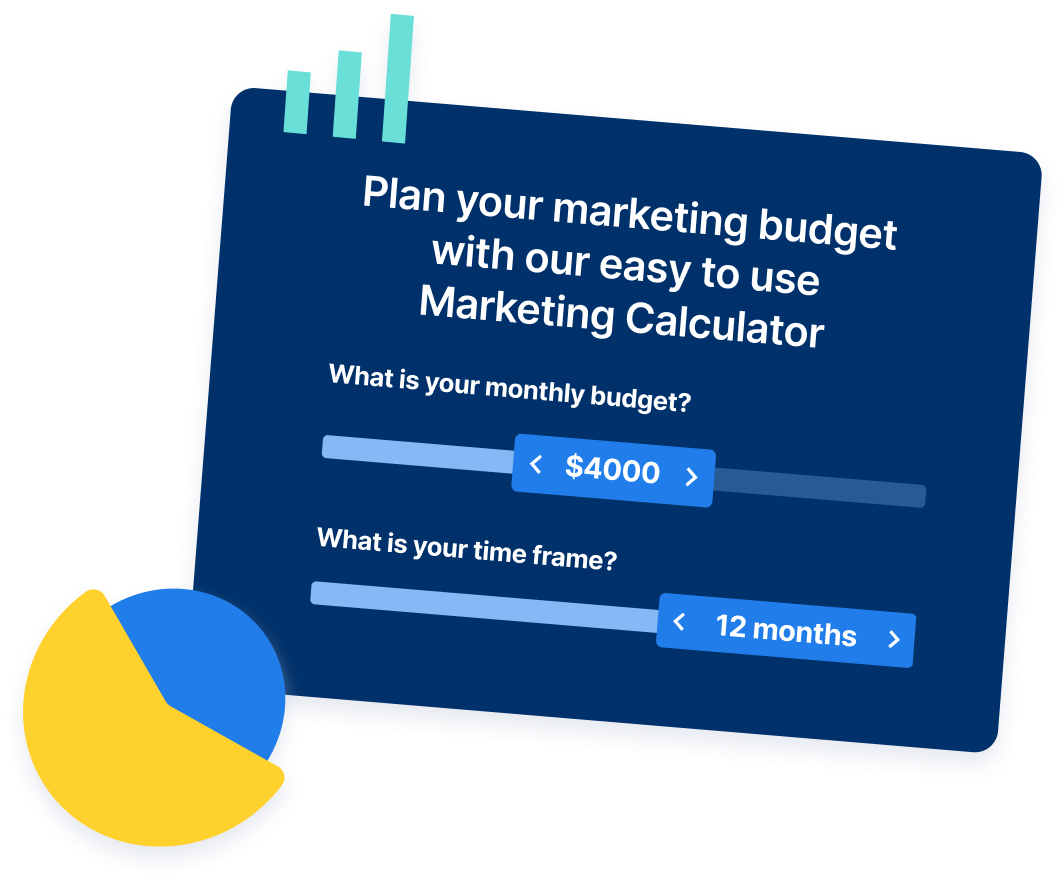
Table of Contents
- Your 5-step playbook for profitable PPC for home services
- Step 1: Choose the best PPC platforms for your home services business
- Step 2: Set a realistic budget and bidding strategy for home services PPC
- Step 3: Structure your home services PPC campaigns for maximum relevance
- Step 4: Write PPC ads and landing pages that convert home service leads
- Step 5: Track and optimize your home services PPC campaigns for profitability
- DIY vs. hiring a PPC agency: Making the right call
- When DIY makes sense
- When hiring an agency makes sense
- The hybrid approach
- Questions to ask before deciding
- FAQs about PPC for home services
- Need help running profitable PPC campaigns?
Share this article


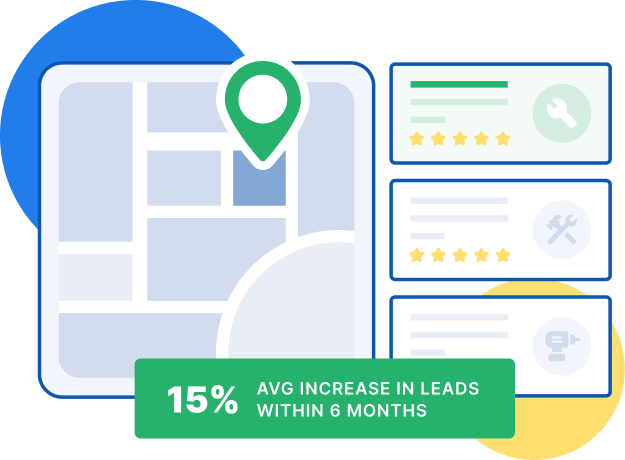
Outrank Local Competitors This Season
See how home service pros like you are dominating local Google results and booking more jobs.
Try our free Marketing Calculator
Craft a tailored online marketing strategy! Utilize our free Internet marketing calculator for a custom plan based on your location, reach, timeframe, and budget.
Plan Your Marketing Budget
What to read next




Additional Reading



Home Services Case Studies
Solving key challenges for home services companies
Our website isn’t ranking in the search results for home services
When people or businesses need home services in their area, they take to search engines like Google. Ensure your website appears at the top of the results when your target audience needs your services.

We’re struggling to grow our team
Expanding your team and growing your business go hand-in-hand. If you need help growing your team with talented and friendly employees, our recruitment marketing services have you covered.

We’re not generating enough leads
Are people visiting your website but not getting in touch with you? Our expert marketing specialists and web designers can optimize all areas of your website so you can attract and convert more of your target audience to use your home services.

We’re not attracting new customers
Having trouble increasing your online visibility, so you can attract new customers? Our award-winning marketing services get your brand in front of the right people in your local area.
