Matthew Gibbons is a Senior Data & Tech Writer at WebFX, where he strives to help businesses understand niche and complex marketing topics related to SEO, martech, and more. With a B.A. in Professional and Public Writing from Auburn University, he’s written over 1,000 marketing guides and video scripts since joining the company in 2020. In addition to the WebFX blog, you can find his work on SEO.com, Nutshell, TeamAI, and the WebFX YouTube channel. When he’s not pumping out fresh blog posts and articles, he’s usually fueling his Tolkien obsession or working on his latest creative project.
What is web design? Web design covers the planning, structure, layout, visuals, and user experience of a website. It helps businesses create sites that look professional, work smoothly, and drive action.
Why does web design matter? Web design shapes how people perceive your brand, use your site, and decide whether to contact, buy, or leave.
What matters most in web design? The most important parts of web design include mobile responsiveness, fast load times, clear navigation, accessibility, strong UX, and SEO-friendly structure.
How much does web design cost? Web design costs between $1,000 and $30,000 on average, with most companies paying between $500 and $5,000 per year.
When should I hire a web design agency? You should hire an agency when your site no longer supports your goals, lacks performance, or needs expert strategy, design, and development support.
Web design refers to how a website looks, works, and guides users toward action. It includes layout, navigation, mobile responsiveness, UX, accessibility, and performance.
Below, you’ll find 50 common web design FAQs for businesses. We grouped them by topic so you can quickly find answers about web design basics, costs, CMS platforms, UX, accessibility, mobile optimization, maintenance, and agency support.
Without further ado, let’s dive into all the biggest FAQs about web design!
Web design basics and definitions
In this first section, we’ll cover the most intro-level, foundational questions about web design, including the definition. These web design FAQs are perfect for businesses just getting started with building their websitwebe, or for those trying to understand the value it offers.
Web design is the process of building and optimizing the look and layout of a website. It incorporates both visual and functional elements, from making use of white space to improving page load speeds. Businesses use web design in conjunction with other marketing strategies to help drive revenue.
Web design and web development often get confused, but they’re different terms. Where web design refers to optimizing the layout of a website and improving the user experience, web development refers to more backend tasks like programming and coding. In short, web design covers the parts of the website users see, and web development covers the parts they don’t see.
That said, people often use “web design” as a catchall term for all elements of building and creating a website. That’s why when you hear people talk about web design as a marketing strategy, they often mention things like page speed optimization and site security alongside things like graphic design.
Web design is an essential tool for businesses because your website is at the center of your digital presence. Strategies like search engine optimization (SEO) and content marketing are meaningless if you don’t have a website for those strategies to direct users to, or if that website is so poorly optimized that it drives those users away.
In fact, 83% of online users say they appreciate when a website looks attractive and up to date, so optimizing those aspects of your site is a surefire way to encourage more traffic retention. By optimizing your web design, you ensure that your site is functional, navigable, and appealing for users. That produces the following benefits:
Better rankings in search engines
Higher website traffic
Greater traffic retention
More leads and conversions
Ultimately, all of those things lead to more revenue for your company, making web design vital to your success.
Virtually all businesses need web design. In today’s digital world, having a website isn’t optional — it’s essential. That’s true whether you operate a restaurant, a pest control company, a clothing brand, or anything in between. But your website won’t benefit you if it’s poorly optimized and doesn’t appear in search results, which is why it’s crucial to optimize it based on core web design practices.
If you’re struggling to justify the cost of web design to skeptical executives, you can tie it directly to conversions and revenue. A well-designed site builds trust, improves the user experience, and makes it easy for visitors to convert. Even small lifts in conversion rate can translate into big jumps in revenue.
When you’re talking to executives, focus on three angles:
Conversion rate: Show how a redesign could raise your conversion rate from (for instance) 1% to 2%, effectively doubling the leads or sales you get from the same traffic.
Revenue per visitor: Tie design changes to higher revenue per visit — for example, more completed quote forms or higher average order values.
Lead quality: Explain how clearer messaging and a better UX attract more qualified leads, not just more traffic.
Expert insights from
Danélle W.Strategic Lead Interactive Project Manager at WebFX
“I would pose this single question: ‘How much revenue are you losing each month due to visitors lacking trust in your site to convert?’
The truth is that your website frequently serves as the initial (and sometimes the only) impression potential clients get of your company. If it appears old-fashioned, takes too long to load, or isn’t functioning correctly on mobile, you’re missing out on valuable opportunities.”
You can also benchmark your site against competitors. Look at how quickly their pages load, how easy it is to find key information, and how prominently their calls to action appear. If their sleek, easy-to-use sites are leaving you in the dust when it comes to rankings and conversions, you can use that gap to make the case that an updated design will help your business win back those clicks and conversions.
Elements of web design
In this section, we’ll cover questions related to the most essential elements of web design, from site speed to performance analytics. When you’re creating a website, these are among the most important questions to get the answers to.
If you’re trying to figure out which elements of web design to prioritize, these are the most important ones to consider:
Mobile-friendly site design
Transparent value offering and conversion routes
Key SEO practices like meta tags, heading hierarchy, and schema markup
User-friendly navigation layout
You can hold off on most other elements of web design until these are taken care of.
Expert insights from
Danélle W.Strategic Lead Interactive Project Manager at WebFX
“What can wait? Tailored animations, detailed brand narrative segments, intricate filtering frameworks — these are impressive, but focus on mastering the basics initially. You can continually improve later using user information. I’ve observed companies invest heavily in flashy elements while their contact forms are malfunctioning or their websites take 10 seconds to load. Don’t be that type of business.”
Website speed has a huge impact on the performance of your site. First of all, if your site takes too long to load, users won’t want to stick around. They’ll hit the “back” button and visit another site instead. In fact, 40% of users leave a site that takes longer than three seconds to load.
Equally as important, though, is the fact that a slow-loading site will perform badly in search results. One of the biggest ranking factors in Google is Core Web Vitals, which are metrics relating to the way pages load. If your site performs poorly in relation to those metrics, it won’t rank, so most users won’t find it to begin with.
The first and most foundational security feature that any website should have is HTTPS. You may have noticed that most website URLs start with “http” or “https.” HTTP is the standard protocol used to load webpages, but HTTPS is the encrypted version. It keeps your website safe from attempts to steal user data. That means users can visit your site safely.
Not only is this important for getting users to trust your site, but it’s also important for ranking in Google, where non-HTTPS sites are ranked lower and marked as unsafe.
In addition to HTTPS, you can also use additional encryption services. And if your site features an online store, you should be sure to get some website security plugins (like Sucuri) that protect users’ financial information when making purchases.
Defining success in the context of web design is highly subjective, so to some degree, it’s going to depend on the specific goals and audience of your company. Having said that, some common ways of measuring website success include the following metrics:
Search engine rankings: Is your site ranking well in search engines like Google?
Website traffic: How many visitors is your site earning?
Average session duration: How much time are users spending on your site?
Conversion rate: How many site visitors end up converting?
Even if you aren’t defining success based solely on these metrics, they’re definitely important to monitor and analyze when considering your website’s performance.
There are a lot of different mistakes you can make when designing a website, but here are some of the most common ones:
Not optimizing for mobile
Failing to use HTTPS
Neglecting page load speeds
Creating a confusing navigation setup
Not maintaining the site after launch
Additionally, you should try to avoid having too many cooks in the kitchen when creating a website design. That can compromise the quality of your site due to clashes between the multiple, competing viewpoints for how it should look.
Expert insights from
Danélle W.Strategic Lead Interactive Project Manager at WebFX
“The largest pitfall? Creating by committee without distinct decision-making power.
I’ve witnessed this countless times. A redesign initiative begins with positive motives, yet each stakeholder seeks involvement. Marketing holds views, Sales holds views, the CEO’s dog holds views. You end up in constant revision loops, scope expansion, and a final product that’s a Frankenstein’s monster of competing priorities, benefiting no one effectively.”
Those are some of the biggest mistakes to watch out for, but there are plenty of others as well, which is why it’s important to spend time learning the best web design tactics before you start building or reoptimizing a website.
Web design process and preparation
The process of building a website can seem very convoluted, and in many ways it is. But with these web design answers, you can hopefully get a better grasp on what to expect from it. The FAQs below deal with some of the elements that go into creating a website for the first time.
There’s really no reliable way to measure how long a website design will take to complete. That’s because everything depends on the specifics of what you’re doing. Here are just a few questions that impact the length of the process:
Are you building a site from the ground up, or redesigning an existing one?
Are you using templates, or designing your site layout yourself?
How many pages will be on your website?
Will you have an online store on your site?
Will your site feature custom graphics or videos?
Depending on the answers to those questions, the process of designing a website can take anywhere from a few days to several months.
There are several ways designers can test the performance of their websites before those sites go live. Some of the methods they’ll commonly use include:
Audience surveys and focus groups
HTML and CSS validation
Live testing on different browsers and devices
Accessibility testing (with a tool like Insytful)
Manual proofreading of all content
Of course, no matter how much testing you do beforehand, you’ll likely still have things to fix or trim up after the site launches, so be prepared for that.
A/B testing refers to the process of creating two versions of a particular website element, and testing them by showing each version to a different group of users to determine which performs better.
For example, say you’re creating a CTA button for your homepage, but you have a couple of different ideas for what the button should say. To determine which one is better, you can run an A/B test, where half the users who visit your homepage see one version and the other half see the other version. If you see way more clicks come from Version A, you know that’s the version you should go with.
Competitive analysis is important for seeing what other businesses in your industry are doing with their web design so you can outperform them. Here’s a simple way to approach competitive analysis for web design:
Start with actions and results: Analyze the overall user experience on your competitors’ sites, looking at things like CTA placement and navigation setup.
Dig deeper with tools: Use specialized competitor analysis tools to analyze specific aspects of a competitor’s site (like using SpyFu to assess their website’s SEO).
Find the gaps: Look for opportunities your competitors are missing, like poor mobile UX or missing content around your audience’s biggest pain points.
Expert insights from
Danélle W.Strategic Lead Interactive Project Manager at WebFX
“Don’t only examine what your rivals are doing — pay attention to what they’re overlooking. That’s where your chance exists. Perhaps their websites are elegantly crafted but offer poor mobile usability. Maybe they aren’t focusing on the particular issues your audience faces. Competitive analysis must uncover opportunities you can leverage, rather than simply providing a moodboard.”
As a side note, one thing you’ll often hear is that you should perform competitive analysis by looking for attractive competitor sites and then mimicking what they’re doing. But this is a bad idea.
When you imitate the look of competitor websites, you’re only focusing on aesthetics. True competitor analysis should look at strategy — why certain visual designs are successful for your competitors (if they’re really successful at all). Keep that in mind as you analyze your competitors’ websites.
Web design costs and budgeting
As with nearly every type of marketing, one of the biggest questions on your mind (or your company executives’ minds) is “So, how much is this gonna cost, anyway?” And for good reason — you need to know how to budget, after all. Fortunately, the answers to these web design questions will help you get some clarity on that subject.
On average, web design costs between $1,000 and $30,000, with most companies paying between $500 and $5,000 per year. For businesses with particularly large or complex websites, though, that price can get even higher, with some businesses spending as much as $100,000 on their web design.
Of course, those numbers form such a broad range that you may not find it super helpful. But the reason for that breadth is that web design is impacted by so many different factors that contribute to the overall cost. Consequently, one company could spend $2,000 on their website while another spends $50,000, simply because they have different approaches to their web design.
That said, here’s a breakdown of some more specific web design cost ranges:
The answer to this question depends heavily on the extent of your proposed redesign. If the foundation of your site is staying the same, and your redesign is focusing more on things like your visual branding, a redesign is almost certainly cheaper and easier than building a whole new website.
On the other hand, if you’re reworking your entire website structure, or if you’re trying to expand your site in a way your current website platform doesn’t support, building a new site could honestly be better and cheaper.
But affordability isn’t the only factor here. When you build a whole new website, you’re starting from scratch with your SEO, which is not something you want to do unless you absolutely have to. That means you shouldn’t build a whole new site without very good reason.
Yes. Web design doesn’t end when a site goes live — you have to regularly update and maintain it, and that comes with expenses. Those expenses include:
SEO maintenance costs
Content creation
Web hosting
Plugin subscriptions
The specifics depend on your company’s unique web design approach, but the factors listed above are among the most common contributors to ongoing website costs.
CMS and website platforms
Your website doesn’t appear out of thin air. It takes work to build it, and for many businesses, that work goes more easily with the help of a content management system (CMS) or other site-building tool. If you’re trying to navigate the different tools available out there and find which one is right for you, these FAQs should help.
A content management system (CMS) is a type of software application that allows you to create and publish website pages and online content. Many businesses use a CMS to build and maintain their website, and that’s something worth considering for your own site, too. Some of the most widely used CMS platforms include WordPress, Magento, and Wix.
There’s no one CMS that every business should use. You’ll have to evaluate your options and decide for yourself which CMS is right for you. That said, some of the most common options include:
Yes, almost certainly. Just about any web designer will be able and willing to work with whatever CMS you’re currently using — their expertise isn’t limited to a specific platform. That means whether you use WordPress, Wix, Joomla, or something else entirely, a web design agency can handle your existing website.
Only you can decide if a custom-built site or a template is the right choice for you. Having said that, it’s almost always better to custom-build your site if you have the means. That’s because you want your website to stand out from your competitors so that your brand will stick in users’ minds.
With a template, your site will just blend in with all the others out there. A custom-built site allows you to do something more unique.
It depends. If you’re using a user-friendly CMS or other website platform, you don’t necessarily need any coding knowledge. But if your site is custom-built from the ground up — or if you want to apply a high level of customization to your CMS-built website — coding knowledge is good to have, and sometimes essential. You’ll need to take that into account when deciding how to build your site.
UX and UI design
Two of the most important components of web design (and to some extent, marketing in general) are the user experience (UX) and the user interface (UI). Those two components are what we’ll cover in the web design answers shown below.
UX design refers to the process of optimizing a website’s technical layout to make things as functional and seamless as possible for users. Some of the most important UX optimizations include:
Visual hierarchy (headings, font sizes, and spacing)
Intuitive navigation setup
Mobile-friendliness
Page speed optimization
All of these serve to make users’ time on your site smooth and free of technical issues.
UI design refers to the process of optimizing the visual appeal of a website to make it aesthetically pleasing for users. It’s very similar to UX, and the two often go hand in hand. Some common optimizations of UI design include:
Color schemes
White space
Branding
Alignment of page elements
Basically, the idea of UI design is to make users enjoy the look of your website. You don’t want your site to be so visually unappealing that users click away immediately.
UX focuses on the functional side of your website — making sure everything runs smoothly, is free of technical issues, and is easy to use. UI, meanwhile, focuses on the aesthetic side of your website — making sure everything looks good on a purely visual level. A successful website will optimize for both of these areas.
The reason UX design is so essential is that it plays a huge role in the amount of traffic and conversions your site generates. When your UX is poorly optimized, not only will Google not rank your site as well, but even what traffic you do get will be driven away by frustration over your slow load times or confusing navigation.
A good user experience, on the other hand, ensures that your site ranks well, pulls in a lot of traffic, and drives that traffic to stick around long enough to convert.
There are several ways to improve the UX design of your website, including:
Optimizing your page load speeds
Making your site mobile-friendly
Creating an intuitive navigation setup
Using a clear visual hierarchy
Ensuring all links and buttons work correctly
All of those are things you should do on your own website.
Website accessibility
Now more than ever, accessibility is a hugely important part of any website. But what is website accessibility, and why does it matter? Find out with this next group of FAQs about web design.
Website accessibility refers to the practice of making websites accessible to all users. In particular, that means optimizing your website to make it available to (and usable by) people with disabilities, such as those who use screen readers to read text content.
There are two big reasons why accessibility is important to web design. Firstly, if your website isn’t accessible, there will be some potential leads who won’t be able to use it. Those leads would have become clients if they could use your site, but since they can’t, they don’t. Needless to say, that hurts revenue.
More importantly, though, a certain level of website accessibility is required by law — specifically, by the Americans with Disabilities Act (ADA) in the United States. The ADA requires accessible digital experiences, and the web content accessibility guidelines (WCAG) are the most widely used standard for demonstrating compliance in the U.S. Be sure to follow those guidelines to avoid legal penalties.
Given how many people use the Internet on their phones in today’s world, it should go without saying that mobile optimization is important for your website. But why, specifically? And how do you go about optimizing a site for mobile? Well, that’s exactly what we’ll cover with these web design answers.
Mobile-friendliness is one of the most important optimizations for your website. That’s the case for two reasons. Firstly, the majority of website traffic comes from mobile devices — over 62% of all traffic worldwide, in fact. To take advantage of that traffic, your site needs to be optimized for mobile devices.
The second reason mobile optimization is so crucial is that Google doesn’t rank websites that don’t have mobile versions. That means that in order to appear in search results at all, you need to have a mobile-friendly website.
If you don’t have a mobile-friendly website, your website likely won’t appear in Google rankings. That means your entire SEO strategy will be pretty much dead in the water, and almost no one will visit your website, so it won’t benefit you at all. Furthermore, even among what little traffic you do get, anyone visiting your site on mobile — which will be most of them — won’t stick around long, since your site won’t load properly on their devices.
In short, a site that isn’t optimized for mobile will fail to drive rankings, traffic, leads, or conversions.
A mobile-friendly website is one that’s optimized to be viewable on mobile devices. However, even on a mobile-friendly site, mobile users could still be an afterthought. The mobile optimization might meet a bare minimum threshold, while still remaining mainly optimized for desktop users.
Mobile-first optimization, however, refers to building your website primarily around mobile users. Since the majority of traffic comes from mobile devices, this is the optimal approach to take. Don’t design a website for desktop users and then add a few mobile features on the side — design it with mobile users in mind from the very beginning.
With mobile-first optimization, you take a website designed for mobile devices and expand it to desktop. That’s a lot easier than the traditional approach of taking a website designed for desktop and trying to condense everything to a mobile screen where it might not fit.
No. Different screens come in different shapes and sizes, so your website page elements will need to be resized and repositioned to fit. Here’s an example of how a page looks on desktop compared to mobile:
The desktop version of a pest control website homepageThe mobile version of a pest control website homepage
If you try to display the desktop version of a site on a mobile screen, text becomes tiny, buttons are hard to tap, and users need to pinch and zoom to read basic information. That’s why it’s important to create different versions of your site that display on different screens. The easiest way to do this is with responsive design.
Responsive design is a type of web design that automatically rearranges page elements on your website to fit the screen where they appear. That means a responsive website will display pages one way on a desktop screen, but another on a mobile phone screen.
Responsive design is the simplest and most straightforward way to make your site mobile-friendly, because it’s a lot easier than manually building a completely different website for each screen size.
How web design affects SEO, leads, and branding
This next group of web design questions focuses on the way it impacts other areas of marketing. After all, web design doesn’t exist in a vacuum — it works together with other strategies to form your overall digital marketing presence. Here’s some more info about how that works.
Web design has a huge impact on SEO. In fact, there’s a lot of overlap between the two. That’s because search engine ranking algorithms tend to reward sites that feature a positive user experience, which means optimizing for those algorithms involves a lot of the same steps as optimizing for good web design.
Some aspects of web design that also affect SEO include:
Just as web design has a big impact on SEO, it also has a big impact on lead generation. That’s because the whole point of a well-optimized website is to drive leads and conversions. Earning rankings and traffic are just the first steps toward that goal. So, web design that doesn’t drive leads isn’t good web design.
Consequently, every aspect of web design — from responsive design to HTTPS — serves to boost your lead generation efforts.
Web design plays a pretty big role in the overall credibility of your brand. If your website is poorly optimized, people will trust it far less.
That makes sense when you think about it. If you visit a company’s physical location and find that it’s a dilapidated old building that no one’s bothered to maintain, you’ll immediately hear the warning bell go off in your head, and you’ll probably go elsewhere. It’s the same with a website.
If you want users to trust your content and offerings, you need your website to be well-optimized so they can have a positive experience using it.
Branding is a big part of any good web design strategy. One aspect of web design involves optimizing the visual look of your site, and branding plays a major role in that. The color scheme you choose, the font you use for your content, the way you align your page elements — all of those things communicate a particular brand.
Do you want to present your business as prestigious? Laid-back? Professional? Fun? Whichever it is, the design of your website is a crucial way of communicating that. If you want to seem professional but your web design screams “silly,” it’ll be very off-putting to your target audience. A site that communicates your brand, on the other hand, helps it stick in users’ minds.
Website maintenance and updates
Web design doesn’t end when your website first launches. Continual maintenance is needed to keep it up to date, and these FAQs will help you see why that is (and how to approach it).
Website maintenance is the process of continuously updating, fixing, and adding to your website over time. It includes tasks such as:
Updating old content
Redesigning graphics
Fixing technical issues
Improving SEO
Maintaining your website is a key part of web design. Without it, your site will eventually become outdated, making it far less effective at driving traffic and leads.
The frequency of your website updates is up to you, and it depends on the specific details of your site. Some sites may not require as many updates as others. But most websites will need a significant refresh every 3–5 years, at least.
This question is difficult to answer because companies don’t really update websites on a set schedule. They update when they see things that need to be fixed, or when they feel that their site has grown outdated in some way. That means you’ll need to keep an eye on your website and make updates when you determine they’re needed.
Having said that, many websites benefit from following a loose schedule similar to this one:
Monthly: Review analytics, fix bugs, and address obvious UX issues.
Quarterly or annually: Refresh key pages, update outdated stats, and test new UX tweaks.
Every 3–5 years: Consider a broader redesign if your branding, tech, or UX feels behind the curve.
To some extent, the difference between an update and a redesign is a matter of semantics. You’ll often hear the terms used interchangeably. That said, one might define a website update as a smaller change — like fixing a technical issue or refreshing a piece of content — while a redesign could be defined as a large change that affects the whole layout and/or appearance of the website.
Web design services and agencies
For this final set of FAQs about web design, we’ll look at the role played by web design agencies. Should you partner with a professional agency for help building or optimizing your website? If so, how should you choose one? Get the answers to those questions below.
A web design agency is a company that helps other businesses design their websites. These agencies offer help with everything from setting up your domain to optimizing your UX.
You don’t have to take advantage of every service a web design agency offers, although sometimes you may want to. At the very least, you may want to hire an agency as a web design consultant.
There are many situations where your business would benefit from partnering with a professional agency. Some of the most common situations where you might need an agency include:
You don’t have time to build or optimize your website
You don’t know how to build or reoptimize your site effectively
You aren’t sure what your website should look like
Your web design optimizations aren’t driving results
Should you find yourself in one or more of those situations, an agency partnership is well worth considering.
There are three main areas in which professional agencies differ from freelancers when it comes to web design:
Pricing: Freelancers are typically far less expensive than agencies.
Time consumption: Agencies have more hands on deck, and can therefore build (or update) your website more quickly.
Support: Agencies will typically offer comprehensive support across all aspects of your website, which will continue after the initial design is up and running.
Overall, freelancers are a good choice for small businesses on a tight budget, but agencies have more to offer for those who can afford it.
Here are some of the most essential attributes to look for when choosing a web design agency:
Affordability: Your chosen agency should be within your budget, but not suspiciously cheap.
Deliverables: The agency should offer all the specific web design deliverables you need.
Results: Your agency should have a proven history of driving results through web design.
Reviews: Whichever agency you choose should have overall positive reviews from clients.
An agency that checks all of those boxes is likely a great choice for your business.
Take your own web design to new heights with WebFX
Now that all your biggest FAQs about web design have been answered, you might be ready to start building your website (or optimizing your existing one). But of course, there’s a lot more to know about web design than just what we covered on this page. If you want your website to be built with true web design expertise, it would be wise to partner with a professional agency like WebFX.
We’ve been building websites for over 30 years, so believe us — we know what it takes to create a high-performing site. If you still aren’t sure, just check out some of the results we’ve driven for our clients over the years. When you partner with us for our web design services, you can expect the same treatment they received.
WebFX will help you create a website that stands out in competitive search results, enhances your local presence, builds long-term trust, and drives more revenue.
Make estimating web design costs easy
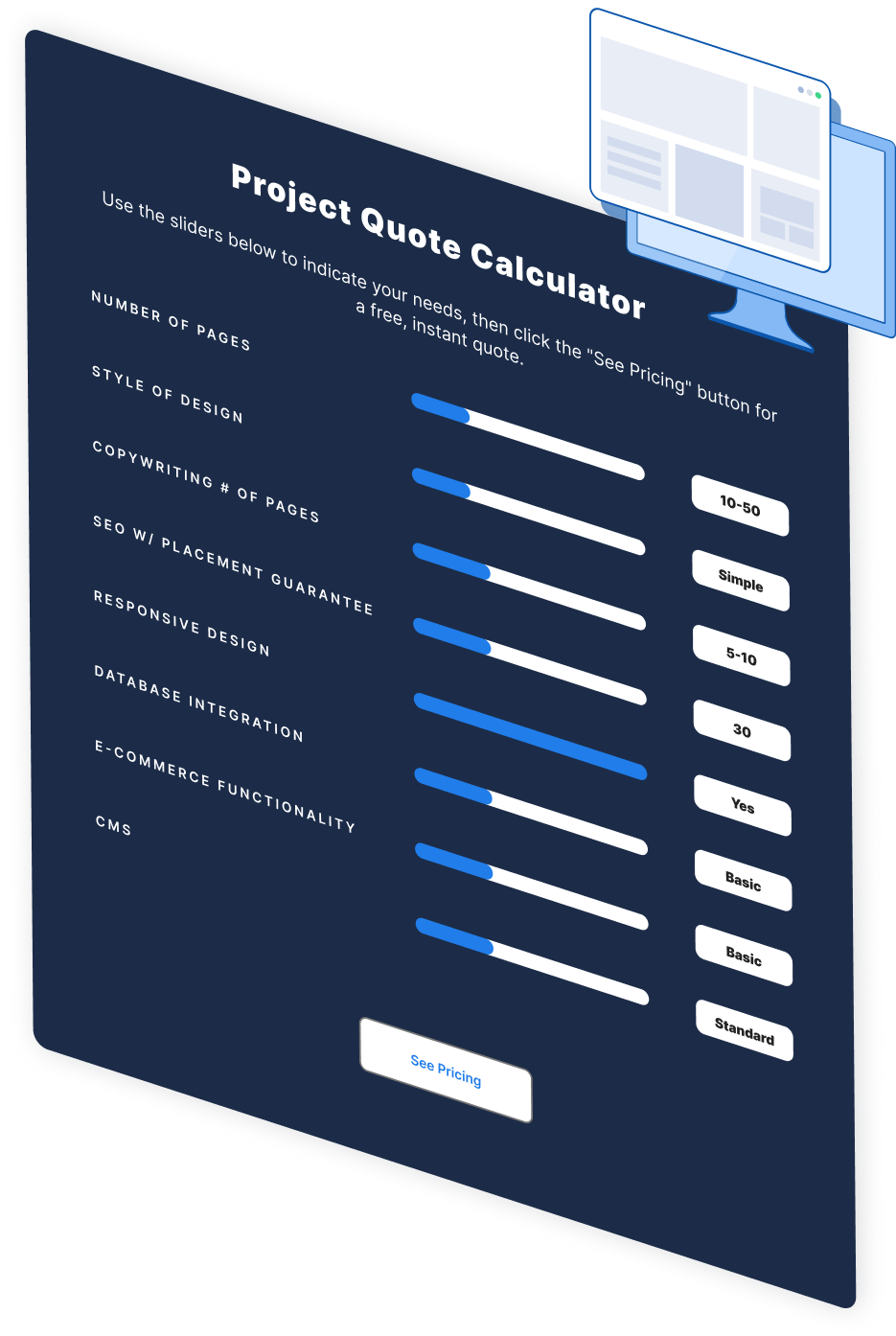
Website design costs can be tricky to nail down. Get an instant estimate for a custom web design with our free website design cost calculator!
Matthew Gibbons is a Senior Data & Tech Writer at WebFX, where he…
More
Matthew Gibbons is a Senior Data & Tech Writer at WebFX, where he strives to help businesses understand niche and complex marketing topics related to SEO, martech, and more. With a B.A. in Professional and Public Writing from Auburn University, he’s written over 1,000 marketing guides and video scripts since joining the company in 2020. In addition to the WebFX blog, you can find his work on SEO.com, Nutshell, TeamAI, and the WebFX YouTube channel. When he’s not pumping out fresh blog posts and articles, he’s usually fueling his Tolkien obsession or working on his latest creative project. Hide









 Matthew Gibbons is a Senior Data & Tech Writer at WebFX, where he strives to help businesses understand niche and complex marketing topics related to SEO, martech, and more. With a B.A. in Professional and Public Writing from Auburn University, he’s written over 1,000 marketing guides and video scripts since joining the company in 2020. In addition to the WebFX blog, you can find his work on SEO.com, Nutshell, TeamAI, and the WebFX YouTube channel. When he’s not pumping out fresh blog posts and articles, he’s usually fueling his Tolkien obsession or working on his latest creative project.