



Table of Contents
- Healthcare marketing definition and basics
- Healthcare marketing strategy
- Healthcare search engine optimization (SEO)
- Healthcare content marketing
- Healthcare pay-per-click (PPC) advertising
- Healthcare web design
- Healthcare social media and email marketing
- Healthcare reputation management
- HIPAA and compliance
- Healthcare marketing agencies and services
- Take your marketing to new heights with these healthcare marketing answers
Like any business, your healthcare organization needs to market itself online. But if you’re new to healthcare marketing, you may not be sure where to start. Which strategies should you use? Which metrics should you track? Should you partner with an agency for help?
To assist you in answering those questions, we’ve compiled this list of 50 healthcare marketing FAQs. The questions on this page are divided into the following categories for convenience:
- Healthcare marketing definition and basics
- Healthcare marketing strategy
- Healthcare search engine optimization (SEO)
- Healthcare content marketing
- Healthcare pay-per-click (PPC) advertising
- Healthcare web design
- Healthcare social media and email marketing
- Healthcare reputation management
- HIPAA and compliance
- Healthcare marketing agencies and services
Get your healthcare marketing answers below!
Healthcare marketing definition and basics
Let’s start by looking at some FAQs about healthcare marketing basics. In this section, we’ll define what healthcare marketing is, as well as why it matters and how it works.
1. What is healthcare marketing?
Healthcare marketing is the practice of promoting healthcare organizations and their services to potential patients or customers, particularly online. It can take place through a variety of channels, from search engine rankings to social media platforms.
2. Why is healthcare marketing important?
Healthcare marketing is important because it’s how patients find you, understand your value, and ultimately choose your organization over other options. If you don’t market yourself, your audience won’t know you exist — or, at least, they won’t see the value in becoming patients or customers.
Marketing is how you turn prospects into leads and then drive those leads to convert. For that reason, healthcare marketing is the key to earning more revenue for your organization.
3. How is healthcare marketing different from other types of marketing?
The biggest factor that sets healthcare marketing apart is trust. All marketing requires trust, but it’s particularly significant in healthcare marketing. That’s because medical issues are uniquely sensitive and risk-filled — in some cases, incorrect medical info can lead to serious health concerns.
That means even more than most other businesses, healthcare organizations must use their marketing to instill trust in their target audience. Moreover, the sensitive nature of healthcare means organizations must comply with regulations like HIPAA. Staying within the boundaries of those regulations is of paramount importance.
4. How do patients find healthcare providers online?
For many patients, the search for a healthcare provider begins in Google (or another search engine). That’s not surprising — search engines are the natural place to look for businesses online. Of course, that’s not to say they’re the only place. Other patients find healthcare providers via online directories like Zocdoc.
Those are the most common ways that patients find providers, but keep in mind that there are many ways for your target audience to discover your business. Other valuable channels for reaching prospects include:
- Social media posts
- Paid advertising
- Marketing emails
5. Which channels are the most effective for healthcare marketing?
It depends on how we define the word “effective.” Are you focused on immediate, short-term conversions? Or are you looking to foster long-term relationships with existing patients?
For the former, some of the most effective marketing channels include:
If you’re prioritizing long-term relationships, however, some of the best channels include:
Ultimately, all of these channels should be used together for the most effective healthcare marketing strategy.
Healthcare marketing strategy
Having covered the basics, let’s now dive into some healthcare marketing questions about the elements of a good marketing strategy. This covers some of the most important considerations for building out your overall healthcare marketing plan.
6. What should a healthcare marketing strategy include?
A good healthcare marketing plan will include the following strategies:
- Search engine optimization (SEO)
- Pay-per-click (PPC) advertising
- Social media marketing
- Website design and development
- Content marketing
- Email marketing
Healthcare marketing should also include compliance with all applicable regulations (like HIPAA).
7. What KPIs matter most in healthcare marketing?
The most important key performance indicators (KPIs) to track in healthcare marketing include:
- Patient acquisition rate
- Website traffic
- Appointment requests
- Cost per appointment
- Return on investment (ROI)
The specific metrics you track will vary across different strategies. Your SEO metrics will look quite different from your email marketing metrics.
8. How do I measure ROI from healthcare marketing?
To measure the ROI of your healthcare marketing, you can connect your marketing activity to actual patient revenue. To do that, track core conversion actions like:
- Phone calls
- Appointment requests
- Online bookings
Then look at how each of those actions impacts your organization’s revenue. You can do that by integrating your marketing data with a data tool like a customer relationship management (CRM) platform. From there, you can calculate your ROI by using the following formula:
ROI = (Revenue generated – Marketing cost) ÷ Marketing cost
Of course, keep in mind that ROI in healthcare often goes beyond immediate revenue. Repeat visits, referrals, and more contribute to your long-term return, and to get the most accurate measurements, you’ll need to use full-funnel tracking over a longer period of time.
9. How do patient personas work in healthcare marketing?
Patient personas are essentially fictional patients you create that represent the type of people you’re marketing to.
Suppose a significant number of your patients are between the ages of 40 and 60. Of those, the majority are men. And of those men, a high percentage of them work in blue-collar industries like construction. In that case, a good patient persona might be Greg, a 50-year-old man who works for a construction company.
You can also incorporate other factors into patient personas, such as location or type of illness. But the point of creating these personas is to give you an idea of who your marketing is for. When you create a new piece of content or a paid ad campaign, ask yourself: What would make this campaign appealing to Greg?
Your patient personas represent the traits most commonly found among your real-life patients. That means if you successfully optimize your marketing for those personas, you’ll also be optimizing it for your actual patients.
Healthcare search engine optimization (SEO)
One of the most important marketing strategies for any industry is search engine optimization (SEO), and healthcare is no exception. In this section, we’ll offer some healthcare marketing answers related to SEO.
10. What is healthcare SEO?
Healthcare SEO is the practice of increasing your organization’s visibility in search engines like Google and Bing. It typically involves optimizing your website to rank higher in search results, as well as optimizing for off-site elements like online directories and a Google Business Profile. The idea is to get your brand in front of your target audience so more people discover you and become patients.
11. Why is SEO important for healthcare providers?
SEO is a crucial strategy for healthcare organizations because it gets you in front of your target audience when they search for healthcare services.
When people are looking for a healthcare organization, the first place most of them will go is Google (or a medical directory site). Whichever organizations they see in those search results are the ones they’ll pick from, so if your organization isn’t included there, you won’t get chosen. That means you’ll really struggle to acquire patients.
But when you rank high in relevant online searches, you’ll be the first healthcare organization many people see. That means a lot of those people will become patients.
12. What keywords should healthcare providers target?
The exact keywords you should target depends on your specific needs and audience. A pediatric practice is going to target very different keywords from an allergist, for example.
Having said that, there are some specific types of keywords you should aim to target. Those include:
- Long-tail keywords: Keywords that are several words long rather than just one or two words
- Local keywords: Keywords that relate to your local area (e.g., “ENT in Alberta” or “urgent care near me”)
- Branded keywords: Keywords that include the name of your brand or practice
13. How long does healthcare SEO take to work?
On average, healthcare SEO takes three to six months to start driving noticeable results. However, the exact length of time varies greatly from organization to organization. A lot depends on the specifics of your strategy and your audience. In some cases, it can take as long as a year to drive results.
And of course, all of that is assuming your SEO strategy is well-optimized. A poorly optimized strategy will take even longer to drive results, if it drives results at all.
14. What is E-E-A-T in healthcare SEO?
E-E-A-T stands for experience, expertise, authority, and trust. It represents a set of guidelines from Google for how healthcare organizations (and other businesses) can rank higher in search results.
Essentially, E-E-A-T states that in order to rank at or near the top of search results, your brand must cultivate a high degree of trust from your audience. And to do that, you need to demonstrate:
- That your organization has years of experience in healthcare
- That you have a high degree of expertise in your specific discipline
- That you are a trusted authority on healthcare topics
Healthcare content marketing
Healthcare SEO is at its most effective when paired with a solid content strategy. To that end, let’s get into some healthcare marketing questions related to content marketing.
15. What is healthcare content marketing?
Healthcare content marketing is a strategy in which you create various types of content on healthcare topics to draw users to your website. Content marketing is used to drive traffic and conversions, as well as to spread brand awareness and increase trust in your organization. It’s particularly useful for demonstrating your strong expertise in your specific medical discipline.
16. What types of content work best for healthcare marketing?
There are many types of content you can harness for your healthcare marketing strategy. Some of the best content formats include:
- Blog posts
- Service pages
- Testimonials
- Videos
- Infographics
All of those types of content are helpful for communicating medical information, be it a breakdown of your organization’s services or simply helpful info about a particular illness or injury.
17. What topics should healthcare providers address in their content?
The specific topics you address in your healthcare marketing content depend on the particular specialty your organization focuses on. It probably goes without saying, but if you run a cardiology practice, you should write about heart-related medical topics. And if you operate a neurology clinic, you should focus on topics related to the brain.
Putting aside the obvious, though, there are also a few general topic categories you can target with your content:
- Educational content to teach your audience about different illnesses and treatments
- How-to guides for managing symptoms and injuries at home
- Service pages (or videos) explaining what to expect at your clinic or organization
18. How does content marketing support patient acquisition?
Content marketing plays a vital role in acquiring new patients. That’s because for someone to become a patient, they first have to trust your organization. They have to feel confident in your medical knowledge and expertise before they’ll let you treat them. And how do you demonstrate medical expertise? Through content.
When people read a helpful blog post explaining some of their symptoms, or when they see a video demonstrating a simple home remedy for a particular injury, their trust in your organization grows. As a result, when they need to get medical treatment, you’ll be the first one they think to go to.
Healthcare pay-per-click (PPC) advertising
Paid advertising is a reliable method by which businesses promote themselves online, but what does it look like for healthcare providers? Get all your PPC questions answered in this section.
19. What is healthcare PPC advertising?
Healthcare PPC is a type of paid advertising strategy where your healthcare organization pays a set amount each time someone clicks on one of your ads. PPC ads can appear in search results, on social media, and on third-party websites, allowing you to quickly appear in front of patients who are searching for care. They can also take different forms — some ads contain only text, while others feature images or even videos.
You can target your ads to specific keywords or demographics, and for each one, you bid a specific amount that you’re willing to pay for each click. With a high enough bid and a well-optimized ad, you can get your ads displayed above your competitors’ and earn clicks, which take users to dedicated landing pages that encourage them to convert.
20. Is PPC better than SEO for healthcare?
PPC isn’t better than SEO for healthcare providers — but it’s not necessarily worse, either. The value of SEO is a long-term one, which works by slowly building up your visibility and trust in organic search results. But PPC is usually more of a short-term strategy, driving immediate patient acquisition. In short, the two strategies are designed for different things.
A good healthcare marketing plan will incorporate SEO and PPC together. That allows you to experience the benefits of both strategies, driving conversions in both the short term and the long term.
21. How much does healthcare PPC cost?
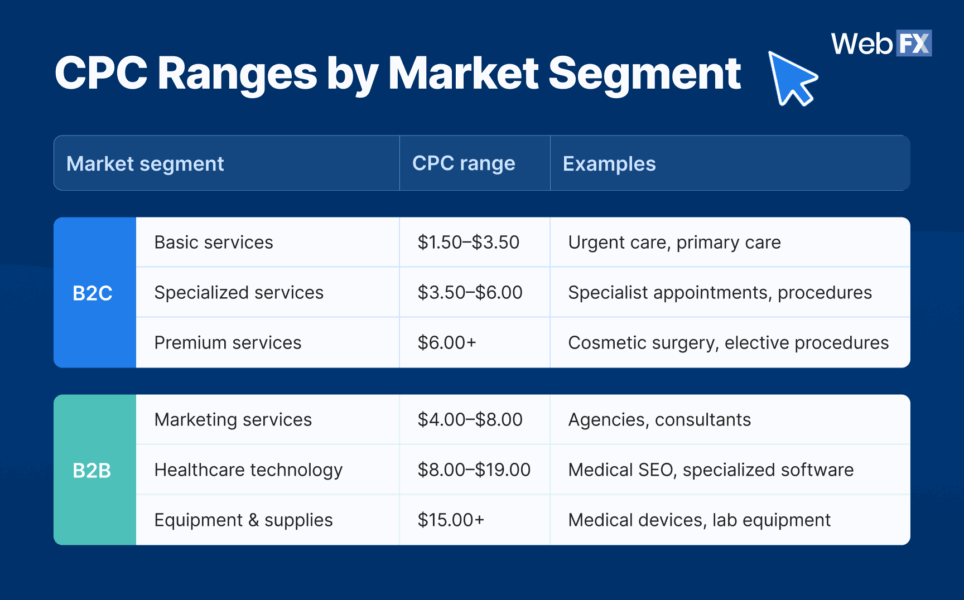
The average cost per click (CPC) of healthcare PPC is $0.01–$1. When you factor in all PPC expenses, healthcare organizations spend between $100 and $100,000 per month on PPC.
If that seems like a big range, the reason is because PPC costs can vary immensely. Factors that affect the cost of PPC include:
- How many PPC ads you run
- Which keywords or demographics you target
- How effectively your ads drive clicks and conversions
- Which PPC platforms or tools you use
- Whether or not you partner with a professional PPC agency
That means your healthcare organization will have to determine your own PPC costs by deciding what you want your PPC strategy to look like.
With all that being said, here are some more specific CPC ranges broken down by market segment:
22. How long does healthcare PPC take to work?
In most cases, healthcare PPC takes around three months to start driving significant results. Having said that, PPC ads can theoretically start driving results immediately. Unlike SEO, where it takes time for your content to work its way up through the search results, PPC ads go live immediately, so they can begin driving conversions right out of the gate.
It all comes down to the quality of your advertising strategy. Well-crafted ads with optimal bids will drive results much more quickly than poor-quality ads that fail to outbid the competition.
23. How do you track conversions for healthcare PPC?
In the context of paid advertising, conversions are usually tracked right in your chosen advertising platform (like Google Ads). Ad platforms let you track specific actions that you consider conversions, which can include:
- Phone calls
- Appointment requests
- Online bookings
You can also use third-party software to track specific types of conversions, like call tracking software for tracking phone calls. However, in the healthcare industry, it’s important to ensure that all your conversion tracking remains HIPAA-compliant.
24. Are there any restricted healthcare ad categories?
Yes — certain healthcare ad categories are restricted or regulated, although it varies from ad network to ad network. Commonly restricted categories include:
- Prescription drugs
- Addiction treatment services
- Weight loss procedures
Additionally, healthcare advertisers are often prohibited from:
- Guaranteeing cures
- Targeting users based on sensitive health conditions
- Using exploitative messaging
In some cases, ad platforms might not restrict an ad category altogether, but may require advertisers to show specific approvals or certifications in order to advertise in that category. For more specific info on ad restrictions, you’ll have to check with your chosen ad network(s).
Healthcare web design
A website is a crucial part of any marketing plan. But what goes into creating a healthcare website? Find out with these healthcare marketing answers about web design.
25. What is healthcare web design?
Healthcare web design is the practice of building and optimizing the functionality, layout, and appearance of a healthcare website so patients can easily find information and book care. The web design process considers functional components as well as visual ones, and deals with website elements like:
- Mobile optimization
- User-friendly navigation
- Page speed optimization
- Branding
Web design is used in conjunction with other marketing strategies, like SEO, to drive up patient acquisition and revenue.
26. Why is web design important for healthcare marketing?
Web design is essential for healthcare marketing because it increases:
- Traffic acquisition
- Traffic retention
- Lead generation
- Conversion rates
- Revenue
Poor web design will prevent your website from ranking well in search results, making it harder for your target audience to find your healthcare organization.
And even if people do still find your website, they expect that website to look appealing and function properly. Poor web design will make them less inclined to trust you, particularly in so sensitive a field as healthcare. That will cause them to leave your site in favor of your competitors.
27. What makes a good healthcare website?
There are many factors that contribute to a good healthcare website, including:
- Easy-access appointment scheduling forms
- Secure hosting (HTTPS)
- Fast page load speeds
- Mobile-responsive web design
- ADA-compliant accessibility features
Each of these things helps optimize your site both for search engine rankings and for a positive user experience (UX).
28. How often should healthcare websites be updated?
In general, you should give your website a significant update every 3–5 years. However, there’s no real right answer to this question. Your update schedule will vary depending on the specifics of your website.
In fact, you may not even follow a fixed schedule at all. Many sites, both in and out of the healthcare industry, make updates only when they see specific issues (like outdated information or broken site elements). You’ll have to monitor your website and determine for yourself when it needs to be updated.
That said, if you’re looking for a general schedule to follow, a lot of websites use one similar to this:
- Monthly: Repair any bugs, fix clear design issues, and go over website analytics.
- Annually: Update any outdated info, make smaller adjustments to the UX design, and refresh key pages.
- Every 3–5 years: Consider revamping the overall look of your site’s branding if it feels outdated.
29. How does mobile optimization impact healthcare marketing?
Mobile optimization has a huge impact on healthcare marketing. One big reason is that Google uses mobile-first indexing, which means it ranks sites based on their mobile version. Moreover, if a site doesn’t have a mobile version, Google won’t rank it at all.
Needless to say, that means a lack of mobile optimization will result in your healthcare site failing to rank well in Google search results. Plus, a site that doesn’t work well on mobile will drive away anyone visiting your site on phones or tablets — which is bad news, since a lot of your traffic will likely come from people looking up health-related questions on the go.
To avoid that issue, be sure to create a mobile-friendly website that works equally well on both desktop and mobile devices.
30. How does website speed impact healthcare marketing?
Website speed is one of the most essential components of web design. For one thing, it’s irritating to visit a site that doesn’t load quickly — that’s why more than half of users will leave a site if it takes more than three seconds to load. And that’s particularly bad in healthcare, where people often need to make appointments quickly.
On top of that, though, Google penalizes sites with slow load times. Some of Google’s biggest ranking factors are known as Core Web Vitals, and they deal with how pages load. Slow-loading pages score low on Core Web Vitals, and consequently get ranked much lower.
To maintain your visibility in search results, be sure to improve your page speeds with tactics like:
- Minifying code
- Compressing images
- Minimizing link redirects
- Caching web pages
31. What accessibility requirements apply to healthcare websites?
Healthcare websites that operate in the United States are responsible for maintaining compliance with the Americans with Disabilities Act (ADA). While this legislation doesn’t outline exact technical rules, the most widely used standard for determining if a website is ADA-compliant is the Web Content Accessibility Guidelines (WCAG).
Among other things, the WCAG advises websites to meet the following requirements:
- Alt text for images
- Intuitive navigation layout
- Clear color contrast
- Captions and/or transcripts for videos
32. What role does UX play in appointment bookings?
UX has an exceptionally big impact on appointment bookings. A poor user experience on your website will make it harder to find or use booking forms, preventing as many people from submitting them. If your forms are difficult to fill out, most people won’t bother.
But even if users have no issue with the forms themselves, a site with unappealing visuals and poor functionality will often be enough to drive them away. Most people would rather just visit a competitor’s website than try to navigate the poor experience on yours.
To ensure that users book appointments on your website, optimize your site to look appealing and function smoothly. That will guide more people to your booking forms and earn you more patients overall.
Healthcare social media and email marketing
Two additional marketing strategies to take advantage of are social media and email marketing, but you may not be familiar with how to use those strategies for healthcare. That’s why we’ll be answering some common questions about both of them below.
33. Is social media effective for healthcare marketing?
Social media is very effective for healthcare marketing because it lets you meet patients where they already spend time and share helpful health information in real time. People spend a lot of time on social media, and they often use it to help them find healthcare information — in fact, 55% of adults in the United States say they use social media to find health information.
That means social media is an ideal place for reaching your target audience. You can share a variety of helpful medical content there that will help position you as the expert on healthcare topics, leading people to choose you as their provider when they need one.
34. Which social media platforms work best for healthcare?
Some of the most useful social media platforms for healthcare providers include:
- Facebook for reaching a broad age range and sharing educational content
- Instagram for sharing medical infographics and showing off your team
- LinkedIn for B2B marketing aimed at targeting executives or referring physicians
- YouTube for sharing explainer videos and procedure overviews
Ultimately, you should use several of these platforms together for the most effective healthcare marketing strategy.
35. What types of posts should healthcare providers share?
Healthcare providers can share a variety of posts on social media, including:
- Educational posts like symptom awareness tips, treatment explanations, and FAQs
- Practice-focused content like doctor spotlights or community involvement
- Seasonal reminders related to topics like flu shots or allergy season
All of these help your target audience view you as an authority on medical topics, deepening their trust in your expertise and making them more likely to become patients.
36. How do you grow an email list for healthcare marketing?
The best way for healthcare organizations to grow an email list is to offer valuable healthcare information through your marketing emails. Types of content you can offer include:
- Health guides
- Wellness checklists
- Health webinars
- Seasonal wellness tips
Whatever you offer, it should be something that benefits your target audience enough that they’re willing to sign up for your email list in order to access it.
Once you’ve settled on the type of content you want to send out, you can place signup forms across your website (on your homepage, blog posts, etc.). You can also include those forms as an optional addition to appointment scheduling forms. Be sure to feature a call to action telling users what they’ll be getting if they sign up.
Through all of this, though, be sure to follow HIPAA guidelines. That means you can’t collect any protect health information as part of the email signup process, and you must ensure your forms support secure data handling. Finally, be sure to always give users an easy way to unsubscribe.
37. What types of healthcare emails perform best?
Some of the best-performing categories of healthcare emails include:
- Educational emails like health guides and wellness tips
- Newsletters or updates on your practice
- Appointment and care reminders
For all three of these categories, though, it’s important to ensure that you’re offering value to your audience. Think about the information your patients would most like to receive, and craft your emails based on that.
38. What are some common social media mistakes in healthcare marketing?
Some of the most common mistakes that healthcare organizations make with their social media marketing campaigns include:
- Overpromotion: Some healthcare organizations lean too hard on the salesy side of their social media marketing. Potential patients usually respond better to informational posts than salesy ones, so overpromotion can drive them away.
- Inconsistent posting: Maintaining a consistent post schedule is important for social media marketing. If you post every week for a while, but periodically go two or three months without posting, engagement will drop.
- Lack of compliance: Most harmful of all is failure to comply with healthcare marketing regulations. Sharing patient information without consent or responding carelessly to reviews can get you into a lot of trouble, not to mention that it can hurt your reputation.
Healthcare reputation management
In healthcare marketing, reputation is everything. If people don’t trust your medical expertise or skillset, no one will come to you for your healthcare services. That’s why it’s essential to manage your reputation online through positive reviews. To help you do that, here are some common healthcare marketing FAQs related to review management.
39. How can healthcare organizations get more patient reviews?
There are a few different methods you can use for requesting patient reviews, including:
- Follow-up emails or texts after appointments
- In-person requests during front desk checkout
- Printed cards with QR codes
It’s not just about the method, though. Timing is also important. You want to ask for reviews shortly after appointments, particularly from patients who’ve expressed having a positive experience.
You also need to stay aware of compliance. Don’t ever offer incentives for reviews, and don’t put any pressure on patients.
40. Can healthcare providers respond to online reviews?
Yes. There are no regulations against responding to patient reviews, despite some online myths that there are. However, there are regulations around what you can say in those responses. As with all aspects of healthcare marketing, you can’t reveal any sensitive patient information in your responses. Keep them generic and don’t reference anything not mentioned in the reviews themselves.
41. What should healthcare providers do about negative reviews?
When people leave negative reviews of your practice, it’s usually in your best interest to respond. But it’s important to respond in the right way, which includes the following:
- Stay HIPAA-compliant. Don’t actually confirm if the reviewer is a patient, and avoid sharing any sensitive health information, even if that information is specifically mentioned in the review.
- Don’t get defensive: Even if you feel the negative review is unwarranted, don’t respond defensively. Instead, say that you’re sorry they had a negative experience, and offer to help them resolve it.
- Take the conversation offline: Encourage the reviewer to give you a call or send you an email to address their concerns with you directly. If they do so, try to find a way to fix or make up for their negative experience.
42. What platforms matter most for healthcare reviews?
For most healthcare providers, the most important source of reviews is Google. If you have a Google Business Profile (which you should), your patients will commonly leave reviews for you there, so that’s the main place to watch. That said, you may also get reviews on various medical directory websites, like:
- Zocdoc
- Healthgrades
- RateMDs
You may even get reviews on social media platforms like Facebook, or on general business review sites like Yelp. You’ll have to check all of these sites for yourself to see where people are leaving reviews for you, and prioritize them accordingly.
HIPAA and compliance
Because of the deep personal nature of the medical world, healthcare marketing is heavily regulated. But how do you comply with those regulations? Find out with these FAQs about healthcare marketing compliance.
43. What is HIPAA-compliant healthcare marketing?
HIPAA-compliant healthcare marketing is any marketing that promotes your organization without exposing protected health information (PHI) or violating HIPAA privacy and security rules. HIPAA is the Health Insurance Portability and Accountability Act, which is a United States law that regulates the way healthcare providers handle sensitive patient information. At its core, it’s designed to keep providers from disclosing patient details to unauthorized individuals or entities.
Here are some examples of ways HIPAA applies specifically to healthcare marketing:
- Healthcare providers can’t disclose who their patients are.
- Healthcare providers can’t publish patient information in case studies or testimonials without written consent.
- Providers can’t mention patient information when responding to online reviews.
Those are just a few examples, but all of your marketing is subject to HIPAA. Violating HIPAA will have serious legal penalties, so be sure to remain compliant in all your marketing efforts.
44. How do healthcare marketers protect patient privacy?
Healthcare providers protect patient privacy in their marketing through a variety of methods, which include the following:
- Using HTTPS encryption on their websites
- Not confirming patient relationships in online review responses
- Avoiding personalized medical advice on social media
- Using clear consent language in email signup forms
- Making all contact forms compliant with HIPAA
The underlying sentiment under all of these tactics is to avoid mentioning patient information in any of your marketing.
45. What patient information can be used in marketing?
There are two main categories of patient information that you’re allowed to use in your marketing:
- General, non-identifiable info: Aggregated statistics (e.g., “We’ve treated over 2,000 patients”) or general success rates that don’t relate to individual patients
- Properly authorized disclosure: Information shared with clear, written consent from patients, where that consent meets HIPAA requirements and clearly states how the info will be used
On the other hand, you should never share specific patient information without express written consent.
46. What are common compliance mistakes in healthcare marketing?
Some of the most common compliance mistakes healthcare providers make in their marketing include:
- Responding to reviews in a way that confirms patient relationships
- Failing to make contact or email forms HIPAA-compliant
- Storing patient data in unsecure systems
- Failing to meet website accessibility requirements
- Sharing protected health information without written patient consent
Be sure to avoid all of these in your own marketing.
Healthcare marketing agencies and services
Many healthcare providers partner with experienced agencies for help with their marketing. But is that the right move for your organization? To wrap up our list of healthcare marketing FAQs, here are some answers to common questions about professional agencies and services.
47. Should healthcare organizations hire an agency or do everything in-house?
Whether or not to choose an agency or an in-house marketing approach depends on your organization’s specific needs.
Healthcare marketing requires a certain level of expertise, and it also requires time to work on it. If you feel you have both of those things — if you know what it takes to build a compelling marketing campaign, and if you have plenty of time to work on it yourself — an in-house approach could work for you.
But if you lack marketing expertise or the time to create your campaigns yourself, a professional agency is probably the better option. An agency can bring their years of experience to your marketing campaigns, spending plenty of time on it while freeing you to focus on running your organization.
48. What services do healthcare marketing agencies offer?
Healthcare marketing agencies offer a variety of different marketing services, including:
- Search engine optimization (SEO)
- Pay-per-click (PPC) advertising
- Social media marketing
- Healthcare website design
- Content marketing
- Email marketing
Not every agency will necessarily offer every one of these services. Some specialize only in one or two strategies. But others — known as full-service marketing agencies — have expertise in all of them.
49. How much do healthcare marketing services cost?
44% of healthcare companies spend between $5,000 and $10,000+ per month on digital marketing. However, the amount that healthcare organizations spend on marketing services varies immensely depending on factors like:
- Which marketing strategies you pursue
- The agency you partner with
- The specific deliverables you request
- How big your campaigns are
For that reason, healthcare companies can end up spending anywhere from $500 to over $10,000 per month on marketing services. Here’s a more detailed breakdown based on our budget research:
- 12% spend less than $500 per month
- 14% spend between $500 and $1,000 per month
- 10% spend between $1,000 and $5,000 per month
- 24% spend between $5,000 and $10,000 per month
- 20% spend over $10,000 per month
- 20% are undecided on their budget
50. What should I look for in a healthcare marketing agency?
There are four qualities that you should consider above all others when seeking a healthcare marketing agency partner:
- Budget: Does the agency’s pricing align with your marketing budget? Are they affordable without being suspiciously cheap?
- Experience: Does the agency have a significant amount of experience in marketing for healthcare organizations? Do they have a proven history of driving results?
- Services: Does the agency offer the services you’re looking for? Do those services include the specific deliverables you want?
- Reviews: Does the agency have overall positive reviews from past clients? Do those clients indicate that they had a good experience with the agency?
When you find an agency that comes up green in all of these areas, they’ll likely make a good partner for your healthcare organization.
Take your marketing to new heights with these healthcare marketing answers
Now that you’ve gone through the full list of healthcare marketing questions, you can begin to apply what you’ve learned to your own organization’s marketing plan. But of course, good marketing requires more than a surface-level understanding of how to promote yourself online. That’s why many healthcare providers partner with an experienced agency partner like WebFX.
When you partner with us for our healthcare marketing services, we’ll help you turn your website and campaigns into a reliable source of new patients, from ranking in local search to filling high-value service lines with qualified appointments. With over 30 years of digital marketing experience, we know exactly what it takes to help your organization stand out from the competition.
Interested in working with us? Just give us a call at 888-601-5359 or contact us online today to get started!
-
 Matthew Gibbons is a Senior Data & Tech Writer at WebFX, where he strives to help businesses understand niche and complex marketing topics related to SEO, martech, and more. With a B.A. in Professional and Public Writing from Auburn University, he’s written over 1,000 marketing guides and video scripts since joining the company in 2020. In addition to the WebFX blog, you can find his work on SEO.com, Nutshell, TeamAI, and the WebFX YouTube channel. When he’s not pumping out fresh blog posts and articles, he’s usually fueling his Tolkien obsession or working on his latest creative project.
 -

WebFX is a full-service marketing agency with 1,100+ client reviews and a 4.9-star rating on Clutch! Find out how our expert team and revenue-accelerating tech can drive results for you! Learn more
Try our free Marketing Calculator
Craft a tailored online marketing strategy! Utilize our free Internet marketing calculator for a custom plan based on your location, reach, timeframe, and budget.
Plan Your Marketing Budget
Table of Contents
- Healthcare marketing definition and basics
- Healthcare marketing strategy
- Healthcare search engine optimization (SEO)
- Healthcare content marketing
- Healthcare pay-per-click (PPC) advertising
- Healthcare web design
- Healthcare social media and email marketing
- Healthcare reputation management
- HIPAA and compliance
- Healthcare marketing agencies and services
- Take your marketing to new heights with these healthcare marketing answers
Share this article


Help More Patients Find Your Practice
See how healthcare providers like Hurst Pediatric Dentistry increased local leads 5× with data-driven SEO from WebFX.
Try our free Marketing Calculator
Craft a tailored online marketing strategy! Utilize our free Internet marketing calculator for a custom plan based on your location, reach, timeframe, and budget.
Plan Your Marketing Budget
What to read next




Additional Reading



Health & Wellness Case Studies
Solving key challenges for healthcare
Our website isn’t driving enough traffic
Our expert SEO specialists, copywriters, and digital advertisers will help you increase your website’s rankings when your target audience searches for your treatments online, so you can continuously drive traffic and revenue for your practice, hospital, or business.

We’re opening a new location
Set your new hospital, brand, or practice up for future success with a range of digital marketing strategies that get your new practice in front of potential patients or B2B buyers.

We’re not attracting enough patients
Get a steady flow of new patients to your practice, hospital, or brand with expertly crafted strategies that provide a seamless, engaging user experience for your website visitors, encouraging them to become patients.

We have high patient turnover
Offer new treatments or services and need to get them in front of your potential client’s eyes? Our range of revenue-driving digital advertising and marketing services have you covered and reach the people who need your facility the most.
