


Contents
- 2026 backlink benchmarks by industry (how many backlinks should a website have)
- Why “it depends” is the wrong answer (and what to measure instead)
- How to calculate your backlink gap
- Proven strategies to surpass your industry backlink benchmarks
- FAQs about how many backlinks you need to rank
- Close your backlink gap with a data-driven SEO partner
-
What is the median number of backlinks needed to rank on page one?
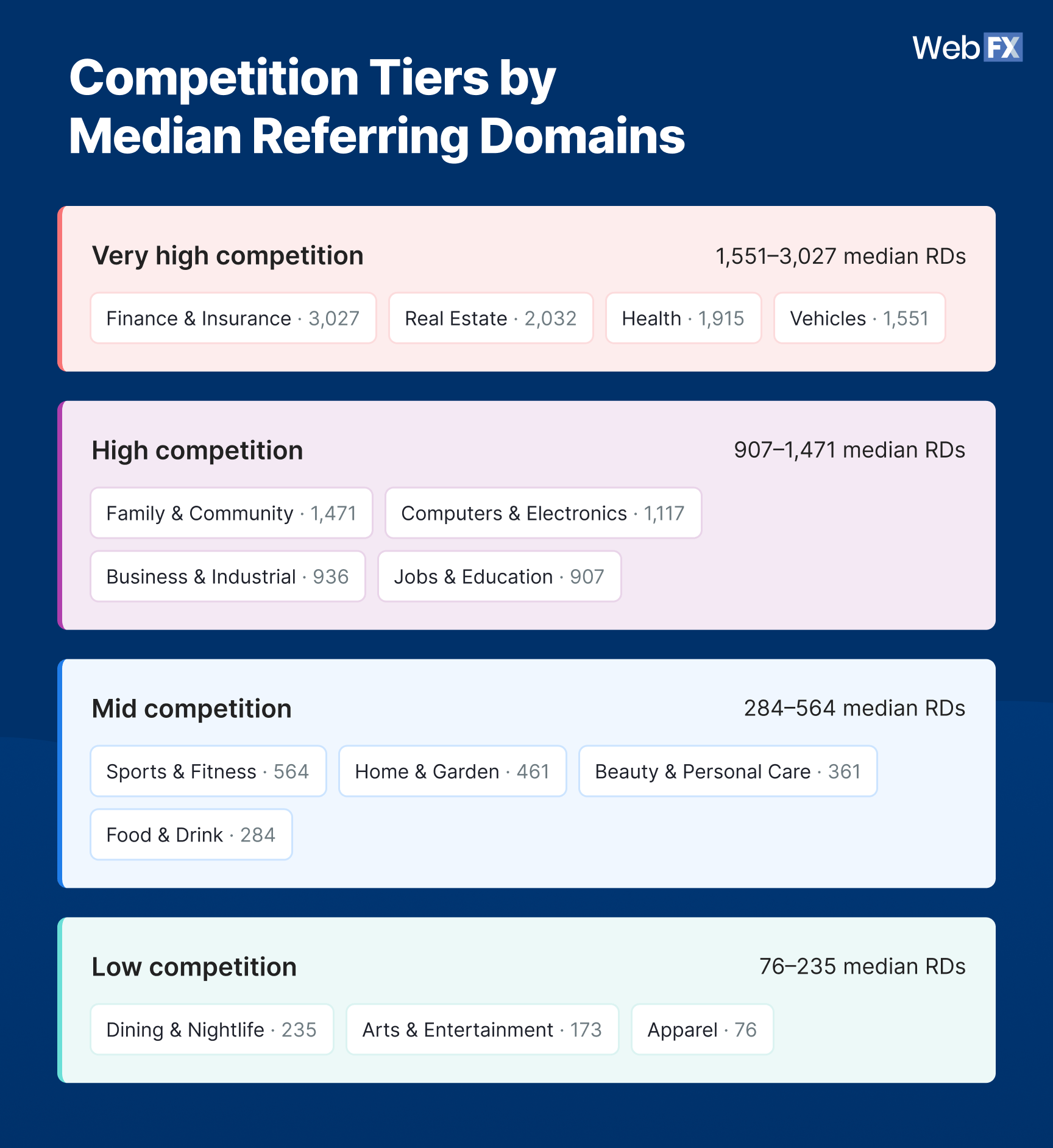
According to our 2026 study of 1,462 domains across 15 industries, websites ranking on page one have a median of 907 referring domains, though this varies dramatically by industry from 76 in Apparel to 3,027 in Finance & Insurance. -
Why do backlink requirements vary so much between industries?
Industry competition shapes backlink benchmarks more than generic SEO advice suggests, with Finance & Insurance requiring 40x more referring domains than Apparel, and different industries showing vastly different link-building velocities ranging from 15 to 101 new referring domains per month. -
How do you calculate your backlink gap?
Subtract your current referring domains from your industry’s median referring domains, then factor in your industry’s average link velocity to set monthly targets that account for competitors continuously adding new backlinks. -
What types of backlinks do top-ranking sites have?
Editorial links dominate page-one rankings across all industries at 92.2% on average, while directory submissions and resource page links combined account for less than 8%, indicating that contextual links within real content are far more effective. -
What strategies help build high-quality backlinks?
Effective link-building strategies include creating data-driven content that earns natural citations, pursuing digital PR placements in industry publications, guest posting on relevant sites, leveraging partnerships for co-marketing opportunities, and building local links through community involvement.

How many backlinks do I need to rank?
- The median number of referring domains for page-one ranking websites is 907 across 15 industries, but the real range spans from 76 (Apparel) to 3,027 (Finance & Insurance). Your industry changes the answer completely.
- Six industries require fewer than 500 median referring domains to compete on page one: Apparel (76), Arts & Entertainment (173), Dining & Nightlife (235), Food & Drink (284), Beauty & Personal Care (361), and Home & Garden (461).
- On average, 92.2% of backlinks pointing to top-ranking sites are editorial links. Directory links account for 6.8%, and resource links just 1.1%. Link type matters more than link count.
- The average link velocity across all industries is 48 new referring domains per month. The fastest-growing industry (Finance & Insurance) averages 101 new referring domains per month.
How many backlinks do I need to rank? According to our 2026 study of 1,462 domains across 15 industries, websites ranking on page one have a median of 907 referring domains, ranging from 76 in Apparel to 3,027 in Finance & Insurance.
Most answers to this question stop at “it depends”, but we wanted actual numbers. So we analyzed the backlink profiles of domains appearing in the top organic search results for 150 service-intent keywords, filtered out directories, publishers, and major retailers, and benchmarked what real businesses need to compete.
This study covers three things: How many referring domains page-one ranking websites have by industry, how fast they are building new ones, and what types of links make up their profiles.
Here’s what we found:
- 2026 backlink benchmarks by industry
- Why “it depends” is the wrong answer
- How to calculate your backlink gap
- Proven strategies to surpass your industry backlink benchmarks
- FAQs about how many backlinks you need to rank
Looking for an all-in-one SEO audit tool? You’ve found it
SEO checker provides data on key metrics to give you:
- Complete SEO score
- Site Speed Analysis
- Content Grade
- and more.

2026 backlink benchmarks by industry (how many backlinks should a website have)
Before reading the backlink benchmarks below, one important note: We are using referring domains as the primary metric, not raw backlink count. One website linking to you from 200 pages still counts as one referring domain.
Backlink counts can vary significantly based on link structure, and some industries, like Real Estate, naturally show higher links-per-domain ratios because of directory, brokerage, and listing ecosystems. Referring domains is the metric that most major SEO platforms treat as the stronger ranking signal because it measures how many distinct sites vouch for your content.
Here is what the backlink profiles of page-one ranking websites look like across 15 industries in 2026:
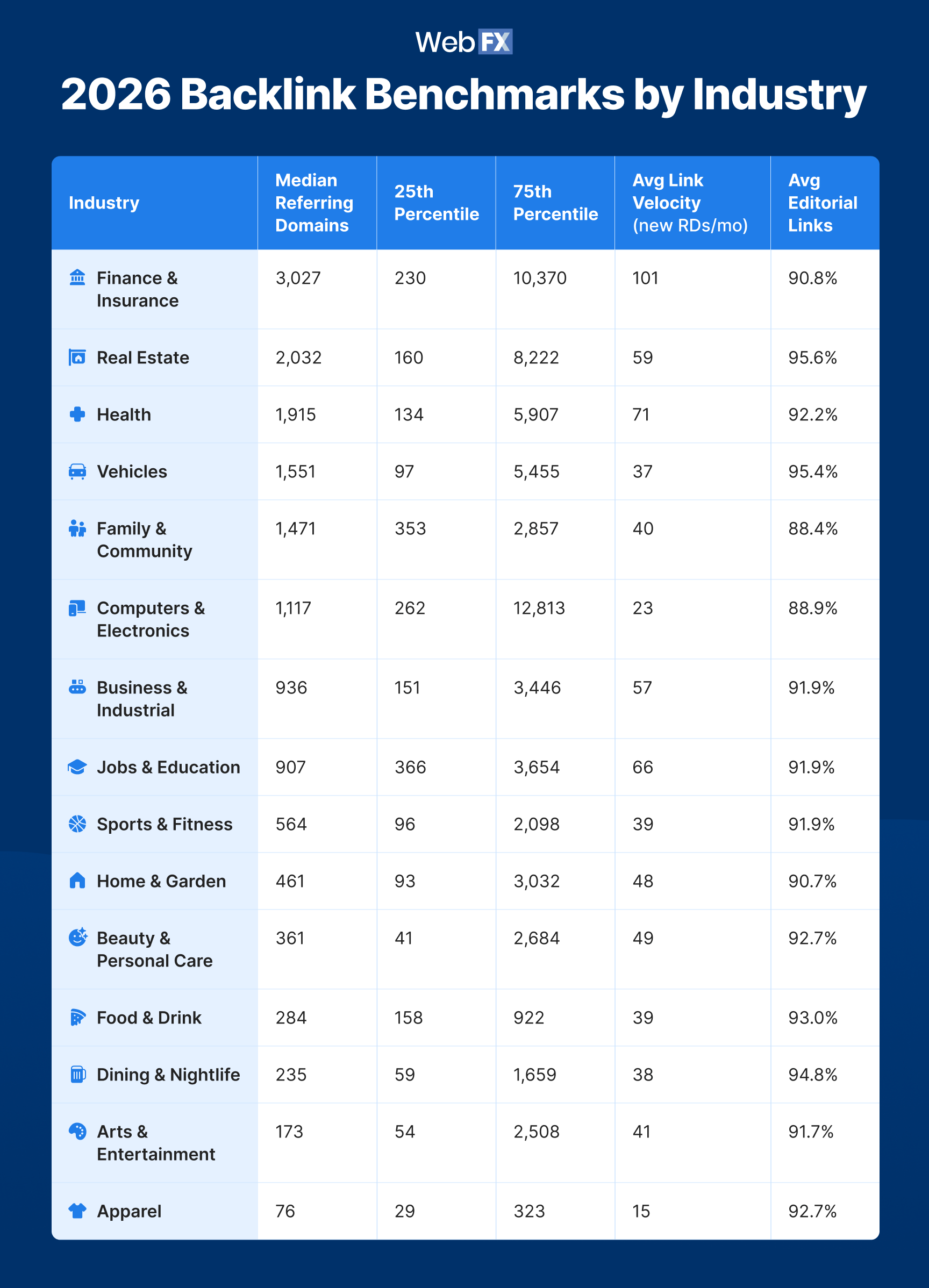
Table view
2026 backlink benchmarks by industry
| Industry | Median Referring Domains | 25th Percentile | 75th Percentile | Avg Link Velocity (new RDs/mo) | Avg Editorial Links |
| Finance & Insurance | 3,027 | 230 | 10,370 | 101 | 90.8% |
| Real Estate | 2,032 | 160 | 8,222 | 59 | 95.6% |
| Health | 1,915 | 134 | 5,907 | 71 | 92.2% |
| Vehicles | 1,551 | 97 | 5,455 | 37 | 95.4% |
| Family & Community | 1,471 | 353 | 2,857 | 40 | 88.4% |
| Computers & Electronics | 1,117 | 262 | 12,813 | 23 | 88.9% |
| Business & Industrial | 936 | 151 | 3,446 | 57 | 91.9% |
| Jobs & Education | 907 | 366 | 3,654 | 66 | 91.9% |
| Sports & Fitness | 564 | 96 | 2,098 | 39 | 91.9% |
| Home & Garden | 461 | 93 | 3,032 | 48 | 90.7% |
| Beauty & Personal Care | 361 | 41 | 2,684 | 49 | 92.7% |
| Food & Drink | 284 | 158 | 922 | 39 | 93.0% |
| Dining & Nightlife | 235 | 59 | 1,659 | 38 | 94.8% |
| Arts & Entertainment | 173 | 54 | 2,508 | 41 | 91.7% |
| Apparel | 76 | 29 | 323 | 15 | 92.7% |
How to read this table
- The median referring domains column is the midpoint. Half the page-one ranking sites in that industry have more, half have fewer. This is your primary benchmark.
- The 25th percentile is the competitive minimum. Sites at this level are competing on page one but sitting at the lower end. If your referring domain count is below this number, you are not yet in the competitive range for your industry.
- The 75th percentile is where the top performers sit. Reaching this level puts you ahead of most competitors in your industry.
- The average link velocity is how many new referring domains top-ranking websites in that industry gain per month on average. This tells you the pace you need to maintain, not just the total you need to reach.
- The average editorial links column is the percentage of backlinks that are editorial (contextual links within content) versus directory or resource links. Higher editorial percentages signal a healthier, more authoritative link profile.
- Note: This study measures the number of unique referring domains, not the domain rating (authority) of those domains. A referring domain from a high-authority site carries more weight than one from a low-authority site. When evaluating your own backlink profile, consider both the count and the quality of your referring domains.
What stands out in this data
1. There is no single backlink benchmark. There is a competitive range.
One of the clearest takeaways from this study is that there is no universal number of backlinks required to rank. There is a competitive range, and that range changes dramatically by industry.
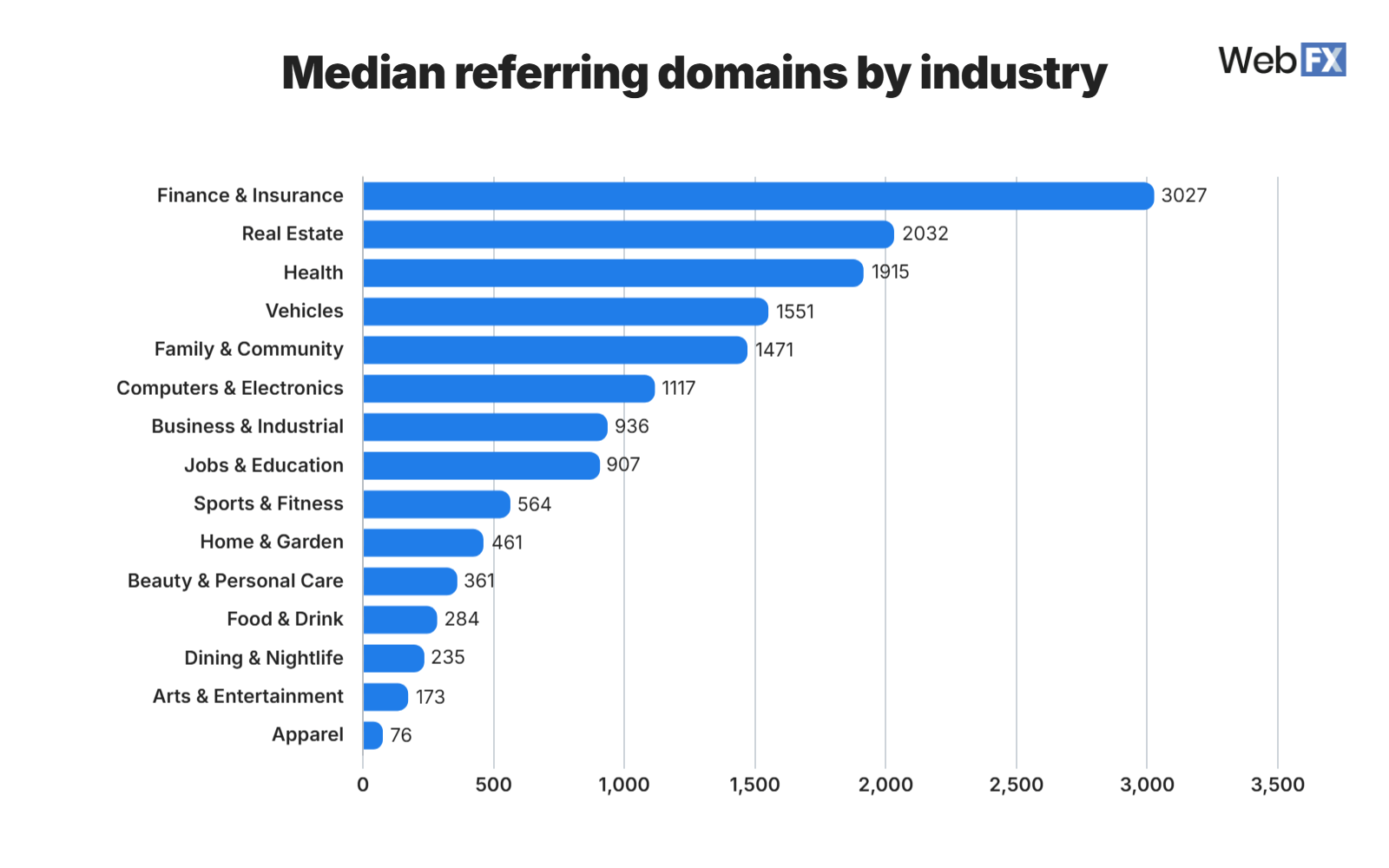
Finance & Insurance has the highest median referring domain benchmark at 3,027, while Apparel sits at just 76. That is a 40x difference between industries. A business asking “how many backlinks do I need?” without factoring in the industry is asking the wrong question.
2. Industry shapes the benchmark more than generic SEO advice suggests.
Finance & Insurance requires the most referring domains to compete, but it also shows the fastest pace of backlink growth at 101 new referring domains per month. These are not static link profiles. The top-ranking websites in finance are actively building backlinks at a pace that most other industries do not match.
On the other end, Apparel has the lowest barrier to entry and the slowest link velocity at 15 new referring domains per month. A local tailor or alterations shop can realistically compete on page one without a massive link-building campaign.
3. Link velocity is just as important as total referring domains.
This study shows that backlinks are not just a total-count game, but they are also a momentum game.
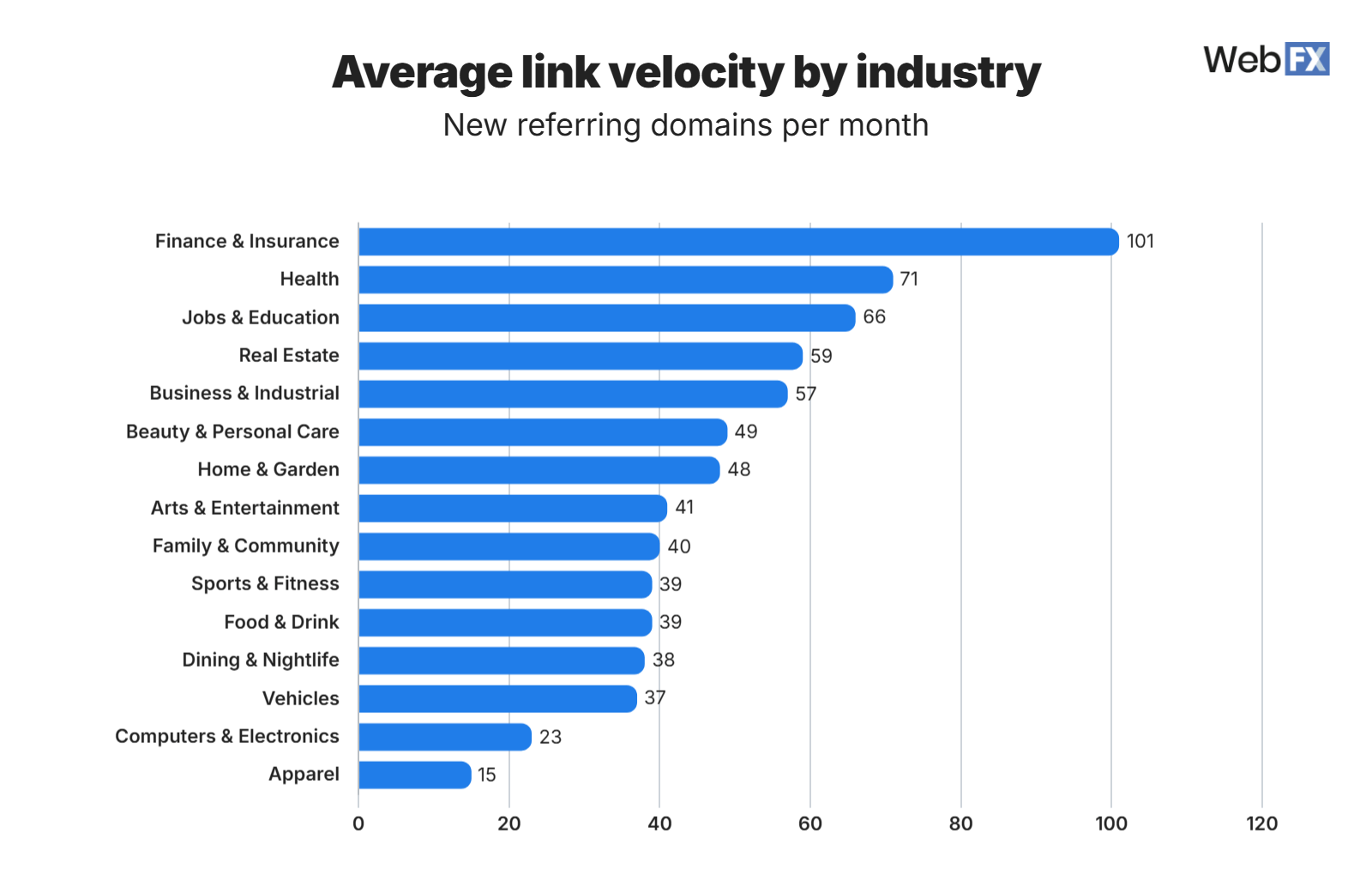
Across industries, average link velocity ranges from 15 new referring domains per month in Apparel to 101 in Finance & Insurance. Even if you reach your industry’s median benchmark, competitors can still outpace you if they are building links faster. That makes link velocity one of the most useful metrics in this study for setting realistic monthly goals.
4. Wide spreads usually signal mixed competition.
The widest competitive spread belongs to Computers & Electronics. The 25th percentile sits at 262 referring domains, but the 75th percentile jumps to 12,813. That gap exists because keywords like “tech support services near me” pull in large brands like Samsung, HP, and Verizon alongside small local repair shops.
If you are a local electronics repair business, you are not competing against Samsung’s backlink profile. You are competing against the smaller businesses clustered closer to the lower end of that range. In industries with wide spreads like this, local businesses typically compete closer to the 25th percentile than the median.
5. Editorial links dominate page-one rankings.
One pattern holds across every industry in this study: Editorial links dominate. Percentages shown below reflect average backlink shares by type across industries, so totals may vary slightly from 100% due to rounding.
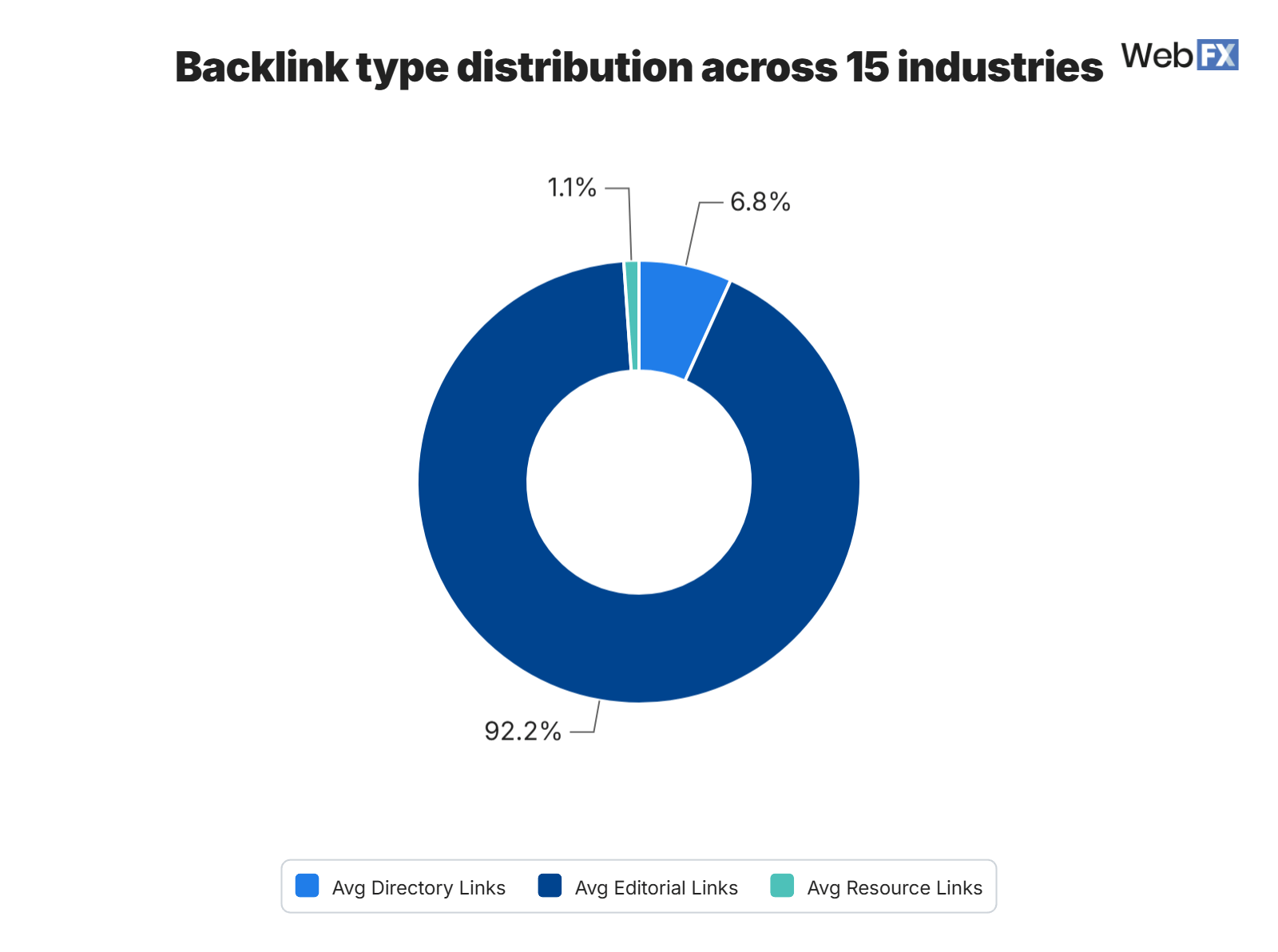
The cross-industry average is 92.2% editorial links. Directory submissions and resource page links combined account for less than 8%. If your link-building strategy relies heavily on directory listings, this data suggests you are investing in the wrong link type.
Directories do not win rankings on their own. They may support visibility, but the domains holding page-one positions are overwhelmingly backed by editorial links earned through content, PR, partnerships, and authority-building efforts.
Why “it depends” is the wrong answer (and what to measure instead)
Search “how many backlinks do I need,” and you will find the same advice repeated across every result: It depends on your niche, it depends on keyword difficulty, and it depends on link quality. That is technically true, but it gives you nothing to work with.
Our data tells a more specific story. The gap between the easiest and hardest industries to compete in is 40x. Apparel requires a median of 76 referring domains. Finance & Insurance requires 3,027. Telling both of those businesses “it depends” is like telling someone the drive is somewhere between 10 minutes and 7 hours.
The problem with generic backlink advice is that it treats every industry the same. It does not account for three things that our data shows actually separate page-one sites from everyone else:
1. Your industry’s median referring domains
This is the single most important number. It tells you the baseline for what it takes to compete in your specific vertical. A plumber does not need the same link profile as a financial advisor. Our data puts a number on that difference: 461 median RDs for Home & Garden versus 3,027 for Finance & Insurance.
2. Your link velocity relative to competitors
Reaching the median is not enough if your competitors are building new links faster than you. Finance & Insurance domains gain an average of 101 new referring domains per month. Apparel domains gain 15. If you match your industry’s median today but stop building, you will fall behind within months. Link velocity tells you exactly the pace you need to sustain.
3. Your link type distribution
Across all 15 industries, 92.2% of backlinks pointing to top-ranking domains are editorial links, and not directory submissions or resource page mentions. These are editorial links earned through content, partnerships, and PR. Thus, if you are spending your link-building budget on directories and hoping to rank, the data says that approach does not match what is actually working for the sites that hold page-one positions.
So instead of asking “how many backlinks do I need,” ask these three questions:
- What is the median referring domain count for my industry?
- Am I building new referring domains at or above the average velocity for my industry?
- Are most of my backlinks editorial?
If you can answer all three with real numbers, you have a strategy. If you cannot, the next section will show you how to calculate the gap.
How to calculate your backlink gap
Now that you know the backlink benchmarks for your industry, the next step is measuring how far your site is from where it needs to be. Here is a simple formula:
Your industry’s median RDs – Your current RDs = Your backlink gap
Here is how to run this calculation for your own site:
Step 1: Find your industry’s median referring domains.
Use the backlink benchmark table above. If your industry is not listed, find the closest match. A dental practice would fall under Health (median: 1,915 RDs). A landscaping company would fall under Home & Garden (median: 461 RDs).
Step 2: Check your current referring domain count.
Enter your domain into a backlink checker, like our free SEO Checker, Ahrefs, or Semrush. Look at the referring domains and not the total backlinks.
Step 3: Run the formula.
Once you have those two numbers, calculate your backlink gap using the formula.
Here’s an example for a landscaping company with 120 referring domains:
- Industry median referring domains: 461
- Current referring domains: 120
- Backlink gap: 461 – 120 = 341 referring domains to close
Step 4: Set a monthly target using link velocity.
Knowing your backlink gap is not the finish line yet. Note that your competitors are actively adding new referring domains every month, which means the target is moving. If you only build enough links to close today’s gap without accounting for your competitors’ pace, you will still fall behind.
Your industry’s average link velocity tells you how fast that target is moving, so factor it into your monthly goal. Here is the math using the landscaping example:
- Backlink gap: 341 RDs
- Industry average link velocity: 48 new RDs/month (what competitors are adding)
- To close the gap in 12 months: (341 / 12) + 48 = 76 new RDs per month
- To close the gap in 24 months: (341 / 24) + 48 = 62 new RDs per month
- After reaching the median: Sustain at 48+ new RDs per month to hold your position
Keep in mind that these velocity figures represent a Q1 2026 snapshot. Seasonal variations may affect link velocity in some industries, so treat these as directional benchmarks rather than exact monthly targets.
Consequently, the shorter your timeline, the more aggressively you need to build. Pick a pace that fits your budget and capacity, but understand that anything below your industry’s average velocity means widening the gap.
This formula gives you a starting point, not a guarantee. Backlink profiles are one of many SEO ranking factors, and the quality of your referring domains matters as much as the count. But having a specific number to work toward is more useful than simply “build more links.”
If you’re not sure where to begin, the next section covers the strategies that can help you hit those numbers.
Proven strategies to surpass your industry backlink benchmarks
You have your backlink gap number, and you know the velocity you need to hit. Now the question is how to actually build those referring domains.
Based on what our data shows about the link profiles of top-ranking sites (92.2% editorial links on average), your strategy needs to prioritize earning contextual links within real content and steer clear of relying on directory listings.
Here are the link-building strategies that align with what is actually working for the domains in our dataset:
6 strategies to close your backlink gap:
1. Create data-driven content that earns links naturally
Original research is one of the strongest link magnets in search engine optimization (SEO). Industry benchmarks, survey results, proprietary data studies, and trend analyses give other websites something to cite and link to. In fact, the piece you are reading right now is an example of this strategy in action.
If you have access to first-party data (customer trends, pricing patterns, service demand by season), packaging that data into a publishable format gives journalists, bloggers, and industry publications a reason to reference your site.
2. Build relationships through digital PR
Digital PR means getting your business featured in online publications, trade outlets, and news sites through story pitches, expert commentary, and press releases tied to newsworthy angles. A single placement in an industry publication with a high domain rating can be worth more than dozens of directory links. This approach directly produces the editorial links that make up 92.2% of top-ranking backlink profiles.
3. Pursue guest posting on relevant industry sites
Guest posting on sites within your industry or adjacent verticals builds referring domains from contextually relevant sources. The key here is to target sites that your audience actually reads, and not those generic “write for us” farms. One guest post on a respected industry blog with a natural link back to your site adds a referring domain that carries topical relevance and editorial weight.
4. Earn links through partnerships and co-marketing
If you work with vendors, suppliers, or complementary service providers, there are often natural link opportunities. Case studies featuring a partner, co-authored guides, event sponsorships, and joint webinars all create reasons for another business to link to your site. These links tend to be high quality because they come from real business relationships.
5. Leverage local and industry-specific opportunities
For service businesses competing in local search, links from local chambers of commerce, business associations, community sponsorships, and local news coverage build referring domains that are both geographically and topically relevant.
Our data shows that local service businesses can compete on page one even at the lower end (25th percentile) of their industry’s range. In Home & Garden, “roof repair near me” has a median of just 144 referring domains. Local link building can get you there without a national-scale campaign.
6. Audit and replicate competitor link sources
Use a tool like our free SEO Checker, Ahrefs, or Semrush to run a backlink analysis on your top-ranking competitors. Look for patterns, like whether they are getting featured in specific publications, listed in certain directories, or earning links from particular types of content. Any source linking to a competitor but not to you is a potential opportunity.
One final point: Link building is not a one-time project. Our data shows that top-ranking sites across all 15 industries are gaining new referring domains every month, with the cross-industry average at 48 per month. Therefore, treat link building as an ongoing investment in order to hold your page-one position.
FAQs about how many backlinks you need to rank
How many backlinks do you need to rank on the first page of Google?
Based on our 2026 backlink study, the median number of referring domains for page-one ranking websites is 907 across 15 industries. But that number varies widely by industry, from 76 (Apparel) to 3,027 (Finance & Insurance). Check the backlink benchmark for your specific industry in the table above and compare it with your current referring domain count to determine your target.
How many backlinks per month should I build?
The average link velocity across all 15 industries in our study is 48 new referring domains per month. To close a backlink gap, you need to build faster than your industry’s average velocity until you reach the median. Once you reach it, sustaining at or above the average keeps you competitive.
How many backlinks should a website have in total?
There is no universal number. A website in Apparel can compete on page one with 76 referring domains, while a website in Finance & Insurance may need over 3,000. Focus on your industry’s median as your benchmark, and prioritize editorial links, which make up 92.2% of backlinks on top-ranking domains across all 15 industries.
Is 100 backlinks good?
If you have 100 referring domains (100 unique websites linking to you), that is competitive in industries like Apparel (median: 76) and Arts & Entertainment (median: 173), but well below the median in Health (1,915) or Finance & Insurance (3,027). If you mean 100 total backlinks from only one or two referring domains, that is a much weaker signal. Search engines value the diversity of sites linking to you, not the number of individual links from a few sources.
Do backlinks still matter for SEO in 2026?
Yes. Backlinks remain one of the strongest SEO ranking signals in 2026. Our study of 1,462 domains currently ranking on page one confirms this: Every single domain in our dataset has an active backlink profile, and the average top-ranking site gains 48 new referring domains per month. Top-ranking websites are not coasting on old links.
How long do backlinks take to work?
There is no fixed timeline, and the impact depends on the authority of the linking site, the relevance of the link, and how competitive your keyword is. What our data shows is that top-ranking domains build links consistently every month, not in one-time bursts. Steady link velocity over time produces better results than a single campaign.
Independent research from Clutch has named WebFX the top SEO company in the United States.
Clutch has personally interviewed more than 250 WebFX clients to discuss their experience partnering with us.

Close your backlink gap with a data-driven SEO partner
You have the backlink benchmarks. You know what your industry requires, how fast competitors are building, and what types of links actually move rankings. The question now is whether your current strategy can close the gap.
Most businesses do not have the bandwidth to run a sustained link-building program at the velocity their industry demands. Building 48+ new referring domains per month while maintaining editorial quality takes dedicated resources, relationships, and a team that knows how to execute.
That is exactly what WebFX does best. With 30+ years of experience and 750+ digital marketing experts, we have driven more than $10 billion in revenue for our clients. Our SEO services are built on the same data-driven approach behind this study, because we believe strategy should start with real numbers, not guesses.
Let’s turn these benchmarks into measurable results. Get your free proposal or call 888-601-5359 to speak with a strategist today about our award-winning SEO services.
Data sources and methodology
This study was conducted by the WebFX marketing team in March 2026 to benchmark the backlink requirements for ranking in service-intent search results across industries.
Data scope
We analyzed the backlink profiles of 1,462 domains ranking on page one across 15 industries and 150 service-intent keywords (10 keywords per industry).
These industries span both local and national service categories, including Finance & Insurance, Real Estate, Health, Home & Garden, and more, to reflect the competitive landscape most businesses face in organic search.
Keyword selection
All 150 keywords were selected to reflect high-value commercial search behavior. Keywords met the following criteria:
- Monthly search volume of 500 or higher
- Keyword difficulty of 24 or higher
- Commercial and/or transactional intent
- A mix of keyword types, including core services, broad services, problem-based queries, and alternative phrasing
The dataset includes a strong representation of “near me” and service-intent queries to align with how users search for providers in real-world scenarios.
Data collection
For each keyword, we extracted the top-ranking organic results (U.S., desktop) using a third-party SERP data provider. Each ranking domain was then analyzed via the Ahrefs API to collect:
- Referring domain counts
- Total backlink counts
- Link velocity (average new referring domains per month over a 3-month period). Seasonal variations may affect velocity, and longer lookback periods could yield different averages.
- Link type classification (editorial, directory, resource)
To ensure benchmarks reflect real service businesses rather than aggregators or publishers, we applied a master exclusion list of approximately 200 domains.
Excluded categories included:
- Directories and review platforms
- Social media and forums
- News and media publishers
- Marketplaces and retailers
- Government and education domains (.gov, .edu, .mil)
We also excluded URLs with patterns such as /maps/, /reviews/, /directory/, /list/, or /best- to remove list-based and aggregator-driven results.
Enterprise brands were retained where they compete directly in service-intent search results, ensuring benchmarks reflect real competitive environments.
Calculations
- Industry-level benchmarks were calculated using medians, 25th percentiles, and 75th percentiles across all domains within each industry.
- Link velocity and link type metrics were averaged across the 10 keywords per industry.
- Link type percentages represent the average share of total backlinks by type (editorial, directory, or resource) across the keywords in each industry. Because values are averaged and rounded, totals may not equal exactly 100%.
-
 Albert Dandy Velasquez blends SEO strategy with compelling storytelling to help businesses boost their visibility and revenue online. With a B.A. in English and certifications from HubSpot, Semrush, and Google Analytics, he has written and optimized hundreds of articles on organic SEO, content strategy, and user experience. He regularly contributes to the WebFX blog and SEO.com, creating content that helps readers turn marketing goals into measurable results. When he’s off the clock, he’s usually exploring new neighborhoods on two wheels, filming travel content, or chasing golden hour with a coffee in hand. View full profile
 -
 Peter Cheung is a Technical Marketer at WebFX, specializing in digital marketing systems and data analytics. He holds several technology certifications, including Google Analytics and Google Tag Manager, and leverages years of experience to ensure the accuracy of presented data. Outside of work, Peter enjoys exploring nature on his scooter, playing acoustic guitar, and spending quality time with his family.
 -

WebFX is a full-service digital marketing agency delivering revenue-driving strategies across online advertising, SEO and AI search optimization, and digital marketing. Backed by 1,100+ client reviews, a 4.9-star rating on Clutch, and proprietary revenue-tracking technology, our team helps businesses grow visibility and revenue across platforms, from Google to ChatGPT to LinkedIn. Discover how our expert team and revenue-accelerating tech can drive results for you. Learn more

Try our free Marketing Calculator
Craft a tailored online marketing strategy! Utilize our free Internet marketing calculator for a custom plan based on your location, reach, timeframe, and budget.
Contents
- 2026 backlink benchmarks by industry (how many backlinks should a website have)
- Why “it depends” is the wrong answer (and what to measure instead)
- How to calculate your backlink gap
- Proven strategies to surpass your industry backlink benchmarks
- FAQs about how many backlinks you need to rank
- Close your backlink gap with a data-driven SEO partner
Share this article


SEO Success with KOA
Try our free Marketing Calculator
Craft a tailored online marketing strategy! Utilize our free Internet marketing calculator for a custom plan based on your location, reach, timeframe, and budget.
What to read next