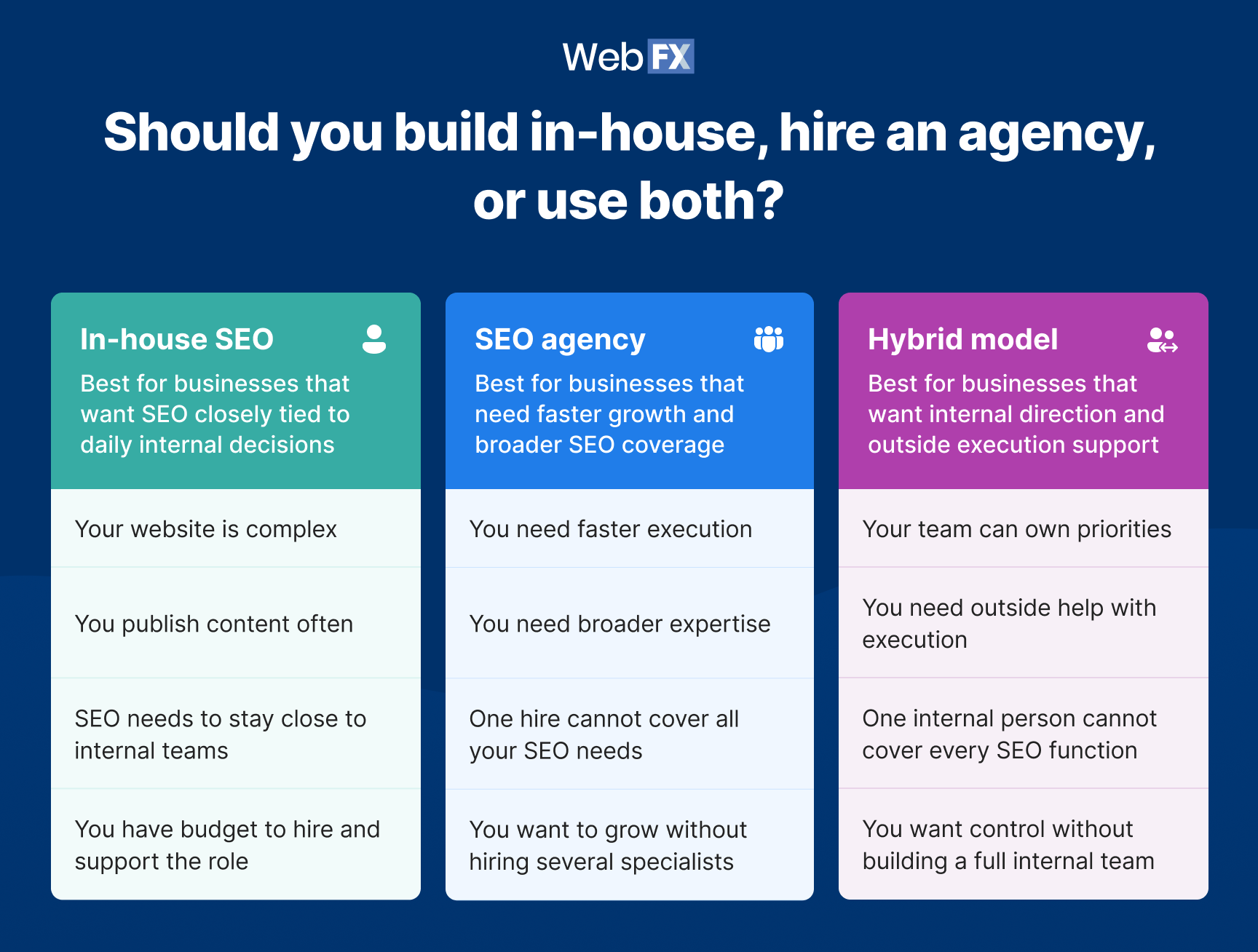
Choose in-house SEO when your website is complex, your business publishes content often, and SEO needs to stay close to internal teams—especially if you have the budget for hiring your own SEO team.
Choose an SEO agency when you need faster execution, broader expertise, and more SEO coverage than one hire can provide.
Choose a hybrid model when your team can own priorities, but you need outside help to execute at scale.
The best choice depends on coverage, speed, and who can actually get the work done and deliver results.
Your business has three main options for your SEO: build an in-house team, hire an SEO agency, or use both. The right choice depends on understanding the key in-house SEO vs. agency SEO differences—including what kind of website you manage, how much SEO work you need done, how quickly you need results, and whether your team can actually execute the work.
Here’s the quick answer:
Choose in-house SEO if your business has a large or complex website, publishes content regularly, needs SEO closely tied to other internal teams, and has the budget to hire and support the role properly.
Outsource to an SEO agency if you need to grow faster, don’t have in-house technical or content SEO experts, or want access to a broader team without hiring several specialists.
Choose a hybrid model if you already have someone in-house who can own direction and approvals, but you need outside help with technical SEO, content strategy, reporting, and execution.
To help you decide, let’s compare in-house SEO vs. agency SEO by cost, ROI, speed, and day-to-day execution:
Before you compare in-house SEO and agency SEO, it helps to define what each model actually includes. While both can support your search strategy, they differ in how the work gets done, who handles it, and how much support your business needs to make SEO successful.
What is in-house SEO?
In-house SEO is when your business manages SEO internally through one employee or a small team. That person may sit within marketing, growth, content, or digital strategy, depending on how your business is structured.
In practice, in-house SEO can include:
Keyword research
Content planning
Technical SEO oversight
Performance reporting
Cross-team coordination
Following up on implementation
In some businesses, the same person also handles content briefs, on-page optimization, local SEO, and even link building.
That setup can work well when your company wants SEO closely tied to brand, product, sales, or compliance conversations. For example, if your business launches products often or operates in a regulated industry, an internal SEO can stay close to shifting priorities and approvals.
That being said, one SEO hire rarely gives you full SEO coverage, because it involves more than one task. SEO is a mix of strategy, technical work, content execution, reporting, testing, and collaboration with other teams. When one person owns all of it, that person often becomes a bottleneck.
What is an SEO agency?
An SEO agency is an outside team that provides outsourced SEO support. Depending on the agency and the engagement, that support can include:
Strategy
Technical SEO
Content planning
Analytics
Reporting
Conversion recommendations
Implementation guidance
For example, an SEO agency engagement may include:
Technical strategist
Content strategist
Analyst
Supporting specialists who can work across different parts of your campaign
Hiring an SEO agency gives you access to expertise you may not be able to hire internally right away.
An agency can also help businesses move faster. Instead of spending months recruiting, onboarding, and building workflows, you start with an existing team that has established tools and a clearer process for getting work done.
Still, an SEO agency is not automatically the better choice in every situation. Some businesses need tighter day-to-day collaboration, faster internal feedback loops, or direct ownership inside the company.
The right model depends on what your business needs most from SEO and what it can realistically support over time.
In-house SEO vs. agency SEO: What’s the difference?
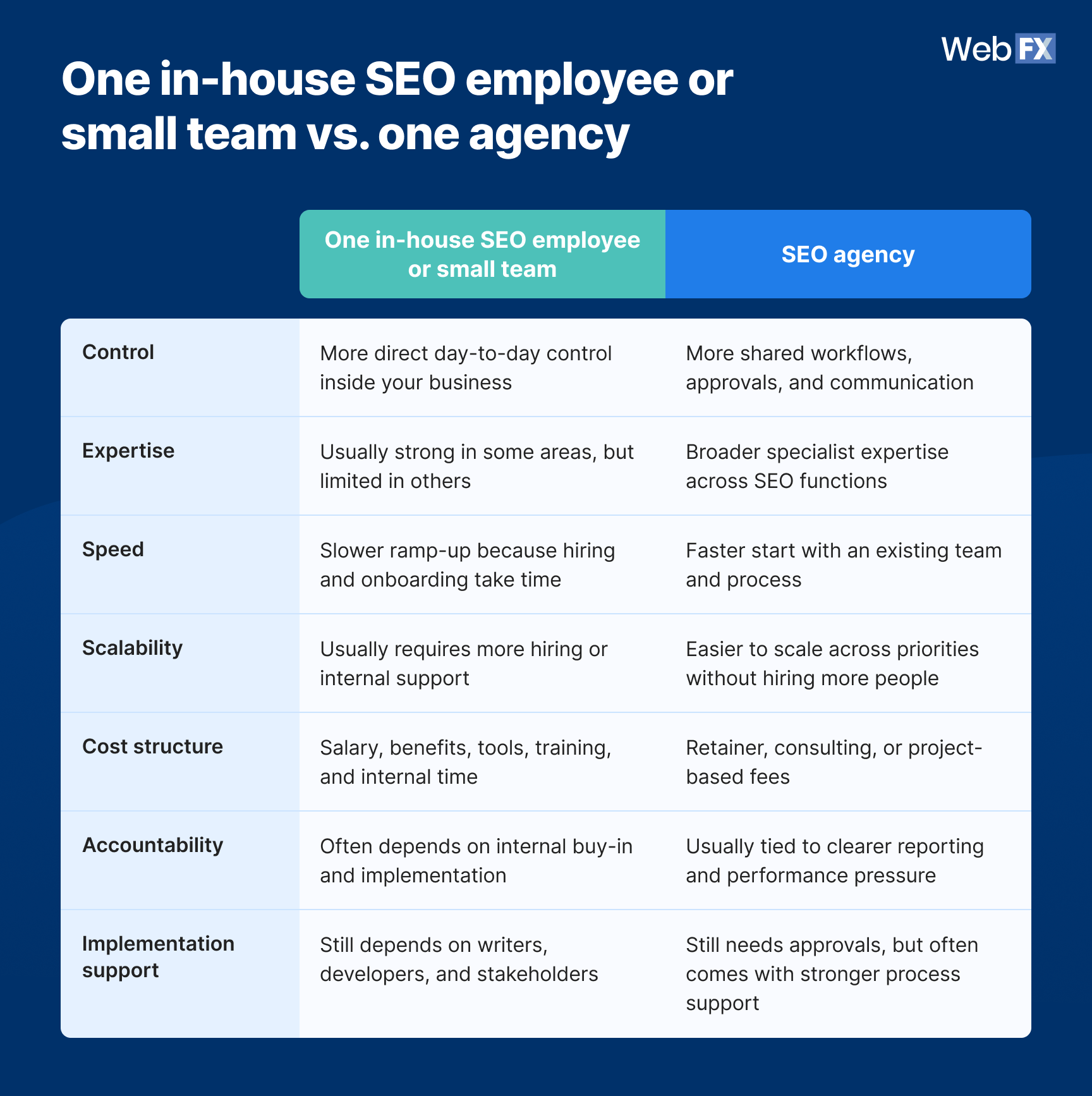
Now that we’ve defined both models, let’s compare how they differ in practice. The biggest differences usually show up in the following:
The biggest differences between a lean in-house SEO setup and an agency usually show up in staffing, speed, support, and execution capacity.
In-house SEO gives you more direct day-to-day control, while agency SEO requires a more collaborative workflow.
With in-house SEO, the work happens inside your business, close to your team, systems, and priorities. That can make it easier to align SEO with product launches, content calendars, sales goals, and internal approvals.
For example, if your product team changes positioning for a core service, an internal SEO may hear about it sooner and adjust supporting pages faster.
Meanwhile, with an agency, you still set priorities and approve direction, but the work usually involves more communication, shared timelines, briefs, and feedback loops. That means your in-house team stays involved, but the workflow depends more on coordination than direct day-to-day control.
Expertise and coverage
In-house SEO usually gives you narrower coverage, while agency SEO often gives you broader specialist support.
A single in-house SEO professional may be strong in some areas and less experienced in others. For example, they may excel at content strategy but have limited experience in technical SEO.
SEO agencies usually bring broader coverage because they work with specialists across functions. That can include technical SEO, content strategy, on-page optimization, local SEO, analytics, and AI search visibility. Instead of relying on one person to cover every discipline, you gain access to a team.
This is why comparing one salary to an agency retainer can be misleading. In many cases, you’re comparing one person’s capacity with a broader team’s coverage.
The AI search visibility dimension in particular follows its own in-house vs. agency logic — GEO requires prompt testing, citation tracking, and measurement tooling that most in-house SEO teams are still building, making the case for outside support stronger for businesses that need AI visibility gains sooner rather than later.
Speed to execution
In-house SEO often takes longer to ramp up, while agency SEO can usually start faster.
You need time to define the role, recruit candidates, hire well, onboard them, and integrate SEO into the way your teams work. If the person needs help from writers, developers, designers, or leadership, you also need time to build those working relationships.
For example, a new internal SEO hire may spend the first few months learning the brand, auditing the site, understanding the team structure, and figuring out how to get changes implemented. That ramp-up is normal, but it does affect speed.
An agency can usually begin faster because the people, tools, and workflows already exist. The agency still needs time to learn your business, but it does not need to build an SEO function from scratch.
Scalability
Scaling in-house SEO usually means adding people or internal support, while scaling agency SEO often means expanding support within an existing outside team.
For example, if your business wants to launch SEO campaigns across several product lines, one internal SEO may not be enough. You may need a writer, a technical resource, and stronger analytics support to scale effectively.
If those product lines are separate brands added through acquisition, hiring becomes the bottleneck. Our guide to in-house vs. agency marketing for private equity portfolios compares how each model handles new brands.
Agency SEO usually scales more easily because the support structure already exists. If priorities change, the agency can often shift more resources into technical work, content planning, reporting, or testing without forcing you to build a larger internal team.
Agencies still have limits, of course. Scope, budget, and communication still shape how far and how fast they can scale.
Cost structure
In-house SEO usually spreads costs across salary, tools, support, and internal time, while agency SEO typically packages support through retainers, project fees, or consulting rates.
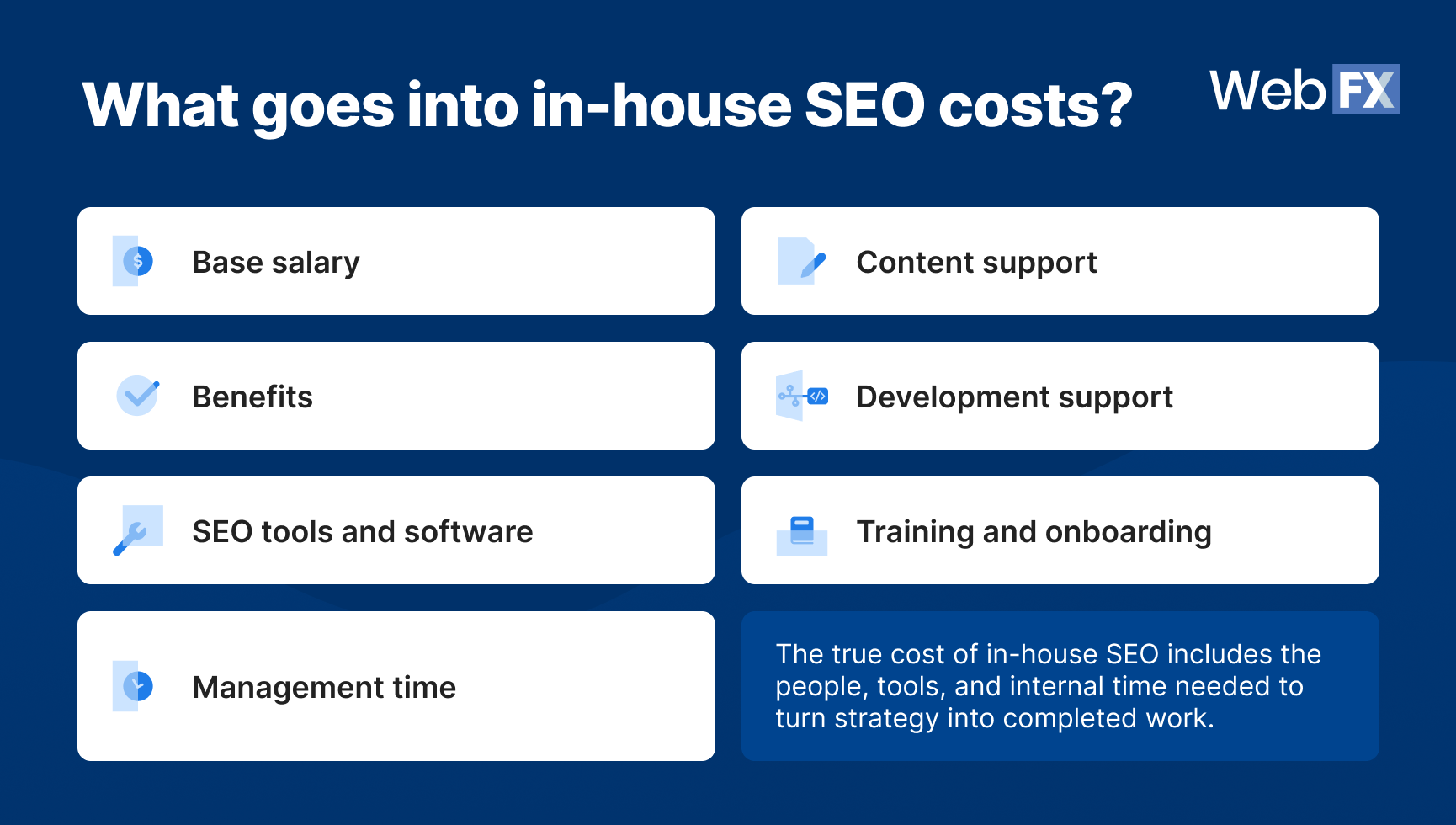
With in-house SEO, the visible cost starts with salary. Then you add:
Benefits
Tools
Training
Management time
Support needed to turn recommendations into completed work
If you want stronger coverage, you may also need content support, development help, or additional hires.
With agency SEO, the visible cost usually comes through a monthly retainer, project fee, or consulting rate. That fee often bundles strategy, specialist access, reporting, and ongoing support into one engagement.
Accountability and reporting
In-house SEO and agency SEO often face different accountability pressures.
Internal SEO teams may struggle more with implementation. They can identify opportunities, but they still need buy-in from content, development, design, leadership, or other stakeholders to get work done. When those teams have other priorities, SEO stays on the back burner.
Agencies often face a different kind of pressure: They need to prove value clearly and consistently.
That usually means stronger reporting, clearer goal-setting, and more pressure to connect SEO work to rankings, traffic, leads, and revenue.
So while in-house teams are more aware of internal priorities and roadblocks, agencies are under pressure to deliver visible results.
Implementation support and dependencies
Both in-house SEO and agency SEO depend on support from other people to get work done.
An internal SEO still needs support from writers, developers, designers, and decision-makers.
An agency has dependencies, too. It still needs access, feedback, approvals, and client-side cooperation.
But because agencies often come with established processes and broader support, they may reduce the operational burden on your internal team.
How much does in-house SEO really cost?
The cost of in-house SEO goes beyond salary. Based on the salary ranges we gathered, a U.S.-based SEO professional may fall into ranges like these:
Entry-level SEO: about $45,000 to $65,000 per year
Mid-level SEO: about $65,000 to $95,000 per year
Senior SEO: about $90,000 to $130,000 per year
Head of SEO or director: about $120,000 to $180,000+ per year
At first glance, that may make one hire seem more cost-effective than an agency retainer. But when comparing in-house vs. outsourcing costs, salary is only one part of the cost.
When you’re hiring an in-house SEO, you also need to budget for:
Benefits
Recruiting
Onboarding
Training
SEO tools and software
Management overhead
Then there is the execution layer. Your SEO hire may still need support from writers, developers, designers, and other stakeholders to implement your SEO strategy.
So when you budget for in-house SEO, look beyond base salary. You also need to account for the support, tools, and internal time required to turn SEO plans into completed work.
The cost of in-house SEO goes well beyond salary once you add tools, support, and execution needs.
The right pricing model depends on the type of support you need. A monthly retainer typically makes sense for ongoing SEO work.
Project pricing often works best for one-off audits, migrations, or focused initiatives. Hourly consulting can work when you need strategic guidance but plan to execute internally.
Note that several factors affect agency pricing, including:
Website size
Competition level
Technical complexity
Content needs
Growth goals
The depth of reporting and strategy support involved
SEO agency pricing can look expensive at first. But when you compare it with the cost of building similar coverage internally, the gap may look smaller than you expect.
When you hire an SEO agency on retainer, the fee doesn’t just pay for time. In many cases, the fee gives you access to specialists, tools, workflows, and reporting systems that would take much more time and money to build in-house.
This is why some businesses choose agencies even when they could hire internally. They are not just buying labor. They are buying a broader operating model.
Which option usually produces ROI faster?
The lower-cost option does not always produce results faster. That is especially true with SEO, where speed depends on expertise, implementation, and consistency.
In-house SEO can generate strong ROI when your business has the right conditions in place. For example, if you already have internal support for content, development, analytics, and approvals, an internal SEO hire may be able to build momentum steadily and create long-term value.
That model can work particularly well when SEO is central to your business, leadership understands the channel, and your team has the patience to build the function over time.
Agency SEO often produces ROI faster when your business needs momentum now. You skip much of the hiring and ramp-up time.
You also gain broader expertise sooner, which can help you spot technical problems, strengthen content strategy, improve reporting, and prioritize the work that drives impact first.
Expert insights from
Trevin S.Director of Sales, WebFX
“Working with an SEO agency saves you time, and you get to work with a team of people who have already tackled whatever digital challenges you’re facing many times.”
“Whether you’re looking to increase traffic, improve your conversion rate, or recover from a Google algorithm change, a good agency has already done all of those things hundreds of times,” Trevin explains. “They’ve seen what works, what doesn’t, and know exactly what to expect as opposed to DIY-ing your SEO and trying to figure all of that stuff out for the first time. The access to expertise in a lot of specific areas is a huge advantage of working with an SEO agency.”
If your team can build and support SEO well internally, in-house may pay off nicely. If your business needs faster progress and broader capabilities, agency SEO may reach ROI sooner.
When should you build in-house, hire an agency, or use both?
At this point, the question is less about what in-house SEO and agency SEO mean and more about which setup fits your business best.
The right model depends on your website, your growth goals, your internal team, and how much SEO work you need to execute consistently.
The decision depends on your goals and how much SEO work you need to execute consistently.
Choose in-house SEO when your business needs close internal ownership
Choose in-house SEO when your business has a large or complex website, publishes content regularly, and needs SEO closely tied to internal teams.
For example, this option makes sense when you already have strong internal talent, leadership support, and enough implementation help from content and development teams. It also makes sense when your business needs SEO closely connected to product, sales, legal, or compliance conversations.
In-house SEO can be a strong fit when:
Your website is large, complex, or updated often
Your business publishes content regularly
Your SEO work needs close coordination with internal teams
You have the budget to hire and support the role properly
This model works best when SEO needs to stay closely connected to your day-to-day business decisions.
Choose an SEO agency when you need broader execution
Choose an SEO agency when your business needs more depth, speed, and flexibility than a lean internal team can realistically provide.
“When it comes to making strategic SEO decisions, SEO agencies have an edge with their extensive access to resources and data, surpassing what in-house teams typically have,” explains Chris V., SEO Lead Consultant at WebFX.
He explains: “By leveraging the diverse knowledge base of a larger team, businesses are assured to have more up-to-date and expansive information about current tactics and strategies. Businesses can also stay agile in adjusting their annual and quarterly strategies, a benefit not easily achievable by hiring or retaining individual SEO experts.”
For example, if your company needs technical SEO help, stronger content strategy, clearer reporting, and faster momentum, an agency may be the more practical choice. It can also be the better fit when your team does not have time to recruit, train, and manage a broader SEO function internally.
An agency often makes sense when:
You need faster growth
Your current team lacks specialized SEO expertise
You want broader support without hiring multiple people
You need help across technical SEO, content, analytics, and execution
You want a partner that can adapt more quickly as search changes
This model often fits well with lean marketing teams that still need measurable growth.
Choose a hybrid model when you want both control and scale
A hybrid model combines internal ownership with outside support. For many businesses, this is the most practical answer.
In this setup, your internal team usually owns brand context, approvals, business priorities, and internal alignment. The agency supports technical work, strategy, reporting, content planning, and execution at scale.
For example, your in-house marketer may manage messaging, product priorities, and stakeholder communication, while the agency handles audits, optimization plans, reporting, and execution support. That allows you to keep strategic context close without asking one internal person to do everything.
A hybrid model often works best when:
You want closer internal ownership
You still need specialized execution help
Your team can guide direction but not cover every SEO function well
You want to scale without building a full internal SEO department
Before you decide, ask:
How much time can your team really dedicate to SEO?
How quickly do you need to show results?
Who will publish content and implement technical fixes?
Are you comparing total costs or just salary vs. retainer?
That depends on your website, your growth goals, and whether your team can handle the work internally.
If your business has a large or complex website, publishes content regularly, and needs SEO closely tied to internal teams, in-house SEO can work well. If you need faster growth, lack in-house technical or content SEO expertise, or want broader capability without hiring multiple specialists, an agency often makes more sense.
It depends on what kind of SEO capability you need. One SEO salary may look cheaper at first, but the real cost of in-house SEO often includes benefits, tools, training, content production, development time, and management overhead.
Agencies may look more expensive upfront, but they often bundle broader expertise into one engagement.
Consider switching when your internal team lacks the bandwidth or expertise to keep up with your goals.
For example, if SEO recommendations pile up, growth stalls, or one internal person can’t cover technical SEO and other tasks, an agency may help you move faster.
Yes, especially if the agency supports SEO work beyond traditional rankings.
That can include improving structured content, strengthening entity and brand signals, supporting answer-focused content, and helping your business stay visible as search evolves through AI Overviews and other answer engines.
WebFX is a full-service digital marketing agency that can help businesses with SEO and generative engine optimization (GEO).
Yes. That is one of the most practical hybrid setups.
Your internal team can own priorities, brand alignment, and stakeholder communication, while your SEO agency can handle the technical work, content planning, reporting, or specialized execution.
An agency can help when the lead-generation problem connects to search visibility, traffic quality, user intent, on-page experience, or weak conversion paths. For example, if your business attracts the wrong visitors or fails to guide qualified traffic toward action, SEO improvements can help.
That being said, SEO cannot fix every lead-generation problem on its own. If the real issue is product-market fit, a weak offer, poor sales follow-up, or pricing friction, an agency will not solve that by rankings alone.
In-house SEO vs. agency SEO: Which is right for your business?
The best choice between in-house SEO and agency SEO depends on what your business needs and what it can realistically manage and execute.
If you have the internal bandwidth, implementation help, and patience to build SEO well, in-house can be a strong long-term investment.
If you need broader expertise, faster execution, and a clearer path to scale, an agency may be the better fit.
And if you want brand alignment without assigning one person to do everything, a hybrid model may offer the best of both worlds.
The bottom line: Do not compare one salary to one retainer and assume the decision is clear. Compare the actual coverage, costs, speed, and execution capacity behind each option. That is where the real difference shows up.
If you need help with SEO, you can always turn to WebFX, an SEO agency with 30+ years of experience. Contact us online or call us at 888-601-5359to learn more about our SEO services!
Try our free Marketing Calculator
Craft a tailored online marketing strategy! Utilize our free Internet marketing calculator for a custom plan based on your location, reach, timeframe, and budget.
Craft a tailored online marketing strategy! Utilize our free Internet marketing calculator for a custom plan based on your location, reach, timeframe, and budget.






 Maria is a Lead Content Specialist at WebFX. With nearly two decades of experience in B2B and B2C publishing, marketing, and PR, she has authored hundreds of articles on digital marketing, AI, and SEO to help SMB marketers make informed strategic decisions. Maria has a degree in B.S. Development Communication major in Science Communication, and certifications in inbound marketing, content marketing, Google Analytics, and PR. When she’s not writing, you’ll find her playing with her dogs, running, swimming, or trying to love burpee broad jumps. View full profile