


Table of Contents
- Tips for launching your plumbing SEO strategy
- 1. Focus on plumbing-related keywords
- 2. Create title tags and meta descriptions that make homeowners click
- 3. Optimize your Google Business Profile
- 4. Optimize the technical components of SEO
- 5. Create industry-related content
- 6. Managing your online directory listings
- 7. Boost local reviews to enhance SEO
- 8. Create location-specific and service-specific pages on your website
- FAQ on SEO for plumbers
SEO for plumbers is the process of increasing a plumbing company’s visibility in Google Search and Google Maps to generate more high-intent service calls and booked jobs by focusing on local search visibility, service-specific content, Google Business Profile optimization, reputation management, and authority signals.
Plumbing demand is immediate and location-driven, with customers making fast decisions based on who appears first in search results. When a pipe bursts, the plumber dominating the Map Pack and review profile captures calls before competitors, making visibility critical for revenue.
The five pillars include dominating the Map Pack with Google Business Profile optimization, turning your website into a lead-generation engine with service-specific pages, building trust with E-E-A-T content signals, earning local authority through citations and backlinks, and creating a systematic 5-star reputation management process.
Most plumbing companies begin seeing measurable improvements from their SEO efforts within three to six months, though competitive markets may require longer timelines, especially for high-value keywords.
Yes, combining SEO with Google Local Services Ads creates layered coverage that captures both urgent and research-driven customers. LSAs provide immediate visibility at the top of search results, while SEO builds long-term assets that strengthen website presence and Google Maps rankings, with 76% of mobile users visiting a business within 24 hours of a local search.
SEO for plumbers is the most reliable way to generate a consistent flow of high-value service calls from Google.
When homeowners wake up to a burst pipe or a failing water heater, they search Google, ChatGPT, or TikTok for plumbers near them or emergency plumbing services. The plumbing companies that appear in Google Search and Google Maps at that moment win the job.
For growth-focused plumbing businesses, SEO becomes a long-term revenue engine. Enduric Plumbing is an example of a company that leverages SEO to book more jobs and achieve consistent revenue. With the help of WebFX, they increased organic traffic by 303% and grew form leads by 120% year over year.
If you want predictable demand instead of waiting on referrals or fluctuating paid leads, this guide will show you how to build that system step by step.
Before you get into the best SEO strategies for your plumbing business, you can start by evaluating where you’re at using our SEO checker. In just a few seconds, you will have your SEO score, a highlight of your site’s issues, and quick fixes to these issues.
Download the SEO Checker here.

What is SEO for plumbers?
SEO for plumbers is the process of increasing a plumbing company’s visibility in Google Search and Google Maps to generate more high-intent service calls and booked jobs.
Plumbing SEO focuses on:
- Local search visibility
- Service-specific content
- Google Business Profile (GBP) optimization
- Reputational management
- Authority signals
The goal of SEO for plumbing is to connect you with customers actively searching for plumbing services in your service area.
Unlike broad digital marketing tactics, local SEO prioritizes proximity, trust, and relevance. It positions your business at the exact moment someone searches “emergency plumber near me” or “water heater repair in [city].”
Why SEO matters more for plumbing than most industries:
- Plumbing demand is immediate and location-driven. When a pipe bursts, customers make fast decisions based on who appears first and looks trustworthy.
- Most plumbing gigs are urgent, making visibility critical. If your competitor dominates the Map Pack and review profile, they capture calls before customers ever see your website.
- Revenue fluctuates when visibility fluctuates. For established plumbing companies with multiple crews or service areas, inconsistent search presence leads directly to inconsistent demand.
- SEO stabilizes and compounds over time. By generating predictable inbound inquiries from high-intent searches, SEO reduces reliance on referrals and volatile paid lead sources.
The 5 pillars of a high-performance plumbing SEO strategy
High-performing plumbing SEO works best as a structured system because Google doesn’t rank you for one thing. It evaluates your profile, website, authority, and reviews together. When those pieces reinforce each other, you earn stronger visibility and more consistent calls.

Pillar 1: Dominate the Map Pack with Google Business Profile optimization

Google Business Profile drives the majority of calls for proximity-based businesses, like plumbing and other home services.
How? When someone says, “Hey Google, find a plumber near me,” Google looks at proximity first, then reviews, then relevance. Your GBP is what connects your company to that specific neighborhood at that specific moment.
If your profile lacks accurate service areas, service categories, or fresh reviews, you lose visibility where it matters most — within a few miles of the job.
However, in 2026 and beyond, optimizing your GBP requires more than accurately filling out basic contact information. You must also:
- Select accurate service categories
- Define service areas properly
- Complete every relevant section
- Add individual services such as drain cleaning, water heater repair, and sewer line replacement
- Develop a consistent process to request reviews after completed jobs and respond to each review professionally.
- Treat GBP management as an operational discipline
Pillar 2: Turn your website into a 24/7 lead-generation engine
Your website is more than a digital brochure. A well-optimized and maintained plumbing website doubles as a reliable conversion system. But not by default. You must be intentional about creating dedicated pages for every high-margin service as well as location.

For service-specific pages, start by distinguishing commercial and residential plumbing services. Then provide detailed and optimized pages, such as:
- Emergency plumbing repair
- Leak detection
- Sewer line repair
- Full-home repiping
- Water heater installation
Dedicated service pages allow you to match exact homeowner intent by targeting “money keywords,” which are essentially the keywords that define homeowner problems.
When your page speaks directly to the problem, Google ranks it more confidently because search engines evaluate individual pages based on relevance and depth. In fact, a generic “Our Services” page that lists 12 offerings weakens topical authority.
Pillar 3: Build unshakeable trust with E-E-A-T content
Homeowners look for credible, local, and experienced plumbing service providers because installations and repairs directly affect their home’s value and safety. A poor repair can lead to water damage, mold, insurance claims, or thousands in unexpected costs.
When the risk is high and the timeline is short, people default to the option that feels safest. They scan reviews, photos, and credentials, then call the business that looks most trustworthy.
You can position your business as trustworthy by optimizing your website to convey Experience, Expertise, Authoritativeness, and Trustworthiness (E-E-A-T) signals.

And here’s how:
- Show real-world experience. Publish photos of your technicians, branded vans, completed projects, certifications, and insurance credentials. Make it clear you actively serve the neighborhoods you claim.
- Demonstrate expertise. Display licenses, certifications, and years in business. Create detailed service pages and helpful articles that answer real questions, such as “How do I know if a pipe is about to burst?”
- Strengthen authority. Encourage consistent customer reviews and earn local mentions. According to BrightLocal, 46% of consumers trust online reviews as much as personal recommendations.
- Maintain trust signals everywhere. Keep your branding, contact details, and messaging consistent across your website, Google Business Profile, and directories.
Publishing helpful content for plumbing companies that answers common plumbing concerns, such as “How do I know if my pipe is about to burst?” builds authority while capturing problem-based search traffic. Strong E-E-A-T signals create defensibility in both traditional search and AI-driven results.
Pillar 4: Earn local authority with citations and backlinks
If Google Business Profile defines where you operate, citations and backlinks reinforce that you belong there.
Citations refer to consistent listings of your business information across directories and platforms, such as Yelp. To attract citations, you must ensure (NAP) consistency, i.e., name, address, and phone details match exactly across your website, GBP, and local listings.
On the other hand, backlinks are digital endorsements you get when local organizations, suppliers, or community partners link to your website. These strengthen your authority and help you rank higher on SERPS.
You need both citations and backlinks to help search engines gain confidence in your legitimacy as a reliable plumber. A closer look at backlinks versus citations is essential to help you understand how to implement an effective off-page SEO strategy:
| Factor | Citations | Backlinks |
| What it is | A mention of your business name, address, and phone number (NAP) on another site | A clickable link from another website pointing to yours |
| Tells Google | This business exists at this location | This business is trusted |
| Primary goal | Reinforce local legitimacy and location accuracy | Build authority and ranking strength |
| Example | Your business listed in a local chamber directory | A local hardware store linking to your plumbing guide |
Pillar 5: Create a 5-star reputation system
In 2026, 90% of consumers read online reviews before they call a local business. So, inadvertently, online reviews do more for your brand than simply build credibility. They influence whether you show up in the Map Pack and whether a homeowner trusts you enough to call.
You, like many other plumbers, are leaving money on the table if you don’t have a system for asking, replying, and managing reviews. This gap creates inconsistent review volume, leading to inconsistent trust and lower conversion rates.
You need a simple online reputation management system you can run weekly. This should involve:
- Asking for reviews at the right moment. This is ideally right after the job is complete, when the customer feels relief and satisfaction.
- Sending direct links via text or email. Ensure you keep the message short and include the technician’s name to make it feel personal.
- Including it in your closeout process. Add the review request to your invoice, your payment confirmation screen, or your “job complete” checklist so it happens every time.
- Responding to every review within a consistent window. Thank customers for positive feedback and reference the service performed. For negative reviews, stay calm, acknowledge the experience, and move the conversation offline with a clear next step.
- Reuse your best reviews as social proof. Feature them on relevant service pages, add a testimonial block to your homepage, and reference them in estimates or follow-up emails.
Reputation management requires structure. Without a system, review generation becomes inconsistent and reactive.
Implement a standardized process to request reviews via text or email after completed service calls. Provide simple instructions and make it easy for customers to respond.
Respond to all reviews promptly, whether positive or negative. Thoughtful responses demonstrate professionalism and engagement. For plumbing companies operating at scale, reputation management influences search rankings and conversion rates across channels.
Beyond rankings: How to measure real SEO ROI

To measure the impact of your SEO efforts, you must track performance metrics that directly drive revenue. Effective SEO reporting should translate activity into booked jobs and revenue impact. Clear attribution supports confident budget decisions.
Key indicators include:
- Calls from Google Business Profile
- Contact form submissions from service pages
- Organic cost per lead
- High-intent keyword growth
Compare organic cost per lead with Google Local Services Ads (LSAs) to evaluate efficiency. As organic visibility strengthens, cost per lead often decreases while total lead volume increases.
Amplifying your reach: Combining SEO with Google Local Services Ads
Google Local Services Ads (LSAs) and SEO solve different problems within the same search journey. When someone searches for a plumber during an emergency, LSAs put you at the very top of the page with the Google Guaranteed badge. That visibility captures immediate demand.
SEO works differently. It builds a long-term asset that strengthens your website, improves your Google Maps presence, and positions your company across traditional search and AI-driven results. It attracts both urgent searches and customers still researching options.
The fact that 76% of mobile users who perform a local search visit a business within 24 hours explains why capturing both instant clicks and research-phase traffic matters.
When these SEO and LSAs work together, they reinforce trust. A homeowner might see your LSA at the top of the page, then scroll and notice your strong reviews and organic rankings. That repeated exposure reduces hesitation.
This integrated approach drives measurable results. For Asbury Electric, a home service company, combining and optimizing both organic SEO and paid advertising ensured visibility across the entire search results page. Instead of competing channels, they created layered coverage that captured urgent and research-driven customers alike.
For established plumbing companies, diversification reduces risk. Relying on LSAs alone ties your pipeline to ad budgets. Relying only on SEO delays short-term opportunity. A blended strategy balances immediate lead flow with long-term growth.
Here’s a closer look at the differences between LSAs and SEO.
| Feature | Google Local Services Ads (LSA) | Local SEO |
| Cost model | Pay per lead | Ongoing investment in optimization |
| Time to see results | Immediate once approved | Gradual, compounding growth |
| Placement on Google | Very top of results with Google Guaranteed badge | Organic listings and Map Pack results |
| Main benefit | Captures urgent, ready-to-call customers | Builds sustainable visibility and long-term authority |
LSAs help you win the next call.
SEO helps you win the next hundred.
Together, they create stronger coverage, higher trust, and more predictable demand.
DIY vs hiring an agency: A plumber’s decision framework
Deciding whether to manage SEO internally or partner with an agency depends on your growth goals and operational capacity.
DIY SEO may work for smaller operations with limited competition. However, multi-crew plumbing companies aiming to dominate their service area often benefit from expert support when selecting a plumbing marketing agency.
Strategic SEO requires technical implementation, content development, authority building, and ongoing optimization. For leadership teams focused on operations and expansion, outsourcing SEO can accelerate results while preserving internal bandwidth.
| DIY SEO | Hiring an agency |
| Lower financial investment | Higher financial investment |
| Significant time commitment | Time savings for leadership |
| Learning curve and experimentation | Proven frameworks and tools |
| Risk of technical mistakes | Reduced execution risk |
Frequently asked questions about SEO for plumbers
What are the most important local SEO strategies for plumbers?
The most critical local SEO strategies that boost trust and visibility include:
- Optimizing your Google Business Profile
- Building service-specific website pages
- Consistently generating positive customer reviews
How long does SEO take for a plumbing company?
Most plumbing companies begin seeing measurable improvements from their SEO efforts within three to six months. Competitive markets may require longer timelines, especially for high-value keywords.
What keywords should plumbers target?
Plumbing companies should ideally focus on keywords that capture clients with urgent plumbing needs or those in the research and comparison phase, such as:
- Location-based service keywords such as “emergency plumber in [city].”
- Problem-based searches like “fix leaking pipe.”
How much should a plumbing company invest in SEO?
The amount you spend on plumbing SEO depends on competition, service area size, and growth goals. Established plumbing businesses often allocate consistent monthly budgets to maintain and expand local dominance.
Can I do plumbing SEO myself?
Yes. You can DIY foundational SEO tasks. However, technical SEO, content strategy, and authority building often require specialized expertise to produce scalable, long-term results.
Build a predictable plumbing lead engine with WebFX SEO services
SEO for plumbers builds a sustainable pipeline of high-intent calls, supports higher-margin services, and strengthens your brand in local search results.
When you implement a structured, five-pillar approach, you move beyond sporadic lead generation and toward predictable growth. Over time, SEO becomes a durable business asset that compounds in value.
We have over 48,000+ hours of expertise in home services, helping businesses like yours increase service calls and revenue growth. Our team creates custom marketing strategies built to help you succeed in your local market.
If you want to evaluate how SEO could impact your plumbing company’s revenue, schedule a strategy session or call us today at 888-601-5359 to assess your current visibility and growth opportunities.
-
 Lornah Ngugi is a seasoned digital marketing writer with 6+ years of experience translating complex marketing strategies into engaging, results-driven content. She holds a B.S. in Business Information Technology and is certified in HubSpot Academy, Google Analytics, LinkedIn Marketing, and Google Digital Academy. Lornah regularly contributes to the WebFX blog and SEO.com, where she’s authored hundreds of marketing guides that help readers turn their goals into measurable results through practical, data-informed insights. When she’s not writing, you’ll find her enjoying a quiet walk in the park, sipping black coffee, or finding creative inspiration in a good chocolate bar.
-

WebFX is a full-service digital marketing agency delivering revenue-driving strategies across online advertising, SEO and AI search optimization, and digital marketing. Backed by 1,100+ client reviews, a 4.9-star rating on Clutch, and proprietary revenue-tracking technology, our team helps businesses grow visibility and revenue across platforms, from Google to ChatGPT to LinkedIn. Discover how our expert team and revenue-accelerating tech can drive results for you. Learn more
Try our free Marketing Calculator
Craft a tailored online marketing strategy! Utilize our free Internet marketing calculator for a custom plan based on your location, reach, timeframe, and budget.
Plan Your Marketing Budget
Table of Contents
- Tips for launching your plumbing SEO strategy
- 1. Focus on plumbing-related keywords
- 2. Create title tags and meta descriptions that make homeowners click
- 3. Optimize your Google Business Profile
- 4. Optimize the technical components of SEO
- 5. Create industry-related content
- 6. Managing your online directory listings
- 7. Boost local reviews to enhance SEO
- 8. Create location-specific and service-specific pages on your website
- FAQ on SEO for plumbers
Share this article


Outrank Local Competitors This Season
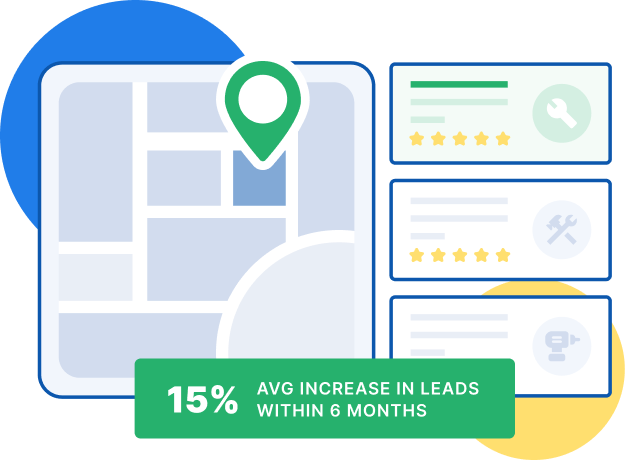
See how home service pros like you are dominating local Google results and booking more jobs.

Try our free Marketing Calculator
Craft a tailored online marketing strategy! Utilize our free Internet marketing calculator for a custom plan based on your location, reach, timeframe, and budget.
Plan Your Marketing Budget




Frequently asked questions about SEO for plumbers
What are the most important local SEO strategies for plumbers?
The most critical local SEO strategies that boost trust and visibility include:
- Optimizing your Google Business Profile
- Building service-specific website pages
- Consistently generating positive customer reviews
How long does SEO take for a plumbing company?
Most plumbing companies begin seeing measurable improvements from their SEO efforts within three to six months. Competitive markets may require longer timelines, especially for high-value keywords.
What keywords should plumbers target?
Plumbing companies should ideally focus on keywords that capture clients with urgent plumbing needs or those in the research and comparison phase, such as:
- Location-based service keywords such as “emergency plumber in [city].”
- Problem-based searches like “fix leaking pipe.”
How much should a plumbing company invest in SEO?
The amount you spend on plumbing SEO depends on competition, service area size, and growth goals. Established plumbing businesses often allocate consistent monthly budgets to maintain and expand local dominance.
Can I do plumbing SEO myself?
Yes. You can DIY foundational SEO tasks. However, technical SEO, content strategy, and authority building often require specialized expertise to produce scalable, long-term results.