
SEO for Veterinarians: 5 Tips to Boost Your Site Rankings
Are you also looking after the health of your online presence? Keep reading to learn veterinary SEO strategies that enable prospective pet parents to find you.
-
 insights from 149,000+ hours of veterinarian marketing experience

SEO for veterinarians is the work of making your clinic easy to find and easy to choose when pet owners search for care, whether that happens in Google or an AI platform like ChatGPT.
Implementing a solid veterinarian SEO strategy is essential to grow your practice and boost your visibility and rankings in search engine results pages (SERPs). Ready to improve your clinic’s online health with SEO? Keep reading!
What is SEO for veterinarians?

Veterinary SEO definition
SEO for veterinarians is a digital marketing strategy focused on improving a vet clinic or animal hospital’s visibility in search results, local map listings, and AI-generated answers.
Veterinarian SEO is a holistic approach that uses multiple strategies like:
- Keyword research
- Page speed optimization
- Content marketing
- Local SEO
All these strategies help your practice attract more website visitors, patients, and revenue.
Why is veterinary SEO important?
Importance of veterinary SEO
SEO for veterinarians is an essential strategy to attract new patients and keep the health of your vet clinic in tip-top shape.
Pet owners begin their search for veterinary care online, whether on Google or in AI assistants like ChatGPT. They look for veterinarians online using terms like “veterinarian in [their city]” or seek pet health info like “when is the best time to get a kitten spayed.”
If your website appears on the first page of search results, chances are your website will get clicks and prospects will learn about your veterinary clinic and services.
Page-one placement doesn’t guarantee the click, though. HubSpot CMO Kipp Bodnar told the BBC that click-through rates on searches with AI Overviews are about 60% to 70% lower, so your clinic also needs to appear in the answer itself.
That means you must rank well for the keywords they’re using and show up in the AI answers they read. Once you rank for those keywords, you attract visitors and callers who want to learn more about your center or book an appointment.
SEO is an ongoing process and involves making improvements on your site while building your authority online. It can be a time-intensive strategy, but it’s well worth the results.
Independent research from Clutch has named WebFX the top SEO company in the United States.
Clutch has personally interviewed more than 250 WebFX clients to discuss their experience partnering with us.

How to get started with veterinary SEO
If you’re new to SEO, here are four steps you can take to optimize your veterinary site for search engines:
- Perform keyword research
- Perform on-page optimization
- Create relevant content for your audience
- Improve your site authority with a link-building strategy
Let’s go through each step.
1. Perform keyword research

Pro tip: Keyword research
Before you optimize your site for search engines, you need to determine the words and phrases pet owners use when searching for your clinic and services.
After all, you don’t want to waste your time optimizing your pages for terms that no one is searching for.
You can find the most relevant keywords for your site by doing keyword research. Use keyword research tools like KeywordsFX to identify how people search for veterinary services and how difficult it is to rank for any given keyword.
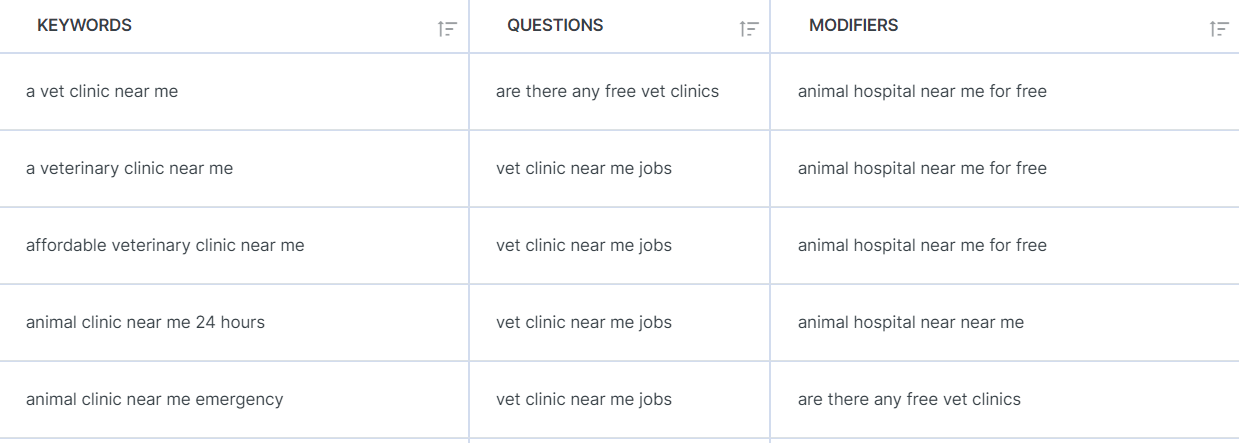
As you do your research, you’ll want to focus on long-tail keywords. These longer and more specific keywords are easier to rank for.
This means that even though fewer people may search for them each month, they’ll ultimately bring more qualified traffic (and potential new patients) to your site.
Include full questions, too.
In WebFX’s analysis of 3,000+ search queries across four generations, Gen Z phrased 43.57% of its queries as questions, the highest of any generation. Pages that answer a pet owner’s exact question, like “how often does a senior cat need bloodwork?”, match the way younger pet owners search.
2. Perform on-page optimization strategies
After you’ve determined the keywords you want to target, you’ll need to incorporate them into different elements throughout your site.

Pro tip: On-page optimization
Target one keyword per page. You can include the keyword in that page’s title, headers, meta description, and body copy.
This helps search engines understand what the page is about and show it in search results.
Ensure you use your keyword only where it fits naturally. Although search engines rank your pages, human readers are the ones who actually want the information. So if your copy is stuffed full of keywords that don’t make sense, your search engine rankings will still suffer.
3. Create relevant content for your target audience
People have lots of questions about pet care. As a veterinary expert, you’re uniquely qualified to answer them.

Pro tip: Create useful content
Add a blog and publish helpful articles, videos, and infographics on your site.
You can create posts based on common questions like “what type of food should I feed a puppy?” or “should I brush my dog’s teeth?” Then, you can optimize these pages for those keywords so that when users search for them, they’ll find the information on your site.
This not only helps attract traffic to your site, but also allows you to build trust with pet owners. So even if their question doesn’t warrant an immediate trip to the vet, they’ll remember you later when it comes time for an appointment.
4. Improve your site authority with a link-building strategy
Another huge factor in your site’s ability to rank well is how authoritative search engines believe it is. They determine this based on how many credible sites link to yours.
If many trustworthy, reputable news sites, blogs, and other publications link to your vet center’s website, search engines will prioritize your pages in the SERPs for relevant queries.
However, link building is more challenging than changing the titles and headings on your pages. You’ll need to reach out to other site owners and explain why your site is worth a link.
If you succeed, they’ll link to you, and you should notice a corresponding improvement in your rankings and organic traffic in Google Analytics 4 (GA4).
5 tips for doing veterinary SEO
SEO for veterinarians requires a special set of tactics to effectively drive qualified traffic and rank for related search terms. Keep in mind these tips for your veterinarian SEO strategy:

Veterinary SEO best practices
Let’s discuss each one.
1. Run a website audit to determine opportunities and spot potential problems
Think of website audits as regular checkups or lab tests that look at your website’s overall health. SEO audit tools can help you do a quick scan of your site to:
- Identify opportunities
- Spot potential problems
- Get recommended fixes
Use our SEO Checker tool to get a free SEO report with the following information:
- An SEO score that tells you your website’s SEO health
- Your site’s SEO issues and fixes
- Recommended fixes to prioritize based on SEO impact
2. Optimize your Google Business Profile
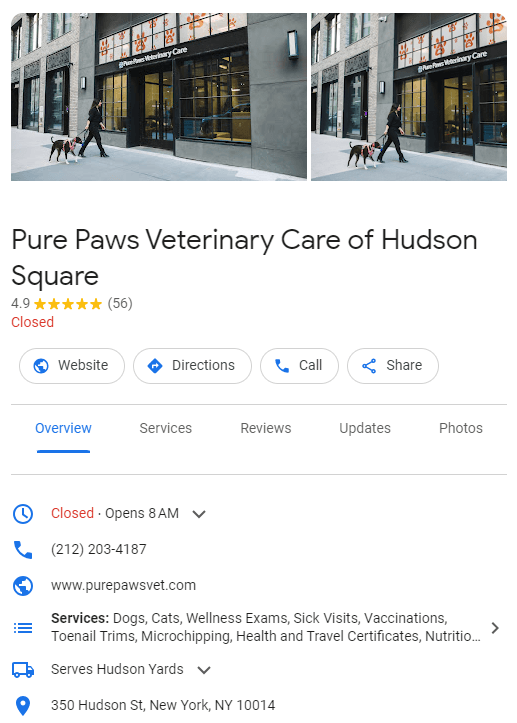
Another excellent veterinary SEO tip is to optimize your Google Business Profile. Doing so makes it easy to spot your website, clinic’s address, and contact details in the SERPs. In addition, it also boosts your vet center’s trustworthiness.
Complete details matter here. Google says businesses with complete and accurate info are more likely to show up in local search results.
Here’s how you can optimize your Google Business Profile to stand out in SERPs and get the attention of potential patients:
- Claim or create your business.
- Fill out your information, including your operating hours, address, website URL, contact details, and services.
- Choose your veterinary clinic’s categories.
- Write a description about your veterinary practice or animal hospital.
- Add photos.
3. Employ local SEO strategies
Veterinarians must focus on the needs of their prospects, who reside in their area. That said, SEO for veterinarians must also focus on optimizing websites and content to be easily found by pet owners in the neighborhood.
Local SEO is the specific digital marketing strategy that enables veterinarians to reach an audience based on location. Older pet owners lean on location terms most: In the WebFX study mentioned earlier, Boomers added location terms to 19.95% of their searches, more than any other generation.
Here are some local SEO best practices for vets:
- Perform local keyword research
- Get local citations for your veterinary center.
- Ensure your business’s name, address, and phone numbers (NAP) are consistent across local citations and your Google Business Profile.
- Learn about your local audience’s pet-related concerns
- Publish location-based content
4. Get more reviews for your vet clinic
Encourage your clients to leave reviews of your services or clinic on Google or through your website. Email them or send an SMS after their appointment.
Or you can have a QR code at your clinic’s reception that directs them to a link to leave a review.
Reviews are social proof that tells your prospects and other people that your vet clinic is dependable, trustworthy, and credible. In fact, 70% of consumers believe in the opinions of other consumers!
Not to mention, reviews also affect where you appear. Google notes that more reviews and positive ratings can help your business’s local ranking.
As an example, Hurst Pediatric Dentistry, a Dallas-Fort Worth practice, managed its local reviews and listings as part of a broader local SEO program and saw a 540% increase in leads from organic search.
Pro tip: Earn more online reviews
Use review management tools like ReviewAccelerationFX so you can easily check and respond to reviews you’ve collected from Google, Yelp, or social media pages from a single platform.
5. Write helpful pet care content for your potential clients
When you’ve done your local keyword research, you’ll likely discover the major concerns of pet owners in your area.
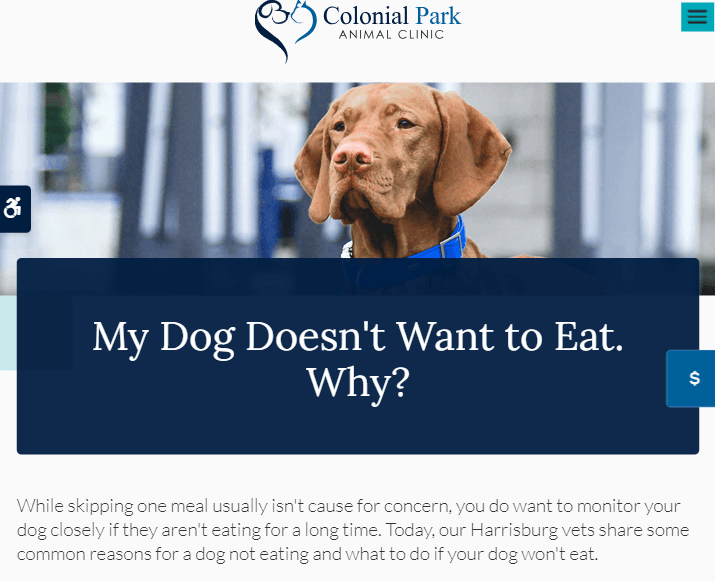
Write and publish content that addresses these concerns. By sharing this information for free, you’re showing your prospects that you are an expert who cares about the well-being of their beloved family member.
When Golden Meadows Retrievers, a California dog breeder, aligned its website content with the interests and needs of potential puppy owners, its organic traffic rose 48% year over year.
As a result, you’re also building trust among them. So when it’s time to pick a veterinarian who’s in charge of their pet’s health, they’ll likely choose you!
Helpful veterinarian SEO services from WebFX
A veterinary SEO strategy requires time, dedication, and skill, which is why many practices partner with an SEO agency like WebFX. As a full-service digital marketing agency, we work as an extension of your business, providing you with a complete marketing team that includes SEOs, web developers, copywriters, and more.
By teaming up with WebFX, you get:
- A custom veterinary SEO strategy
- Dedicated account manager
- Thorough SEO audit
- In-depth competitor analysis
- Custom content strategy
- Call, lead, and revenue tracking with RevenueCloudFX, our platform that connects marketing to revenue
- Regular reporting
- AI search visibility tracking with OmniSEO®
We’ve helped our clients achieve the following results in the past five years:
- Over $10 billion in revenue
- Over 24 million leads
- Over 7.14 million qualified phone calls
- Over 14.9 million managed transactions
When your veterinary practice partners with WebFX for SEO, you can count on us to make a real, measurable impact on your clinic. Whether you’re looking to attract more patients or increase the number of annual check-up appointments, we can help.
Hear What It’s Like to Work With WebFX!

“Although we have only been working with WebFX for a short time, I have already received more communication and better ideas than all of the prior SEO companies I have used before combined. I’m looking forward to a long lasting relationship with WebFX.”
Animal Hospital
Grow your veterinary practice with our SEO services
SEO for veterinarians improves your visibility among pet owners near your clinic or hospital. If you’re ready to grow your vet practice with SEO, let WebFX help.
We have 30+ years of experience crafting successful SEO strategies for our clients. We’ll be glad to put the same care and attention into your vet practice, so you can reach more pet owners through SEO.
Veterinary SEO management from WebFX starts at $2,900 / month.
Contact us online or call us at 888-601-5359 to speak with a strategist about our SEO services for veterinarians!



Solving key challenges for veterinarians
Our website isn’t driving enough traffic
When consumers search for your services in their local area, your website needs to be one of the first results so you can drive more qualified traffic to your site. Make that goal a reality with our top-tier SEO and web design services.

We’re not attracting new customers
Having trouble boosting your online visibility so you can keep attracting new customers? Our award-winning marketing services get your business in front of the right people in your local area.

We’re struggling to sell our new services
When you partner with WebFX, we’ll help you get your new services in front of the people actively searching for them so you can maximize your revenue.

We aren’t retaining customers
Reduce your customer churn and implement top-tier marketing strategies that help you form long-lasting relationships with customers that turn into long-term brand loyalty.
